What Can You Actually Build for $2,000?
What can you build for $2000? One complete workflow, live in about two weeks — AI-drafted, senior-reviewed — with the exact scope and what gets deferred to phase two.
Quick answer
- What $2,000 buys
- One production workflow — data model, screens, one or two roles, one integration, tests, deployment, source-code handover. AI drafts; senior engineers review.
- Typical timeline
- 10–20 days. The median quoted delivery across 79 published catalogue builds is 13 days; quoted windows run 3 to 30 days.
- What it does not buy
- Multi-tenant SaaS with billing, separate native iOS and Android builds, regulated compliance platforms, or open-ended scope.
- Market context
- Clutch puts a typical project at $10,000–$49,999. The difference is production method — AI first draft, senior engineer review — not thinner engineering.
- Best for
- Small teams replacing a manual process, founders validating one idea, and businesses stuck on a spreadsheet that has outgrown itself.
- Price ceiling
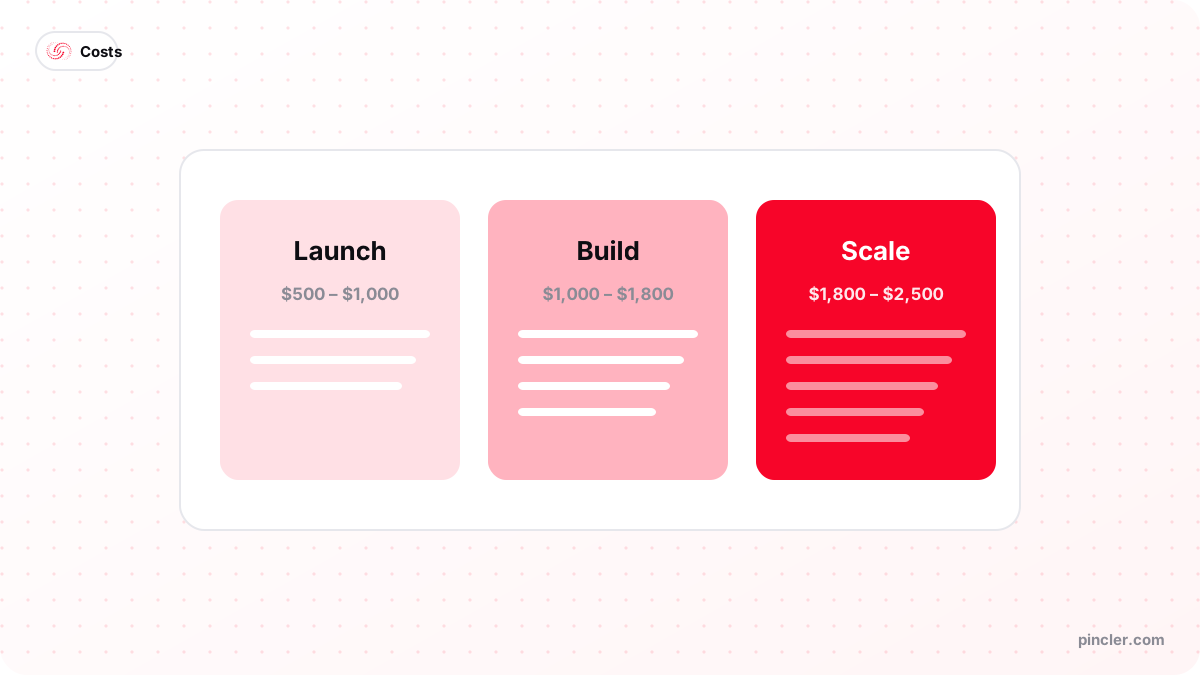
- $2,500 per phase, fixed before work starts — possible because AI drafts and senior engineers review and harden. Larger ideas ship as consecutive phases.
For $2,000 you can build one complete workflow and put it into production: a defined data model, the screens that sit on top of it, one or two user roles, one external integration, tests around the core logic, deployment into your own cloud account and the source code in your own repository. The price works because AI writes the first draft and senior engineers review, test and harden every build — generation got cheap, so the budget goes to verification. Across the 79 builds in PINCLER's published fixed-price catalogue — every one priced between $500 and $2,500 — a $2,000 budget reaches all 79 at their published starting price, the median price is $1,450 and the median quoted delivery 13 days.
That number sits a long way below the published market. Clutch's software development pricing guide, updated September 2026, reports that a typical project on the platform runs $10,000 to $49,999 and that the average custom software project costs $132,480 and takes about 13 months. The gap is not a discount and it is not a smaller team working longer hours. It is a different production method: AI writes the first draft, senior engineers own the architecture, the security review and the release.
This guide answers the literal question. What genuinely ships at $2,000, what does not, a worked scope broken into what is in and what waits for phase two, and the honest cases where you should spend the money on something other than software. The full build-by-build catalogue behind the numbers is published in our research library.
What can you actually build for $2,000?
One workflow, built properly, rather than five built partially. At this budget you get a defined data model, the interface that sits on it, one or two roles, one external integration, automated tests around the core logic, deployment into your accounts and a handover. It is a complete product with a narrow job — not a partial product with a broad one.
The band is not hypothetical. A $2,000 budget reaches every one of the 79 builds in our published catalogue at its starting price, and the category medians below show where the work lands. Websites and small data tools sit near the bottom; web apps and mobile builds use most of the band.
- A lightweight CRM for a small team — contacts, companies, deals, stages, notes and a CSV import.
- An admin dashboard or back-office tool that replaces three spreadsheets and a group chat.
- An AI customer support chatbot answering from your own documents, embedded on your site.
- An online booking and appointment system with reminders, staff calendars and cancellations.
- A spreadsheet converted into a proper web app with logins, validation and an audit trail.
- A workflow automation chain that moves data between systems you already pay for.
| Category (of 79 catalogue builds) | Median published price | Median quoted delivery |
|---|---|---|
| Websites | $1,025 | 8 days |
| Data | $1,100 | 9 days |
| Integrations | $1,200 | 10 days |
| Chatbots | $1,375 | 13 days |
| AI Agents | $1,450 | 13 days |
| Dashboards | $1,600 | 14 days |
| Internal Tools | $1,725 | 16 days |
| Web Apps | $1,925 | 18 days |
What does $2,000 not buy?
A short, firm list. Being specific about the ceiling is what makes the rest of the number credible, and a vendor who says yes to everything at this price is quoting you a problem rather than a project.
None of this puts the bigger idea out of reach. It changes the shape of the engagement: the idea arrives as consecutive phases, each one shipping something usable, rather than as a single large invoice. Our MVP versus full product guide covers how to choose which slice goes first.
- A multi-tenant SaaS product with billing, subscription tiers, admin tooling and a marketing site. That is three or four phases.
- Native iOS and Android apps as separate codebases. Cross-platform fits the band; two native builds do not.
- Anything requiring formal compliance work, third-party penetration testing, or clinical, financial or safety certification.
- A like-for-like replacement of a ten-year-old system with its full history, custom reports and forty integrations.
- Open-ended scope. The price holds because the scope is fixed — 'we will work it out as we go' is the most expensive sentence in software.
- An ongoing product team. $2,000 buys a build, and a build is a finite thing with a start and an end.
Why does the internet say $2,000 is impossible?
Because almost every published pricing figure measures the same production method: a staffed team, billed by the hour, over a number of months. Search 'what can you build for $2000' and the results are cost guides written by studios whose floor is twenty times higher, which is why the honest answer to this question is hard to find rather than genuinely unavailable.
The market numbers are worth stating plainly. Clutch's software development pricing guide, updated September 2026, reports that most listed companies charge $24–$49 per hour and that the average custom software project costs $132,480 over about 13 months. FullStack Labs' 2026 Software Development Price Guide reports that 65.7% of custom software projects fall between $30,000 and $100,000, and that only 14.1% come in under $30,000 at the time of writing. Andersen's 2026 cost guide puts a basic MVP at $25,000–$80,000 over two to four months.
Now look at what those figures have in common: every one is hours multiplied by a rate. When the market wants a lower number it changes geography — Accelerance's 2026 outsourcing rate research, drawn from 60 software development partners worldwide, puts senior rates at $31–$41 per hour in Asia against $64–$76 in Central and Eastern Europe. Geography moves the price by a factor of two. Changing how the hours are produced moves it considerably further, which is the argument we set out in full in why agencies charge $30,000 for what we charge $2,500.
| Source | What it reports a build costs | Method it assumes |
|---|---|---|
| Clutch (2026) | $10,000–$49,999 typical project; $132,480 average over ~13 months | Hourly billing at $24–$49 per hour |
| FullStack Labs (2026) | 65.7% of projects $30,000–$100,000; 14.1% under $30,000 | Staffed team priced by seniority |
| Keyhole Software (2026) | $40,000–$120,000 for a simple or MVP-scope build | Two to four months of a delivery team |
| Andersen (2026) | $25,000–$80,000 for a basic MVP | Two to four months including discovery |
What does a real $2,000 scope look like, line by line?
Here is the shape we quote most often, with the line items visible. Take an eight-person services business running its jobs on a shared spreadsheet: work gets logged twice, the status is whatever someone last typed in a group chat, and nobody can say how many jobs are open without counting rows.
The left column is the $2,000 build. The right column is not a sales device — it is the list written down during scoping so the 'no' is specific rather than vague. Set out this way, the deferred work is roughly the same size as the delivered work, so it ships as a second phase of about $1,800 once a month of real use has shown which parts matter.
- Days 1–2: scope document signed, data model and screens agreed, phase-two list written down.
- Days 3–8: build. AI generates first-draft components, boilerplate and tests; the engineer owns the model, the access rules and anything touching money or identity.
- Days 9–11: senior review, security pass, testing against real exported data rather than tidy sample data.
- Days 12–14: migration, deployment into your own cloud and GitHub accounts, handover walkthrough, warranty starts.
| Line item | In the $2,000 phase one | Deferred to phase two |
|---|---|---|
| Data model | Clients, jobs, stages, assigned staff, notes | Suppliers, purchase orders, cost lines |
| Screens | Job list with filters, job detail, client record, kanban board | Customer-facing portal |
| Users | Two roles — admin and staff | Granular permissions, client logins |
| Automation | Email when a job changes stage | WhatsApp reminders, escalation rules |
| Integration | One — accounting export as a clean CSV | Live two-way accounting sync |
| Reporting | Jobs by stage, jobs per staff member this month | Margin analysis, forecasting |
| Data migration | One import of the current spreadsheet | Historical archive from the retired system |
How do you scope an idea to fit $2,000?
Start from the workflow, not the feature list. If you can name the one manual process that disappears on day one, the scope is usually already the right size; if you cannot, no budget will help, because the cost of software is mostly the cost of indecision. The decision tree below is the one we run on a scoping call.
The counterintuitive part is that features are cheap and connections are expensive. A modern component library makes a clean interface the inexpensive half of the work. Authentication, failure handling and testing against a third-party API you do not control is the expensive half — which is why our guide to scoping a project to fit a budget asks you to count integrations before you count screens.
Will your idea fit one $2,000 phase?

  Can you name ONE workflow it replaces on day one?
      NO  -> not ready to build. Write the process down first.
      YES -> continue

  How many external systems must it talk to?
      0-1 -> fits comfortably        ($900-$1,600)
      2-3 -> fits at the top of band ($1,600-$2,500)
      4+  -> split it; integrations become phase two

  How many kinds of user see different things?
      1-2 -> fits
      3+  -> roles and permissions become phase two

  Payments, compliance or an app store review?
YES -> budget the top of the band, or phase it- Name the one workflow. 'Replace the jobs spreadsheet' is a scope. 'Improve operations' is a budget with no floor.
- Count integrations before features. Each external system carries authentication, failure handling and its own test surface.
- Defer reporting. Dashboards are the most requested and least used part of a first build — ship the workflow, watch a month of real usage, then report on what people actually did.
- Build for the person doing the work, not the person reading the summary. Tools that add work for their users quietly stop being used.
- Write the phase-two list rather than arguing it away. A recorded 'later' is far easier to accept than a flat 'no'.
Who should buy a $2,000 build — and who should not?
It fits best when there is a specific, repeating, manual process costing real hours: a small team on a spreadsheet that has outgrown itself, a founder who needs one workflow live to test demand, an operations lead stitching two systems together by hand every morning. In all three cases the return shows up within weeks, which is the only test that matters at this size.
It is the wrong spend in four situations, and we say so on calls regularly. When off-the-shelf software is enough — it already covers about 90% of the job — buy it and bend slightly, as our build versus buy guide sets out. If you need twelve months of continuous product development, a single fixed-price phase is the wrong instrument and you should hire. If the problem is really a process or staffing problem, software will encode the mess and make it permanent. And if nobody can find 30 minutes to define the scope, the project has already told you its priority.
What mistakes waste a $2,000 budget?
Budgets at this size rarely fail on engineering. They fail on decisions made before any code exists, and every one of these is avoidable in the first two days.
- Splitting the money across three half-built things. One finished workflow beats three demos, every time.
- Buying screens instead of a data model. A wrong model is expensive to change later; a plain interface is not.
- Skipping the migration conversation. Messy historical data is often a third of the effort, and finding that out mid-build is what turns a fixed price into an argument.
- Specifying a dashboard first. Reports describe work; they do not do it.
- Not asking who owns the result. Code in your GitHub, data in your database, IP assigned on final payment — get it in writing, as our guide to who owns your code explains.
- Treating the fixed price as an invitation to add. The band holds because the scope holds; new ideas go on the phase-two list, where they are cheap to consider.
PINCLER's perspective: what a published catalogue of 79 builds shows
PINCLER is an AI-first custom software development studio. We build these systems using tools such as Claude, GPT, Cursor, Claude Code and Gemini, and the systems themselves are CRMs, dashboards, chatbots, booking tools, integrations and internal business apps. Every project is fixed price between $500 and $2,500, and the ceiling is real — bigger ideas become phases rather than bigger invoices.
The catalogue is specific about what each budget reaches. At $500, 11 of the 79 published builds are within reach at their starting price. At $1,000 it is 55. At $1,500 it is 75, and at $2,000 all 79. That distribution is the honest answer to this article's question: $2,000 is not the edge of what is possible in this band, it sits comfortably inside it, which is why the published median settles at $1,450. Those are advertised prices and quoted windows rather than a record of delivered work — a complete itemised price list, published so you can check it against your own idea before you speak to anyone.
The method behind that is neither mysterious nor unsupervised. Across the 79 catalogue entries, GPT is listed on 76, Cursor on 75, Claude Code on 63 and Claude on 55 — but architecture, access control, the security pass and the release are a senior engineer's responsibility on every build. AI writes the first draft. Humans decide what ships, test it against real data, and hand over the repository. That review step is exactly the one cheap delivery is assumed to skip, which is why the price is a method rather than a risk.
The bottom line
$2,000 buys one workflow, built and shipped, in roughly two weeks — with the code, the data and the accounts belonging to you. It does not buy a platform, and any vendor who says otherwise is describing a phase one without telling you.
To sanity-check your own idea against published numbers, the full catalogue of 79 builds lists what comparable work is priced at and the delivery windows quoted for it, and the pricing page shows where the bands sit. A 30-minute call is usually enough to say which side of the line your idea falls on, and a written fixed quote follows within a working day.
Related PINCLER builds
Frequently asked
Is $2,000 enough to build custom software?
Yes, for one scoped workflow. $2,000 covers a defined data model, its screens, one or two user roles, one external integration, testing, deployment and source-code handover, delivered in roughly ten to twenty days because AI writes the first draft and a senior engineer reviews, tests and hardens it. It is not enough for a multi-tenant SaaS product, two native mobile codebases or a regulated platform. Those are real projects too; they simply arrive as consecutive phases rather than one build.
What is the difference between a $2,000 build and a $30,000 one?
Usually production method and scope breadth, in that order. Published market figures price a staffed team by the hour over several months, which is why Clutch reports a typical project at $10,000–$49,999. A $2,000 build covers one workflow instead of a platform, and is produced AI-first with senior engineers owning architecture, review and release. The engineering steps are the same; the hours spent typing boilerplate are not.
How long does a $2,000 software project take?
Ten to twenty working days for the scopes described here. Across the 79 builds in the published fixed-price catalogue the median quoted delivery is 13 days, 33 are quoted within 14 days and all 79 within 30. The usual delay is not engineering — it is waiting on decisions about fields, stages and who sees what. Arriving with a one-page process description reliably lands you at the fast end of the range.
Can a bigger idea be split into $2,000 phases?
Yes, and that is the standard approach when scope exceeds the $2,500 ceiling. Each phase is fixed price, AI-drafted and senior-reviewed, and ships something usable on its own rather than a fragment waiting on the next instalment. A typical split puts the core workflow first, then integrations, then roles and reporting. The benefit beyond budget is evidence: a month of real usage between phases usually changes what phase two should contain.
Does $2,000 include hosting and running costs?
No, and no honest quote would fold them in. The build price is one-off; running costs are yours and are usually modest — hosting on a small cloud plan, a domain, and any third-party API usage such as an AI model or a messaging provider. For a small internal tool that commonly lands between $5 and $25 a month. Everything deploys into your own accounts, so you pay providers directly at their published rates.
Is affordable software development safe at this price?
It is safe when the process around it is disciplined and verifiable. Ask for a written fixed quote, a scope document naming every feature, code delivered to your own GitHub organisation, IP assigned on final payment and a stated bug-fix warranty. Price stopped being a reliable proxy for quality once production methods diverged. Judge a studio on how sharp its scoping questions are and how precise its paperwork is.
Sources
Want to build this?
PINCLER builds custom software, AI agents and GTM systems for a fixed price between $500 and $2,500, delivered in 3–30 days, with the code owned by you.
Keep reading
Related articles

Why Do Agencies Charge $30,000 for What We Build for $2,500?
Why is custom software so expensive at one supplier and not another? A transparent breakdown of agency cost structure, hour counts and the arithmetic behind a $2,500 build.
Can You Build a Custom CRM for Under $2,000?
The cheapest way to build a custom CRM, compared honestly: free tiers, spreadsheets, no-code, and an AI-drafted, senior-reviewed $1,200–$2,000 build. Which one you should pick.
How Much Does Custom Software Development Cost in 2026?
Custom software development cost in 2026: $500–$2,500 fixed price by project type, held there because AI drafts each build and senior engineers review, test and harden it.