MVP vs Full Product: What to Build First
MVP vs full product: when a lean first version wins, the rare cases where building the full thing first is right, and the cost of guessing wrong.
Quick answer
- Default
- Build the MVP — the smallest complete loop: sign up, use the core feature, pay
- Build full first when
- Replacing a system staff depend on, or meeting a fixed regulatory or contractual spec
- MVP cost
- $1,800–$2,500 fixed, live in 2–4 weeks — AI writes the first draft, senior engineers review and test it
- Full product cost
- Fixed-price phases of $2,500 or less, each AI-drafted and senior-reviewed; typically $5,000–$7,500 across three phases
- The evidence
- CB Insights: roughly 42% of failed startups cite no market need
Build the MVP first. For roughly nine ideas out of ten that is the whole answer to the mvp vs full product question, and the reasoning is not fashion — it is that most assumptions about what users want are wrong in the details, and an MVP is the cheapest machine ever invented for finding out which ones.
The tenth case is real, though. There are situations where a minimal version cannot do its job — where partial software is worse than none — and pretending otherwise wastes money in the opposite direction. Replacing a working internal system, meeting a regulatory bar, or serving a customer who has already specified the requirements can all justify building the full product first.
The evidence for defaulting to the MVP is unusually strong. CB Insights' analysis of startup post-mortems found no market need to be the most commonly cited cause of failure, at roughly 42% — and the Standish Group's oft-quoted research found 64% of built features are rarely or never used. Together those two numbers describe the same waste from both ends: products built in full, for demand that was never tested.
This guide sets out the honest decision rule, what each path costs with real numbers, and the failure mode on each side: the full product nobody wanted, and the MVP so minimal it tested nothing.
The short answer
If the biggest risk in your project is whether people want the thing, build the MVP. If the biggest risk is whether the thing meets a specification that already exists — a regulation, a contract, a working system it must replace outright — build the full product, scoped properly, usually in phases. Naming your biggest risk answers the question in one step.
Most founders and most small businesses are in the first situation and talk themselves into the second, because the full product is more satisfying to imagine. The market does not reward complete software; it rewards software that solves the problem, and completeness is only correlated with that when the problem is fully understood — which, before launch, it almost never is.
What is the biggest risk in your project?
    "Will anyone pay for this?" → BUILD THE MVP
        smallest complete loop, $1,800–$2,500 fixed
    "Can we meet a spec that already exists?"
        (regulation, contract, replacing a system
         staff depend on) → FULL PRODUCT, in phases
    Not sure? Write down the one assumption that
    kills the project if wrong:
        about demand      → MVP
        about feasibility → build that phase first
What does the evidence say about guessing?
Three well-known bodies of research converge on the same warning. CB Insights' post-mortem analysis found the most common reason startups fail is no market need, cited in roughly 42% of cases — teams built the thing before checking anyone wanted it. The Standish Group's feature-usage findings, presented by its chairman at XP 2002, put 64% of delivered features in the rarely-or-never-used pile. And the Standish CHAOS research has reported for decades that only around a third of software projects fully succeed against their original time, budget and scope.
None of these numbers is an argument against building software. They are an argument against building on unverified assumptions — which is precisely the practice an MVP replaces with evidence. A lean first version converts the biggest risk from 'we spent everything on a guess' to 'we spent $2,000 to find out'.
MVP vs full product at a glance
The comparison is not simply small versus large. The two paths differ in what they optimise for, what they cost to be wrong about, and when you find out.
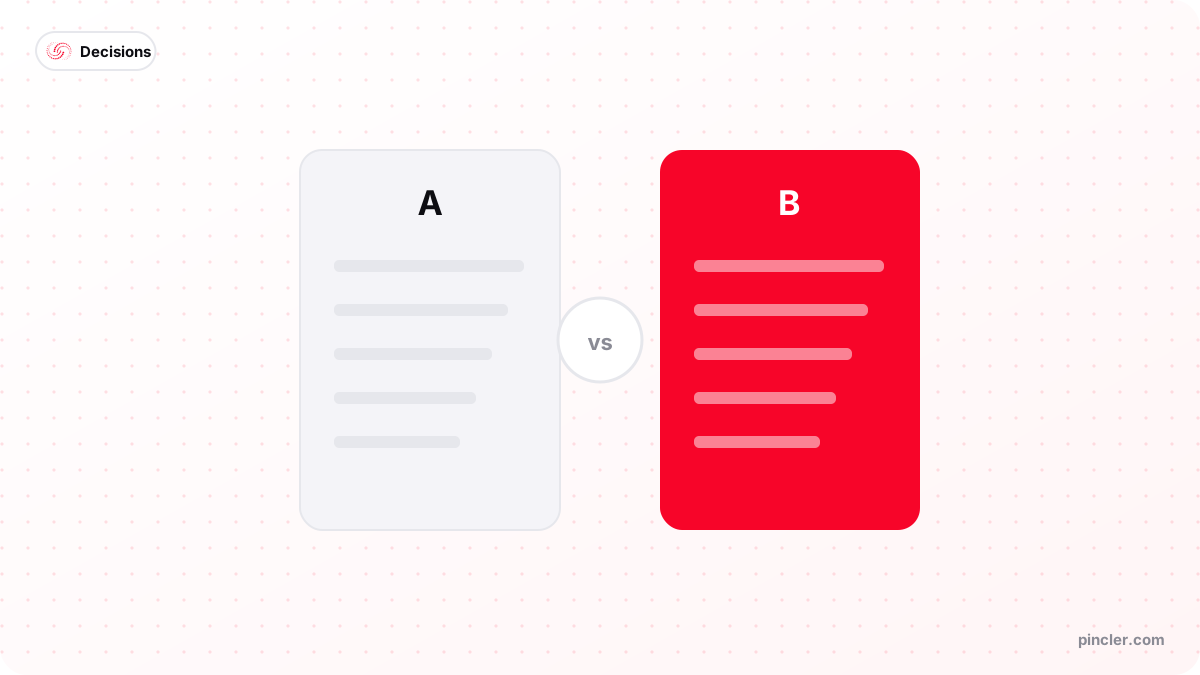
| Dimension | MVP first | Full product first |
|---|---|---|
| Optimises for | Learning what users actually do | Completeness against a known spec |
| Typical fixed cost | $1,800–$2,500, one phase | Multiple phases, each $2,500 or less |
| Time to first real user | 2–4 weeks | 2–4 months across phases |
| Cost of a wrong assumption | Days of rework on a small surface | Rework spread across everything built on the guess |
| Right when | Demand is unproven | Requirements are genuinely fixed in advance |
What actually counts as an MVP?
The word has been abused into meaning 'whatever we could afford', so it is worth restating: a minimum viable product is the smallest complete loop of value. A stranger arrives, understands the offer, uses the core feature, and — if it is a commercial product — pays. Every step works properly. Nothing else exists. Minimal describes the breadth, never the quality of what ships.
A broken signup flow is not an MVP; it is a bug with a landing page. Equally, a product with five features where users only needed one is not a full product; it is an MVP wearing four disguises. The test in both directions is the loop: complete, narrow, working. Where prototypes and proofs of concept fit is a separate question — MVP vs prototype vs proof of concept draws those lines.
The arithmetic of testing before committing
Put numbers on the two paths and the asymmetry is stark. Path one: a $2,200 MVP ships in three weeks and meets the market. If the idea works, later phases are built on evidence. If it does not, the total tuition paid for the lesson is $2,200 plus a month of calendar time.
Path two: the full product, built in one push. Even at AI-assisted prices, five phases of scope land around $8,000–$12,000 and three to four months. If the Standish 64% figure applies even loosely, well over half that spend went to features that will rarely be used — and if the core assumption is wrong, the CB Insights statistic is waiting. The expected cost of being wrong is roughly five times higher, and you find out three months later. That gap — not ideology — is why the MVP is the default.
When is the full product the right first build?
The honest exceptions share one property: a minimal version cannot perform the job at all. If you are replacing the system a business runs on — invoicing, stock control, patient records — a half-replacement forces staff to run two systems at once, which is worse than either alone. The replacement has to reach parity with the workflows people depend on before it ships, even if it ships in internal phases.
Fixed external requirements are the other case. Where a regulator, an insurer or a signed contract defines what the software must capture and report, the specification is not a guess to be tested — it is a bar to be met, and 'viable' is defined for you. Even here, phasing still applies to everything beyond the bar; compliance rarely requires the nice-to-haves that tend to ride along with it. For what software must capture in regulated areas, confirm specifics with a licensed advisor rather than a blog post.
What does building too much really cost?
Overbuilding costs three times. First the build itself — every speculative feature is paid for up front. Then the drag: more code means slower changes, more testing and more places for bugs to hide, a tax charged on every future edit. Then the big one: when real usage reveals the product should work differently, the redesign cost scales with everything built on the wrong assumption. A wrong guess inside a lean MVP costs days; the same guess inside a full product can cost most of the budget.
The pattern is not confined to startups. McKinsey's research with the University of Oxford across more than 5,400 IT projects found large projects deliver 56% less value than predicted while running 45% over budget — overcommitment to unvalidated scope, at industrial scale. AI-assisted development sharpened the temptation: building is now so much cheaper that the urge to build more has grown faster than the wisdom to build less. Speed makes scoping discipline more valuable, not less.
PINCLER's perspective: MVP cost and speed across 79 catalogue builds
Published price data makes the default concrete. Across the 79 builds in PINCLER's published fixed-price catalogue — every one priced between $500 and $2,500 — the median advertised price is $1,450 against a median quoted delivery of 13 days; 33 of the 79 are quoted at 14 days or fewer, and all 79 within 30. Web apps, the closest category to a full SaaS MVP, carry a median of $1,925 and 18 days. The full dataset is published at /research/what-you-can-build.
Those timelines change the strategic picture. When a production-grade first version ships in two to four weeks — the MVP in 14 days sprint is built around exactly that window — the cost of testing an assumption approaches the cost of a good trade-show stand. And unlike the stand, you keep the software, the code in your GitHub and everything it taught you. Custom application development at this speed makes 'test first' the financially conservative option, not the scrappy one.
Failure modes on both sides
The MVP path fails when minimal becomes broken: a signup that errors, payments that need a workaround, a core feature that half-works. Users do not grade on a curve — they leave, and the test returns a false negative on an idea that might have been good. Guard against it by keeping the loop complete and production-grade, however narrow — what to build in an MVP and what to leave out lists which cuts are safe and which are not.
The full-product path fails slower and more expensively: months of building in silence, a launch against untested assumptions, then a redesign bill that touches everything. It also fails politically — after that much sunk cost, teams defend the product against the evidence instead of adjusting it. If you notice launch dates slipping to fit 'just one more feature', you are watching this failure mode in progress.
Both failure modes have the same antidote: define the loop in writing before the build starts, and refuse changes in either direction. Nothing gets cut from the loop to save time, and nothing gets added around it to feel finished. A one-page definition of done is the cheapest project insurance available at any budget.
Who is each path best for?
The MVP path is best for anyone whose largest unknown is whether people want the thing: a new product with no paying users, a service business testing an online version of what it currently does by phone, a side idea that has to earn its next budget. The full-product path is best for a team replacing something that already works — an internal process with known steps, a contract that specifies the deliverable, a migration where the requirements are already written and agreed.
Neither path is for the reader whose answer is already available off the shelf. If a standard product covers the workflow — a storefront on Shopify, a pipeline on HubSpot's free tier, scheduling on Calendly — then the minimum viable version of your idea is a subscription, and the money is better spent getting customers to it. Build when the workflow is genuinely yours, not when building is simply more interesting than selling.
A practical way to decide this week
Write down the one assumption that, if wrong, kills the project. If that assumption is about demand — will they sign up, will they pay, will they switch — build the MVP and aim it squarely at that question. If the assumption is about feasibility against a fixed spec, scope the full product in phases and get the risky phase built first. Either way, nothing bigger than $2,500 should be committed before the riskiest assumption has been tested.
If you are weighing the two paths for a specific idea, this is a conversation we have most weeks — a free 30-minute call gets you a straight recommendation and a written fixed quote within a working day, and the SaaS MVP use-case page shows exactly what a first complete loop includes.
Related PINCLER builds
Frequently asked
How minimal can an MVP be before it stops being useful?
The floor is the complete loop: a user can discover, use and pay for the core feature without a human intervening behind the scenes. Below that you are demoing, not testing. A concierge version — where you manually perform parts of the service — can be a legitimate pre-MVP experiment, but treat its results carefully: people behave differently with software than with a person doing them a favour.
Does building an MVP first mean building twice and paying twice?
Rarely, if the MVP is built to production standard — proper auth, payments and deployment — rather than as a throwaway prototype. Then version two is an extension, not a rebuild: the phases add features onto a sound base. What genuinely forces rebuilds is the opposite path — a full product built on untested assumptions, where the redesign after launch touches everything at once.
What does the full product cost if the MVP costs $2,500?
As a sequence of fixed-price phases, each $2,500 or less and each shipping something usable, with AI drafting the code and senior engineers reviewing and testing it every time. A typical arc: phase one is the MVP loop, phase two adds the admin panel and second user role, phase three the extra integrations and reporting. Three phases land around $5,000–$7,500 in total — with the large advantage that phases two and three are scoped from real usage rather than guesswork, so the money buys features people have already asked for.
How long should an MVP take to build?
Two to four weeks is the realistic band for a production MVP at AI-assisted prices. Across PINCLER's published catalogue of 79 builds the median quoted delivery is 13 days, with web apps — the closest category to a full SaaS MVP — at a median of 18 days, and everything within 30. If a proposal quotes three months for a first version, the scope has almost certainly drifted past minimum; ask which features could move to phase two and watch the timeline halve.
Should my MVP charge money from day one?
Yes, in almost every commercial case — payment is the strongest signal an MVP can collect. Sign-ups measure curiosity; transactions measure demand, and the CB Insights finding that ~42% of failed startups cite no market need is really a finding about teams that never forced that test. Practical middle grounds exist — a founding-member price, a money-back trial — but a free MVP mostly postpones the only question that matters and lets a weak idea look healthy for months.
Is an MVP the right approach for a non-startup — an established small business?
Yes, and arguably more so, because an established business can validate against real customers immediately. The same logic that guides software development for startups applies: build the smallest complete workflow, put it in front of the people who already buy from you, and phase the rest. The one difference is the exception list — established businesses more often hit the genuine full-product cases, like replacing a system staff already depend on, where parity matters before launch.
Sources
- CB Insights, Why Startups Fail: Top Reasons
- The Standish Group, feature-usage findings presented at XP 2002
- The Standish Group, CHAOS research
- McKinsey & University of Oxford, Delivering large-scale IT projects
Want to build this?
PINCLER builds custom software, AI agents and GTM systems for a fixed price between $500 and $2,500, delivered in 3–30 days, with the code owned by you.
Keep reading
Related articles
Is Cheap Custom Software Too Good to Be True?
Is cheap custom software any good? The six failures that actually sink low-cost builds, the checks that separate method from corner-cutting, and how to run them on us.
Internal Tool Development for Under $3,000
Internal tool development for a small business runs $800–$2,500 fixed price at PINCLER — AI-drafted, senior-reviewed — not the five-figure numbers agency guides quote. When Retool wins.
Freelancer vs Agency vs AI-Assisted Studio
Freelancer vs agency software development vs an AI-assisted studio: honest cost ranges, risks and delivery speed for each — and how to pick the right one for your project.