MVP vs Prototype vs Proof of Concept
MVP vs prototype vs PoC: what each one proves, who each is for, what each costs, and a decision tree for which to build first — with real fixed-price numbers.
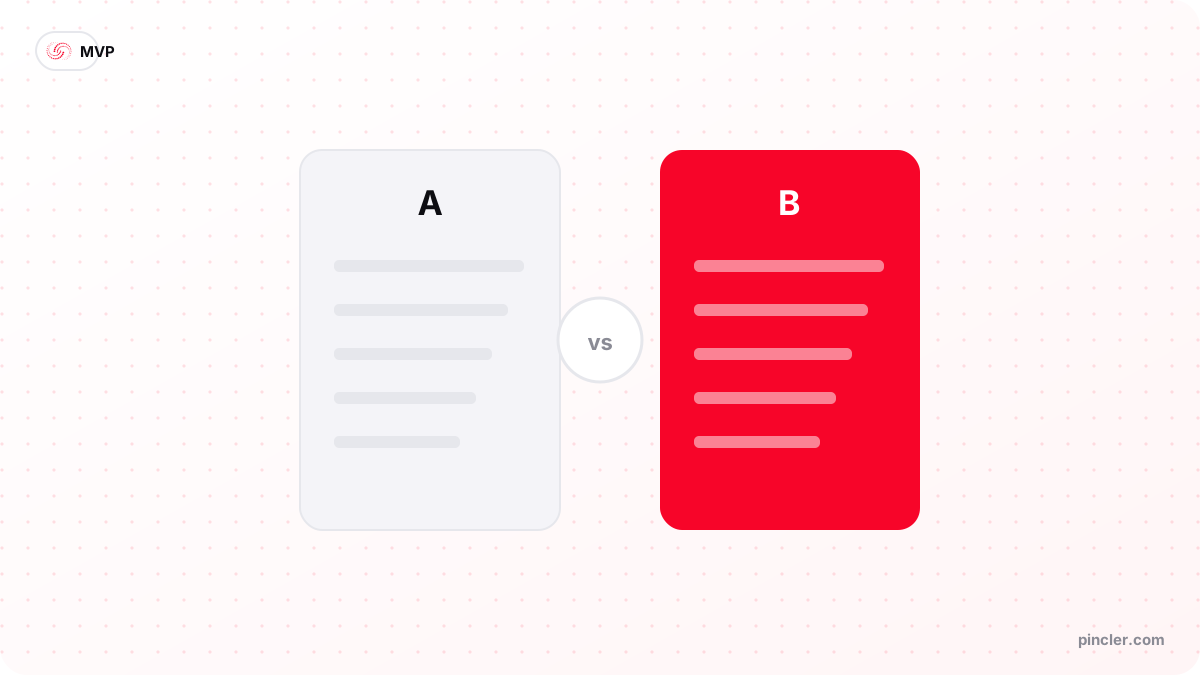
The difference in one line each: a proof of concept (PoC) proves the technology can work, a prototype shows how the product will look and behave, and an MVP proves strangers will use — and ideally pay for — the smallest real version. In the mvp vs prototype vs poc decision, the question that picks between them is simply which risk scares you most right now: technical feasibility, user comprehension, or market demand.
The three get confused because all of them are 'early versions', but they answer different questions for different audiences at different costs — and shipping one while believing it is another causes real damage: prototypes sold as products, demos pitched as traction, MVPs delayed for months by feasibility work the stack had already proven.
This guide defines each properly, prices them honestly, gives you a decision tree for which to build first, and covers the common case where the right number of these artefacts to build is fewer than three.
What Is the Difference Between a PoC, a Prototype and an MVP?
Each artefact exists to retire one specific risk, for one specific audience. A PoC is for your own team: a rough, private demonstration that the hard technical thing — the algorithm, the integration, the extraction accuracy — is achievable at all. A prototype is for users and stakeholders: clickable screens that show the flow and feel, with nothing real behind them. An MVP is for the market: the smallest complete product a stranger can use and pay for, instrumented so the results are measurable.
The table makes the contrasts concrete. Note the lifespan row — it is the one founders most often get wrong. PoCs and prototypes are deliberately disposable; only the MVP is built to be kept, extended and owned.
| Proof of concept | Prototype | MVP | |
|---|---|---|---|
| Question answered | Can the technology work? | How will users experience it? | Will strangers use it and pay? |
| Audience | Your own team | Users, stakeholders, early investors | The real market |
| What is real | One hard mechanism, roughly | Screens and flows, nothing behind them | One complete workflow, end to end |
| Lifespan | Days — then discarded | Weeks — then discarded | Kept, measured, extended |
What Is a Proof of Concept — and When Do You Need One?
A PoC is the narrowest possible test of the one thing you are not sure is technically achievable: can the model extract line items from these scanned invoices reliably, can this legacy system be integrated with at all, can the matching algorithm run fast enough on real volumes. It is ugly on purpose — a script, a notebook, a hard-coded demo — because every hour spent on anything except the core uncertainty is waste.
You need one only when genuine technical uncertainty exists, and for most software businesses in 2026 it does not: authentication, payments, dashboards, bookings and CRUD applications sit on stacks proven millions of times, and ai based software development has made even the AI-flavoured versions of these routine. Where PoCs earn their keep is at the edges — unusual data, untested accuracy requirements, hostile integrations. A useful tell: if you can name the specific sentence you need to hear ('yes, extraction hits 95 percent on our documents'), a PoC is the cheapest way to hear it.
What Is a Prototype — and What Is It For?
A prototype is the product's appearance without its machinery: clickable screens wired together so a person can walk the flow, react to it, and expose the confusions before anything expensive is built. Modern tools have made this stage almost free — design tools and AI UI generators such as v0 produce convincing clickable flows in hours, and across the 79 builds PINCLER publishes fixed prices for, v0 appears on 28 builds precisely for this first-draft role.
Use a prototype to test comprehension, not demand: five people attempting three tasks on clickable screens will surface most onboarding confusion for a fraction of the cost of discovering it in production. What a prototype cannot do is validate a market — nobody's polite click on a fake button predicts a payment. And never let one ship: a prototype has no error handling, no security and no data layer, and 'we'll just launch the prototype' is how demo-ware ends up holding real customer data.
What Is an MVP — and Why Is It the Only One That Proves Demand?
An MVP is the smallest version of the product that completes one real workflow for a real user, takes real money, and reports real usage — a live SaaS MVP with auth, billing and a dashboard rather than a simulation of one. It is the only artefact of the three that generates market evidence, because it is the only one a stranger can adopt without you in the room.
That evidence is the point. CB Insights' analysis of startup post-mortems found 42 percent of failures cited no market need — a risk neither a PoC nor a prototype can even address, since neither meets the market. Scope stays deliberately minimal (the boundary with a fuller build is drawn in our guide to MVP versus full product), but everything inside the scope is production-real: payments clear, errors are handled, and the code is yours.
Which One Should You Build First?
Order by your scariest risk, and let the tree below decide. The honest default for most founders is further down the tree than pride suggests: if your product is a workflow on a standard stack, feasibility is already proven and comprehension is testable in a week — demand is the only question that matters, and only the MVP answers it.
Is there genuine doubt the core technology CAN work?
    YES → PoC first (days, private, disposable)
    NO  ↓
Is the user flow novel enough that people might not get it?
    YES → prototype first (clickable, 5 test users, a week)
    NO  ↓
The open risk is demand → build the MVP
    (one workflow, real payments, instrumented)
Do You Need All Three — and What Does the Sequence Cost?
Rarely. The full PoC → prototype → MVP ladder suits genuinely novel technology headed for a complex product; most businesses should skip at least one rung. What changed the calculus is cost compression at the top: when the median full build across the 79 catalogue builds PINCLER lists prices for is $1,450 with a quoted delivery of 13 days — every project fixed-price between $500 and $2,500 — the MVP is no longer the precious final stage that earlier artefacts must protect. Sometimes the 14-day MVP sprint is the cheapest experiment on the table.
When the earlier rungs do run, keep them proportionate: a PoC is days of focused work at the small end of the budget band, a prototype is hours of tooling plus a week of user conversations, and neither should consume the budget the MVP needs. The full pricing picture across project types sits in our MVP development cost guide — the allocation logic here only needs the ratios, and the ratio that matters is that the artefact facing the market deserves most of the money.
What Are the Common Mistakes With PoCs, Prototypes and MVPs?
Nearly every failure with these three artefacts is a category error — using one to answer a question that belongs to another.
- 1. Shipping the prototype as the product — demo-ware holding real customer data is a breach story waiting to happen.
- 2. Pitching a PoC as traction — investors price the difference between 'it runs' and 'they pay' instantly.
- 3. Building a PoC for a solved problem — a booking system needs no feasibility study in 2026.
- 4. Polishing the prototype for weeks — its job is to be argued with, not admired.
- 5. Building the MVP without instrumentation — an unmeasured MVP is just a small product, not an experiment.
- 6. Treating the sequence as mandatory — each rung must retire a real risk, or it is ceremony.
PINCLER's Perspective: the Ladder Got Shorter
PINCLER is an AI-first custom software development studio, and the clearest pattern in our data is how the economics compressed the ladder. Across the 79 catalogue builds PINCLER lists prices for, integrations — the classic PoC territory of 'can these systems talk?' — run a median of just $1,200 and 10 days as full production builds, and the overall median is $1,450 in 13 days, with the complete dataset at our research page. When the real thing costs this little, a month of pre-artefacts needs a better justification than habit.
Our working advice from that data: reserve the PoC for genuine technical unknowns, get the prototype value from a day of AI-generated screens reviewed with five users, and put the budget where the market evidence is. The stages still exist; they have simply stopped deserving equal weight.
The Bottom Line
PoC, prototype and MVP answer three different questions — can it work, will users understand it, will anyone pay — and you build only the ones whose question is genuinely open. For most software ideas on standard stacks, that means going straight to a small, instrumented MVP and letting the market answer the only question that decides anything.
If you are unsure which rung your idea is on, that is a fifteen-minute conversation: a free 30-minute call gets you an honest read on which artefact your riskiest assumption deserves, and a written fixed quote for it within one working day.
Related PINCLER builds
Frequently asked
What is the difference between an MVP and a prototype?
A prototype is clickable screens with nothing real behind them, built to test whether users understand the flow; an MVP is a working product with real payments, real data and real error handling, built to test whether strangers will use and pay. A prototype is discarded after it teaches; an MVP is kept and extended. The practical test: if a stranger cannot adopt it without you present, it is a prototype.
Do I need a proof of concept before an MVP?
Only if genuine technical uncertainty exists — unusual data, strict accuracy requirements, a hostile legacy integration. Standard product mechanics such as auth, payments, bookings and dashboards are proven technology and need no feasibility work. A useful test: write the exact sentence a PoC would need to prove. If you cannot name one, skip the stage and put the days into the MVP instead.
Can a prototype be turned into the MVP later?
The design thinking carries over; the artefact should not. A prototype has no security, no data layer and no error handling, and grafting production machinery onto demo-ware reliably costs more than building properly from the prototype's lessons. Treat the prototype as a specification you validated cheaply. With custom application development on an AI-assisted model, rebuilding properly is fast enough that reuse saves nothing worth having.
How long does each stage take?
A focused PoC takes days — it tests one mechanism, privately. A prototype takes hours to generate with modern AI UI tools and about a week to test with five users. An MVP takes one to four weeks as a real build: across the 79 builds in PINCLER's published fixed-price catalogue, the median is 13 days, with 33 of 79 shipping inside a fortnight. If any stage is consuming months, its scope has quietly grown past its question.
Which should I show investors — a PoC, prototype or MVP?
The most real thing you honestly have, labelled honestly. A prototype shown as a prototype is respectable at pre-seed; a PoC pitched as a product is a credibility loss you do not recover in the meeting. As builds have become cheap, expectations have shifted towards working MVPs with usage data — which is why, if the choice is a month of prototype polish or a month of live MVP evidence, the MVP wins.
Want to build this?
PINCLER builds custom software, AI agents and GTM systems for a fixed price between $500 and $2,500, delivered in 3–30 days, with the code owned by you.
Keep reading
Related articles
How to Build an MVP Without Being Technical
How to build an MVP without coding: the three realistic routes for non-technical founders, what each costs, where no-code breaks, and how AI-assisted builds compare.
How to Build an MVP Fast Without a Large Development Team
How to build an MVP fast: shrink the scope before growing the team. A day-by-day 14-day plan, the research on small-project success, and what AI-assisted delivery changes.
How to Make an MVP Profitable
How to make an MVP profitable: charge from day one, keep the build small enough that a handful of customers covers it, and let retention decide what you add next.