How to Build an MVP Fast Without a Large Development Team
How to build an MVP fast: shrink the scope before growing the team. A day-by-day 14-day plan, the research on small-project success, and what AI-assisted delivery changes.
Quick answer
- Realistic fast timeline
- 7–14 days for a single-workflow MVP; 18–28 days for a SaaS build with auth and billing
- What makes it fast
- Scope discipline, one user type, standard components, AI-assisted development with senior review
- Catalogue median
- 13 days quoted across the 79 builds PINCLER publishes fixed prices for; 33 of 79 quoted inside 14 days
- Team size
- One or two senior engineers with AI tooling — not a five-person squad
- Best for
- Founders who need market evidence quickly and can defer every nice-to-have to phase two
The way to build an MVP fast is to shrink the product, not grow the team: one core workflow, one user type, boring proven technology, and a hard deadline under three weeks. Built that way with AI-assisted development, a real working MVP ships in 7–14 days — across the 79 builds in PINCLER's published fixed-price catalogue, the median quoted delivery is 13 days, 33 projects ship within a fortnight, and 4 within a single week.
This runs against instinct. Founders in a hurry usually add people, and adding people to a small software project slows it down — every new person adds coordination overhead that a two-week build cannot absorb. The fastest builds in the catalogue are the ones scoped for tiny senior teams with AI tooling and a scope that fit on one page.
This guide gives you the day-by-day plan, the research on why small beats big, what to cut when the deadline is fixed, and the cases where building fast is genuinely the wrong goal.
How Fast Can You Actually Build an MVP?
Seven to fourteen days for a single-workflow MVP, and 18–28 days for a full SaaS product with authentication and billing — provided the scope is frozen before work starts. Those are not aspirational numbers: across the 79 builds in PINCLER's published fixed-price catalogue, 4 are quoted inside seven days, 33 within fourteen, and all 79 within thirty, with a median of 13 days. The dataset behind those figures is published at our research page on building in 14 days.
What separates a 10-day build from a 60-day build is rarely engineering difficulty. It is decision latency — how long the team waits for answers about scope, content and edge cases. A founder who answers questions within hours, accepts standard components, and refuses mid-build additions gets the fast timeline. One who redesigns the dashboard in week two does not.
Be precise about what 'done' means, too. Fast MVPs ship a complete core workflow — sign up, do the thing, pay — not a demo of half of everything. Half of everything is the slowest product there is, because nothing in it can be tested with a real customer, and untested software teaches you nothing regardless of how quickly it was written. One finished workflow beats five started ones every single time.
Why Does Speed Come From Scope, Not Headcount?
Because coordination is the cost that scales. Every additional person on a software project adds communication paths, hand-offs and merge conflicts, and on a two-week build that overhead never pays itself back. The research on project size points the same direction from the failure side: McKinsey, working with the University of Oxford on more than 5,400 IT projects, found large IT projects run 45 percent over budget and deliver 56 percent less value than predicted, while the Standish Group's original CHAOS research reported project success rates of just 9 percent in large companies against 28 percent in small ones — and its later work has consistently found small projects succeed at far higher rates than large ones.
The practical reading for an MVP: keep the project small enough that it cannot develop the diseases of big projects. A build that one or two senior people can hold entirely in their heads has no status meetings, no hand-off documents and no integration phase. That is where the days go on slow projects — not into writing code.
Scope discipline has a compounding effect. A product with one user type needs one interface, one permission model and one onboarding flow. Add a second role and you have roughly doubled the surface area — which is why the fastest builds in the catalogue are single-role tools, and why our guide on what to build in an MVP treats role-count as the first thing to cut.
What Does a 14-Day MVP Plan Look Like?
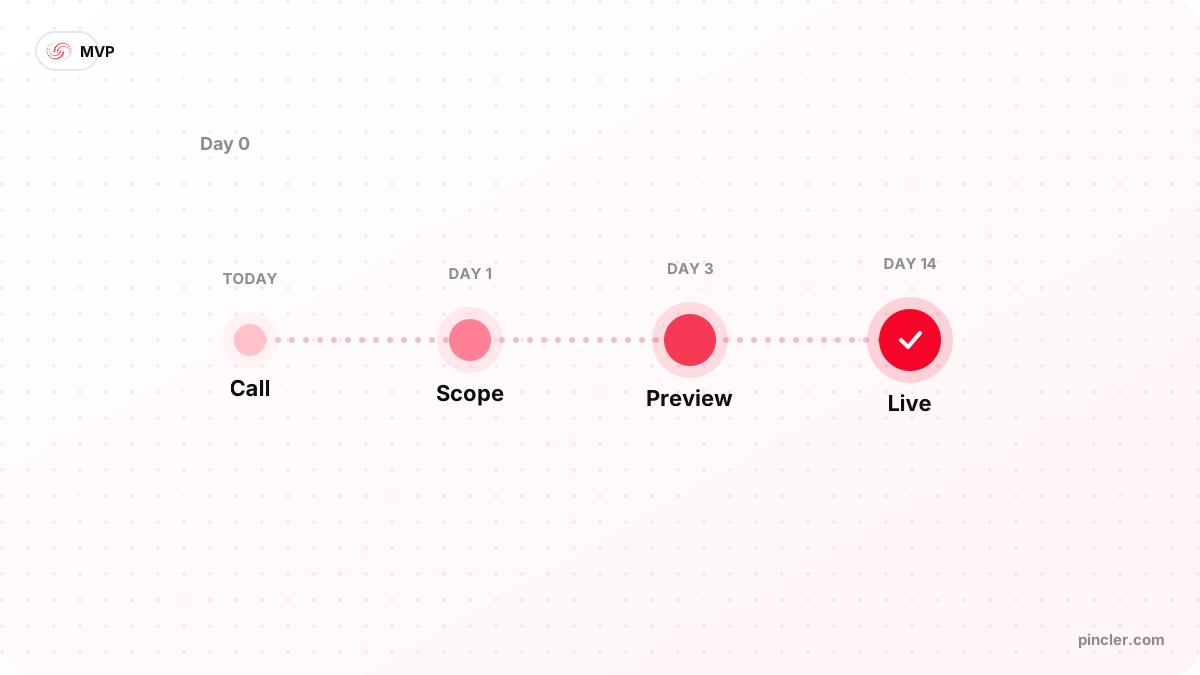
Work backwards from a live deployment, and deploy on day one, not day thirteen. An empty app in production from the first morning means every later day ends with something shippable, and launch stops being an event. Here is the shape of the 14-day MVP sprint we run, generalised:
Day 1        Day 6         Day 9          Day 13      Day 14
  |------------|-------------|--------------|-----------|
  deploy       core          auth +         hardening    launch
  skeleton     workflow      payments       + analytics
  (live)       (usable)      (sellable)     (trustable)  (yours)
| Days | Focus | Output |
|---|---|---|
| 1–2 | Scope freeze, data model, deploy skeleton | Live empty app, written scope, tracking plan |
| 3–6 | Core workflow end to end | The one thing the product does, working with real data |
| 7–9 | Auth, payments, emails around the core | A stranger can sign up, pay and use it unaided |
| 10–11 | Edge cases, error states, mobile widths | The embarrassing bugs found before users find them |
| 12–13 | Analytics events, seed content, polish pass | Instrumented product with something to look at |
| 14 | Launch checks and hand-over | Code in your repo, app on your cloud, live users possible |
What Do You Prepare Before Day One So the Build Stays Fast?
Everything slow about fast projects happens before they start. A build begins quickly when three artefacts exist on day one: a one-page scope with the excluded features listed explicitly, the content and accounts the build will need, and a decision-maker who answers within hours. Prepare those in the week before, and the fourteen days are all production.
The accounts point is mundane and decisive. Stripe access, a domain, hosting and email credentials, logo files, any API keys — each one that arrives on day nine instead of day one costs a day of blocked work. The same goes for example data: five real customer records beat fifty invented ones, because real data exposes the edge cases the scope forgot.
Finally, agree the definition of done in writing before the first commit: which workflow, demonstrated on which device, with which payment flow live. Fast projects fail politically, not technically, when 'done' turns out to mean different things to the founder and the builder in week two.
How Does AI-Assisted Development Compress the Timeline?
By removing the volume work, not the judgement. AI tooling now writes boilerplate, tests, CRUD screens and first-draft interfaces in minutes — GitHub's randomised controlled study found developers using its AI pair programmer completed a benchmark task 55.8 percent faster, finishing in 1 hour 11 minutes against 2 hours 41 minutes without it. And this is now the normal way software gets made: Stack Overflow's 2025 Developer Survey found 84 percent of developers use or plan to use AI tools, with 51 percent of professional developers using them daily.
PINCLER is an AI-first custom software development studio, and the split matters: AI produces the first draft of nearly everything, while senior engineers own architecture, security, code review and the release. Across our published catalogue of 79 fixed-price builds, GPT appears on 76, Cursor on 75 and Claude Code on 63 — but every line that ships passes a human senior review. Speed without that review is how fast projects become slow rewrites; the mechanics are covered in building an MVP with AI and what timelines to expect.
What Should You Cut to Go Fast?
Cut anything that does not help a stranger complete the core workflow and pay. The list below is where two-week builds go to die, and every item can ship in phase two once real users justify it.
A useful discipline: for each candidate feature, write down what launching without it would cost you in week one. For most of the list below the honest answer is nothing — no user notices a missing admin panel or a second pricing tier in the first fortnight. The features whose absence costs something in week one are your MVP; everything else is a roadmap.
- Admin panels — for the first month, the founder reading the database directly is the admin panel.
- Native mobile apps — a responsive web app tests the same demand for a fraction of the time; a cross-platform app can follow as its own phase.
- Multiple pricing tiers — one plan, one price, until customers tell you otherwise.
- Social login and SSO — email and password is fine for version one.
- Configurable anything — settings pages are a tax paid weekly; hard-code the defaults.
- A second user role — the single most expensive 'small addition' in software.
Who Should Build Fast — and When Is Fast the Wrong Goal?
Fast building suits founders with a validated problem, a deadline that matters — an accelerator demo day, a seasonal window, a customer waiting — or a market where being second with the same idea costs real money. It also suits anyone testing demand, because the sooner version one meets strangers, the cheaper the lesson.
Fast is the wrong goal in three cases. Regulated or safety-critical products — health data, financial transactions at scale, anything where a bug harms someone — need compliance and testing time that no sprint should compress. Products whose core is genuinely hard engineering, where the difficult part is the point, deserve a proof of concept first rather than a rushed MVP. And an unvalidated idea does not deserve a fast build at all: two weeks spent on the checks in how to validate an MVP beats two weeks of building the wrong thing quickly. Speed amplifies direction; it does not supply it.
What Are the Common Mistakes When Building Fast?
Speed fails in predictable ways. These six account for most blown MVP timelines we see in inbound briefs.
- 1. Adding scope mid-build — the number one killer; every 'small' addition restarts testing.
- 2. Custom-designing what a component library already solves — novelty UI is a phase-two luxury.
- 3. Growing the team when behind — new people slow a two-week project down further.
- 4. Skipping deployment until the end — integration week is where deadlines die; deploy on day one.
- 5. Building for imagined scale — a thousand users fit on a $15 server; optimise when the problem is real.
- 6. Confusing fast with careless — skipping code review and tests converts this month's speed into next month's rewrite.
What Does PINCLER's Delivery Data Show About Speed?
Across PINCLER's published catalogue of 79 fixed-price builds, delivery time tracks structural complexity almost perfectly. Websites ship at a median of 8 days and integrations at 10; chatbots and AI agents at about 13; dashboards at 14; and the heavy end — web apps at 18 days, mobile apps at 19 — is exactly where multiple roles, billing and app-store machinery live. Nothing in the catalogue exceeds 30 days, because nothing is allowed to: a bigger idea becomes two phases, each shipping something usable.
The budget corollary matters for planning: the median catalogue build is priced at $1,450, and every listed build is fixed-price between $500 and $2,500 — what those numbers buy is broken down in the SaaS MVP development cost guide rather than here. Read together, the data says the fast timeline is not a heroic exception. With frozen scope and AI-assisted production, it is just what small projects take.
The Bottom Line
Building an MVP fast is a scoping decision executed with modern tooling: one workflow, one user type, deploy on day one, freeze the scope, and let AI-assisted development do the volume work under senior review. Two weeks is enough for most first versions, and the research says small is also the safest size a software project can be. The founders who ship fastest are rarely the most technical — they are the ones who decided, in writing, what version one refuses to include.
If you have a deadline, the quickest way to a real plan is a free 30-minute call — you get a written fixed quote within one working day, and if the scope fits, a live product a fortnight later. Come with the one workflow written down, the excluded-features list drafted, and a launch date you actually believe, and the fortnight starts sooner.
Related PINCLER builds
Frequently asked
How fast can an MVP realistically be built?
Seven to fourteen days for a single-workflow MVP, and 18–28 days for a SaaS product with auth and billing, provided scope is frozen before work starts. Across the 79 builds PINCLER publishes fixed prices for, the median quoted delivery is 13 days, with 33 of 79 quoted inside a fortnight. Timelines stretch when decisions stall or scope grows mid-build — not usually because the engineering is hard.
Does building an MVP fast mean lower quality?
Not if the speed comes from scope and tooling rather than skipped review. A fast build done properly still includes tests, code review by a senior engineer, error handling and a clean deployment — it simply covers one workflow instead of five. Quality problems come from careless speed: no review, no tests, no staging. Ask any builder what their fast process still refuses to skip.
Do I need a bigger team to ship an MVP quicker?
No — usually the opposite. On a two-week project, every added person brings coordination overhead that never pays itself back, which is why the fastest builds come from one or two senior engineers with AI tooling. The Standish Group's CHAOS research has long found small projects succeed at far higher rates than large ones. Add people for phase two, if the product earns one.
What is the fastest MVP tech stack?
Boring, proven and hosted: a mainstream framework such as Next.js, a managed database like Postgres on Supabase or Neon, Stripe for payments, and a deploy platform such as Vercel. The fastest stack is the one with the most solved problems, because ai based software development tools have seen millions of examples of it. Exotic technology choices are the quietest way to double a timeline.
When is building fast a bad idea?
Three cases: regulated or safety-critical products, where compliance and testing time is non-negotiable; deep-tech products where the hard engineering is the point and needs a proof of concept first; and unvalidated ideas, where speed just delivers the wrong product sooner. If none of those apply, slow usually means over-scoped rather than careful — cut the scope and the speed follows.
What slows MVP builds down the most?
Decision latency, in almost every case we see. The engineering in a small build is rarely the bottleneck — waiting two days for an answer about scope, content or an account credential is. The next biggest drags are mid-build scope additions and late deployment. A founder who answers within hours, freezes scope in writing, and hands over accounts on day one removes most of the schedule risk personally.
Sources
Want to build this?
PINCLER builds custom software, AI agents and GTM systems for a fixed price between $500 and $2,500, delivered in 3–30 days, with the code owned by you.
Keep reading
Related articles
How to Build an MVP Without Being Technical
How to build an MVP without coding: the three realistic routes for non-technical founders, what each costs, where no-code breaks, and how AI-assisted builds compare.
How to Make an MVP Profitable
How to make an MVP profitable: charge from day one, keep the build small enough that a handful of customers covers it, and let retention decide what you add next.
How to Validate an MVP Before Spending Money on Development
How to validate an MVP before paying for a build: customer interviews, landing page tests and pre-sales — with real conversion benchmarks and a spending ladder.