SaaS MVP Development Cost: What You Get at Each Budget
SaaS MVP development cost: $1,800–$2,500 fixed buys auth, Stripe billing and a dashboard — AI drafts it, senior engineers review and test it. What to cut from version one.
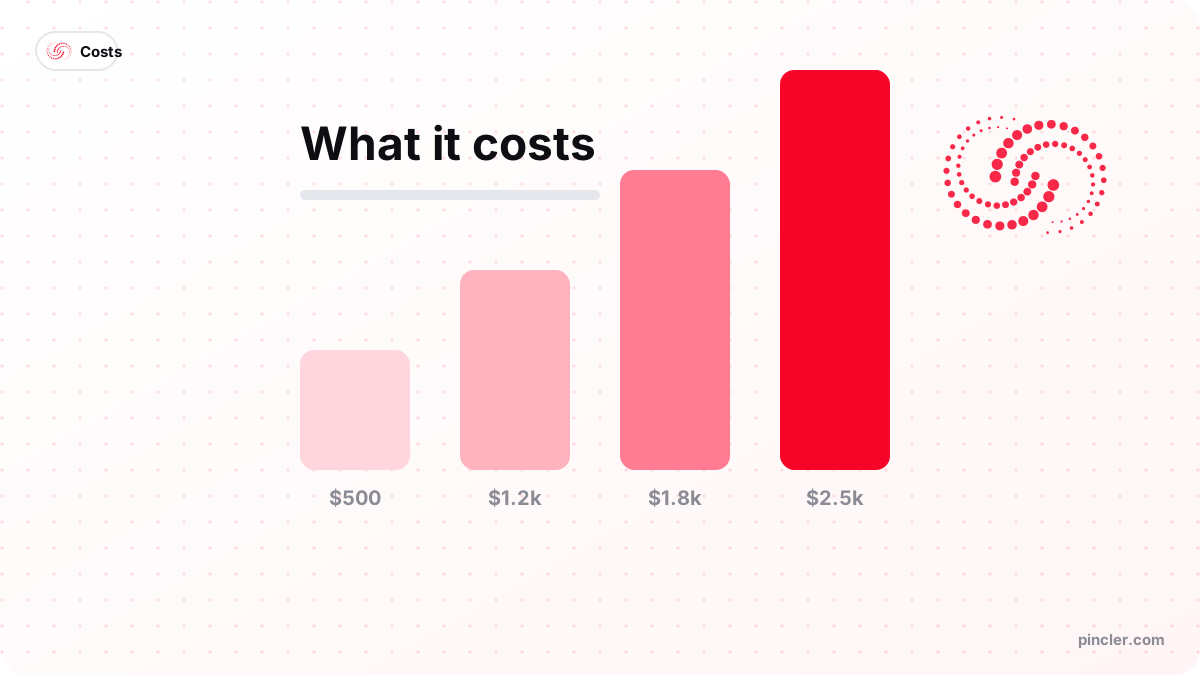
Quick answer
- Cost
- $1,800–$2,500 fixed for auth, Stripe billing, core feature and dashboard — AI-drafted, senior-reviewed and tested before release
- Timeline
- 18–28 days; web apps carry a median quoted delivery of 18 days across PINCLER's 79 catalogue builds
- Running costs
- Roughly $30–80/month at low volume, before payment fees
- Best for
- Founders who need a product that can take payment, without hiring a team
- Ownership
- Code in your GitHub, your cloud and Stripe accounts from day one
A SaaS MVP with authentication, subscription billing and a working dashboard costs $1,800–$2,500 at PINCLER, fixed price, and ships in 18 to 28 days — AI drafts the code and senior engineers review, test and harden it before release. That is the complete product: users sign up, pay through Stripe, use the core feature and manage their account, deployed to your own cloud with the code in your own GitHub.
If you have been quoted $30,000–$80,000 for the same scope, you have met the traditional agency cost base — a general market pattern, not a scam. Teams of five hand-writing code for three months genuinely cost that much. AI-assisted development is what moved the number, not corner-cutting. This is what fixed-price software development for startups looks like when the production method changes.
This guide walks through the saas mvp development cost tier by tier, shows where the money actually goes with the arithmetic in the open, and lists the features worth deliberately cutting from version one — because the cheapest feature is the one you discover nobody wanted before you build it.
How much does a SaaS MVP cost to build?
The number covers the full commercial loop: a marketing-ready front end, sign-up and login, subscription checkout, the core product feature working end to end, and a dashboard where users see their data and manage their plan. It is not a prototype or a clickable mock — it is software you can charge money for the day it ships.
The reason a band exists at all is that two founders asking for a SaaS MVP rarely want the same thing. One needs a single-plan tool with email login. Another wants team workspaces, three pricing tiers and a free trial. Both are MVPs; they sit at opposite ends of the band.
What the band never includes is ambiguity about the total. The quote you receive is the invoice you pay, and anything discovered mid-build is absorbed rather than billed. That single contractual detail changes founder behaviour more than any discount: when additions carry a written price instead of quietly inflating an hourly total, most of them turn out to be phase-two ideas after all.
What does each budget buy?
Here is how the band breaks down in practice. Note what moves the price between tiers: almost never the core feature itself, almost always the machinery around it — billing models, roles, onboarding.
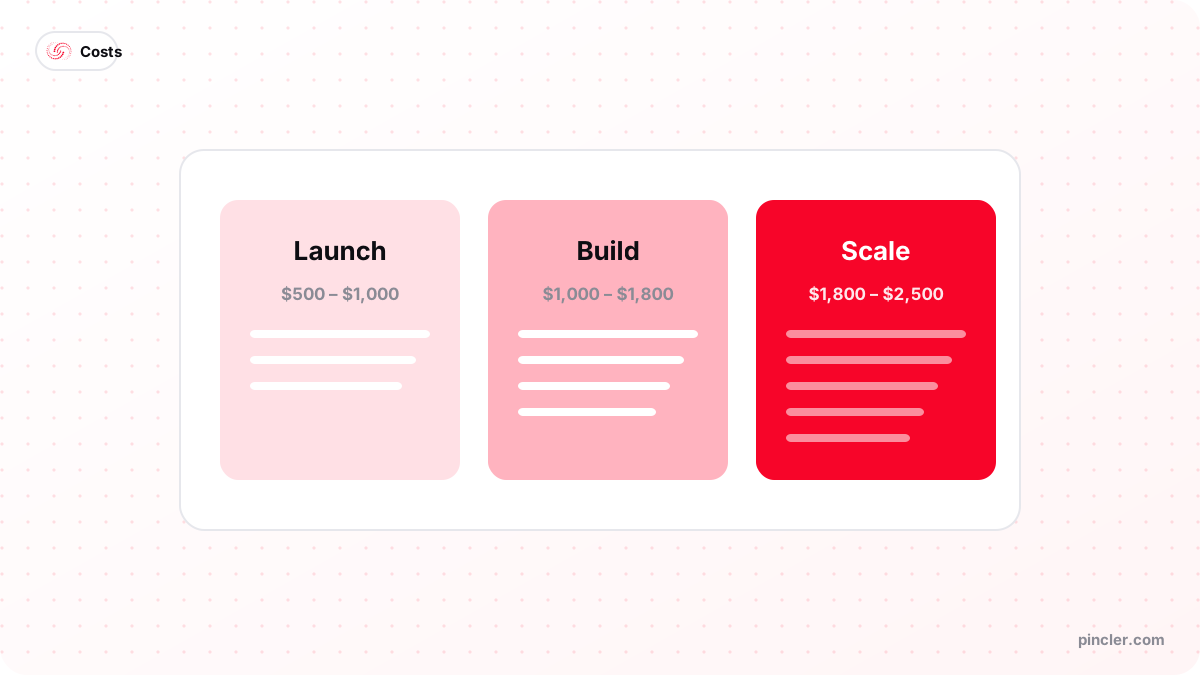
| Tier | Fixed price | What changes |
|---|---|---|
| Lean | $1,800–$2,000 | Email/password auth, single-plan Stripe checkout, one core feature, clean standard UI |
| Standard | $2,000–$2,300 | Multiple plans with trials, social login, transactional email, basic team accounts |
| Full | $2,300–$2,500 | Usage-based or seat-based billing, roles and permissions, admin panel, onboarding flow, analytics events |
PINCLER's perspective: what the project data says
Across the 79 builds in PINCLER's published fixed-price catalogue — all priced between $500 and $2,500 — web apps carry the highest advertised prices: a median of $1,925 and a median quoted delivery of 18 days across the eight published web app builds, on a range of $900 to $2,500. That squares with everything above: a SaaS product carries the most machinery of anything we build, so it sits at the top of the band. The overall catalogue median, for comparison, is $1,450 and 13 days.
Budget reach across the dataset is worth knowing before you scope: $1,000 covers the starting price of 55 of the 79 published builds, $1,500 covers 75, and $2,000 covers all 79. So if your SaaS idea can be phased — a landing test first, the billed product second — the early phases sit well below the MVP band. The full catalogue is published on our research page.
Why do agencies quote $30,000 or more for the same scope?
It helps to see why the market quotes what it does, with every input visible. A traditional MVP team of five — two developers, a designer, a project manager, a QA engineer — at a blended $60 an hour, working six weeks: 5 people times $60 times 40 hours times 6 weeks is $72,000. At a leaner $45 an hour and four weeks with three people, it is still $21,600. Nobody in that chain is overcharging; the model itself sets the floor.
AI-first development attacks the inputs rather than the margin. One senior engineer with AI tooling produces the boilerplate, tests and first-draft UI that used to occupy most of those hours — Stack Overflow's 2025 Developer Survey found 84 percent of developers now use or plan to use AI tools, and GitHub's randomised controlled study measured a 55.8 percent speed-up on a benchmark task for developers using its AI pair programmer. Compress the hours and the headcount, keep senior review on everything that ships, and $2,500 stops being a suspicious number and becomes an explicable one.
Where does the money actually go?
Founders consistently overestimate the cost of their core feature and underestimate everything around it. In a typical SaaS MVP, the feature you are excited about is perhaps a third of the work. The rest is the plumbing every SaaS needs and no user ever compliments.
Authentication sounds trivial and is not: password resets, email verification, session handling and account deletion all have to work flawlessly, because failures there are the ones that lose customers permanently. Billing is the same story multiplied — payment integration means webhooks from Stripe for failed payments, cancellations mid-cycle, plan changes. This plumbing is exactly where AI-assisted development saves the most, because it is well-trodden code that models generate reliably and senior engineers can review quickly.
What does the failure data say about scope?
The most expensive mistake in SaaS is not overpaying for a build; it is building the wrong thing thoroughly. CB Insights' well-known analysis of startup post-mortems found 42 percent of failed startups named no market need as a reason they died, with 29 percent running out of cash — and running out of cash is often the same problem wearing a different hat, because the cash went into building something the market had not asked for.
The Standish Group's CHAOS research points the same direction from the project-management side: small projects succeed at far higher rates than large ones. Both findings argue for the same behaviour — make version one the smallest thing that can take a payment, ship it in weeks (a fixed 14-day sprint exists for exactly that), and let real customers redesign version two. A $2,500 MVP that gets corrected by the market beats a $70,000 one that gets corrected by the liquidator.
What should you cut from version one?
Every feature you postpone is money saved twice — once in build cost, once in the redesign you avoid when real usage teaches you what the feature should have been. These are the cuts we recommend to almost every founder, and the reasoning is the same each time: none of them changes whether a stranger will pay for your core idea.
Does removing the feature stop you learning
whether strangers will pay?
    YES → build it in version one
    NO  → is a real customer demanding it in writing?
              YES → phase two, priced before it grows
NO → CUT IT- Native mobile apps — ship a responsive web app first; build mobile once retention data justifies it (mobile app costs are a separate decision with their own guide).
- SSO and SAML — enterprise buyers who need it will also need features you have not discovered yet. Sell to them in version two.
- A polished admin panel — for the first hundred customers, direct database access and Stripe's own dashboard are enough.
- Complex permissions — owner and member is plenty. Granular role matrices can wait.
- Every integration except one — pick the single integration your first customers cannot live without, usually Stripe or Slack, and stop there.
What does a SaaS MVP cost to run?
The build is a one-off; the running costs are forever, so they belong in any honest saas mvp development cost calculation. At low volume the stack is cheap: hosting on Vercel or a small VPS typically lands between $5 and $25 a month, transactional email a few dollars, and a managed Postgres from roughly $10. Stripe takes its percentage only when you earn.
That percentage is worth pricing precisely. Stripe's standard published rate for online card payments is 2.9 percent plus 30 cents per transaction at the time of writing. On 100 customers paying $29 a month, that is $2,900 of revenue, $84.10 in percentage fees plus $30 in fixed fees — about $114, or just under 4 percent of revenue. It scales with income, which is exactly the kind of cost you want.
If your product calls an LLM, add token costs — usually modest at MVP volume, but worth metering from day one so a single enthusiastic user cannot surprise you. All of these run in your own accounts, not ours, so there is no markup and no dependency.
A three-year cost model
Here is the full three-year picture for a lean SaaS MVP, with every line visible. It assumes the top of our band for the build and typical low-volume infrastructure prices; your own numbers will drift, but the shape holds. The striking thing is that three years of ownership costs less than one month of a traditional agency team.
| Item | Monthly | Three-year total |
|---|---|---|
| Build (phase one, fixed) | one-off | $2,500 |
| Hosting (Vercel or VPS) | $20 | $720 |
| Managed Postgres | $15 | $540 |
| Transactional email | $10 | $360 |
| Domain | about $1.25 | $45 |
| Total | — | $4,165 |
Who is this priced for, and who should wait?
This band is for founders who can already name the person who will pay and describe what that person does instead today. It suits a solo founder validating a first product, a service business productising something it currently delivers by hand, and an operator inside a larger company who needs a chargeable product without opening a headcount request. In each case the money buys an answer from the market, not a finished company.
It is the wrong purchase in three situations, and they are common enough to name plainly. If you cannot describe the workflow on one page, sell it manually first — a payment link, a shared spreadsheet and a fortnight of doing the work by hand teach you more than any build, and cost nothing. If a tool you already pay for runs the loop end to end, keep it; a subscription that fits beats a build you then have to maintain. And if what you actually need is a demand test, buy a landing page instead: it sits near the bottom of the custom software cost bands, not near the top.
The honest test is whether a paying stranger would change your next decision. If yes, build the smallest thing that can take their money. If no, the build is a way of postponing the conversation you should be having with customers.
- Good fit — a defined product, one customer type, and a price you can already say out loud.
- Poor fit — an idea whose scope changes each time you describe it, or one waiting on a partnership, a licence or a regulator.
- Wrong tool — an internal process problem, which a workflow automation solves for a fraction of an MVP budget.
- Not yet — anything you have not tried to sell by hand for at least a fortnight.
Which questions should you ask any SaaS MVP builder?
Quotes only become comparable when you interrogate them the same way, so put these five questions to every builder you talk to — including us. The answers separate a priced product from an open-ended engagement faster than any portfolio review, and a builder who hesitates on the ownership question is telling you something worth hearing before the deposit, not after.
- Is the price fixed in writing, and what happens if the build takes longer than planned?
- Whose GitHub, cloud and Stripe accounts does the product live in on day one?
- What exactly ships — list the screens, integrations and billing model, not adjectives?
- What does the warranty cover after launch, and for how long?
- What will version two cost, so the roadmap has numbers rather than hopes attached?
From quote to launch in under a month
The process is deliberately boring: a free 30-minute scoping call, a written fixed quote within one working day, then an 18–28 day build with a staging link you can watch progress on. You get the repo from day one, and the warranty covers bug fixes after launch.
If this matches what you are planning, the SaaS MVP use case page has the full deliverable list and current pricing — or book the call and bring your idea. The quote is free either way. Still deciding how much product to build first? The MVP development cost guide prices version one by build type.
Related PINCLER builds
Frequently asked
Can I really get subscription billing done properly for under $2,500?
Yes, because subscription billing is a solved problem. Stripe handles the hard parts — card storage, tax, dunning — and the integration work around it is well-understood code that AI tools draft quickly and senior engineers verify. The price would be very different if you were building a payments engine; you are not, and you should not.
How long does it take to build a SaaS MVP?
Eighteen to twenty-eight days in our model, and the data backs the band: across the 79 builds in PINCLER's published catalogue, web apps — the category a SaaS MVP belongs to — carry a median quoted delivery of 18 days. The variables that push towards four weeks are billing complexity, team accounts and onboarding flows, not the core feature.
What does a SaaS MVP cost to run each month?
Roughly $30–80 a month at low volume, before payment fees. Typical lines: hosting $5–25, managed database from $10, transactional email a few dollars, and Stripe's published 2.9 percent plus 30 cents per transaction at the time of writing — which only bites when revenue exists. LLM-powered features add token costs that should be metered from day one.
What stack will my SaaS MVP be built on, and do I own it?
Typically Next.js with TypeScript, Postgres, and Stripe, deployed on Vercel or your preferred cloud — a mainstream stack any developer can pick up later. You own all of it from day one: the GitHub repo is yours, the cloud account is yours, the database is yours. If we disappeared tomorrow, nothing about your product would stop working.
Do I need a technical co-founder to launch a SaaS product?
Not for version one. Fixed-price software development for startups exists precisely for this stage: you get the MVP built and owned outright, then decide from evidence whether the business justifies a full-time technical hire. What a co-founder gives you later is continuous product iteration; what a fixed-price build gives you now is a market answer for $2,500 or less — AI drafts it, senior engineers review and test it — without giving away equity to get it.
My idea needs more than an MVP. How does the fixed-price model handle that?
By phasing, and the ceiling holds in every phase because the method behind it never changes: AI drafts, senior engineers review and test, and a human owns the release. The MVP is phase one at $1,800–$2,500; later phases — mobile app, integrations, enterprise features — are each separately quoted at $2,500 or less and each ships something usable. You decide after every phase whether to continue, which keeps the incentive on us to make each release genuinely valuable.
What does it cost to add features after the MVP ships?
Each addition is quoted as its own fixed phase, almost always in the $500–$1,500 range, drafted with AI and reviewed by a senior engineer exactly as the original build was: a second integration, team workspaces, a customer-facing API, an onboarding flow. Because you own the repository and the infrastructure, you can also take any phase to a different developer and lose nothing. The healthy pattern we see is one feature phase per month or two, each justified by what real users did with the last one.
Sources
Want to build this?
PINCLER builds custom software, AI agents and GTM systems for a fixed price between $500 and $2,500, delivered in 3–30 days, with the code owned by you.
Keep reading
Related articles

Why Do Agencies Charge $30,000 for What We Build for $2,500?
Why is custom software so expensive at one supplier and not another? A transparent breakdown of agency cost structure, hour counts and the arithmetic behind a $2,500 build.
What Can You Actually Build for $2,000?
What can you build for $2000? One complete workflow, live in about two weeks — AI-drafted, senior-reviewed — with the exact scope and what gets deferred to phase two.
Can You Build a Custom CRM for Under $2,000?
The cheapest way to build a custom CRM, compared honestly: free tiers, spreadsheets, no-code, and an AI-drafted, senior-reviewed $1,200–$2,000 build. Which one you should pick.