MVP Development Cost in 2026: Real Numbers by Build Type
MVP development cost in 2026 by build type: $500 landing-page tests to $2,500 SaaS and mobile MVPs, AI-drafted and senior-reviewed — and what belongs in version one.
Quick answer
- Typical cost
- $500–$2,500 fixed — AI drafts it, senior engineers review and test it — depending on what you need to learn next
- Landing test
- $500–$1,000, live in 3–7 days — AI drafts the page, a senior engineer reviews and deploys it
- Fundable MVP
- $1,800–$2,500 with auth, payments and dashboard in 18–28 days, AI-drafted then hardened under senior review
- Catalogue median
- $1,450 advertised and 13 days quoted across PINCLER's published catalogue of 79 fixed-price builds, all AI-drafted with senior review
- Best for
- Buying answers one question at a time instead of one big build
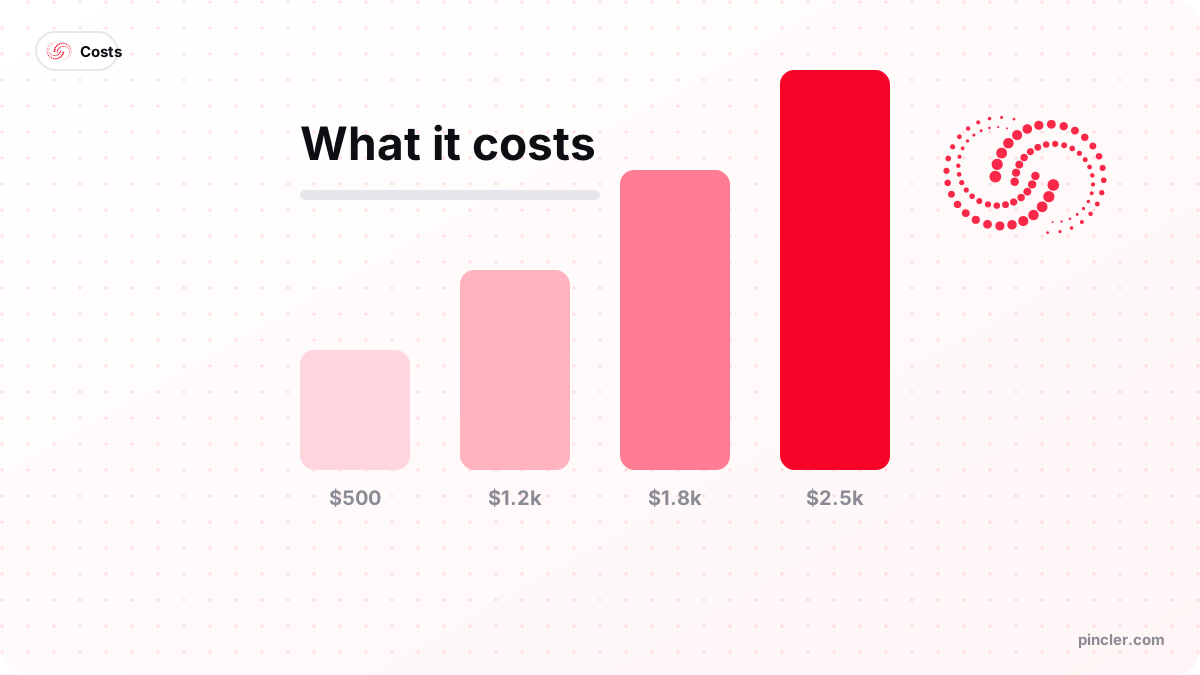
An MVP costs between $500 and $2,500 to build at PINCLER, fixed price — a landing-page demand test starts near $500, a working web tool lands around $1,200–$1,800, and a full SaaS or mobile MVP tops out at $2,500, shipping in 14 to 28 days. Those numbers come from one production method: AI writes the first draft, senior engineers review, test and harden it, and what ships is deployed software rather than a prototype.
The reason mvp development cost quotes vary so wildly across the market — from a few hundred dollars to $150,000 for the same one-line idea — is that MVP has stopped meaning anything specific. Some builders hear prototype, some hear version one of the full product, and the quotes differ by two orders of magnitude accordingly. Fixed-price software development for startups only works when the scope is pinned in writing first.
So this guide prices MVPs by what you are actually trying to learn, backs the bands with PINCLER's published catalogue of 79 fixed-price builds, and walks through the runway arithmetic that makes small builds a survival strategy rather than a compromise. That framing does more to control your budget than any negotiation, because the cheapest build is the one that answers your question and nothing more.
How much does an MVP cost to build?
Before pricing anything, answer one question: what is the next thing you need to learn? If it is whether the problem resonates, a landing page with a waitlist answers it for under $1,000, and building more would be spending money to avoid finding out. If it is whether people will pay, you need a working product with a payment flow, and that is a $1,800–$2,500 build.
Founders regularly buy the expensive answer to the cheap question. The reverse mistake exists too — endlessly testing landing pages when the market has already said yes — but it wastes months rather than money. Match the build to the question and the budget mostly takes care of itself.
One more definitional point saves arguments later: minimum viable does not mean minimum effort. Every tier in this guide ships as production software — deployed, tested, owned by you — because an MVP that crashes teaches you nothing except that crashes lose users. The minimum refers to scope, never to quality, and any builder who treats the two as interchangeable is quoting for a different product.
What do you need to learn next?
    "Will anyone care?" → landing test    $500–$1,000
    "Will anyone use it?" → working core  $1,200–$1,800
    "Will anyone pay?"  → fundable MVP    $1,800–$2,500
What are the three tiers of MVP?
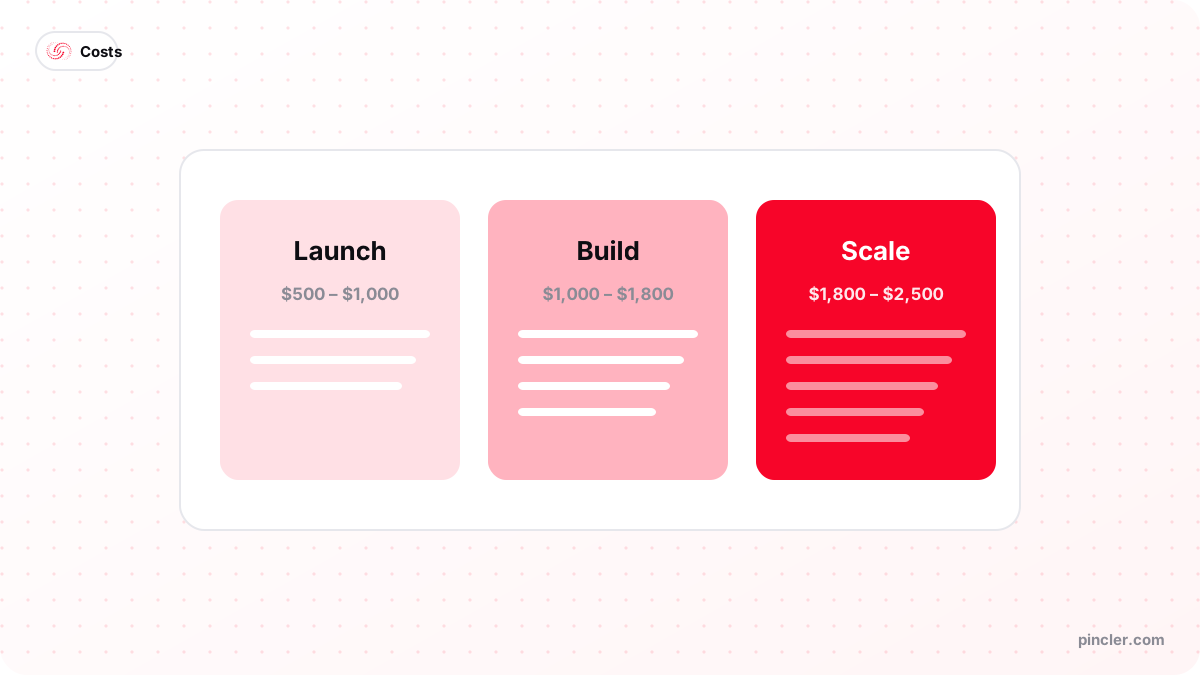
Across every project type, MVP budgets collapse into three tiers. The third column is the one to internalise: each step up buys evidence, not decoration.
| Tier | Typical fixed price | What changes |
|---|---|---|
| Smoke test | $500–$1,000 | Landing page, waitlist, analytics — proves demand exists before you build the product |
| Working core | $1,200–$1,800 | One user journey working end to end; manual steps allowed behind the scenes |
| Fundable MVP | $1,800–$2,500 | Auth, payments, dashboard and deploy pipeline — something you can charge for and demo to investors |
What does each build type cost?
Here are the fixed-price bands by the kind of product being tested. Every row ships as a real deployed product with the code in your GitHub and a bug-fix warranty — none of these are throwaway prototypes. The SaaS MVP cost guide breaks the largest tier down line by line.
| Build type | Fixed price | Timeline |
|---|---|---|
| Landing page + waitlist test | $500–$1,000 | 3–7 days |
| Workflow tool or internal MVP | $500–$1,500 | 4–10 days |
| Web app MVP (auth, billing, dashboard) | $1,800–$2,500 | 18–28 days |
| Cross-platform mobile MVP | $1,500–$2,500 | 18–28 days |
| MVP in 14 days (fixed-scope sprint) | $2,000–$2,500 | 14 days |
PINCLER's perspective: what 79 published builds are priced at
The bands above are not theoretical. Across the 79 builds in PINCLER's published fixed-price catalogue — every one priced between $500 and $2,500 — the median advertised price is $1,450 and the median quoted delivery 13 days. Thirty-three of the 79 are quoted within a fortnight, and all 79 within thirty days. The categories founders most often start with cluster at the affordable end: websites at a median $1,025 and 8 days, integrations at $1,200 and 10 days, web apps — the full SaaS-style builds — at $1,925 and 18 days.
Budget reach is the number to plan around: $500 covers the starting price of 11 of the 79 published builds, $1,000 covers 55, $1,500 covers 75, and $2,000 covers all of them. Put differently, a founder with $1,000 already has two thirds of the catalogue open, which changes what a first experiment needs to cost. The full catalogue is published on our research page.
What does the failure data say about building too much?
The research on why startups die is unusually consistent. CB Insights' analysis of startup post-mortems found 42 percent of failures cited no market need, with 29 percent running out of cash — and the second number is frequently a symptom of the first, because the cash went into building something nobody had asked for. The expensive risk in an MVP is not overpaying a builder; it is thoroughly building the wrong thing.
Project research points the same way. The Standish Group's CHAOS studies have consistently found small projects succeed at far higher rates than large ones, and McKinsey's joint study with Oxford of more than 5,400 IT projects found that every additional year of project duration adds around 15 percent to cost overruns on average. Duration is risk. A build measured in weeks keeps you inside the safe zone both datasets describe — and keeps the budget small enough that a wrong guess is a lesson rather than a funeral.
What belongs in version one?
Scope is where MVP budgets are won and lost, so here is the filter we apply in scoping calls: a feature belongs in version one only if removing it would stop you learning what you need to learn. Almost everything fails that test.
- In: the single core journey, a way to pay you, basic analytics so you can see behaviour rather than guess it.
- Out: native mobile apps (responsive web first), admin panels (use the database directly at first), granular roles, SSO, and every integration except the one your first users cannot live without.
- Out, emphatically: anything justified by the phrase while we are at it. That phrase is responsible for more blown MVP budgets than any hourly rate.
The runway arithmetic: experiments per dollar
Think of your budget as a number of experiments rather than a number of features. A founder with $20,000 who spends it on one $20,000 build gets exactly one guess at product-market fit. The same founder spending $2,000 per fixed-price experiment gets ten guesses — ten landing tests, working cores and pivots, each one informed by the last. Given the CB Insights failure numbers above, buying more guesses is the single most rational use of an early budget.
The traditional cost base makes that impossible, and the arithmetic shows why: a 5-person team at $60 an hour for six weeks is $72,000 before the first customer conversation. AI-first development inverts it — one senior engineer with AI tooling shipping in two to four weeks at $500–$2,500 per phase. The output is a real product either way; the difference is how many times you get to be wrong before you are right.
A worked example: phasing a marketplace idea
Take a familiar brief — a two-sided marketplace connecting, say, tutors and families — quoted at $60,000 or more by the traditional route because marketplaces carry search, profiles, messaging, payments and reviews. Phase it by questions instead. Phase one, about $800: a landing page with two waitlists, one per side, plus analytics — answering does either side care. Phase two, about $1,500: a curated directory where supply is listed and demand books through a form, with matching done manually behind the scenes — answering will demand pay. Phase three, at $2,500: accounts, payments and reviews for the loop the first two phases proved.
Total to a functioning, revenue-taking marketplace: roughly $4,800 across three decisions, each of which could have stopped the spend with most of the budget intact. The same journey as one up-front build costs twelve times more and answers the fatal question — does anyone want this — last instead of first. That inversion, not the hourly rate, is where the real saving lives.
When is the 14-day sprint the right buy?
If you have already validated demand — a waitlist, pre-orders, a pilot customer waiting — speed becomes worth paying for. The 14-day sprint is a fixed-scope, fixed-price build at $2,000–$2,500: scope locked on day one, daily progress you can watch on a staging link, a live product on day fourteen.
The honest trade-off is that mid-sprint scope changes are parked for phase two rather than absorbed. That constraint is precisely what makes the deadline real, and founders with a genuine launch date tend to find it clarifying rather than restrictive.
Who should build an MVP now, and when should you not?
Build now if a specific person has told you they would pay, and version one exists to find out whether they meant it. That is the whole test. Founders in that position get more from a small build than from another month of planning, because the market answers a question no amount of research will.
Do not build yet in three cases. If you cannot describe the workflow on a single page, run it manually for a month — the description is the expensive part, not the code. If an off-the-shelf tool already does the job, use it and put the budget into finding customers; plenty of ideas that later deserved software were validated on a spreadsheet and a form. And if the idea depends on something outside your control — a licence, a regulator, a partner's API — settle that before spending anything on a build.
One more case is worth naming because it is uncomfortable. If you want the MVP mainly to show investors something, be honest that the goal is a demo, not a product. Demos are cheaper and faster to make. Buying a production build to serve as a slide is one of the commonest ways a small budget gets spent twice.
- Right fit — a named buyer, a one-page workflow, and a question the build genuinely answers.
- Wait — an idea that changes shape each time you explain it out loud.
- Buy instead — a standard need already met by a subscription tool at a monthly price you can absorb.
- Different purchase — a fundraising demo, or an SEO landing page to test demand before any product exists.
How do MVP budgets blow up?
The classic failure is scope creep on an hourly contract: each while-we-are-at-it addition looks small, none has a price tag attached at the moment of decision, and the total arrives as a surprise. Fixed pricing fixes the incentive — additions get a written number before they get built, which turns most of them into phase-two items the moment the number is visible.
The second failure is building for imagined scale: microservices, Kubernetes and a data warehouse for a product with zero users. At MVP stage, boring architecture on a $20 server is a feature, not a shortcut — it can be rebuilt for scale after the market says yes, using revenue rather than runway. The third is skipping analytics to save a day. Without event tracking, the MVP produces anecdotes instead of answers, and you will pay for the missing instrumentation twice when the pivot decision arrives with no data under it.
From idea to fixed quote
Bring the one-line idea and the question you need answered next; a free 30-minute call is enough to identify the right build type, and a written fixed quote follows within one working day. Every quote sits inside the $500–$2,500 band, and bigger visions get phased so each phase ships something usable.
If you want numbers before talking to anyone, the SaaS MVP, mobile app MVP and 14-day sprint use case pages each list exact deliverables, prices and timelines — and the full 79-build catalogue behind this article's medians is on our research page.
Related PINCLER builds
Frequently asked
Why do MVP quotes range from $2,000 to $150,000 for the same idea?
Because builders price different interpretations of the word MVP, with different cost bases. A traditional agency staffs a team for months and prices accordingly; an AI-first studio ships the same version-one scope in weeks with senior engineers reviewing AI-drafted code. Fix the scope in writing first — then quotes become comparable, and the differences become visible as process overhead rather than mystery.
How long should an MVP take to build?
Two to four weeks for most build types — across the 79 builds in PINCLER's published catalogue the median quoted delivery is 13 days, with 33 builds quoted inside a fortnight. If a proposal quotes four to six months for version one, you are usually looking at either a padded scope or a padded process. The useful question is not how long a team needs, but what the earliest shippable slice of your idea is.
What is the cheapest way to validate a startup idea?
A landing-page demand test at $500–$1,000 — AI drafts the page and a senior engineer reviews and deploys it, which is why the number is small rather than the work being thin: a sharp value proposition, a waitlist form, basic analytics, and enough traffic to see whether strangers care. CB Insights' post-mortem research found 42 percent of failed startups cited no market need — this test attacks exactly that risk for the price of a laptop. If sign-ups come, the next phase at $1,800–$2,500 builds the product those sign-ups asked for, drafted with AI and reviewed by a senior engineer exactly as the test page was.
Is a $2,500 MVP good enough to show investors?
A fundable MVP at that price is a real deployed product — working auth, payments, core feature, clean interface — which is more than many pitch decks are backed by. Investors care about evidence of demand and pace of learning far more than code volume. What the budget deliberately excludes is scale infrastructure you do not need yet, which no early-stage investor expects to see.
Should I hire freelancers or a studio for my MVP?
Freelancers can be excellent value if you can judge code quality and manage the project yourself; the risk is the lottery — availability, consistency and what happens when they disappear mid-build. A fixed-price bespoke software development studio removes the schedule and budget risk by contract — AI drafts the code, a named senior engineer reviews and tests it, and the quote does not move — and the ownership test applies to both: repo in your GitHub, cloud in your name, so switching later costs nothing. Whichever route you choose, never pay hourly for an undefined scope.
What does it cost to keep an MVP running after launch?
Typically $10–50 a month at validation-stage volume: hosting on a small server or serverless plan, a managed database, transactional email, and a domain. Payment processing costs a percentage only when revenue exists, and LLM-powered features add metered token usage. There is no retainer in our model — the bug-fix warranty covers the launch period, and later improvements are optional fixed-price phases you commission when the data justifies them.
What happens to the MVP if my idea changes after launch?
That is the expected outcome, not a failure — MVPs exist to be corrected by contact with users. Because you own the repo, the cloud accounts and the database from day one, pivoting means a new phase quote — again $2,500 or less, because the same AI first draft and senior review applies — rather than a renegotiation or a rebuild from scratch. Well-structured version-one code survives most pivots largely intact.
Sources
- CB Insights, The Top Reasons Startups Fail
- The Standish Group, CHAOS research
- McKinsey & Company / University of Oxford, large IT project research
Want to build this?
PINCLER builds custom software, AI agents and GTM systems for a fixed price between $500 and $2,500, delivered in 3–30 days, with the code owned by you.
Keep reading
Related articles

Why Do Agencies Charge $30,000 for What We Build for $2,500?
Why is custom software so expensive at one supplier and not another? A transparent breakdown of agency cost structure, hour counts and the arithmetic behind a $2,500 build.
What Can You Actually Build for $2,000?
What can you build for $2000? One complete workflow, live in about two weeks — AI-drafted, senior-reviewed — with the exact scope and what gets deferred to phase two.
Can You Build a Custom CRM for Under $2,000?
The cheapest way to build a custom CRM, compared honestly: free tiers, spreadsheets, no-code, and an AI-drafted, senior-reviewed $1,200–$2,000 build. Which one you should pick.