How Much Does Custom Software Development Cost in 2026?
Custom software development cost in 2026: $500–$2,500 fixed price by project type, held there because AI drafts each build and senior engineers review, test and harden it.
Quick answer
- Typical cost
- $500–$2,500 fixed per phase — AI drafts, senior engineers review, test and harden — and no quote ever exceeds $2,500
- Catalogue median
- Median advertised price $1,450, median quoted delivery 13 days across PINCLER's published catalogue of 79 builds, each AI-drafted and senior-reviewed
- Timeline
- 3–30 days depending on project type
- Cheapest builds
- Landing pages and workflow automations from $500, AI-drafted and senior-reviewed like every other build
- Priciest category
- Web apps — median advertised price $1,925, quoted at 18 days; more moving parts to draft, review and harden than any other category
- Getting a quote
- Free 30-minute call, written fixed quote within one working day
Custom software development costs between US$500 and US$2,500 at PINCLER — fixed price, agreed in writing before work starts — because AI writes the first draft and senior engineers review, test and harden every build. Most projects take 3 to 30 days. That covers the software most small and mid-sized businesses actually need: a booking system, a customer portal, an internal dashboard, an AI chatbot, or a workflow automation that removes a day of manual work every week.
The wider market tells a different story. Traditional agencies commonly quote five and sometimes six figures for comparable scope, and the honest reason is not greed — it is headcount, process overhead and hand-written code. AI-assisted development changed that arithmetic, and pricing across the industry has not caught up everywhere yet.
This guide breaks down what you get at each budget level, which factors genuinely move the price up or down, and — just as important — when custom software is the wrong purchase and an off-the-shelf tool will serve you better. Unlike most cost articles, it is backed by a published dataset: PINCLER's complete fixed-price catalogue of 79 builds, with every median in this article computed from the prices advertised in it.
How much does custom software development cost?
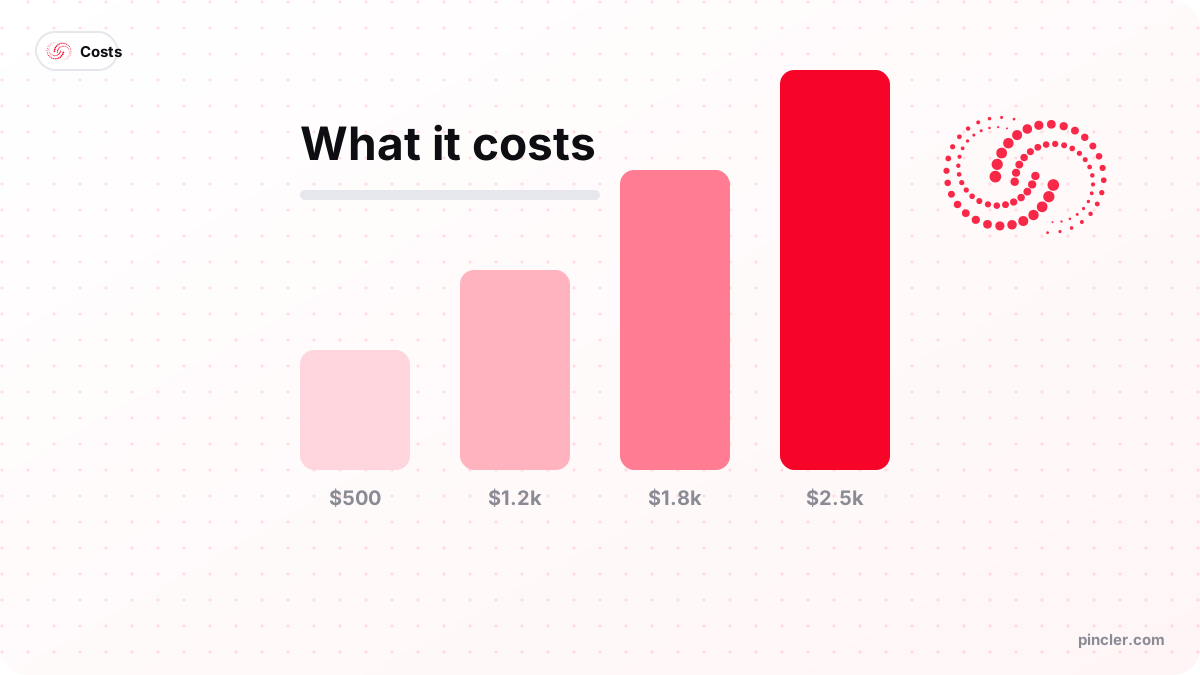
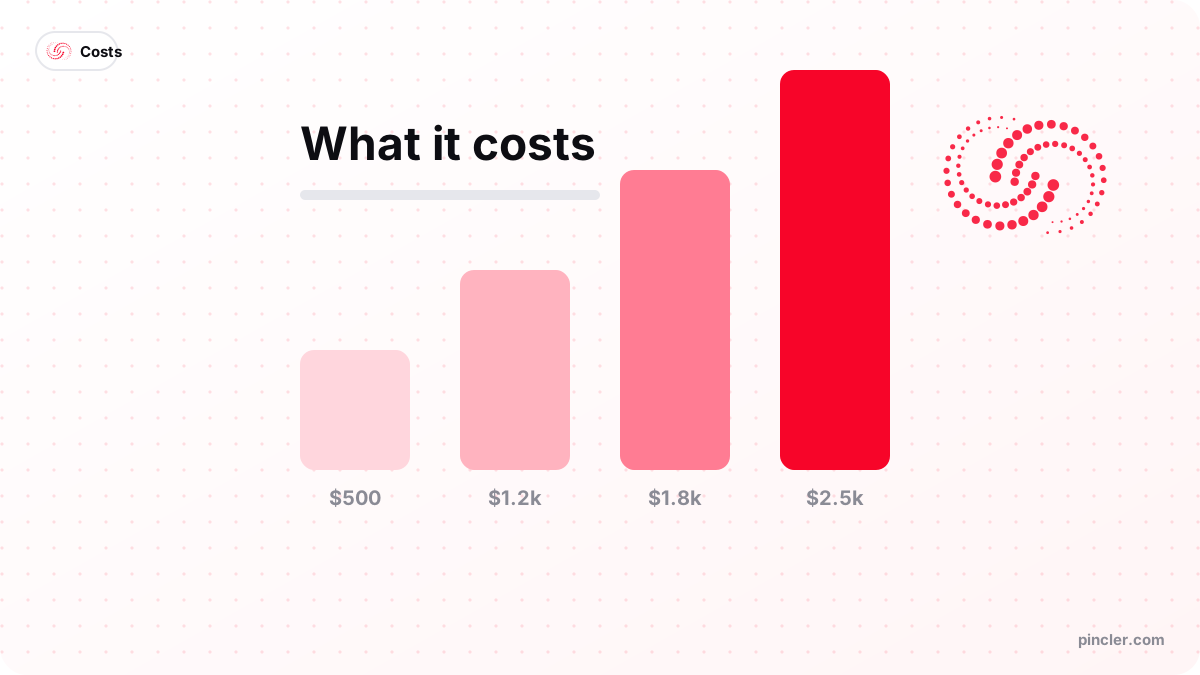
Every PINCLER project is priced between $500 and $2,500, and the number is fixed before a line of code is written. A landing page sits at the bottom of that band. A SaaS product with authentication, subscription billing and a dashboard sits at the top. Nothing goes above $2,500 — a bigger idea gets split into phases, and each phase ships something you can actually use. That is what affordable custom software development looks like when the production method changes: same deliverables, different cost base.
Fixed pricing matters more than the headline number. Hourly billing puts the risk of slow work on you; a fixed quote puts it on the builder, which is exactly where the incentive to work efficiently belongs. When comparing quotes, always ask what happens if the work takes longer than expected. If the answer is a bigger invoice, keep looking.
PINCLER's perspective: what 79 published catalogue builds are priced at
Generic cost bands are easy to publish and impossible to check, so here is a published price list instead. Across the 79 builds in PINCLER's fixed-price catalogue — every one priced between $500 and $2,500 — the median advertised price is $1,450 and the median quoted delivery 13 days. Four of the 79 are quoted at seven days or less, 33 at fourteen days or less, and all 79 within thirty. These are prices and delivery windows published in advance and committed to in writing, not figures reconstructed afterwards; the catalogue behind every number in this section is on our research page.
Budget reach is the more useful way to read it. A $500 budget covers the starting price of 11 of the 79 published builds; $1,000 covers 55; $1,500 covers 75; and $2,000 covers all 79. In plain terms: if you have a thousand dollars, more than two thirds of the catalogue is already open to you, and nothing in it requires more than $2,500.
The category medians below show how the price follows structural complexity. Websites and data work sit at the cheap, fast end; web apps and mobile apps — more screens, more state, more integration surface — sit at the top. No category median exceeds $1,925, which says something about how far the economics of building software have moved.
| Category | Median fixed price | Median delivery |
|---|---|---|
| Websites | $1,025 | 8 days |
| Integrations | $1,200 | 10 days |
| Chatbots | $1,375 | 13 days |
| AI Agents | $1,450 | 13 days |
| E-commerce | $1,525 | 13 days |
| Dashboards | $1,600 | 14 days |
| Internal Tools | $1,725 | 16 days |
| Mobile | $1,850 | 19 days |
| Web Apps | $1,925 | 18 days |
What does each budget get you?
The custom software development cost bands below are broad on purpose — the same budget buys different things depending on project type — but they hold across most of the work we quote. The pattern is consistent: the jump from tier to tier is rarely about prettier screens. It is about more moving parts talking to each other.
| Tier | Typical fixed price | What changes |
|---|---|---|
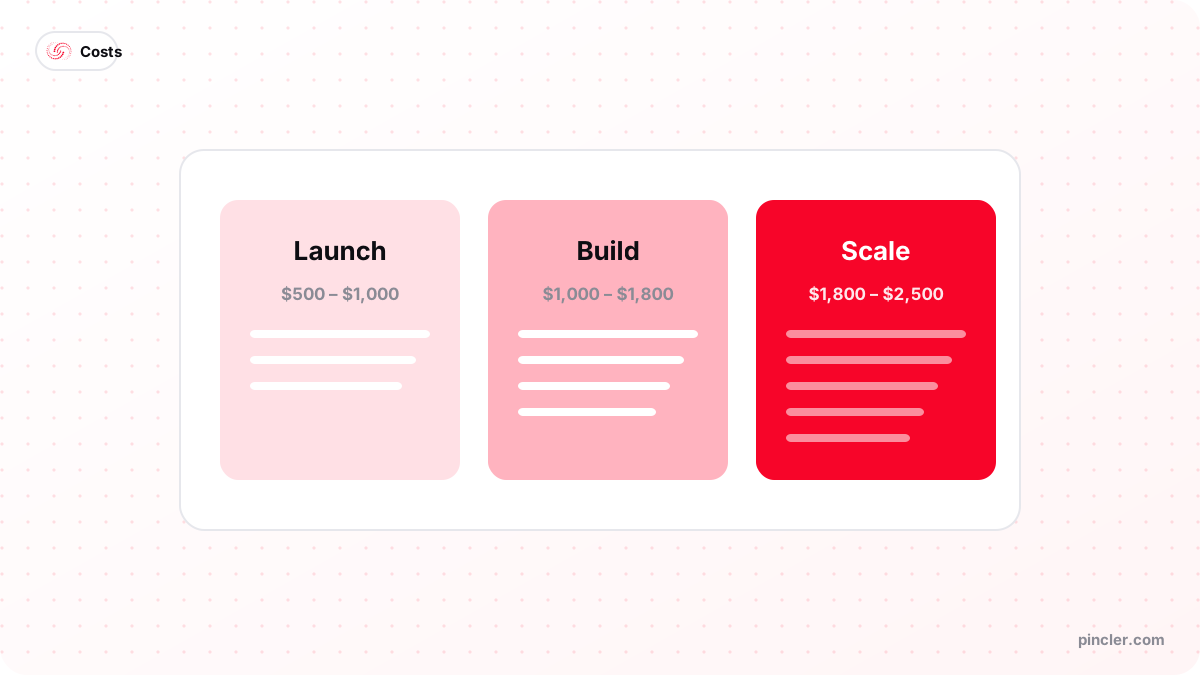
| Starter | $500–$1,000 | One core workflow, one user type, standard design system, deployed to your cloud |
| Standard | $1,000–$1,800 | Multiple screens and roles, one or two integrations (Stripe, HubSpot, WhatsApp), email notifications |
| Full build | $1,800–$2,500 | Auth, billing, admin panel, several integrations, analytics events and a CI/CD pipeline |
What do typical projects cost by type?
Averages hide more than they reveal, so here are the actual fixed-price bands we quote by category. Each is a real product, delivered to the client's own GitHub and cloud accounts, with a bug-fix warranty of 14 to 60 days depending on tier.
| Project type | Fixed price | Typical timeline |
|---|---|---|
| Landing page or SEO site | $500–$1,000 | 3–7 days |
| Workflow automation (n8n, Zapier, Make) | $500–$1,500 | 4–10 days |
| AI chatbot (website or WhatsApp) | $500–$2,000 | 5–18 days |
| Booking or appointment system | $900–$2,000 | 10–16 days |
| Internal dashboard or admin panel | $800–$2,200 | 8–18 days |
| Mobile app MVP (React Native / Flutter) | $1,500–$2,500 | 18–28 days |
| SaaS MVP with auth and billing | $1,800–$2,500 | 18–28 days |
What actually moves the price?
Clients often assume design is the expensive part. It almost never is — modern component libraries have made good-looking interfaces cheap. The real cost drivers are structural, and knowing them helps you write a brief that lands at the bottom of the band rather than the top.
- Integrations — every external system (CRM, payment gateway, ERP, WhatsApp Business API) adds authentication, error handling and testing time.
- User roles and permissions — an app where admins, staff and customers see different things costs meaningfully more than a single-role tool.
- Payments and billing — one-off Stripe checkout is simple; subscriptions, trials, proration and invoicing are not.
- Data migration — moving years of spreadsheet history into a new system is often more work than the system itself.
- Compliance surface — anything touching health, finance or personal data at scale needs stricter handling, and you should budget for it.
- Ambiguity — the vaguer the brief, the more the quote has to protect against surprises. A sharp one-page spec is worth real money.
What does the research say about software project budgets?
The strongest argument for small fixed-price phases does not come from any vendor. It comes from decades of research into why software projects overrun. McKinsey, working with the University of Oxford on a study of more than 5,400 IT projects, found that large IT projects run 45 percent over budget and 7 percent over time on average, while delivering 56 percent less value than predicted — and that around 17 percent go so badly they threaten the existence of the company itself.
The Standish Group's long-running CHAOS research tells the same story from a different angle: its recent figures classify roughly 31 percent of projects as successful, about half as challenged — late, over budget, or delivering less than planned — and around a fifth as outright failures. The same research consistently finds that small projects succeed at far higher rates than large ones.
Read together, the lesson is not that software is doomed; it is that project size is the risk. A $2,500 phase that ships in three weeks simply does not have room to fail the way an eighteen-month programme does. If it misses, you have lost weeks and a small sum, and the next phase gets corrected. That is risk management by structure rather than by process documents.
Why does AI-first development cost less?
The economics behind these numbers are simple. Tools such as Claude, GPT and Cursor now write boilerplate, tests and first-draft interfaces at a small fraction of the time a human takes. At PINCLER, senior engineers own the architecture, security, code review and release — the judgement calls — while AI handles the volume. The result is small-team output at a small-team price, without the quality dropping to freelancer-lottery levels.
This is not a niche production method any more. Stack Overflow's 2025 Developer Survey found 84 percent of developers use or plan to use AI tools in their work, up from 76 percent the year before, with 51 percent of professional developers using them daily. GitHub's own randomised controlled study found developers with an AI pair programmer completed a benchmark coding task 55.8 percent faster than those without. Across the 79 builds in PINCLER's published catalogue the pattern is visible in the tooling each build lists: GPT on 76 builds, Cursor on 75, and Claude Code on 63.
This is also why quotes vary so wildly across the market right now. A studio still hand-writing every line has a cost base that forces five-figure minimums for the same deliverable. Neither approach is dishonest; they are just different production methods, the way CNC machining and hand-carving coexist at very different prices.
A worked example: custom build versus SaaS subscription
Take a 12-person services firm paying $30 per user per month for a scheduling tool it only half-uses. That is $360 a month, $4,320 a year, and $12,960 over three years — every input in that sum visible and checkable. A custom booking system scoped to exactly what the team needs costs about $1,400 to build at our rates, plus hosting of roughly $15 a month: $1,400 plus $540, or $1,940 over the same three years.
The break-even arrives in around five and a half months ($1,940 divided by $360), and everything after that is saved cash. But run the honest version of the comparison too: the SaaS product includes support, a roadmap and years of edge-case fixes you would otherwise pay to rediscover. If the team genuinely uses most of the product, the subscription is the better buy. The arithmetic only turns decisively when you are paying per-seat prices for a fraction of the features, or when the workflow you actually run does not fit the tool you are renting. The full three-year version of this comparison has its own guide.
When should you not build custom software?
An honest costing guide has to include this: sometimes the right custom software development cost is zero. If Calendly covers your scheduling, Shopify covers your store, or HubSpot's free tier covers your CRM, buy the tool and spend your budget elsewhere. Off-the-shelf software wins whenever your process is standard, because you inherit years of edge-case fixes for a monthly fee.
Custom code earns its keep in the gaps — when you need three tools glued together, when a SaaS product forces a workflow your team hates, or when per-seat pricing across a growing team starts to exceed what a one-off build would cost, which is the comparison how much it costs to build a CRM runs seat by seat. Run the three-year arithmetic before deciding; it is usually decisive in one direction or the other.
There is a third answer besides buy and build: wait. If you cannot yet describe the workflow you want on one page, the cheapest next step is to run the process manually for another month and write down what actually happens. A build commissioned from a vague brief pays for that vagueness twice — once in the quote, once in the rework.
Does an off-the-shelf tool cover ~90% of the workflow?
    YES → BUY IT (usually $30–100/month)
    NO  → can you describe the workflow on one page?
              NO  → WAIT — run it manually for a month first
              YES → BUILD IT ($500–$2,500, phased)
How do you get a real number for your project?
Generic cost articles can only give you bands. A real number takes a short conversation about what you are building, what it must integrate with, and what version one can live without. We do that in a free 30-minute call and send a written fixed quote within one working day — no obligation, and the quote will never exceed $2,500 for a single phase.
If you would rather browse first, our use-case pages list fixed prices and timelines for more than seventy common builds, from booking systems to SaaS MVPs — and the research page shows the full 79-build catalogue behind this article. Find the build closest to your idea and you will have a working budget in about two minutes.
Related PINCLER builds
Frequently asked
Why is the ceiling $2,500 when agencies quote $50,000 for custom software?
Different production methods. AI-assisted development lets a small senior team ship in days what once took a delivery team months, and the price reflects that cost base. Larger agencies carry project managers, QA departments and office overhead into every quote. For enterprise systems with heavy compliance needs, that machinery can be worth paying for — for most small-business software, it is not.
What happens if my project is genuinely bigger than $2,500?
It gets split into phases, each fixed-price at $2,500 or less, and each shipping something usable on its own. The ceiling holds at any size because the production method does not change with scope: AI drafts the code, senior engineers review, test and harden it, and each phase starts from working software rather than a fresh estimate. Phase one might be the customer-facing product; phase two the admin panel; phase three the integrations. You can stop after any phase and own everything built so far — code in your GitHub, running on your cloud.
How long does custom software development take?
Three to thirty days in our model, and the median quoted delivery across the 79 builds in PINCLER's published catalogue is 13 days. Four of those builds are quoted within a week and 33 within a fortnight; the longer end of the range belongs to mobile apps and full SaaS builds. Traditional agency timelines of three to nine months for comparable scope reflect team coordination overhead more than engineering necessity.
Is a $2,500 fixed-price build lower quality than a $50,000 agency build?
Not inherently — the deliverable standard is the same: clean code in your repository, tests, and a working deployment. What you give up against a large custom software development company is headcount: no dedicated project manager, no weekly steering meetings, no big-team ceremony. What you keep is senior engineering review on everything that ships. For a defined small-business system, the ceremony rarely changes the software; it changes the invoice.
Are there ongoing costs after the software is delivered?
Yes, and you should budget for them honestly: hosting (often $5–25/month for small apps on Vercel or a modest VPS), any third-party API fees such as Stripe's transaction percentage or LLM usage, and a domain. There is no mandatory retainer — a bug-fix warranty of 14 to 60 days is included, and support beyond that is optional.
Where can I see real examples of what custom software costs?
The published dataset at /research/what-you-can-build lists all 79 fixed-price builds in PINCLER's catalogue, with a median advertised price of $1,450 and a median quoted delivery of 13 days. It is the same data this article's category table is computed from, and it is more useful than a generic calculator because every band assumes one production method: AI writes the first draft, senior engineers review, test and harden it, and the total stays inside $500–$2,500.
Sources
Want to build this?
PINCLER builds custom software, AI agents and GTM systems for a fixed price between $500 and $2,500, delivered in 3–30 days, with the code owned by you.
Keep reading
Related articles

Why Do Agencies Charge $30,000 for What We Build for $2,500?
Why is custom software so expensive at one supplier and not another? A transparent breakdown of agency cost structure, hour counts and the arithmetic behind a $2,500 build.
What Can You Actually Build for $2,000?
What can you build for $2000? One complete workflow, live in about two weeks — AI-drafted, senior-reviewed — with the exact scope and what gets deferred to phase two.
Can You Build a Custom CRM for Under $2,000?
The cheapest way to build a custom CRM, compared honestly: free tiers, spreadsheets, no-code, and an AI-drafted, senior-reviewed $1,200–$2,000 build. Which one you should pick.