How Much Does It Cost to Build a Custom CRM?
Custom CRM development cost in 2026: $1,200 to $2,500 fixed, because AI drafts the build and senior engineers review it. What each budget buys, and when HubSpot wins.
Quick answer
- Cost
- $1,200–$2,500 fixed for a small-team custom CRM, agreed in writing before work starts — AI drafts it, senior engineers review and test it
- Timeline
- 14–21 days; the median quoted delivery across PINCLER's 79 catalogue builds is 13 days
- Cheaper alternative
- HubSpot's free tier, or Sales Hub Starter at $15/seat/month at the time of writing
- Breakeven vs per-seat SaaS
- Roughly 3–4 seats on the three-year arithmetic in this guide
- Running costs
- $5–25 a month hosting; no per-seat fees, code and data in your own accounts
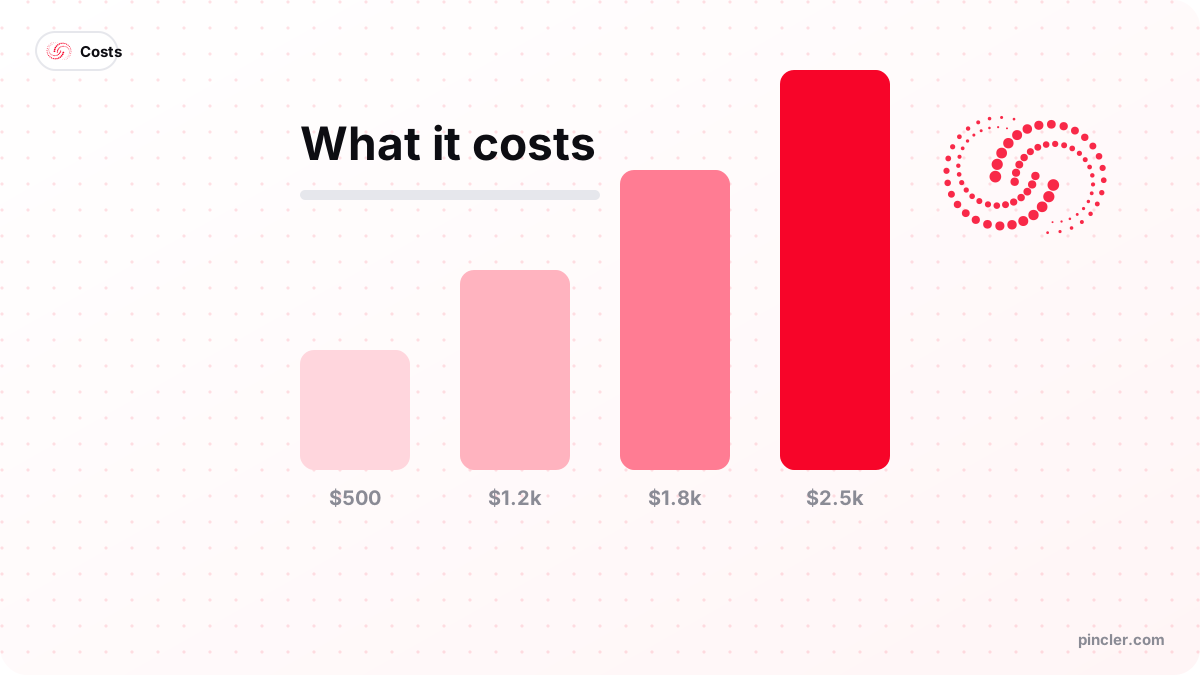
A custom CRM for a small team costs between $1,200 and $2,500 at PINCLER, fixed price, delivered in roughly two to three weeks — AI writes the first draft of the pipeline, forms and reporting, and senior engineers review, test and harden it before it holds a single customer record. That buys a pipeline shaped around how your business actually sells — your stages, your fields, your follow-up rules — rather than a generic sales tool you bend your process around.
The wider market quotes very different numbers. Traditional agencies commonly price a bespoke CRM in the tens of thousands, and the big platforms are not free either once you add seats: a mainstream CRM at $30–100 per user per month across a ten-person team is $3,600–12,000 a year, every year. That is a general market observation, but it is the arithmetic most buyers skip.
This guide breaks down custom CRM development cost band by band, shows the three-year arithmetic with every input on the table, brings in what our own published catalogue of 79 fixed-price builds says about CRM-adjacent work, and is honest about the cases where you should not build at all — because for a fair number of teams, a free HubSpot account is the right answer.
How much does a custom CRM cost to build?
Every CRM we build is priced between $1,200 and $2,500, agreed in writing before work starts. The bottom of the band is a clean single-pipeline tool: contacts, companies, deals, notes and a kanban view of your stages. The top of the band adds multiple user roles, reporting, automation rules and one or two integrations such as Stripe or a mail provider.
The number is fixed on purpose. CRM projects are notorious for scope drift — one more field here, one more automation there — and hourly billing turns that drift into an open-ended invoice, a mechanism we take apart in fixed price vs hourly billing. A fixed quote forces the scope conversation up front, where it is cheap, instead of at invoice time, where it is not.
We can hold that band because we are a custom software development company that works AI-first: models generate the boilerplate, tests and first-draft screens, and senior engineers spend their time on the data model, permissions and release. The hours that used to make CRMs expensive have mostly gone, and the price reflects that.
What does each CRM budget buy?
The bands below hold for most of the CRM work we quote. Notice what changes between tiers: it is almost never the interface. Modern component libraries make a clean, fast UI the cheap part. The cost lives in how many external systems the CRM talks to and how many kinds of user it has to serve differently.
Use the tiers as a scoping tool, not just a price list. If your brief mentions three integrations and four user roles, you are describing the top band; if it is one pipeline and a CSV import, you should be quoted at the bottom. A vendor who quotes top-band money for bottom-band scope is pricing their overhead, not your project.
| Budget | What you get | Typical timeline |
|---|---|---|
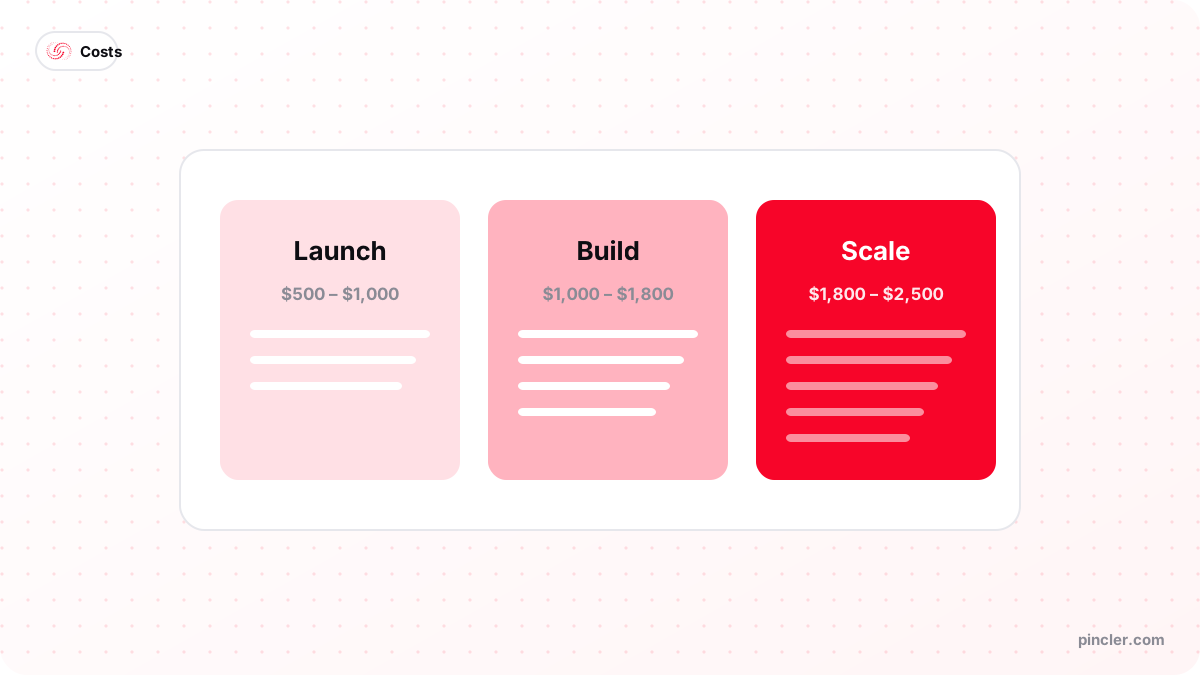
| $1,200–$1,600 | Single pipeline, contacts and deals, notes and tasks, one user role, CSV import | 14–16 days |
| $1,600–$2,000 | Multiple pipelines, email notifications, activity timeline, basic reporting, one integration | 16–19 days |
| $2,000–$2,500 | Roles and permissions, automation rules, dashboards, two or three integrations, full data migration | 18–21 days |
What do 79 published catalogue prices say a CRM should cost?
Bands are easier to trust when they come from a published price list rather than from assertion. Across the 79 builds in PINCLER's fixed-price catalogue — every one priced between $500 and $2,500 — the median advertised price is $1,450 and the median quoted delivery 13 days, with the full range running 3 to 30 days. The complete catalogue, build by build, is published in our research library.
CRM builds draw on the same engineering as several categories in that catalogue, and their medians bracket the CRM band neatly. A budget of $1,000 already reaches 55 of the 79 published builds; $1,500 reaches 75; and $2,000 covers all 79 — which is why our CRM quotes cluster where they do.
| Adjacent category (of 79 catalogue builds) | Median advertised price | Median quoted delivery |
|---|---|---|
| Integrations | $1,200 | 10 days |
| Dashboards | $1,600 | 14 days |
| Internal Tools | $1,725 | 16 days |
| Web Apps | $1,925 | 18 days |
When should you not build a custom CRM?
An honest pricing guide starts here. If your sales process is standard — leads come in, someone calls them, deals close or die — an off-the-shelf CRM's free or cheap tier will serve you well, and you inherit years of edge-case polish for nothing. HubSpot's free tier in particular covers a surprising amount for small teams, and its Sales Hub Starter is listed at $15 per seat per month on annual billing at the time of writing. Salesforce lists its small-business Starter Suite at $25 per user per month at the time of writing.
Custom earns its keep in three situations. First, when per-seat pricing across a growing team exceeds a one-off build — run the three-year total, not the monthly sticker. Second, when the tool forces a workflow your team quietly refuses to follow, because a CRM nobody updates is worth exactly nothing. Third, when your process has structure a generic tool cannot hold: unusual deal stages, industry-specific fields, or a pipeline that spans quoting, delivery and repeat business in one view.
Do you need a custom CRM at all?
  Standard pipeline, 1–3 seats      → use a free tier (HubSpot or similar)
  Free tier fits but team is growing → run the three-year seat maths
      3-year seat total > ~$3,000    → BUILD ($1,200–$2,500 fixed)
  Tool forces a workflow reps skip   → BUILD around your process
  Generic tool holds your process    → BUY, and revisit in a year
Who should build a custom CRM?
A custom CRM is for teams whose sales process does not look like anybody else's. If your pipeline stages are unusual, if the record you care about is a project or a property or a patient rather than a contact, or if half the team's day goes on working around fields the tool will not let them change, a build stops being an indulgence and starts being the cheaper option.
The second group is teams outgrowing per-seat pricing while using a fraction of the features. Ten seats on a mid-tier plan is a standing annual cost for capability nobody opens; a focused build carries a one-off price and a hosting bill in the tens of dollars a month. The three-year table in the next section is where that comparison gets settled.
Who it is not for: anyone whose process is standard. A free tier covers a surprising amount of pipeline management and a paid tier covers most of the rest. Three people, a straightforward pipeline and no unusual data model — keep the subscription and spend the budget where it changes an outcome.
- Good fit — an unusual pipeline, a non-standard core record, or fields the tool refuses to bend.
- Good fit — ten or more seats paying for features the team never opens.
- Poor fit — a standard pipeline and a small team, where a free tier genuinely covers the work.
- Poor fit — a sales process still being invented. Settle the process by hand first, then build to it.
Custom CRM or subscription: what does three years cost?
Here is the comparison with every input visible — the same method our custom software vs SaaS guide applies to the general case. A ten-person team on a $25-per-user plan pays 10 × $25 × 36 months = $9,000 over three years. On a $50-per-user tier — common once automation and reporting features unlock — the same team pays $18,000. Neither number includes paid add-ons, onboarding fees or the price rises that arrive at renewal.
The custom side: a $2,500 top-band build, plus hosting at roughly $15 a month (× 36 = $540), plus a realistic $600 reserve for occasional adaptive fixes over the period. Total: $3,640. The subscription route costs 2.5 to 5 times more over the horizon, and at the end of it you own nothing.
The breakeven falls out of the same numbers. Three years of a $25 seat costs $900, so a $3,040 build-plus-hosting total pays for itself at roughly 3.4 seats. Below three or four users, subscriptions genuinely win on cost. Above that, the argument for renting weakens every month — provided the custom tool actually fits how your team sells, which is the next section's point.
Why do CRM projects fail?
The uncomfortable research first: Forrester Research has suggested that close to half of CRM projects fail to deliver the expected benefits, and industry analyses consistently name poor user adoption — not technology — as the leading cause. Reps who do not trust the tool stop logging deals; managers then distrust the pipeline; the CRM becomes a reporting fiction maintained for meetings.
This is, counterintuitively, the strongest argument for small custom builds. Adoption fails when the tool demands work that produces nothing for the person doing the work. A CRM shaped around your actual process — your stages, your language, your two clicks instead of nine — removes most of the friction that kills adoption. The build is the cheap part; design it around the rep, not the report.
It also argues for starting small. A $1,400 single-pipeline tool that the whole team uses daily beats a $2,500 many-featured one that half the team avoids. Ship the core, watch real usage for a month, then add automation where people are already doing the manual version.
What actually moves custom CRM development cost?
Buyers tend to budget for screens. The real drivers are structural, and knowing them lets you write a brief that lands at the bottom of the band instead of the top.
- Integrations — every external system (email, Stripe, accounting, WhatsApp Business API) adds authentication, error handling and testing time; it is the same engineering as our third-party integration and data sync builds.
- Roles and permissions — a CRM where managers, reps and finance see different things costs meaningfully more than a single-role tool.
- Data migration — moving years of spreadsheet or legacy-CRM history in cleanly is often a third of the project on its own.
- Automation rules — 'when a deal moves to Won, generate an invoice and notify Slack' is easy once, but ten such rules need a proper rules engine.
- Reporting depth — a pipeline summary is cheap; cohort analysis and forecasting are not, and most small teams never look at them.
PINCLER's perspective: why the cost base moved
The reason a CRM that once cost $20,000 now costs $2,000 is not corner-cutting; it is a different production method. Stack Overflow's 2025 Developer Survey found 84% of developers use or plan to use AI tools in their work, with 51% of professional developers using them daily. The tools are mainstream, and studios built around them carry a fraction of the production hours.
The effect is measurable. GitHub's controlled experiment on AI pair programming — published as 'The Impact of AI on Developer Productivity' — found developers with an AI assistant completed a standard server-building task 55.8% faster than the control group. Across a whole project the compounding is larger, because boilerplate, tests and first-draft UI are precisely what CRMs are mostly made of.
What does not change is who owns the decisions. Across our own published catalogue of 79 builds, GPT is listed on 76 and Cursor on 75, but every architecture choice, security review and release is a senior engineer's responsibility. AI writes the first draft; humans own what ships.
What does a custom CRM cost to run?
A small custom CRM is cheap to run: hosting on Vercel or a modest VPS is typically $5–25 a month, plus a domain and whatever transactional email you send — the full post-launch picture is in our software maintenance cost guide. There are no per-seat fees, which is the entire point — the eleventh user costs you nothing.
Budget honestly for occasional maintenance too. APIs you integrate with change, and once or twice a year something will need a small fix. Our builds carry a 14–60 day bug-fix warranty by tier, and everything ships to your own GitHub and cloud accounts, so any developer can maintain it — you are not locked to us.
How do you get a real number for your CRM?
Bands are only bands. A real quote takes a short conversation about your pipeline stages, the systems the CRM must talk to, and how much history needs migrating. We do that in a free 30-minute call and send a written fixed quote within one working day, capped at $2,500 for a single phase.
If you would rather read first, the lightweight CRM for small teams use case lists the exact scope and fixed price band we deliver, and the full catalogue at /research/what-you-can-build shows what comparable builds are priced at — it is the fastest way to sanity-check your budget.
Related PINCLER builds
Frequently asked
Is a custom CRM really cheaper than Salesforce or HubSpot?
Over three years, often yes — for teams of five or more, per-seat fees typically total more than a one-off $1,200–$2,500 build, a price that holds because AI drafts the code and senior engineers review and test it, and that is before paid add-ons. Under three seats, or if a free tier covers your process, off-the-shelf usually wins. The deciding factor is rarely month one; it is the three-year total plus how much the forced workflow costs you in unlogged deals.
How long does a custom CRM take to build?
Fourteen to twenty-one days for the scopes described here, built AI-first with senior engineers owning architecture and review. For context, the median quoted delivery across PINCLER's 79 catalogue builds is 13 days. The single biggest schedule risk is not the code — it is deciding your pipeline stages and fields. Teams that arrive with a clear one-page process brief routinely land at the fast end of the range.
Can you migrate our existing spreadsheet or CRM data?
Yes, and you should insist on it being in the quote rather than a surprise later. Clean CSV exports migrate quickly; messy historical data with duplicates and inconsistent fields takes real cleanup work and can be a third of the project on its own. Share a sample export before the quote and the migration effort can be priced accurately up front.
How many seats before a custom CRM pays for itself?
Roughly three to four seats, on the arithmetic in this guide. Three years of one $25-per-user seat costs $900; an AI-drafted, senior-engineer-reviewed $2,500 build plus about $540 of hosting totals $3,040, so the crossover sits near 3.4 seats. Teams on pricier tiers, or ones paying for add-ons, cross over even earlier. Below that line, use the subscription and revisit when the team grows.
Do I need a big agency for this, or is affordable custom software development safe?
Affordable custom software development is safe when the process around it is disciplined: a written fixed quote, a scope document with named features, code delivered to your own GitHub, and a stated warranty. Price has stopped being a proxy for quality — AI-assisted studios have a structurally lower cost base, not a lower standard. Judge vendors on the sharpness of their questions and the precision of their paperwork, not the size of their invoice.
What happens to our CRM if we stop working with the developer?
Nothing, if the engagement was structured properly — that is the test to apply before signing. The code should live in your GitHub organisation, the database and hosting in your own cloud accounts, and the IP should be assigned to you on final payment. Any competent developer can then take over maintenance. If a vendor resists any of those conditions, the real price of the CRM is hidden in your future dependence on them.
Sources
- Forrester Research — CRM projects failing to deliver expected benefits
- HubSpot Sales Hub pricing
- Salesforce Starter Suite pricing
- Stack Overflow 2025 Developer Survey — AI
- Peng et al., The Impact of AI on Developer Productivity: Evidence from GitHub Copilot
Want to build this?
PINCLER builds custom software, AI agents and GTM systems for a fixed price between $500 and $2,500, delivered in 3–30 days, with the code owned by you.
Keep reading
Related articles

Why Do Agencies Charge $30,000 for What We Build for $2,500?
Why is custom software so expensive at one supplier and not another? A transparent breakdown of agency cost structure, hour counts and the arithmetic behind a $2,500 build.
What Can You Actually Build for $2,000?
What can you build for $2000? One complete workflow, live in about two weeks — AI-drafted, senior-reviewed — with the exact scope and what gets deferred to phase two.
Can You Build a Custom CRM for Under $2,000?
The cheapest way to build a custom CRM, compared honestly: free tiers, spreadsheets, no-code, and an AI-drafted, senior-reviewed $1,200–$2,000 build. Which one you should pick.