AI-Assisted MVP Development: Can You Really Build Faster?
How long to build an MVP with AI? Real timelines from a studio shipping in 3–30 days: what each stage takes, what AI compresses, and what still refuses to hurry.
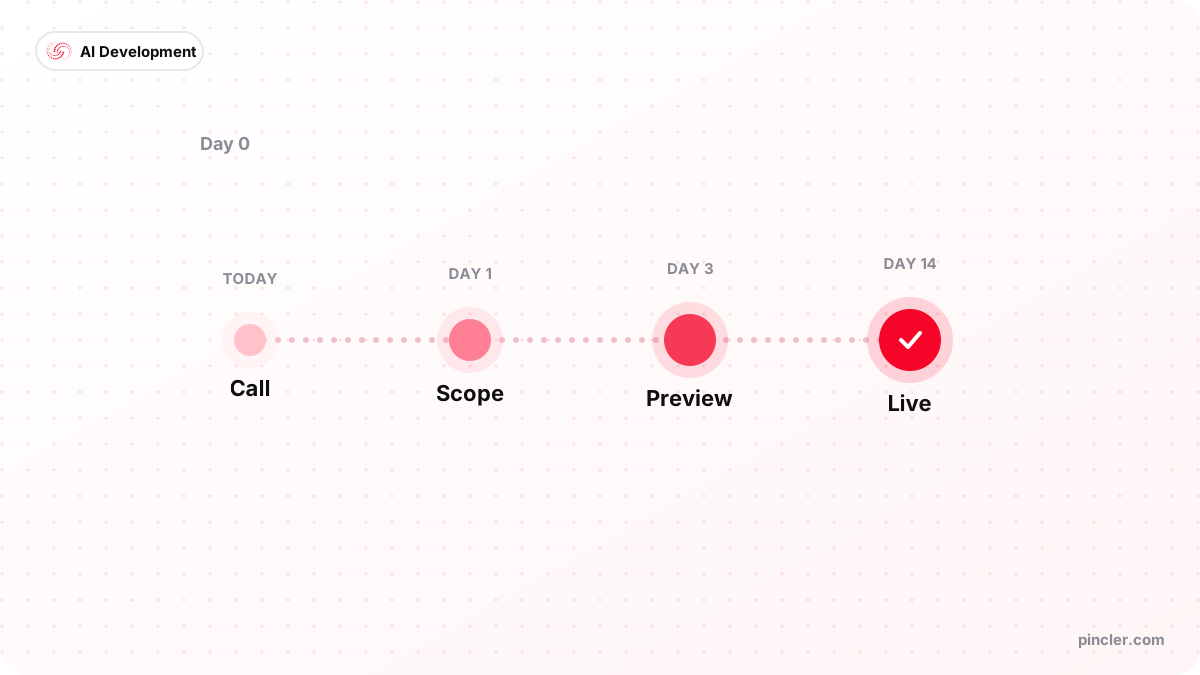
Quick answer
- Can you really build faster?
- Yes — 3 to 30 days for a working MVP, against the three to six months a traditional build of the same scope historically took.
- Median delivery
- 13 days across PINCLER's 79 published catalogue builds; 33 of them are quoted at 14 days or fewer.
- What compresses
- Scaffolding, CRUD, integrations, tests and first-draft UI — roughly five to ten times faster.
- What does not
- Your decisions, staging feedback rounds, and external queues such as app store review.
- Typical price
- Fixed between $500 and $2,500 — AI writes the first draft, senior engineers review and test it; the 79-build median is $1,450.
Yes — you really can build faster. A working MVP takes 3 to 30 days to build with AI-assisted development — most land between 10 and 28 — against the three to six months a traditional build of the same scope historically took. Those are the delivery windows we commit to in writing at PINCLER, so they are numbers we are contractually held to rather than marketing rounding.
The compression is real but uneven, and that unevenness is what this post is about. AI collapses the typing-heavy middle of a project — scaffolding, CRUD, integrations, tests — while leaving other stages almost untouched: your decisions, third-party approval queues, and the feedback loops where you look at staging and change your mind.
If you are planning to build an MVP with AI, the stage-by-stage numbers below will let you set a launch date you can actually hit — and show you the handful of things on your side of the table that most often decide whether a 14-day plan takes 14 days or 40. It doubles as a planning template for affordable custom software development generally: the stage arithmetic is the same whoever builds it.
Where does the time actually go?
The clean way to see AI's effect is to split an MVP into stages and ask what compresses. In a traditional build, writing and wiring code dominates the calendar, which is why AI's impact is so large — that is precisely the stage models attack. The stages on either side of it were never typing-bound, and they shrink far less.
MVP calendar
    decisions & spec   → human speed — yours to control
    build middle       → AI speed: scaffolding · CRUD · tests (5–10x faster)
    integrations       → part AI, part provider approval queues
    external queues    → fixed: app store review · payment verification
feedback loops → human speed — budget two rounds| Stage | Traditional build | AI-assisted build |
|---|---|---|
| Scope, spec and design decisions | 1–3 weeks | 1–3 days |
| Core build: scaffolding, features, CRUD, UI | 6–12 weeks | 3–10 days |
| Integrations (payments, email, WhatsApp, CRM) | 2–4 weeks | 2–5 days |
| Testing, hardening, review | 2–4 weeks | 2–4 days |
| Deployment and launch | 1–2 weeks | 1–2 days |
What does AI genuinely compress?
The five-to-ten-times compression in the build middle comes from work that is voluminous but well-trodden. Authentication flows, database schemas, admin screens, form validation, API endpoints, test suites, deployment configuration — models generate all of it in minutes, and a senior engineer's review of generated code is far faster than writing it by hand ever was.
First-draft UI deserves its own mention. Where a designer-developer loop once took days per screen, tools now produce credible, on-brand interfaces from a written description in an afternoon, leaving humans to refine rather than originate. The refinement still matters — default AI design has a recognisable sameness — but the calendar cost drops from weeks to days.
The compression is consistent with controlled research on well-specified work: a GitHub, Microsoft Research and MIT Sloan experiment measured developers completing a bounded build task 55.8% faster with AI assistance — 71 minutes against 161. MVP middles are made of exactly that kind of bounded, well-trodden task, which is why the effect compounds across a build in a way it does not on open-ended legacy work.
What still refuses to hurry?
Three categories of time are stubbornly incompressible, and honest planning builds around them rather than pretending. First, decisions: every day a question like 'should users pay before or after booking?' sits unanswered is a day added, and AI cannot answer it for you. Second, external queues: app store review takes the time it takes, WhatsApp Business API verification runs on its own clock, and payment providers verify businesses at their own pace.
Third, feedback loops. You will look at a working staging build and want changes — this is healthy and is the entire point of shipping an MVP quickly — but each loop costs a day or two, and a project that budgets zero of them is planning to disappoint someone. We assume two rounds on every build; projects that finish early usually finished deciding early.
Put numbers on the queues where numbers exist. Apple's published App Review figures state that on average 90% of submissions are reviewed within 24 hours at the time of writing — but first submissions from new accounts, sensitive categories and re-reviews stretch that in practice, so we plan mobile launches with a buffer measured in days. Payment-provider business verification is similarly outside your control, which is why it starts the day the project does.
What does industry data say about software schedules?
It is worth seeing the baseline the MVP approach exists to escape. The McKinsey–Oxford study of more than 5,400 IT projects found large projects run 45% over budget and 7% over time on average while delivering 56% less value than predicted — and that each additional year of duration adds roughly 15% more cost overrun. Duration itself is a risk factor, which is the strongest argument going for scopes measured in weeks.
The Standish Group's CHAOS research tells the same story from another angle: its long-running project data has reported roughly 31% of projects succeeding outright, around half challenged on budget, schedule or scope, and about one in five cancelled. The pattern behind both datasets is consistent — the bigger and longer the project, the worse the odds. An MVP is, structurally, a bet on staying small enough to stay in the successful third.
Why does speed matter more than polish at MVP stage?
CB Insights' analysis of startup post-mortems found the most-cited reason for failure was no market need, at around 42%, with running out of cash second at 29%. Both argue for the same discipline: find out whether anyone wants the thing before spending serious money building it. An MVP delivered in two weeks for under $2,500 is a market experiment; the same idea built over nine months at conventional agency rates is a mortgage on an unvalidated guess — which is why we recommend reading how to validate an MVP before commissioning anything.
This is the honest frame for software development for startups generally: the first version's job is to generate evidence, not admiration. Every week shaved off the timeline is a week of real user feedback bought at the cheapest point in the product's life — and if the evidence says pivot, a small fixed spend is a survivable tuition fee rather than a company-ending one.
Realistic timelines by build type
These are the delivery windows we quote and commit to for common MVP shapes, including review, hardening and deployment — not hackathon time to a demo. Your project will vary with integrations and scope, but these bands hold across most of the work we ship.
| Build type | Typical timeline | Fixed price band |
|---|---|---|
| Landing page or workflow automation | 3–10 days | $500–$1,500 |
| AI chatbot or booking system | 5–18 days | $500–$2,000 |
| Mobile app MVP (React Native / Flutter) | 18–28 days | $1,500–$2,500 |
| SaaS MVP with auth and billing | 18–28 days | $1,800–$2,500 |
| Two-sided marketplace MVP | 20–30 days | $1,800–$2,500 |
PINCLER's perspective: our published catalogue, in the open
The bands above are backed by delivery records rather than optimism. Across the 79 builds in PINCLER's published fixed-price catalogue — the full dataset is published on our research page — the median quoted delivery is 13 days, 4 builds are quoted at a week or less, 33 within 14 days, and all 79 within 30. Every one was fixed-price between $500 and $2,500, with the median at $1,450.
| Category | Median price | Median delivery |
|---|---|---|
| Websites | $1,025 | 8 days |
| Integrations | $1,200 | 10 days |
| Chatbots | $1,375 | 13 days |
| E-commerce | $1,525 | 13 days |
| Web apps | $1,925 | 18 days |
| Mobile apps | $1,850 | 19 days |
A worked example: the same MVP, costed two ways
Take a bookings-and-payments MVP. A conventional two-developer team at $50 an hour, full-time for six weeks, is 2 people × 40 hours × 6 weeks × $50 = $24,000 before project management — and six weeks is an optimistic conventional schedule for that scope. The same build as an AI-assisted fixed-price project is $1,800 and roughly 14 days, because the boilerplate majority of the code is generated and the paid human hours concentrate on architecture, review and the payment integration. A fuller budget breakdown by build type sits in our MVP development cost guide.
Add the founder's side of the ledger. If the idea earns, say, $2,000 a month once live, each month of delay costs that much in unearned revenue — so a build that starts returning evidence and income ten weeks earlier is worth several thousand dollars beyond the quote difference. Every input in both sums is visible; rerun them with your own rates and expected revenue before deciding how to build.
How do you keep your build on the fast path?
Across our projects, the difference between a build that hits its window and one that drifts is almost always on the client side of the table — which is good news, because it means it is controllable. The list below is what we ask of clients before a sprint starts; each item exists because its absence has cost someone a week.
- Name one decision-maker who can answer questions within a working day — committees are where fast builds go to stall.
- Prepare content and access up front: logo, copy, domain registrar login, and accounts for Stripe, WhatsApp or whatever you integrate.
- Start external approvals on day one — payment-provider verification and app store accounts can run parallel to the build instead of after it.
- Freeze scope for the sprint; park every new idea in a phase-two list rather than folding it in mid-build.
- Review staging within 24 hours each time it is updated — slow feedback is the quietest and commonest schedule killer.
When should you not compress the timeline?
Some builds should not chase the fast bands, and pretending otherwise creates exactly the overruns the industry data documents. Anything under formal regulatory approval, handling clinical or safety decisions, or dependent on integrations with slow-moving enterprise systems inherits external calendars no methodology compresses. Genuinely novel algorithmic work also resists generation — where the core is invention rather than assembly, there is no well-trodden pattern for a model to draw on.
For those, the honest play is still phased: ship the unregulated, well-trodden shell fast, and give the genuinely slow core its own realistic schedule. What you should refuse is the opposite pattern — a routine bookings app quoted at six months because the process, not the problem, is slow.
How do you plan your own launch date?
Work backwards from the table above and add your own constants: the days you will realistically need for decisions and feedback, plus any external queue your product touches. A SaaS MVP with auth and billing led by a decisive founder genuinely launches inside a month; the same build with a distracted one takes two, and no amount of AI changes which of those you get.
If you want a date with a price attached, our use-case pages list fixed timelines for over seventy build types — the MVP-in-14-days sprint shows exactly what a fixed two-week window contains. Or book a free 30-minute call, and you will have a written quote with a committed delivery window within one working day.
Related PINCLER builds
Frequently asked
Can you really build a production MVP in 14 days?
Yes, for well-scoped builds — it is a product we sell with the window written into the quote, and 33 of the 79 builds in our published catalogue are quoted at 14 days or fewer. The qualifier is 'well-scoped': one core workflow, a decisive client, and integrations without long external approval queues. Projects needing app store review or lengthy provider verification get honest longer windows instead.
Why do software projects run over budget so often?
The McKinsey–Oxford study of more than 5,400 IT projects found large efforts run 45% over budget and deliver 56% less value than predicted, with each extra year of duration adding around 15% more overrun; the Standish Group's CHAOS research has long reported only about a third of projects succeeding outright. The common driver is size and duration — which is exactly why small fixed scopes with committed delivery windows exist.
Does AI-assisted development make an MVP cheaper as well as faster?
Yes — the compression shows up in price as much as calendar, because AI writes the first draft and senior engineers spend their hours on review, testing and hardening rather than typing. Across PINCLER's catalogue of 79 fixed-price builds the median is $1,450, with web app MVPs at a median of $1,925 and mobile MVPs at $1,850 — every one between $500 and $2,500, never more, and 55 of the 79 start within a $1,000 budget. Conventional agency quotes for comparable scopes typically run to five figures, a general market observation you can verify with a quote request or two.
How long does app store review add to a mobile MVP timeline?
Plan for days, not hours. Apple's published App Review figures state that on average 90% of submissions are reviewed within 24 hours at the time of writing, but first submissions from new accounts and apps in sensitive categories regularly take longer, and a rejection restarts the clock. We open store accounts and submit early builds as soon as possible so the queue runs parallel to development rather than after it.
What is the most common reason an MVP timeline slips?
Slow decisions, by a wide margin. Unanswered questions, mid-sprint scope additions and staging feedback that takes a week instead of a day dwarf every technical cause we see. The fixes are unglamorous: one named decision-maker, a frozen sprint scope, and feedback within 24 hours.
Is an MVP built in days lower quality than one built in months?
Not inherently — the compression comes from generating well-trodden code faster, not from skipping review, testing or hardening, which stay in the schedule explicitly. What a fast MVP deliberately has less of is scope. Fewer features built properly beats many features built badly, and at MVP stage fewer features is usually a strategic advantage anyway.
Sources
Want to build this?
PINCLER builds custom software, AI agents and GTM systems for a fixed price between $500 and $2,500, delivered in 3–30 days, with the code owned by you.
Keep reading
Related articles
How to Build an MVP Without Being Technical
How to build an MVP without coding: the three realistic routes for non-technical founders, what each costs, where no-code breaks, and how AI-assisted builds compare.
How to Build an MVP Fast Without a Large Development Team
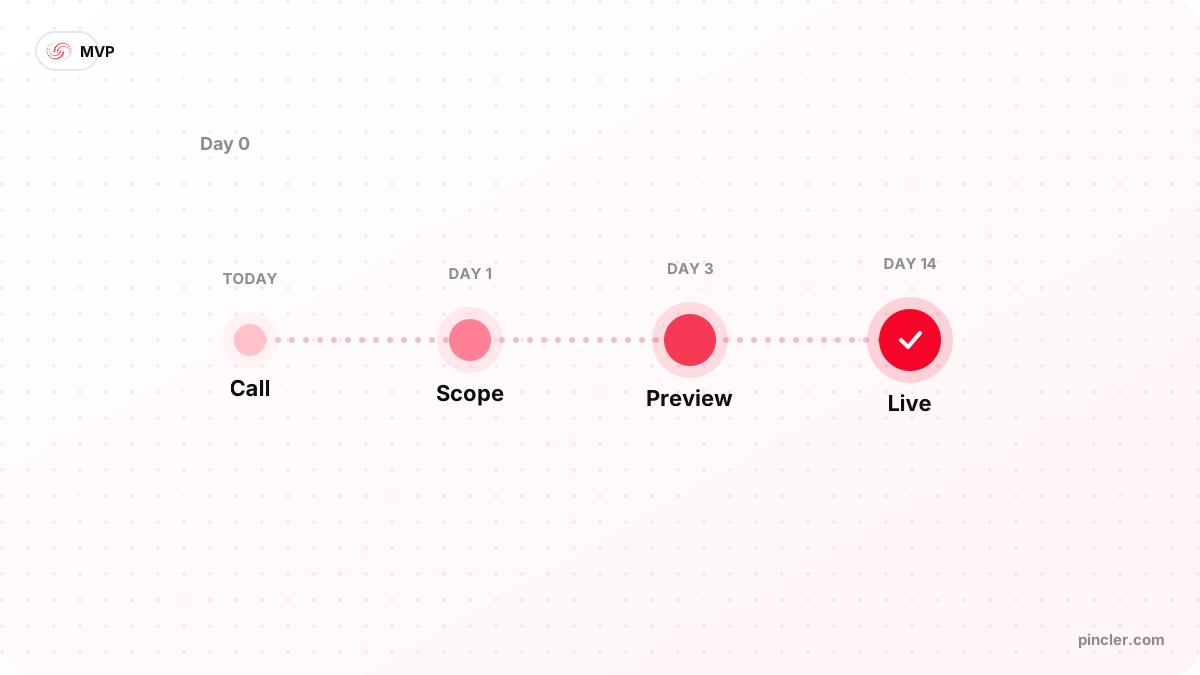
How to build an MVP fast: shrink the scope before growing the team. A day-by-day 14-day plan, the research on small-project success, and what AI-assisted delivery changes.
How to Make an MVP Profitable
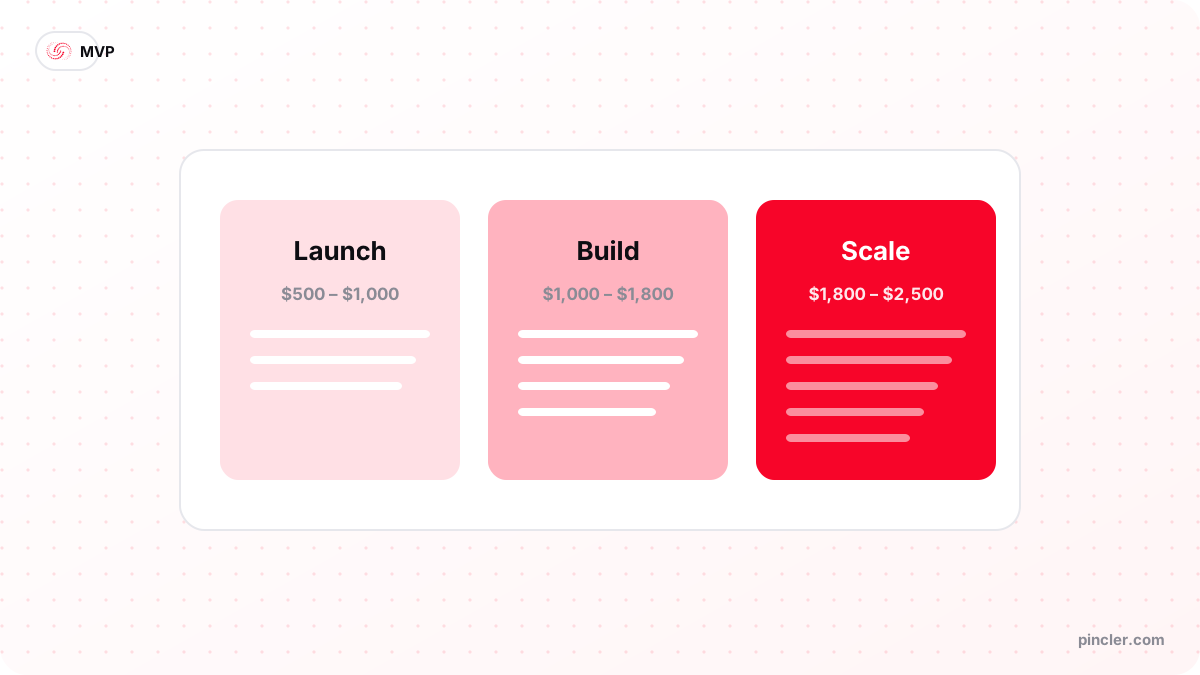
How to make an MVP profitable: charge from day one, keep the build small enough that a handful of customers covers it, and let retention decide what you add next.