How to Make an MVP Profitable
How to make an MVP profitable: charge from day one, keep the build small enough that a handful of customers covers it, and let retention decide what you add next.
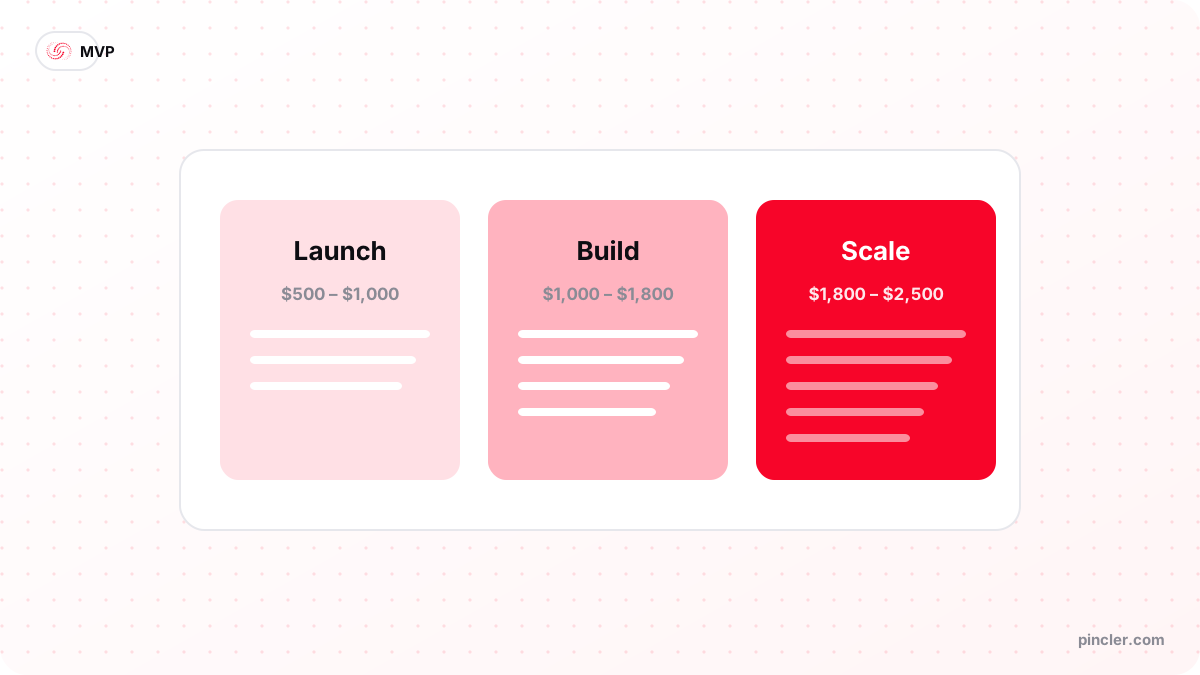
The honest answer to how to make an MVP profitable has three parts: charge real money from the first user, keep the total cost base small enough that a handful of customers covers it, and hold retention — not feature count — as the number that decides what you build next. Profitability at MVP stage is mostly a cost-side achievement: a product that cost $2,300 to build — AI writes the first draft, senior engineers review and harden it — and $15 a month to run breaks even on its first twenty $29-a-month customers within months.
That framing is unfashionable because the venture-scale playbook — free product, growth first, monetise later — dominates startup writing. It is the right playbook for a small minority of companies and a slow way to lose money for everyone else. If you are not raising venture capital, your MVP is not a growth experiment; it is a small business, and small businesses live on unit economics.
This guide works through those economics with every number visible: pricing, the cost base, retention, acquisition, and the specific mistakes that keep otherwise good MVPs permanently underwater.
Can an MVP Actually Be Profitable?
Yes — if the build cost is small, the running cost is smaller, and it charges money from launch. Profitability is a ratio, and most writing about MVP monetisation only ever discusses the revenue side. The cost side is where the game is decided: an MVP that cost $40,000 to build needs 115 customer-months at $29 just to recover the build with nothing left for acquisition, while the same product built for $2,300 needs 80 customer-months to cover an entire year of total costs.
This is the deepest change AI-assisted development made to startup economics. When a SaaS MVP with auth, billing and a dashboard costs $1,800–$2,500 fixed instead of a mid-five-figure sum, profitable-from-early stops being a fantasy and becomes an arithmetic exercise. The full price breakdown lives in our SaaS MVP development cost guide — here we take the cost as given and work the business model around it, number by number.
What Do the Unit Economics Need to Look Like?
Four numbers run the whole model: price, variable cost per customer, customer acquisition cost (CAC), and how many months a customer stays. Here is a fully worked example with every input visible. Product: a scheduling tool at $29 a month. Variable costs: payment fees at roughly 3% ($0.87) plus a share of hosting and email, call it $2.13 — leaving $26 a month of margin per customer. If the average customer stays 18 months, lifetime value is 18 × $26 = $468. If a customer costs $90 to acquire, the CAC pays back in $90 ÷ $26 ≈ 3.5 months and returns roughly 5× over the customer's life.
Now the whole-business version. Build cost $2,300 once; running costs $15 a month hosting plus $30 a month in tools. At 20 customers, revenue is 20 × $29 = $580 a month against roughly $63 of total monthly cost including fees — about $517 a month of contribution. The build cost is recovered in $2,300 ÷ $517 ≈ 4.5 months. Every number in that paragraph is checkable, which is exactly how you should model your own MVP before building it.
price − variable cost = margin per customer
margin × months retained = lifetime value (LTV)
LTV ÷ CAC ≥ 3  → the model works
payback (CAC ÷ margin) ≤ 6 months → cash flow survives
| Input | Example value | Where it comes from |
|---|---|---|
| Price | $29/month | Your pricing page — set it before you build |
| Margin per customer | $26/month | Price minus payment fees and per-customer running cost |
| CAC | $90 | Total sales and marketing spend ÷ new customers |
| Average lifetime | 18 months | 1 ÷ monthly churn rate, measured from cohorts |
| Payback period | ≈3.5 months | CAC ÷ monthly margin |
| Break-even on a $2,300 build | ≈20 customers | Build cost ÷ monthly contribution |
How Should You Price an MVP?
Charge from the first user, and charge more than feels comfortable. A price is the only validation signal that cannot be faked — sign-ups, waitlists and compliments are all free for the giver. The common fear is that an early product cannot justify money; in practice, the customers you most need to learn from are precisely the ones with a problem painful enough to pay for a rough solution. A free tier at MVP stage mostly recruits users whose problem is mild, and their feedback drags the roadmap towards comfort features.
Keep the structure trivially simple: one plan, one price, monthly, with an annual option at roughly two months' discount if you want cash up front. Anchor the number against the cost of the problem, not against your costs — a tool that saves a business five hours a week is cheap at $49 a month regardless of what it costs you to run. You can add tiers later, when real usage tells you where the value concentrates; a payments integration that handles one plan cleanly is a solved, inexpensive problem.
Raise the price with every few cohorts until resistance is audible. Underpricing is the most common and least visible profitability mistake — at $9 a month you need three times the customers, and therefore three times the acquisition spend, to earn what $29 delivers.
Annual prepay deserves a special mention for MVP cash flow. Ten customers taking a $290 annual plan put $2,900 in the bank in month one — more than the median published price across our catalogue — while the same ten on monthly billing deliver $290. Early on, when the build cost is the mountain, that timing difference is the difference between funding phase two from revenue and funding it from savings.
Why Does Retention Decide Profitability?
Because every retained month is margin without acquisition cost. The research here is old and unusually strong: Bain & Company's work, popularised through Harvard Business Review, found that a 5 percent improvement in customer retention increases profits by 25 to 95 percent, with the original Reichheld and Sasser study measuring gains across banking, insurance and services. In subscription software the mechanism is direct — halve your churn and you double average customer lifetime, which doubles LTV without touching price or CAC.
Practically, this means an MVP must be instrumented for retention from day one: cohort retention by sign-up month, activation rate (how many new users reach the core value once), and weekly return usage. Ship the minimal analytics events, then watch cohorts, not the total user count — totals grow even while the business quietly leaks. And when deciding what to build next, a feature that moves week-four retention nearly always beats a feature that attracts sign-ups.
The arithmetic makes the point sharper than the principle does. At 8 percent monthly churn, the average customer stays 1 ÷ 0.08 = 12.5 months, worth 12.5 × $26 = $325 of margin. Cut churn to 4 percent — usually through better onboarding and one genuinely sticky feature — and lifetime doubles to 25 months and $650. Same product, same price, same CAC; the business is twice as profitable because customers stopped leaving.
How Do You Get Customers Without Burning the Budget?
Match the channel to the price. At $29 a month you cannot afford salespeople, so the channel has to be search, communities, marketplaces or partnerships. A focused SEO landing page answering the exact question your buyer types is the cheapest compounding asset an MVP can own — slow to start, nearly free to run. Paid ads can work at this price only if the funnel converts well; at $2 a click and a 2 percent visit-to-customer rate, a customer costs $100, which against $26 monthly margin pays back in under four months — workable, but only just.
Higher prices buy more expensive channels. At $199 a month, outbound email, demos and hand-holding onboarding all become affordable, because one customer carries $180+ of monthly margin. This is why underpricing quietly breaks acquisition as well as revenue: the price you choose is also choosing your marketing options. Whatever the channel, track CAC honestly — total spend divided by customers, including your own time at a real hourly value.
Who Is This For — and When Should Profit Not Be the Goal?
Profit-first MVPs suit bootstrappers, agency owners productising a service, domain experts solving a problem they know intimately, and anyone whose plan B is 'keep running it as a small business'. For them, early profitability is not just survival — it is negotiating power with every future investor, partner or acquirer. A product covering its own costs can wait, and a founder who can wait negotiates everything from a stronger seat, including whether to raise money at all.
There are honest exceptions. If you are deliberately playing the venture game — a winner-takes-most market where growth speed is the strategy — early monetisation can be the wrong move, and you should optimise for validated usage instead. Two-sided marketplaces usually need a free side to solve the cold-start problem before anyone pays. And some developer tools grow through free adoption first. What is not an exception is 'we'll figure out monetisation later' with no funding plan: CB Insights' post-mortem analysis found 29 percent of failed startups ran out of cash, and 42 percent cited no market need — a price on the product from day one is your early-warning system for both. If demand is still unproven, start with validating the MVP rather than monetising it.
What Mistakes Keep MVPs Unprofitable?
The same patterns appear in most MVPs that make money but never make a profit. Every one of them is a decision, which means every one is reversible.
- 1. Launching free 'to get feedback' — free users give feedback about a free product, which is a different product from the paid one.
- 2. Underpricing — $9/month triples the customers and acquisition spend needed versus $29 for the same revenue.
- 3. Overbuilding — every month of extra build is cost with zero revenue; ship the one workflow people pay for.
- 4. Ignoring churn until it hurts — cohort retention is visible in month two if you instrument it; most founders look in month eight.
- 5. Buying growth before payback maths works — scaling a channel with a 14-month payback burns cash faster than no marketing at all.
- 6. Counting your own time at zero — a 'profitable' MVP consuming 30 unpaid founder-hours a week is a job, not yet a business.
PINCLER's Perspective: the Cost Base Is the Head Start
PINCLER is an AI-first custom software development studio, and the profitability angle on our data is simple: across the 79 catalogue builds PINCLER lists prices for, every build is fixed-price between $500 and $2,500 with a median of $1,450 and a quoted delivery of 13 days. At those numbers, the break-even arithmetic in this article stays small — a median build is covered by roughly 56 customer-months at $26 margin, which a modest product reaches in its first year. The whole dataset is public at our research page.
The phasing model matters as much as the price. Because anything larger than $2,500 becomes phases that each ship something usable, revenue can start after phase one while phases two and three are funded by customers instead of savings. That sequencing — earn, then extend — is, in our experience of affordable custom software development, the most reliable route to an MVP that pays for itself.
The Bottom Line
A profitable MVP is built backwards from four numbers — price, margin, CAC, retention — on a cost base small enough that twenty customers cover it. Charge from day one, instrument cohorts before launch, and let retention pick the roadmap rather than the loudest feature request. The step-by-step launch mechanics, from pre-launch checks to the first hundred users, are in our guide to launching a SaaS MVP.
If you want the cost side of your model pinned down before you commit, a free 30-minute call gets you a written fixed quote within one working day — a number you can drop straight into the break-even table above. If the payback maths does not work with a real quote in the model, you will have learnt that for free, before spending anything at all.
Related PINCLER builds
Frequently asked
Can an MVP be profitable from day one?
From its first months, yes — day one literally, rarely, because acquisition precedes revenue. The mechanism is a small cost base: a $2,300 build — AI-drafted, senior-engineer reviewed — with about $63 a month of running costs breaks even on roughly 20 customers at $29 a month, reachable within a few months in a niche with real demand. The founders who get there charge from launch and keep version one to a single workflow.
Should an MVP be free or paid?
Paid, in almost every case. A price is the one validation signal that cannot be faked, and paying customers give feedback about the product you are actually selling. Free tiers at MVP stage attract users with mild problems and skew the roadmap towards their comfort. The defensible exceptions: two-sided marketplaces solving cold-start, deliberate venture-scale land grabs, and developer tools that spread through free adoption.
What is a good price for an MVP?
Higher than feels comfortable, anchored to the cost of the problem rather than your costs. For business tools, $29–$99 a month is a sensible opening range; consumer products price lower and need volume economics. One plan, one price, monthly. Test upward with each few cohorts — underpricing is the least visible profitability mistake because revenue still arrives, just three times slower than the acquisition spend deserves.
How much does it cost to run an MVP after launch?
Typically $20–$80 a month for a small SaaS: hosting at $5–$25 on a platform such as Vercel or a modest VPS, a managed database, transactional email, and payment fees of around 3% of revenue. AI features add usage-based API costs worth watching. Keep total running costs under one customer's monthly revenue and the profitability arithmetic stays forgiving from the start.
How many customers does an MVP need to break even?
Divide total build cost by monthly contribution per customer. A median $1,450 build — the midpoint across the 79 builds in PINCLER's published fixed-price catalogue, all fixed-price under $2,500 through an ai development company model where AI writes the first draft and senior engineers review and harden it — breaks even on about 56 customer-months at $26 margin: twenty customers for three months, or ten for six. A $40,000 agency build needs roughly 27 times more. The build price largely decides how early profit is possible.
Which metric matters most for MVP profitability?
Retention, measured as cohort survival month by month. Bain research popularised through Harvard Business Review found a 5% retention improvement lifts profits by 25–95%, and in subscription software the mechanism is mechanical: halving churn doubles customer lifetime and therefore lifetime value, without touching price or acquisition cost. Watch activation and week-four return usage before you watch sign-up totals — totals flatter, cohorts tell the truth.
Sources
Want to build this?
PINCLER builds custom software, AI agents and GTM systems for a fixed price between $500 and $2,500, delivered in 3–30 days, with the code owned by you.
Keep reading
Related articles
How to Build an MVP Without Being Technical
How to build an MVP without coding: the three realistic routes for non-technical founders, what each costs, where no-code breaks, and how AI-assisted builds compare.
How to Build an MVP Fast Without a Large Development Team
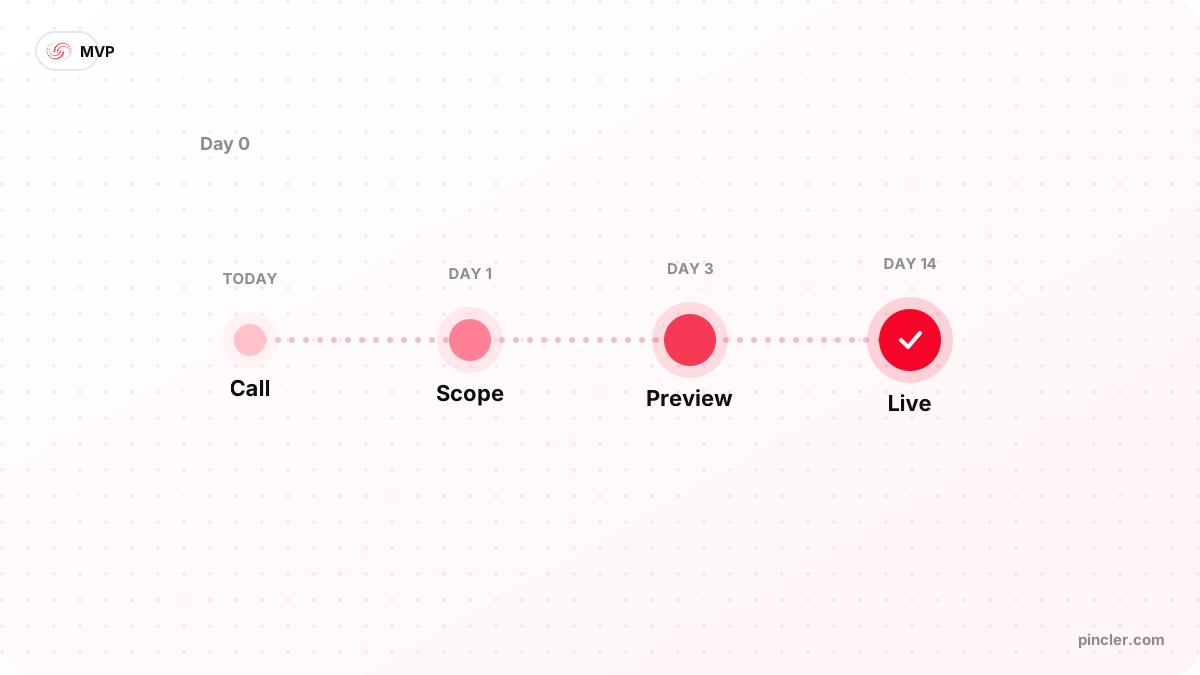
How to build an MVP fast: shrink the scope before growing the team. A day-by-day 14-day plan, the research on small-project success, and what AI-assisted delivery changes.
How to Validate an MVP Before Spending Money on Development
How to validate an MVP before paying for a build: customer interviews, landing page tests and pre-sales — with real conversion benchmarks and a spending ladder.