Clay for CGOs: Building a More Efficient GTM Engine
Clay for go-to-market leaders: how CGOs use one enrichment layer to cut tool spend, raise reply rates and make pipeline arithmetic visible across the funnel.
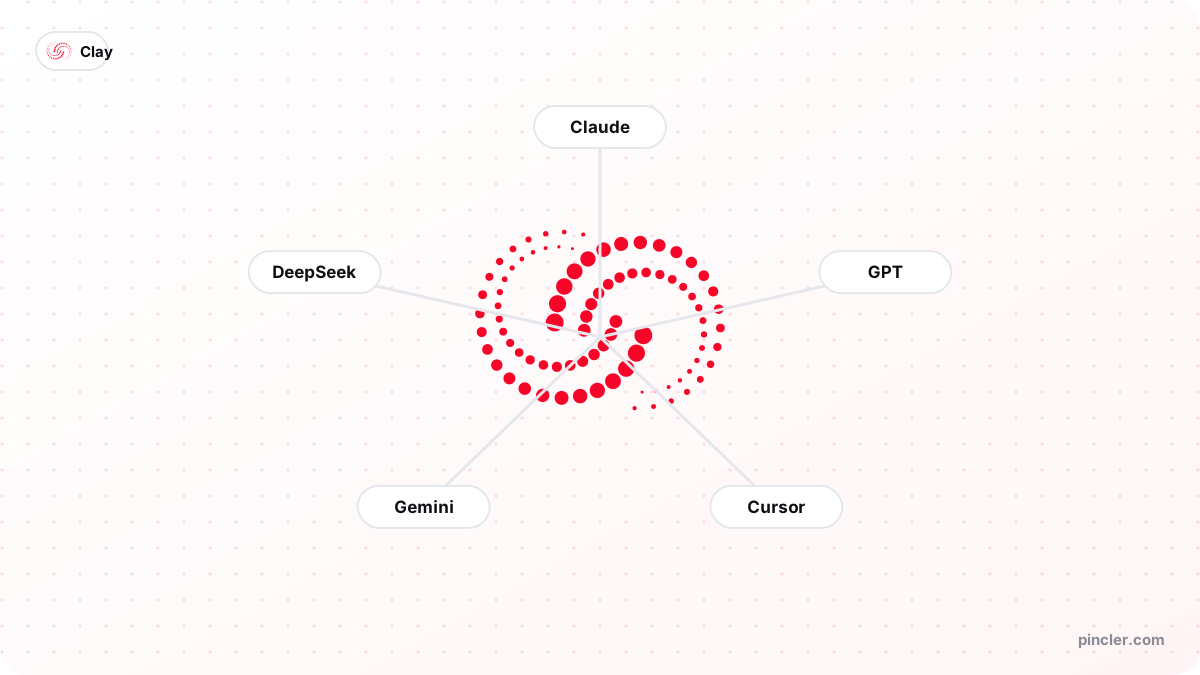
Quick answer
- What Clay is for a CGO
- A shared data layer feeding sales, marketing and RevOps from one enriched source of truth
- Cost
- Plans from $167/month per clay.com at the time of writing, plus a workflow owner; AI-drafted, senior-reviewed builds $700–$1,800 fixed in PINCLER's catalogue
- Rollout
- 90 days: one revenue-critical workflow, then shared segments, then the outcome feedback loop
- Efficiency target
- Fewer human hours per qualified account, and no budget spent on decayed records
For a chief growth officer, Clay is the connective tissue of the GTM engine: one data layer that feeds sales prospecting, marketing segmentation and RevOps hygiene from the same enriched tables, instead of three functions maintaining three contradictory versions of the truth. Used that way, Clay for go to market work is less a tool purchase than an architecture decision — and this guide treats it as one.
The efficiency problem it attacks is well documented. Salesforce's State of Sales research found reps spend under 30 per cent of their time actually selling, and HubSpot's database-decay research puts B2B contact data decay around 22.5 per cent a year. A GTM engine leaks in exactly those two places — human hours on data work, and budget spent contacting records that have gone stale.
Below: where the leaks are, what the Clay-centred architecture looks like, a 90-day rollout a CGO can actually sponsor, the economics with visible arithmetic, and the honest cases where this is the wrong project this quarter.
What Does Clay Actually Give a Growth Leader?
Three things no dashboard alone provides. First, a single defensible answer to which accounts are in our market and what do we know about them, queryable by every function. Second, a place where growth experiments become repeatable workflows — a play that worked once becomes a table that runs weekly. Third, visible unit economics: when list building, enrichment and personalisation run through one metered layer, cost per qualified account stops being a finance estimate and becomes a report.
That third point is the CGO-specific value. Growth leadership is arbitration — which motion gets the next dollar — and arbitration needs comparable numbers. A shared data layer produces them as a by-product of operating, which is why we wire Clay into the measurement stack in our pipeline and revenue analytics builds rather than treating reporting as a separate project.
Where Does a GTM Engine Actually Leak?
Two places, both measured. Human hours: Salesforce's State of Sales research found sales reps spend less than 30 per cent of their week actually selling, the remainder going to administration, research and data entry. Every hour of that overhead is fully loaded payroll producing no pipeline. Data quality: HubSpot's database-decay research puts B2B contact decay around 22.5 per cent a year, so an unrefreshed engine sends a meaningful share of its budget at people who have changed jobs or died as records.
There is a third leak that is behavioural rather than structural: volume worship. Hunter.io's State of Cold Email analysis of 31 million messages found sequences sent to 21–50 recipients earned 6.2 per cent replies against 2.4 per cent for 500-plus blasts. Engines optimised for sends-per-month are optimising the wrong numerator, and a CGO is the only person positioned to change that incentive.
What Does the Clay-Centred GTM Engine Look Like?
One enriched account universe in the middle, functions reading and writing around it. Sales consumes verified contacts and research context; marketing consumes segments and personalisation attributes; RevOps consumes hygiene — deduplication, field freshness, routing signals. Outcomes from every channel flow back into scoring, which is what makes it an engine rather than a pipeline.
The whole architecture fits in one diagram, and the arrows matter as much as the boxes — particularly the bottom one, where outcomes flow back into scoring, and the CRM write-back at the top, which stops the account universe and the system of record drifting apart:
The design rule that keeps this honest is single ownership of the middle. One operator — usually RevOps-shaped — owns the tables, the field mappings and the refresh schedule, and the functions consume through agreed contracts. Where that role does not exist yet, the pragmatic move is commissioning the initial build with a runbook, which is exactly the shape of our Clay workflow projects, then hiring or assigning into a working system.
            SIGNALS (hiring, funding, tech changes)
                     │
   SOURCES ──►  CLAY ACCOUNT UNIVERSE  ◄── CRM write-back
                (enrich · score · route)
           ┌─────────┼──────────┐
           ▼         ▼          ▼
        SALES     MARKETING   REVOPS
      (contacts,  (segments,  (hygiene,
       context)    attributes) routing)
           └─────────┴──────────┘
              outcomes feed scoring
How Should a CGO Phase the Rollout?
Ninety days, three phases, one sponsored metric per phase. The discipline that matters is refusing breadth: every failed enterprise Clay rollout we have examined tried to serve all three functions in month one and served none.
Phase one (days 1–30): stand up the single most revenue-critical workflow end to end — usually outbound list building with verification and CRM sync, the core of an outbound prospecting engine. Phase two (days 31–60): open the account universe to marketing as shared segments with agreed field ownership. Phase three (days 61–90): close the loop — replies, meetings and opportunity outcomes flow back into scoring, and the first cost-per-qualified-account report ships.
Each phase gets a kill criterion as well as a metric. If phase one cannot produce verified contacts at an acceptable unit cost after a tuned month, the later phases inherit a broken foundation and the right move is to stop and fix the ICP or the waterfall, not to press on to the diagram's full glory.
| Phase | Deliverable | Metric the CGO sponsors |
|---|---|---|
| Days 1–30 | One workflow live: source → enrich → verify → CRM | Verified contacts per week |
| Days 31–60 | Shared segments + field ownership contract | Segment-fed campaign lift |
| Days 61–90 | Outcome feedback into scoring + unit-cost report | Cost per qualified account |
What Are the Economics of the Clay-Centred Engine?
Run the arithmetic with visible inputs. Suppose a five-person GTM team (two reps, two marketers, one ops) collectively spends 20 hours a week on list building, research and data cleanup — a conservative reading of Salesforce's under-30-per-cent finding. At a blended $50 loaded hourly cost, that is $1,000 a week, roughly $48,000 a year of payroll doing data work. A Clay-centred engine that automates 60 per cent of it returns about $28,800 a year of capacity, against a Growth subscription near $5,352 annually at the time of writing per clay.com, plus a fixed build in our published $700–$1,800 range and an owner's weekly hour.
Two honesty notes on that model. Reclaimed hours only count if they are redeployed into selling or campaign work — capacity that evaporates into meetings saved nothing. And the model says nothing about pipeline lift from better targeting and personalisation, which in practice is often the larger effect but should be claimed only after your own baseline comparison, not from anyone's benchmark. The wider framework for this kind of reasoning is in our GTM engineering ROI guide.
Who Is This For — and When Should a CGO Wait?
This architecture fits companies with a working motion and visible friction: reps drowning in research, marketing and sales arguing about account truth, a CRM nobody trusts. It assumes product-market fit and at least a five-figure annual GTM budget worth optimising.
Wait if you are pre-motion — a startup still discovering its ICP should spend on customer conversations, not enrichment infrastructure, and might be better served by the focused scope of a GTM launch kit. Wait, too, if this quarter's constraint is product or capacity rather than pipeline; an engine that fills a calendar the team cannot serve manufactures churn. And skip the grand version entirely if no one will own the middle: architecture without an owner is diagram-ware.
A middle path exists for the undecided: run phase one only, as a bounded experiment with its own success bar, and defer the architecture decision until it reports. One workflow, one metric, one quarter — the cost of learning the answer is a fraction of the cost of guessing it, in either direction.
What Mistakes Do Growth Leaders Make Here?
Four, repeatedly, and all four are governance rather than tooling. They are also cheap to avoid if named at kickoff.
- 1. Serving three functions in month one — breadth before depth; the engine should earn trust one workflow at a time.
- 2. Leaving field ownership unresolved — sales ops and marketing discover conflicting overwrite rules in week six, and the sync gets switched off.
- 3. Sponsoring activity metrics — rows enriched and emails sent are operator numbers; the CGO's numbers are cost per qualified account and meetings per thousand sends.
- 4. Skipping the counterfactual — without a baseline quarter, the renewal debate becomes opinion against opinion.
PINCLER's Perspective: What the Published Catalogue Shows
PINCLER is an AI-first custom software development studio, and the GTM engineering category is one of our published specialisms: across the 79 catalogue builds PINCLER lists prices for, those builds carry a median fixed price of $1,600 and a median quoted delivery of 14 days, with a $700–$2,500 range — Clay workflows at the lighter end, full prospecting engines at the heavier. The dataset is published at our research page.
The pattern most relevant to a CGO: phased delivery beats platform projects. Our builds ship one working workflow inside a fortnight because that is the unit a growth team can absorb, measure and defend at the next budget review. The 90-day plan above is the same philosophy applied from the buyer's side — an engine assembled from proven fortnight-sized pieces, each cheaper than the payroll week it replaces.
The Bottom Line
A Clay-centred GTM engine is an architecture decision a CGO can sponsor in one quarter: one shared data layer, one owner, three phases, and unit economics visible by day ninety. The leaks it plugs — rep hours on data work, budget sent at decayed records, volume-worship sequencing — are all documented, and so is the arithmetic for fixing them.
If you want the first workflow live without consuming your team's sprint capacity, a fixed-price Clay build ships in 5–12 days at our published rates — and for the conceptual map behind all of this, the GTM engineering guide is the definitive companion read.
Related PINCLER builds
Frequently asked
What is Clay's role in a go-to-market stack?
Clay is the shared data layer: it builds and enriches the account universe, scores and routes records, and feeds sales (contacts and context), marketing (segments and personalisation attributes) and RevOps (hygiene and routing) from one source of truth. Sending, nurturing and closing stay in the sequencer, campaign tools and CRM around it.
How long does it take to stand up a Clay-centred GTM engine?
Ninety days to a working engine with visible unit economics: one revenue-critical workflow in the first month, shared segments and field-ownership contracts in the second, and the outcome feedback loop plus a cost-per-qualified-account report in the third. A single workflow alone is faster — 5 to 12 days across PINCLER's published fixed-price catalogue.
What should a CGO measure to judge the engine?
Two unit numbers and one quality number: cost per qualified account, meetings per thousand sends, and verification pass rate. Those separate engine performance from rep performance and survive budget scrutiny. Activity counts — rows enriched, emails sent — belong on the operator's dashboard, not the growth leader's, because they can rise while the engine gets worse.
Is Clay worth it for a startup still finding product-market fit?
Usually not yet. Pre-motion teams learn more per dollar from founder-led conversations than from enrichment infrastructure, and an engine that scales an unvalidated ICP just automates the wrong outreach. The free plan is fine for light research, but the architecture investment belongs after the motion works — custom application development pays best when it multiplies something proven.
What does professional help with a GTM engine cost?
Across the 79 builds in PINCLER's published fixed-price catalogue, GTM engineering builds run $700–$2,500 fixed with a $1,600 median and 14-day median quoted delivery — Clay workflow builds at $700–$1,800, full outbound engines towards the top. AI writes the first draft of each build and senior engineers review, test and harden it, which is what puts those numbers where they are. Fixed pricing matters here: engine work has fuzzy edges, and a written quote keeps the scope honest on both sides.
Sources
Want to build this?
PINCLER builds custom software, AI agents and GTM systems for a fixed price between $500 and $2,500, delivered in 3–30 days, with the code owned by you.
Keep reading
Related articles
Clay for Marketing and GTM Teams: The Definitive Guide
Clay for marketing and GTM teams, explained end to end: what Clay does, how waterfall enrichment works, what it costs, and the workflows worth building first.
How to Get Started With Clay for Your Sales Team
How to use Clay for sales: a practical first-week setup — workspace, first table, waterfall enrichment, CRM push — plus credit costs and the mistakes to avoid.
How to Get Started With Clay for a Marketing Team
How to use Clay for marketing: build ICP account lists, enrich and segment them, and feed personalised campaigns — a practical first-month plan for marketers.