GTM Engineering ROI: How Much Can Automation Save?
GTM engineering ROI with the arithmetic in the open: cost per meeting, hours saved and payback for a $1,200–$2,500 AI-drafted, senior-reviewed automation build.
Quick answer
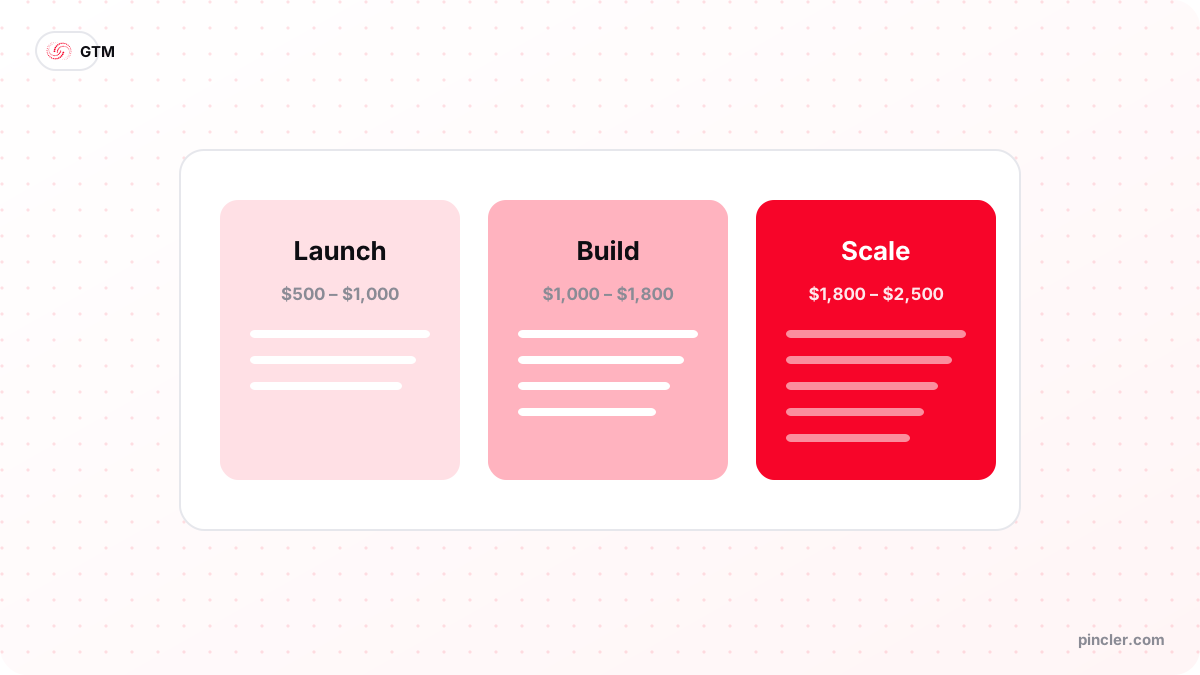
- Typical build cost
- $1,200–$2,500 fixed — AI drafts, senior engineers review and harden; GTM category median $1,600 across the 79 builds in the published catalogue
- Running cost
- Roughly $200–$600 a month in data, sending and API tools
- Payback period
- Under one month on reclaimed hours alone at conservative assumptions; 2–3 months on cautious ones
- Headline metric
- Cost per qualified meeting, tracked from the first send
- When ROI fails
- Unproven pitch, tiny addressable market, or nobody owning the system
GTM engineering ROI comes from three measurable places: hours of expensive selling time returned, cost per qualified meeting reduced, and revenue protected by speed. Run conservative numbers and the result is stark — a $1,600 median build, AI-drafted then hardened under senior engineering review, reclaims twelve rep-hours a week and pays for itself in under a month. Everything after that is compounding return.
The reason the returns are this steep is that the baseline is this poor. Salesforce's State of Sales research found reps spend less than 30 per cent of their time actually selling; the other 70 per cent of a $70,000–$90,000 on-target salary is spent on work a workflow does for cents. Automation ROI is mostly the arithmetic of buying back that gap.
This guide works every number in the open — assumptions labelled, inputs visible — across hours saved, cost per meeting and a three-year model, then covers the cases where the ROI genuinely is not there. For what to measure once a system is live, the companion piece on GTM engineering metrics goes deeper.
Where Does GTM Engineering ROI Actually Come From?
Three sources, in descending order of certainty. First, reclaimed time: automation absorbs sourcing, verification, drafting, follow-up and logging — hours currently paid for at selling-salary rates. Second, cheaper output: a system produces qualified meetings at a cost per meeting that headcount cannot match at small scale. Third, protected revenue: replies and enquiries answered in minutes instead of days convert at materially higher rates, per the response-time research covered below.
Hold the claims to the same standard you would hold a vendor to: every number that follows is either first-party data from PINCLER's published catalogue, a cited external study, or arithmetic with visible inputs you can re-run with your own figures.
GTM ENGINEERING ROI
  |- Reclaimed hours
  |    rep hours automated x loaded hourly rate
  |- Cheaper output
  |    (build/12 + tools + review time) / meetings
  |    vs manual: prospecting hours x rate / meetings
  |- Protected revenue
       faster response -> higher qualification rate
       (HBR: ~7x within the first hour)
What Are the Hours Worth? The Reclaimed-Time Calculation
Every input visible. A mid-band SDR or founder-seller at $80,000 on-target earnings, loaded to roughly $88,000 with employer costs, works about 2,080 hours a year: $42 an hour, call it $40 to stay conservative. Suppose automation absorbs twelve hours a week of sourcing, list-building, drafting, follow-up and CRM entry — a modest figure given Salesforce's research puts non-selling time above 70 per cent of the week.
Twelve hours at $40 is $480 a week, roughly $2,080 a month. Against that: a one-off build at the $1,600 GTM median plus, say, $400 a month in tools. Month one nets $80 positive on the cautious maths ($2,080 minus $1,600 minus $400); every subsequent month nets about $1,680. Over a year the reclaimed-time value alone is roughly $24,960 against total costs near $6,400 — close to a four-to-one return before counting a single extra meeting. Halve every assumption and the build still pays back inside a quarter.
What Does Cost per Qualified Meeting Look Like?
This is the metric worth putting on a wall, because it forces every cost into one honest number. Manual version: a rep spending fifteen prospecting hours a week at $40 an hour is $600 a week; if that books two qualified meetings, cost per meeting is $300. Engine version: amortise a $1,600 build over twelve months ($133 a month), add $400 in tools and three hours a week of human review ($520 a month) — about $1,053 a month; if the engine books twelve qualified meetings monthly, cost per meeting is $88.
Your inputs will differ, which is the point: the formula travels even where the assumptions do not. What tends to hold across implementations is the shape — the manual number scales linearly with hours, while the engine's fixed costs spread across whatever volume deliverability allows. Wire the calculation into a pipeline and revenue analytics dashboard so it updates itself; a metric computed quarterly in a spreadsheet changes no behaviour.
| Input | Manual prospecting | Engineered system |
|---|---|---|
| Monthly cost basis | 15 hrs/week x $40 = $2,600 | $133 build amortised + $400 tools + $520 review = $1,053 |
| Qualified meetings/month | 8 (2 per week) | 12 (assumption — insert yours) |
| Cost per qualified meeting | $325 | $88 |
| Scales by | Adding paid hours | Deliverability and data quality |
What Is Speed Worth in Revenue Terms?
The least visible return is the most researched. A Harvard Business Review study of 2,241 companies found firms attempting contact within an hour of an enquiry were nearly seven times as likely to qualify the lead as those waiting even sixty minutes — and the average firm took 42 hours, with 23 per cent never responding. Whatever your close rate and deal size, multiplying qualification odds on the same enquiry volume is revenue found down the back of the sofa.
Make it concrete with labelled assumptions: twenty inbound enquiries a month, a 10 per cent meeting rate under slow response, $5,000 average first-year contract value, 25 per cent close rate from meeting. Slow: two meetings, 0.5 closes, $2,500 a month. If instant routing lifts the meeting rate to just 20 per cent — far below what a seven-fold qualification multiplier implies — the same enquiries yield $5,000 a month. That $2,500 monthly difference, against a lead routing build at $900–$2,000 one-off, is the fastest payback in the whole discipline. McKinsey's estimate of a 3–5 per cent sales-productivity lift from generative AI is the same effect measured at macro scale.
When Is the ROI Not There?
Three situations reliably produce negative returns, and an honest ROI guide leads with them. Unproven offer: if manual selling has not shown the pitch converts, automation manufactures rejection at scale — the spend is real, the pipeline is not. Tiny market: with under a couple of hundred target accounts, the engine's fixed costs never spread; hand-research each account instead. No owner: a system nobody tunes drifts into contacting the wrong people well, and its costs quietly outlive its returns.
A fourth, subtler case: teams whose real constraint is closing, not volume. If meetings already happen and do not convert, the engine buys more of what is already failing — the comparison in GTM engineering versus hiring SDRs covers when the next dollar belongs in human skill instead. ROI discipline means running the cost-per-meeting arithmetic before the build, with your own honest inputs, and walking away when it does not clear.
What Does the Three-Year Picture Look Like?
Automation ROI compounds because the build cost is one-off while the returns recur. Three-year model with the assumptions above held flat and no expansion of the system: engine costs $1,600 once plus $400 a month ($14,400 over three years) — $16,000 total. Reclaimed time alone returns $2,080 a month — $74,880 over three years — a 4.7x multiple before meetings or speed effects. The equivalent headcount route: roughly $88,000 loaded per year, $264,000 over three, subject to the ramp and turnover costs the Bridge Group's benchmarks document.
The honest caveats: tools prices move, the system needs a few review hours a week (already costed above), and a build left untuned degrades — budget a small refresh in year two. None of those change the shape of the curve; they just stop it being a fairy tale. This is the same phased, fixed-price arithmetic PINCLER applies across custom software development generally: cap the downside, let the upside recur.
Who Should Expect the Best Returns, and Who Should Not Bother?
The returns are largest where expensive people do cheap work: a small revenue team on real salaries, a proven offer, and several hundred accounts to work through. That combination is what makes the reclaimed-hours arithmetic above land in weeks rather than quarters, because the higher the loaded cost of the person copying and pasting, the faster a one-off build clears its own price.
Do not bother when the arithmetic cannot clear. A solo operator before revenue has no hours to reclaim on paper, and a free CRM tier plus two disciplined hours a week beats any build until volume arrives. Teams working under a couple of hundred accounts never spread the fixed cost far enough. And where meetings already happen but do not close, more meetings is the wrong purchase — that money belongs in the sales conversation, not in the pipeline feeding it.
- Strongest returns: 2–10 revenue staff, loaded cost above $40 an hour, a proven offer, and 300 or more workable accounts.
- Weakest returns: solo operators before revenue, markets under about 200 accounts, or a closing problem dressed up as a volume problem.
- No return at all: a system with no named owner — drift eats the gain inside a quarter, whoever built it.
PINCLER's Perspective: ROI Patterns Across the Catalogue
PINCLER is an AI-first custom software development studio — every project fixed-price between $500 and $2,500, delivered in 3 to 30 days, client owns everything. Across the 79 builds in PINCLER's published fixed-price catalogue, the seven GTM engineering builds carry a median of $1,600 and 14 days, and the fixed ceiling is itself an ROI instrument: the worst case on any build is known before it starts, which makes the payback arithmetic in this article checkable rather than aspirational.
The pattern we watch for in scoping calls: the teams with the fastest measured payback are the ones automating a leak they can already quantify — enquiries answered in days, reps hand-building lists — because the baseline is measurable and the delta shows up in week one. Teams chasing a vague sense of 'more pipeline' take longer to see returns because they never measured the before. Quantify the leak first; the dataset behind every median here is public at our research page.
The Bottom Line
GTM engineering ROI is unusually easy to verify: the costs are fixed and small, the reclaimed hours are visible in the first fortnight, and cost per qualified meeting turns the whole question into one number. At conservative assumptions a $1,600 median build pays back in under a month and returns a multiple every month after — provided the offer is proven, the market is big enough, and someone owns the system. Run the formulas with your own inputs, and if you want the build side priced, a free 30-minute call yields a written fixed quote within one working day.
Related PINCLER builds
Frequently asked
What is a typical payback period for a GTM engineering build?
Under one month on reclaimed time alone at conservative assumptions: a $1,600 median build — AI writes the first draft, senior engineers review and test it — against roughly $2,080 a month of automated rep-hours (twelve hours a week at a $40 loaded rate). Cautious teams that halve every assumption still land inside a quarter. The precondition is a proven sales motion — payback maths only applies to systems amplifying something that already works.
How do I calculate GTM engineering ROI for my own team?
Three formulas with your inputs. Reclaimed time: automated hours per week times loaded hourly rate. Cost per qualified meeting: amortised build plus tools plus review time, divided by meetings booked. Speed value: enquiry volume times the meeting-rate lift from fast response times average deal value. Measure your manual baseline first — teams that skip the before-measurement can never prove the after.
What ongoing costs should be counted against the ROI?
Four lines: tools at roughly $200–$600 a month (data platform, sending infrastructure, mailboxes), model API usage at $10–$50 per workflow, a few hours a week of human ownership (cost it honestly at the owner's rate), and a small tune-up budget in year two as sequences and filters age. Counting all four, the three-year cost of a typical engine stays under $20,000 — the returns compound; the costs do not.
Does automation ROI hold up if reply rates are low?
It weakens but rarely collapses, because reclaimed time is independent of reply rates. Instantly's benchmark data puts average cold email replies at 3.43 per cent — build your volume assumptions on that, not on top-performer numbers. If your measured cost per qualified meeting exceeds what a meeting is worth to you, the fix is targeting and message quality, which are tuning problems, before any conclusion about the system itself.
Is the ROI better than hiring another salesperson?
For volume problems, yes, by roughly an order of magnitude — under $10,000 a year all-in against about $88,000 loaded, per the arithmetic in this article. For conversation problems — meetings happening but not closing — a skilled human beats any system and the automation ROI is genuinely negative. Diagnose the bottleneck first; the two investments are answers to different questions and the ROI comparison only makes sense within the right one.
How does an affordable custom software development company change the ROI equation?
It caps the denominator. ROI is returns over cost, and AI-assisted development compressed the cost side dramatically: systems that carried five-figure agency quotes are now $1,200–$2,500 fixed builds, shipping in two to three weeks with senior engineering review. Across PINCLER's published catalogue of 79 fixed-price builds, the GTM median is $1,600 — at that denominator, even modest returns clear the bar, and the fixed price makes the worst case known in advance.
Sources
Want to build this?
PINCLER builds custom software, AI agents and GTM systems for a fixed price between $500 and $2,500, delivered in 3–30 days, with the code owned by you.
Keep reading
Related articles
How GTM Engineering Generates Leads
GTM engineering lead generation explained: how sourcing, enrichment, personalisation and routing become one automated pipeline, with real fixed build costs.
GTM Engineering vs Traditional Sales and Marketing
GTM engineering vs traditional sales: what changes when prospecting runs on software, what stays human, and the honest arithmetic behind both models.
GTM Engineering vs Hiring More SDRs
GTM engineering vs hiring SDRs: the full-cost arithmetic of another rep against a $1,200–$2,500 AI-drafted, senior-reviewed automation build, and when each wins.