Clay for CMOs: 10 Ways to Reduce Marketing Costs
Clay for CMOs: ten concrete ways marketing leaders cut data, agency and tooling costs with Clay — with the arithmetic shown and the honest limits stated.
Quick answer
- What Clay replaces
- Flat-fee data contracts, list-buying agency work, manual research hours, and 2–4 point tools for finding and verifying contacts
- Clay's own cost
- Free plan; Launch from $167/month, Growth from $446/month at the time of writing, per clay.com/pricing
- Biggest single saving
- Teams on large database contracts — median $31,875/year per Vendr contract data reported by Pin — moving to usage-priced enrichment
- Condition for savings
- A named workflow owner with weekly maintenance time; without one, Clay is an added cost, not a substituted one
For a CMO, Clay is a cost instrument before it is a growth instrument: it converts several line items you already pay — data contracts, list-buying agencies, manual research hours, point tools for email finding and verification — into one usage-priced workbench. The savings are real but conditional, and this guide lists the ten levers with the arithmetic shown, because a Clay for CMO business case built on vibes deserves the procurement pushback it will get.
The budget backdrop makes the exercise urgent rather than optional. Gartner's 2025 CMO Spend Survey found marketing budgets flat at 7.7 per cent of company revenue for a second consecutive year, with half of CMOs reporting 6 per cent or less. Flat budgets mean every new capability has to displace an existing cost, and Clay is one of the few marketing tools whose honest pitch is displacement.
What follows: the ten levers, what Clay itself costs, one fully worked consolidation example, and the situations where the correct CMO decision is not to buy it.
Can Clay Actually Reduce Marketing Costs?
Yes, when it substitutes for spend you already carry — and no, when it lands on top of an unchanged stack. Clay's pricing is usage-based, so its cost scales with enrichment volume, while the things it replaces (annual data contracts, per-list agency fees, researcher hours, per-seat point tools) are largely fixed. The CMO's job in the business case is to name the displaced line items and cancel them on schedule; the tool will not cancel them for you.
A useful discipline: write the substitution table before the pilot. Left column, current line items with annual figures; right column, what replaces each. If the right column is all new capability and no displacement, you are not buying a saving — you are buying growth, which can be fine, but should be judged as growth. Our Clay pricing and ROI guide carries the credit-level arithmetic that feeds this table.
What Are the 10 Cost Levers?
Ranked roughly by the size of saving we see in practice. The first three are procurement moves, the middle four are productivity moves, and the last three are waste-reduction moves. Few teams pull all ten; most CMOs find three or four that map to real line items.
- 1. Consolidate the data contract — replace a flat annual database fee with pay-per-result waterfall enrichment; the worked example below prices this lever.
- 2. Bring list building in-house — a per-list agency fee becomes credits plus an hour of an ops marketer's week.
- 3. Retire point tools — separate email finders, verifiers and technographic look-ups collapse into columns in one enrichment workflow.
- 4. Reclaim research hours — prospect and account research moves from analyst time to AI research columns, with humans reviewing rather than producing.
- 5. Defer an ops hire — one systems-minded marketer with Clay covers the list operations that would otherwise justify a junior role.
- 6. Make personalisation cheap — Hunter.io's 2025 data shows two custom attributes lift replies 56%; Clay produces those attributes at scale without copywriter hours per prospect.
- 7. Cut wasted ad spend — enriched account lists become precise targeting and suppression audiences, so paid budget stops buying impressions on non-ICP companies.
- 8. Protect deliverability — systematic verification keeps bounce rates down, which protects the send capacity you have already paid to warm.
- 9. Stop campaigning to decay — HubSpot's database-decay research puts B2B data decay near 22.5% a year; scheduled re-enrichment stops budget flowing to dead records.
- 10. Concentrate spend on in-market accounts — hiring and funding triggers focus campaigns where propensity is highest, the pattern behind our intent monitoring builds.
What Does Clay Itself Cost?
At the time of writing, clay.com/pricing lists a free plan with 100 data credits and 500 actions a month, a Launch plan from $167 a month (3,000 data credits, 15,000 actions), a Growth plan from $446 a month (6,000 data credits, 40,000 actions) and custom Enterprise pricing, with annual billing saving roughly 10 per cent. For budgeting, treat the subscription as the floor and credits as the variable: heavy contact enrichment can outgrow a tier, and top-ups carry a 30 per cent premium.
Add the honest hidden line: ownership time. A maintained workspace needs a named owner and a weekly hour or two. Price that at the owner's real cost and put it in the model — it is still small against the levers above, but a business case that omits it will be quoted back to you at renewal.
| Cost line | Typical figure | Notes |
|---|---|---|
| Clay Launch, annual billing | about $2,004/year | $167 × 12, at the time of writing per clay.com |
| Clay Growth, annual billing | about $5,352/year | $446 × 12, at the time of writing per clay.com |
| Owner maintenance time | 1–2 hours/week | Named owner; price at loaded cost |
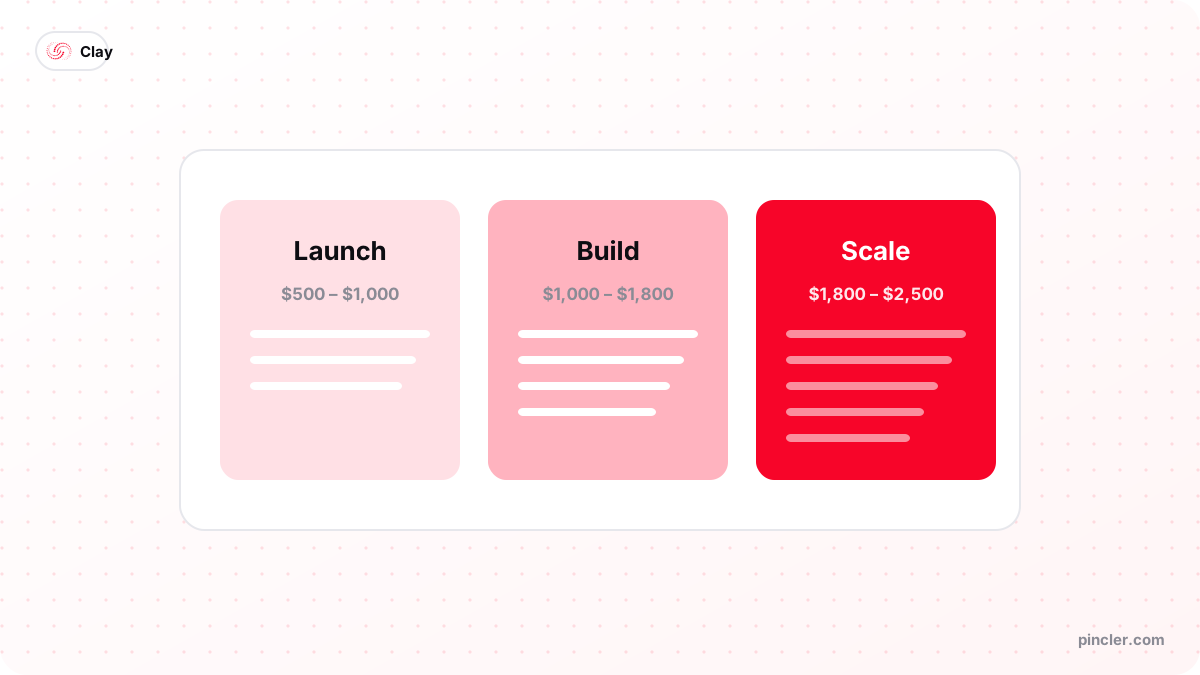
| One-off workflow build | $700–$1,800 fixed | PINCLER published range, 5–12 days |
A Worked Example: Consolidating the Data Contract
Take the largest lever with every input visible. Vendr's verified contract data, reported in Pin's coverage of ZoomInfo costs, puts the median ZoomInfo agreement at $31,875 a year across 1,313 purchases. Replace it with Clay Growth billed annually — about $5,352 a year at the time of writing — plus a one-off professional workflow build at the top of our published range, $1,800, plus an owner hour a week priced at, say, $60 loaded: roughly $3,000 a year. Year-one total: $5,352 + $1,800 + $3,000 = $10,152, against $31,875 — a first-year saving of about $21,700, and larger in year two when the build cost drops out.
Now the honest caveats, because this lever is not universal. If your team genuinely uses the big database's seat licences, intent module and phone data daily, the comparison narrows — our Clay vs ZoomInfo guide walks the trade-offs rather than assuming them away. And credits scale with volume: a team enriching tens of thousands of contacts monthly should model the Enterprise tier, not Growth. The arithmetic above is a template to refill with your own numbers, not a promise.
Which Lever Should a CMO Pull First?
Sequence by what you already pay. The decision tree below is how we scope it in practice: start where a signed invoice already exists, because substituting a real cost produces a defensible number in one quarter, while productivity gains take longer to evidence.
Whichever branch you take, instrument it. Segment-level campaign lift, cost per useful record and displaced spend belong on the same dashboard your pipeline numbers live on — the kind of view our pipeline and revenue analytics builds exist to provide. A saving nobody can see at renewal time is a saving that did not politically happen.
Do you pay a flat data contract today?
  YES → Lever 1 (consolidate) — biggest, fastest number
  NO  → Do you pay an agency for lists or research?
         YES → Levers 2–4 (in-house the list work)
         NO  → Is paid media your top line item?
                YES → Levers 7 + 10 (audiences, triggers)
                NO  → Levers 8–9 (deliverability, hygiene)
Who Is This For — and When Should a CMO Not Buy Clay?
The cost case fits CMOs whose teams run account-based or outbound-assisted marketing, carry data or agency line items worth displacing, and include at least one systems-minded operator. It works at startup scale precisely because the free plan and Launch tier let the substitution start small.
Do not buy Clay to fix a strategy gap: if the ICP is unvalidated, no enrichment layer will validate it. Do not buy it into a team with no owner — an orphaned workspace is pure added cost. And if your entire motion is brand and content with no account targeting, there is no spend for Clay to displace; put the budget into the channels themselves, or into the kind of measurement dashboard that shows where the next dollar works hardest.
What Are the Common CMO-Level Mistakes?
The tool-level mistakes belong to operators; these four belong to the leadership tier, and each one has undone an otherwise sound business case we have watched from close range.
- 1. Buying without cancelling — approving Clay while the contracts it was meant to displace quietly renew.
- 2. No named owner in the approval — capability without capacity; the workspace stalls by month three.
- 3. Measuring activity — accepting rows enriched as a KPI instead of displaced spend and campaign lift.
- 4. Skipping the renewal file — not logging the savings evidence quarterly, then rebuilding the case from memory under budget pressure.
PINCLER's Perspective: What the Fixed-Price Data Says
PINCLER is an AI-first custom software development studio, and GTM systems are a published slice of our catalogue: across PINCLER's published catalogue of 79 fixed-price builds, the GTM engineering category medians $1,600 fixed price with 14-day delivery, and Clay workflow builds specifically run $700 to $1,800 in 5 to 12 days. Every build is priced inside a $500–$2,500 band — the catalogue is public at our research page.
From the CMO seat, the relevant pattern in that data is proportionality: the one-off cost of professionalising a Clay pipeline is smaller than a single month of the median data contract it helps displace. The builds that pay back fastest are the unglamorous ones — contract consolidation, CRM hygiene, verified sends — not the AI-heavy showpieces. We would rather ship you a boring workflow that cancels an invoice than a clever one that decorates a slide.
The Bottom Line
Clay reduces marketing cost through substitution, and the CMO's role is to make the substitution real: name the displaced line items, appoint an owner, and put the savings on a dashboard before renewal season. Three or four of the ten levers pulled properly will fund the tool many times over; ten levers admired from a distance will fund nothing.
If you want the pipeline stood up without consuming your team's quarter, a fixed-price Clay workflow build ships in under a fortnight — and the full definitive guide to Clay is the right next read if your operators are still forming their own view.
Related PINCLER builds
Frequently asked
How does Clay reduce marketing costs in practice?
By substitution across ten levers: consolidating flat-fee data contracts into usage-priced enrichment, bringing agency list work in-house, retiring point tools, reclaiming research hours, deferring an ops hire, cheapening personalisation, sharpening ad audiences, protecting deliverability, stopping campaigns to decayed records, and concentrating spend on in-market accounts. The savings are conditional on cancelling the displaced spend.
What is the realistic total cost of running Clay for a marketing team?
Three lines: the subscription (Launch from $167/month or Growth from $446/month at the time of writing, per clay.com), an owner's weekly maintenance hour or two priced at loaded cost, and optionally a one-off professional build — $700–$1,800 fixed across the 79 builds PINCLER publishes fixed prices for, a price set by AI drafting the build and senior engineers reviewing and testing it. Credit top-ups at a 30% premium are the overflow risk to watch.
How big is the saving from replacing a database contract with Clay?
Using published figures: Vendr contract data reported by Pin puts the median ZoomInfo agreement at $31,875 a year, while Clay Growth billed annually is about $5,352 at the time of writing. With a $1,800 build — AI-drafted, senior-engineer reviewed — and roughly $3,000 of owner time, year one lands near $10,150 — a saving around $21,700, provided your team does not depend on the features only the big contract offers.
Does Clay replace marketing headcount?
It defers rather than replaces. One systems-minded marketer with Clay covers list operations that might otherwise justify a junior ops hire, and research columns turn analyst production into analyst review. Teams with an existing motion get more output per head; Clay does not run campaigns or set strategy, so it substitutes for tasks, not for the people who own outcomes.
What should a CMO ask a vendor before commissioning Clay work?
Four things: a written fixed price with scope, who owns the workspace and credentials afterwards (it should be you), what the handover runbook covers, and the warranty terms. An affordable custom software development company should answer all four in a one-page quote — across PINCLER's published catalogue, that means $700–$1,800 fixed — AI writes the first draft, senior engineers review and test it — with client-owned accounts and a 14–60 day warranty by tier.
Sources
Want to build this?
PINCLER builds custom software, AI agents and GTM systems for a fixed price between $500 and $2,500, delivered in 3–30 days, with the code owned by you.
Keep reading
Related articles
Clay for Marketing and GTM Teams: The Definitive Guide
Clay for marketing and GTM teams, explained end to end: what Clay does, how waterfall enrichment works, what it costs, and the workflows worth building first.
How to Get Started With Clay for Your Sales Team
How to use Clay for sales: a practical first-week setup — workspace, first table, waterfall enrichment, CRM push — plus credit costs and the mistakes to avoid.
How to Get Started With Clay for a Marketing Team
How to use Clay for marketing: build ICP account lists, enrich and segment them, and feed personalised campaigns — a practical first-month plan for marketers.