How Much Does Clay Cost? A Practical ROI Guide
Clay pricing in plain numbers: what each plan costs, how data credits and actions work, and a worked ROI model to tell whether Clay pays for itself.
Quick answer
- Free plan
- 100 data credits + 500 actions/month, at the time of writing per clay.com
- Launch
- From $167/month — 3,000 data credits, 15,000 actions
- Growth
- From $446/month — 6,000 data credits, 40,000 actions
- Billing mechanics
- Annual saves about 10%; credit top-ups cost a 30% premium; credits only burn on successful results
- Break-even shorthand
- Clay pays when it displaces roughly 4+ researcher-hours a week or an existing data/tool contract
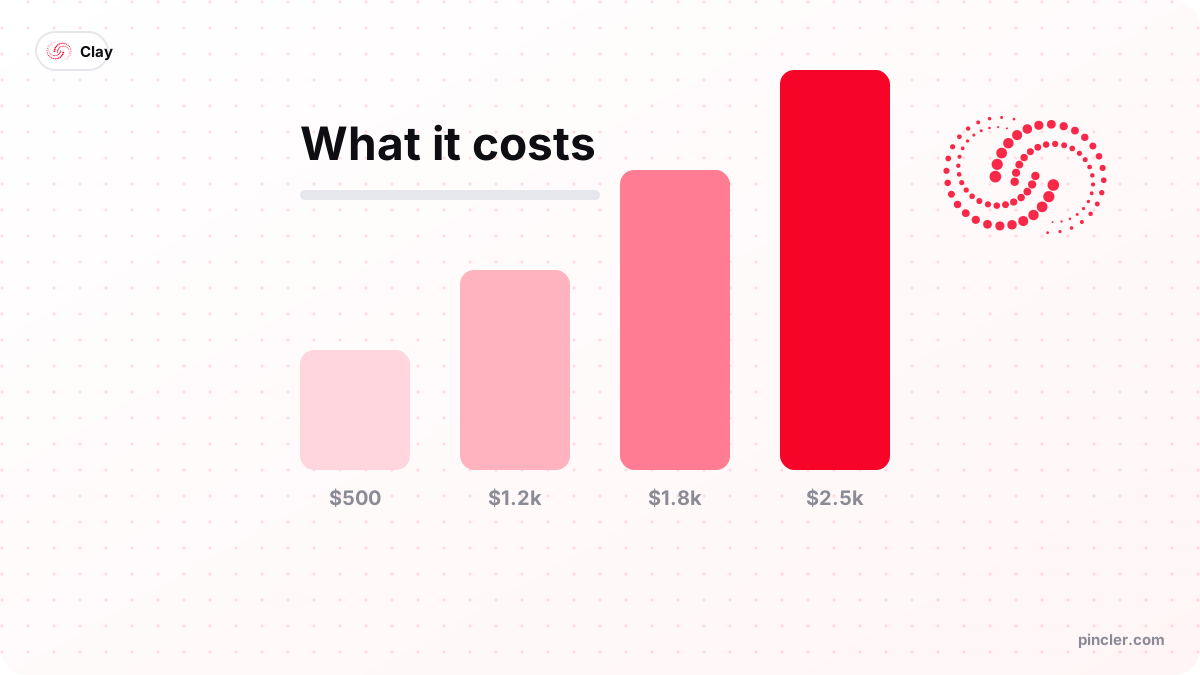
Clay pricing, at the time of writing per clay.com/pricing: a free plan with 100 data credits and 500 actions a month, a Launch plan from $167 a month with 3,000 data credits and 15,000 actions, a Growth plan from $446 a month with 6,000 data credits and 40,000 actions, and custom Enterprise pricing on annual commitment. Annual billing saves roughly 10 per cent; data-credit top-ups carry a 30 per cent premium.
The sticker prices are the easy part. What actually determines your bill is credit consumption — how many enrichment results your workflows buy each month — and what determines your return is whether those results displace real costs: researcher hours, data contracts, point tools. This guide works both sides of that ledger with the arithmetic visible.
It also takes the question seriously in the other direction: several situations where Clay's ROI is genuinely negative, and where the honest advice is the free plan or no plan at all.
How Much Does Clay Cost Right Now?
The current structure dates from March 2026, when Clay replaced its previous $149, $349 and $800 self-serve tiers with the two-plan model, as Warmly's pricing coverage documents — worth knowing because a lot of older articles quote the dead tiers. The live numbers, at the time of writing, are below; treat clay.com/pricing as the canonical source since credit allowances have moved before and will move again.
Two mechanics matter more than the headline figures. Credits burn only on successful results — a provider that returns nothing costs nothing — which makes waterfall ordering an economic decision, not just a coverage one. And the two currencies are separate: data credits pay for enrichment results, actions pay for workflow operations, and teams occasionally exhaust one while sitting on a surplus of the other.
| Plan (clay.com, at the time of writing) | Price | Monthly data credits / actions |
|---|---|---|
| Free | $0 | 100 / 500 |
| Launch | from $167/month | 3,000 / 15,000 |
| Growth | from $446/month | 6,000 / 40,000 |
| Enterprise | custom, annual commitment | custom |
What Does a Contact Actually Cost in Credits?
There is no universal answer, because credit burn per contact depends on which providers your waterfall calls and how well they cover your market — so measure it in a pilot rather than trusting anyone's average, ours included. The method: run 100 representative target contacts through your intended waterfall on the free plan, divide credits consumed by verified emails produced, and you have your team's real unit cost.
For planning before that pilot, a worked assumption: if your waterfall settles at two data credits per found-and-verified email once misses and verification are counted, Launch's 3,000 monthly credits buy about 1,500 contacts (roughly $0.11 each at $167), and Growth's 6,000 buy about 3,000 (roughly $0.15 each at $446). Niche markets with worse coverage might run at three or four credits per contact — halving those figures — which is exactly why the pilot beats the assumption. Our enrichment workflow guide shows where each credit gets spent inside the pipeline.
Which Plan Should You Actually Choose?
Choose by measured monthly volume, not ambition. The free plan is a real pilot environment, not a teaser; Launch covers most small outbound teams; Growth is for multi-segment or multi-rep volume; Enterprise is a procurement conversation about six-figure row counts.
The sizing decision compresses into the short tree below — and note that not sure routes to the free plan rather than to the safest-looking paid tier, because a fortnight of measured usage answers the question for nothing:
One tactical note: start one tier lower than your forecast says and let a measured month promote you. Under-buying costs a 30 per cent premium on a few top-up credits; over-buying costs the full gap between tiers for every month of the mistake. The asymmetry favours starting small.
How many verified contacts do you need per month?
  < 100, or still testing  → Free (pilot properly first)
  100 – 1,500              → Launch, from $167/month
  1,500 – 3,000            → Growth, from $446/month
  Well beyond 3,000        → Enterprise conversation
  Not sure                 → Free pilot → measure credits/contact → resize
How Does Clay's Cost Compare With the Alternatives?
Comparisons only work at the category level, because the products price different things. A contact database sells access to its records: Vendr's verified contract data, reported by Pin, puts the median ZoomInfo agreement at $31,875 a year. A sequencer sells sending: Landbase's coverage lists Instantly's outreach plans at $47 to $358 a month. Clay sells orchestration and enrichment on top of many databases, from $0 to $446-plus. Stack roles, not rivals — which is why most mature teams run Clay alongside a sequencer, and some keep a database subscription too.
The detailed head-to-heads live in their own guides — Clay vs ZoomInfo for the database decision, Clay vs Instantly for the stack pairing, and Clay vs Apollo for the all-in-one question. For pricing purposes the summary is: Clay is mid-priced within its stack, and the expensive mistake is not choosing the wrong tool but paying for two tools that do the same job.
A Worked ROI Model, With Every Input Visible
Model the labour side first, since it applies to every team. Glassdoor lists average SDR pay in the United States at $94,647 a year — about $46 an hour across 2,080 working hours. Suppose Clay automates six hours a week of one rep's list building and research: 6 × $46 × 48 working weeks is $13,248 a year of reclaimed selling capacity. Set against that, Launch billed annually is about $2,004 and a professional build sits at PINCLER's published top end of $1,800 — AI writes the first draft and senior engineers review, test and harden it. An owner hour a week adds roughly $2,900 a year at a $60 loaded rate, putting year-one cost near $6,700. The model returns roughly two dollars of capacity per dollar spent, before any pipeline lift from better targeting.
Now stress it honestly. If the rep's reclaimed hours are not redeployed into selling, the return is zero — capacity is only worth what it produces next. If your volume is 200 contacts a month, the free plan captures most of the value and the subscription's ROI collapses. And if you already pay for a data contract, run the substitution version instead: the CMO cost guide works that model, where the returns are larger and arrive faster because a cancelled invoice is not hypothetical.
When Is Clay Not Worth Paying For?
Four cases, stated plainly. No downstream motion: if nothing consumes the enriched data — no outbound, no ABM, no lifecycle branching — every credit is decoration. Tiny volume: below roughly 100–200 records a month, the free plan is the correct plan indefinitely, and pretending otherwise is how tools accumulate. No owner: an unmaintained workspace decays into wrong data with a subscription attached, which is worse than no data. Unvalidated ICP: enriching a guess produces a well-documented guess.
There is also a timing version of no: teams mid-way through a CRM migration or a repositioning should finish first. Clay hard-codes assumptions about fields, segments and messaging; building on ground that is about to move buys rework. The cheaper interim step is usually the process fix — the same advice we give in build-versus-buy decisions generally: the tool is rarely the constraint it appears to be.
What Are the Common Budgeting Mistakes?
Clay budgets fail in predictable ways. These five cover nearly every overrun or false-negative ROI verdict we have been asked to untangle.
- 1. Sizing tiers by ambition — buying Growth for a motion that measured 400 contacts a month, then reading the unused credits as tool failure.
- 2. Ignoring the two-currency split — exhausting actions while data credits sit idle, or the reverse, and topping up at the 30% premium monthly.
- 3. Enriching unfiltered lists — the single biggest credit waste; score first, enrich survivors.
- 4. Omitting labour from the model — the owner's weekly hour is real cost, and the reclaimed rep hours are only real if redeployed.
- 5. Judging ROI at week two — the pipeline needs a built month and a tuned month before its numbers mean anything.
Who Should Pay for Clay, and Who Should Stay on the Free Tier?
A paid Clay seat earns its keep when you research more than a few hundred contacts a month, need attributes no static database sells — hiring signals, technology in use, a phrase on a careers page — and have somebody who will maintain the tables week to week. Those three conditions together are what turn credits into meetings; miss any one and the subscription becomes a monthly reminder of good intentions.
Stay on the free tier, or on nothing at all, in the cases below. If your pipeline is inbound-led and your CRM's own enrichment already fills most fields, paying for a second source duplicates work you are not using. If your target list is a couple of hundred named accounts, a researcher with LinkedIn and an afternoon produces better rows than any waterfall. And if your sequencer bundles enrichment credits you have never exhausted, use those first — the honest sequence is to outgrow what you already pay for before adding a line item.
- Worth paying for: several hundred researched contacts a month, custom attributes, and a named owner with an hour or two a week.
- Free tier is enough: occasional list-building, a small named account list, or a team still validating who it sells to.
- Buy nothing yet: enrichment credits already sitting unused inside your CRM or sequencer, or no routing to consume the rows.
PINCLER's Perspective: The Build Cost Beside the Subscription
PINCLER is an AI-first custom software development studio, and across the 79 builds in PINCLER's published fixed-price catalogue, the Clay workflow builds — enrichment waterfalls, AI research columns, CRM push — run $700 to $1,800 fixed price and ship in 5 to 12 days, inside a GTM engineering category whose median is $1,600 and 14 days. Every build in the public catalogue at our research page is priced between $500 and $2,500.
Set beside the subscription, the pattern is useful: a one-off professional build costs roughly four to ten months of Launch, buys the part teams most often get wrong (verification discipline, CRM sync contracts, the feedback loop), and comes with a runbook so the workspace survives staff changes. The subscription is recurring; the competence should not have to be. That is the practical argument for commissioning the pipeline once and owning it afterwards — your workspace, your credentials, your data.
The Bottom Line
Clay costs between nothing and $446-plus a month at the time of writing, but your real price is credits per useful contact and your real return is displaced cost — researcher hours, contracts, point tools. Pilot free, measure your unit cost, size the tier from evidence, and run the ROI model with your own inputs in place of ours.
If the model says yes and you want the pipeline built properly first time, a fixed-price Clay workflow build ships in under a fortnight — and if the model says not yet, the free plan and our definitive Clay guide cost exactly nothing.
Related PINCLER builds
Frequently asked
What are Clay's current plans and prices?
At the time of writing, clay.com/pricing lists four tiers: Free (100 data credits and 500 actions a month), Launch from $167 a month (3,000 data credits, 15,000 actions), Growth from $446 a month (6,000 data credits, 40,000 actions) and custom-priced Enterprise on annual commitment. Annual billing saves about 10%, and top-up data credits carry a 30% premium.
What is the difference between data credits and actions?
Data credits pay for enrichment results — a provider returning an email, phone number or company record — and only burn on success. Actions pay for workflow operations the table performs. They are separate allowances: teams sometimes exhaust one while holding a surplus of the other, so monitor both when sizing a tier.
How many contacts does a Clay plan actually buy?
Depends on your waterfall's hit rate, so pilot it: run 100 target contacts on the free plan and divide credits burned by verified emails produced. As a planning assumption at two credits per verified contact, Launch's 3,000 monthly data credits buy about 1,500 contacts and Growth's 6,000 about 3,000 — niche markets with weaker coverage can halve that.
Is Clay cheaper than a ZoomInfo contract?
For most small and mid-sized teams, substantially: Clay Growth billed annually is about $5,352 at the time of writing, while Vendr contract data reported by Pin puts the median ZoomInfo agreement at $31,875 a year. They are different products, though — a database with seats and intent modules versus an orchestration layer — so heavy users of database-only features should compare carefully before switching.
When does Clay pay for itself?
The labour model with visible inputs: at Glassdoor's average SDR pay of $94,647 (about $46/hour), automating six research hours a week returns roughly $13,200 a year of selling capacity against a year-one cost near $6,700 including Launch, a professional build and owner time. It fails to pay when volume is tiny, hours are not redeployed, or nothing downstream consumes the data.
What does it cost to have Clay set up professionally?
Across the 79 builds PINCLER publishes fixed prices for, Clay workflow builds run $700–$1,800 fixed price and ship in 5–12 days, with the wider GTM engineering category at a $1,600 median — AI-drafted first passes reviewed, tested and hardened by senior engineers. Any affordable software development company quoting this work should give you a written fixed price, client-owned accounts and a warranty — ours runs 14–60 days by tier.
Sources
Want to build this?
PINCLER builds custom software, AI agents and GTM systems for a fixed price between $500 and $2,500, delivered in 3–30 days, with the code owned by you.
Keep reading
Related articles
Clay for Marketing and GTM Teams: The Definitive Guide
Clay for marketing and GTM teams, explained end to end: what Clay does, how waterfall enrichment works, what it costs, and the workflows worth building first.
How to Get Started With Clay for Your Sales Team
How to use Clay for sales: a practical first-week setup — workspace, first table, waterfall enrichment, CRM push — plus credit costs and the mistakes to avoid.
How to Get Started With Clay for a Marketing Team
How to use Clay for marketing: build ICP account lists, enrich and segment them, and feed personalised campaigns — a practical first-month plan for marketers.