AI Agent Development Cost: A Transparent 2026 Breakdown
AI agent development cost in 2026: $800–$2,500 fixed, because AI drafts the integration code and senior engineers review, test and harden it. What drives the number.
Quick answer
- Typical cost
- $800–$2,500 fixed — AI drafts the agent, senior engineers review and test it; catalogue agent builds carry a median advertised price of $1,450
- Timeline
- 7–20 days; median quoted delivery 13 days
- Running costs
- Typically tens of dollars a month in tokens and hosting at small-business volume
- Best for
- One measurable job — email triage, monitoring, lead qualification
- Cheaper routes
- A chatbot (answers only) or a rule-based workflow from $500 — same method, less machinery: AI drafts it, a senior engineer reviews and tests it
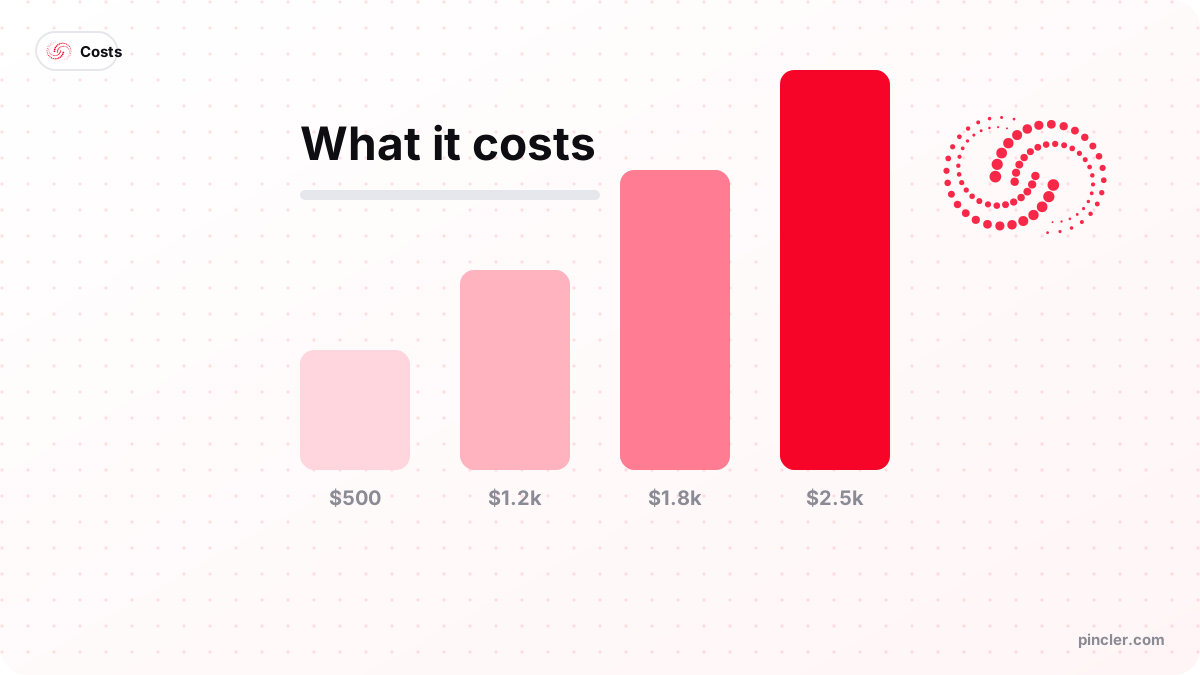
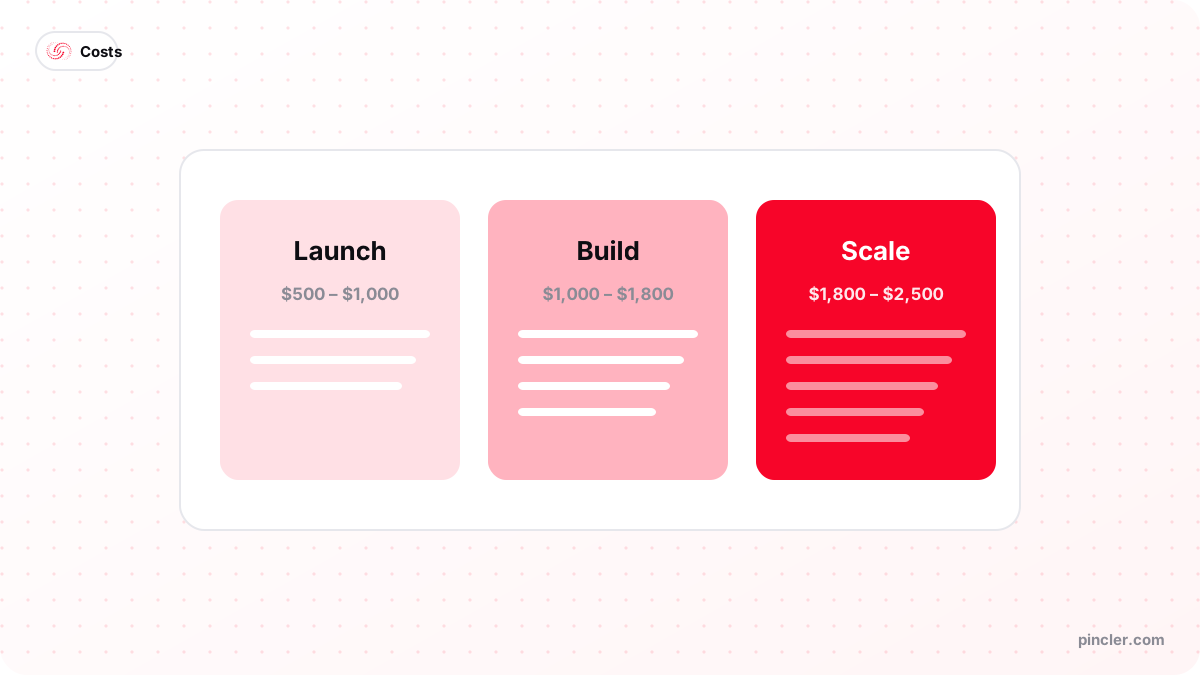
An AI agent costs $800–$2,500 to build at PINCLER, fixed price, and takes 7 to 20 days depending on how many systems it has to touch. That band is possible because AI writes the first draft of the integration and prompt code, while senior engineers own the architecture, review every line and test the failure paths before the agent goes near live data. An email triage agent that reads one inbox sits near the bottom of that band; a lead qualification agent that converses, scores, writes to your CRM and routes to your sales team sits at the top.
The market for this work is chaotic. The same brief can attract quotes from $500 to $50,000, largely because the phrase AI agent covers everything from a prompt wrapped in a cron job to a multi-step system with tool access and guardrails. Knowing what actually drives ai agent development cost is the difference between paying for engineering and paying for the label — and it is the first thing to press any ai development company on before signing anything.
This breakdown prices three common agents, explains the cost drivers in plain terms, covers the running costs — because with agents, the token bill after launch matters as much as the build — and looks at what the research says about why so many agent projects get cancelled, so yours does not join them.
How much does an AI agent cost to build?
An AI agent, properly defined, is software that perceives something — an email arriving, a lead filling a form, a competitor changing pricing — reasons about it with an LLM, and then acts across your systems: drafting a reply, updating a CRM record, posting a digest to Slack. The build cost is mostly determined by that last part. Reasoning is cheap; reliable action is engineering.
Every agent we build is quoted fixed before work starts, ships to your own infrastructure with the code in your GitHub, and includes a bug-fix warranty. The $800–$2,500 band is a product of method rather than of corner-cutting: AI drafts the integration and prompt code in hours, and senior engineers then own the architecture, review every line and test the failure paths — retries, rate limits, malformed inputs — that decide whether an agent is safe to leave running. No per-task fees, no platform rent on top.
Three common agents, priced
These three cover most of what businesses actually commission, and they map neatly to the low, middle and top of the band. The pattern to notice in the third column: the price climbs with integrations and autonomy, not with how clever the AI sounds.
| Agent type | Fixed price | What changes |
|---|---|---|
| Email triage & auto-responder | $800–$1,800 | Reads one inbox, classifies and prioritises, drafts replies a human approves before sending |
| Research & monitoring agent | $1,000–$2,200 | Watches competitors, news or prices on a schedule, summarises what changed, delivers a digest to Slack or email |
| Lead qualification agent | $1,200–$2,500 | Converses with inbound leads, scores against your criteria, writes to the CRM and routes hot leads to sales instantly |
PINCLER's perspective: what the project data shows
Across the 79 builds in PINCLER's published fixed-price catalogue, the seven AI agent builds carry a median advertised price of $1,450 and a median quoted delivery of 13 days, with individual builds priced from $500 to $2,500. That median sits almost exactly on the overall catalogue median — $1,450 and 13 days across all 79 builds — which tells you something useful: an agent is not an exotic purchase. It prices like a normal piece of business software, because that is what it is.
The neighbouring categories give context for phasing decisions. Chatbots, which answer rather than act, come in slightly cheaper at a median $1,375 and 13 days; integrations — the plumbing an agent often rides on — at $1,200 and 10 days. If budget is tight, a sensible route is to build the integration layer first and add the reasoning layer as phase two. The full catalogue is published on our research page.
What drives AI agent development cost?
Four factors set the price, and you can influence every one of them at the briefing stage.
- Systems touched — each integration (Gmail, HubSpot, Slack, WhatsApp Business API, your database) adds authentication, rate-limit handling and failure recovery.
- Autonomy level — draft-for-approval is cheaper than act-autonomously, because autonomous action needs guardrails, logging and rollback paths.
- Judgement complexity — classifying emails into five buckets is easy; scoring a lead against nuanced criteria takes prompt engineering, test cases and tuning cycles.
- Volume and reliability needs — an agent handling 20 items a day can fail gracefully and retry; one handling 5,000 needs queues and monitoring, which is real engineering time.
What does the research say about agent projects?
The adoption numbers are genuinely large. McKinsey's State of AI research reported that 88 percent of organisations now use AI in at least one business function, up from 78 percent a year earlier — yet the same research found only around 7 percent describe AI as fully scaled across the enterprise. Most organisations, in other words, are somewhere between a pilot and a plan.
The cautionary number matters more for your budget. Gartner predicted in mid-2025 that over 40 percent of agentic AI projects will be cancelled by the end of 2027, citing escalating costs, unclear business value and inadequate risk controls — and warned about agent washing, vendors relabelling ordinary chatbots and RPA as agents. That prediction is not an argument against agents; it is an argument against vague ones. The agents that survive are scoped to one measurable job, priced small, and instrumented so the value is visible in a spreadsheet within a month.
This is exactly why the fixed-price band matters. A $1,450 agent that saves 60 hours a month you have actually measured cannot be cancelled for unclear business value, because the value is arithmetic. A six-figure agent platform with a roadmap instead of a metric is the kind Gartner is counting.
What does an AI agent cost to run?
The build is one number; the tokens are forever. Every time the agent reasons, it calls an LLM API — Claude, GPT or a cheaper model where the task allows — and you pay per token in your own account. For a typical small-business agent processing tens of items a day, that bill usually lands in the tens of dollars a month, not hundreds. Volume is the multiplier to watch.
Good engineering keeps this down in ways worth asking any builder about: routing easy cases to smaller, cheaper models and reserving the expensive one for genuinely hard calls; caching repeated context; and skipping the LLM entirely when a plain rule answers the question. An agent that classifies obvious spam with a regex before ever calling a model is a cheaper agent every single day.
Put rough shape on it: an email triage agent handling 50 messages a day makes perhaps 1,500 reasoning calls a month, most of them short. Routed sensibly — small model for classification, large model only for the dozen genuinely ambiguous cases a day — that volume lands comfortably in the tens of dollars. The same volume pushed naively through the most capable model on every call can cost several times more for identical outcomes. The design choice, not the workload, sets the bill.
The payback arithmetic, worked through
Price an agent the way you would price any hire: against the hours it removes. Suppose an operations person spends 15 hours a week triaging and qualifying inbound enquiries at a loaded cost of $25 an hour. That is 65 hours a month, or $1,625 of monthly cost, every month. A lead qualification agent at $1,800 fixed, plus roughly $40 a month in tokens and hosting, pays for itself in about five weeks — $1,800 divided by the $1,585 of monthly net saving — and then keeps paying.
Speed adds a second, harder-to-see return. A widely cited Harvard Business Review audit of 2,241 US firms found companies that contacted a web lead within an hour were nearly seven times more likely to qualify it than those that waited even sixty minutes — and that the average response time was 42 hours. An agent that responds in seconds does not just save the hours; it moves you into the response bracket where deals actually happen.
Run the same two-line calculation on your own numbers before commissioning anything, including from us. If the hours are small and the leads are few, the honest answer is that you do not need an agent yet.
Do you actually need an agent?
Here is the opinion most vendors will not give you: a large share of agent briefs are really chatbot briefs. If the job is answering questions from a knowledge base — support queries, product FAQs, policy lookups — you need a chatbot, it costs less, and it will be live sooner. You need an agent when the job involves doing things across systems: updating records, sending sequences, monitoring and acting — the agents vs chatbots comparison draws the line in detail.
There is also a step below both: plain workflow automation. If every step of the process can be written as a rule with no judgement involved, an n8n or Zapier workflow from $500 will beat an agent on cost, speed and reliability. Use AI where judgement lives, and pipes everywhere else.
Does the job need ACTIONS across systems
(update records, send, route, monitor)?
    YES → AI AGENT ($800–$2,500)
    NO  → does it mainly answer questions from
          your content? → CHATBOT ($500–$1,800)
          every step a fixed rule, no judgement?
          → WORKFLOW AUTOMATION (from $500)
Who should buy an agent, and when should you not?
An agent is worth commissioning when somebody currently spends measurable hours moving information between systems and applying judgement while they do it — triaging an inbox, qualifying inbound leads, checking supplier prices. That is the profile where the payback arithmetic above works: the hours are countable, the judgement is real, and the systems involved have usable APIs.
Do not build one if the work is genuinely rule-based. A dozen if-then steps with no judgement belongs in a workflow tool, and a $500 automation beats an agent on cost, speed and reliability every time. Do not build one to answer questions from documents either — that is a chatbot, cheaper and quicker to launch. And do not build one where a single mistake is expensive and unrecoverable, such as moving money or making commitments to customers, unless a person approves each action before it goes out.
There is also a volume floor below which nothing pays back. If the process runs a handful of times a week, or consumes less than a day of someone's month, the honest recommendation is to leave it alone and revisit when the volume grows. We say that on scoping calls more often than we quote.
- Best for — high-volume, judgement-heavy work in systems with decent APIs, measured in hours per week today.
- Not worth building — rule-only processes, one-off tasks, or anything you cannot attach a number to.
- Wait instead — a process still changing week to week; automate the version that stops changing.
- Buy instead — if a mainstream tool already covers most of it, the remainder rarely justifies a build.
Where do agent projects go wrong?
The commonest failure is overscoped autonomy: giving a new agent the power to act on customers before it has earned trust. The fix costs nothing — launch in draft-for-approval mode, review a fortnight of output, then widen its permissions one action at a time. The second failure is the missing audit trail. An agent that acts without logging what it saw, decided and did cannot be debugged, cannot be improved, and cannot be defended when someone asks why it emailed a client at 3am.
The third is commissioning an agent against a vague benefit — better productivity, improved efficiency — rather than a number. Decide the metric before the build: hours removed, response time cut, leads contacted within five minutes. Agents measured from day one get renewed; agents justified by adjectives get cancelled, and the Gartner statistic above is what that looks like at industry scale.
Getting a fixed quote for your agent
The fastest way to a real number is to describe three things: what the agent should watch, what it should decide, and what it should do — plus the systems involved. With those, we can send a written fixed quote within one working day, always inside the $800–$2,500 band for a single phase.
Start with the lead qualification agent use case if speed-to-lead is your problem, the email triage page if your inbox is the bottleneck, or book a free 30-minute call and we will tell you honestly whether you need an agent, a chatbot, or just a well-built workflow.
Related PINCLER builds
Frequently asked
How long does it take to build an AI agent?
Seven to twenty days for the agents in our band, and the median quoted delivery for the AI agent builds in PINCLER's published catalogue is 13 days. A single-inbox email triage agent lands near one week; a lead qualification agent with CRM writes and routing takes closer to three. Add a few days of live tuning after launch — real traffic always surfaces cases the test set missed, and the warranty period covers adjusting for them.
What is the difference between an AI agent and an AI chatbot?
A chatbot answers; an agent acts. A chatbot retrieves knowledge and holds a conversation — support questions, product FAQs. An agent watches for events, reasons about them, and then does things across your systems: updates a CRM record, drafts and sends a sequence, posts a digest. Agents cost more because reliable action needs integrations, guardrails and logging that pure conversation does not.
What are the monthly running costs of an AI agent?
Three lines: hosting (often $5–20 on a small server or serverless plan), LLM tokens (typically tens of dollars monthly at small-business volume, scaling with usage), and any platform fees for connected tools you already pay for. Everything runs in your own accounts, so you see the real bills with no markup.
Why do so many AI agent projects fail?
Mostly for unclear business value, not broken technology — Gartner has predicted over 40 percent of agentic AI projects will be cancelled by the end of 2027, citing costs, fuzzy value and weak risk controls. The pattern behind that number is overscoped platforms chasing vague productivity gains. The defence is unglamorous: one measurable job, a small fixed price, an approval step on risky actions, and a metric agreed before the build starts. Any ai development company you talk to should volunteer this framing unprompted.
Can I start with a small agent and expand it later?
Yes, and it is the recommended route. Phase one is one job done well — say, email triage at $800–$1,800 — instrumented so the saving is visible. Later phases add systems and autonomy, each fixed-price at $2,500 or less on the same basis: AI drafts, senior engineers review, test and harden. Because you own the code and infrastructure from day one, each expansion builds on what exists rather than starting over, and you can stop at any phase with a working tool.
Can the agent work with the tools we already use?
Almost certainly. Mainstream tools — Gmail, Outlook, HubSpot, Salesforce, Slack, WhatsApp Business API, Google Sheets — all have solid APIs and are routine to integrate. Genuinely closed legacy systems are the exception; when we hit one, we say so at the quoting stage and design around it, often via export files or email hooks, rather than discovering it mid-build.
Sources
Want to build this?
PINCLER builds custom software, AI agents and GTM systems for a fixed price between $500 and $2,500, delivered in 3–30 days, with the code owned by you.
Keep reading
Related articles

Why Do Agencies Charge $30,000 for What We Build for $2,500?
Why is custom software so expensive at one supplier and not another? A transparent breakdown of agency cost structure, hour counts and the arithmetic behind a $2,500 build.
What Can You Actually Build for $2,000?
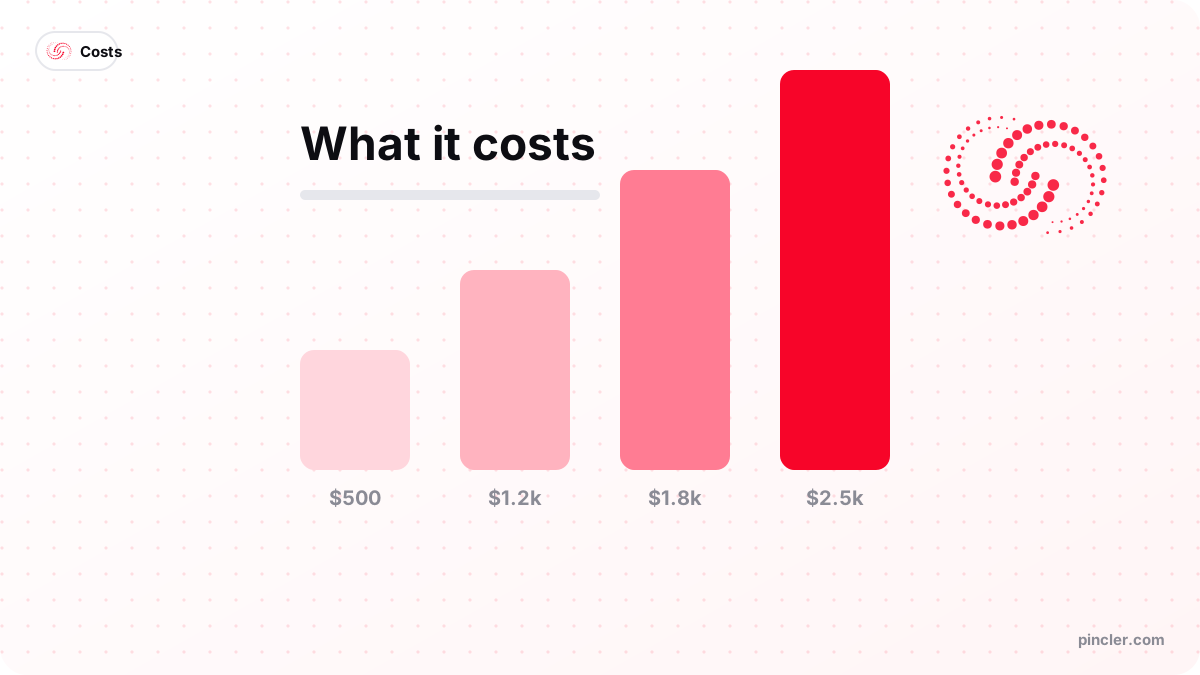
What can you build for $2000? One complete workflow, live in about two weeks — AI-drafted, senior-reviewed — with the exact scope and what gets deferred to phase two.
Can You Build a Custom CRM for Under $2,000?
The cheapest way to build a custom CRM, compared honestly: free tiers, spreadsheets, no-code, and an AI-drafted, senior-reviewed $1,200–$2,000 build. Which one you should pick.