How Much Does an AI Chatbot Cost to Build?
AI chatbot development cost in 2026: $500–$1,800 fixed, because AI drafts the build and senior engineers review and test it. What each budget buys, plus running costs.
Quick answer
- Typical cost
- $500–$1,800 fixed, AI-drafted and senior-reviewed; multi-channel builds with integrations reach $2,500
- Catalogue median
- $1,375 advertised and 13 days quoted across PINCLER's published chatbot builds, every one AI-drafted and put through senior review
- Timeline
- 5–14 days for most builds
- Running costs
- Roughly $10–50/month in LLM tokens plus $5–15 hosting
- Best for
- Support deflection, lead capture and after-hours response
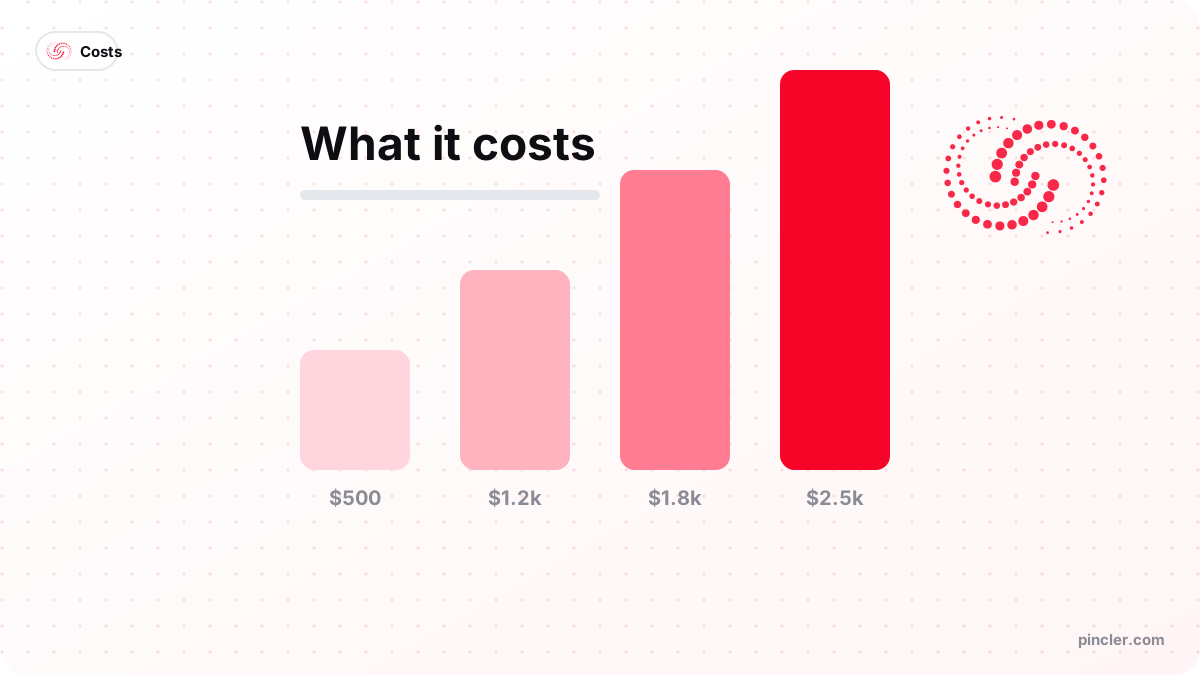
A custom AI chatbot costs $500–$1,800 to build at PINCLER, fixed price, and ships in 5 to 14 days — the price holds because AI drafts the retrieval and integration code while senior engineers review it, test the answers against your own content, and harden the handoff to a human. A website lead-capture bot starts at $500; a support chatbot trained on your documentation lands between $800 and $1,800; push the same brain onto WhatsApp and Instagram with CRM integration and you reach $2,500 at most.
Those numbers surprise people in both directions. Founders who have seen agency quotes expect five figures; founders who have seen $29/month chatbot builders wonder why custom costs anything at all. Both reactions miss what actually determines ai chatbot development cost: not the chat interface, which is trivial, but the knowledge behind it and the systems it connects to. That is the part where ai powered software development earns its keep — and WhatsApp builds, with Meta's fees on top, get their own breakdown.
This guide prices the three common builds, separates one-off cost from monthly running cost, runs the arithmetic against per-resolution platform pricing, and gives an honest answer on when a subscription builder is all you need.
How much does an AI chatbot cost?
The band is wide because chatbot covers three genuinely different products. At the bottom, a lead-capture bot greets website visitors, answers common questions and collects contact details. In the middle, a retrieval-based support bot answers from your actual documentation. At the top, one assistant serves several channels and reads or writes data in your other systems.
All three are quoted fixed before work starts, run on your own infrastructure with code in your GitHub, and carry a bug-fix warranty. The prices are low because the work is split rather than skipped: AI drafts the retrieval pipeline, the prompts and the interface, and a senior engineer then reviews the code, tests the bot against your real questions and builds the guardrails — source citations, confidence thresholds, human handoff — that a cheap bot leaves out. What you are buying in each case is the same thing: fewer repetitive conversations handled by humans, and no enquiry left waiting overnight.
What does each budget buy?
Here is the band as three tiers. Read the third column closely — the jumps are about knowledge and integration depth, never about a fancier chat bubble.
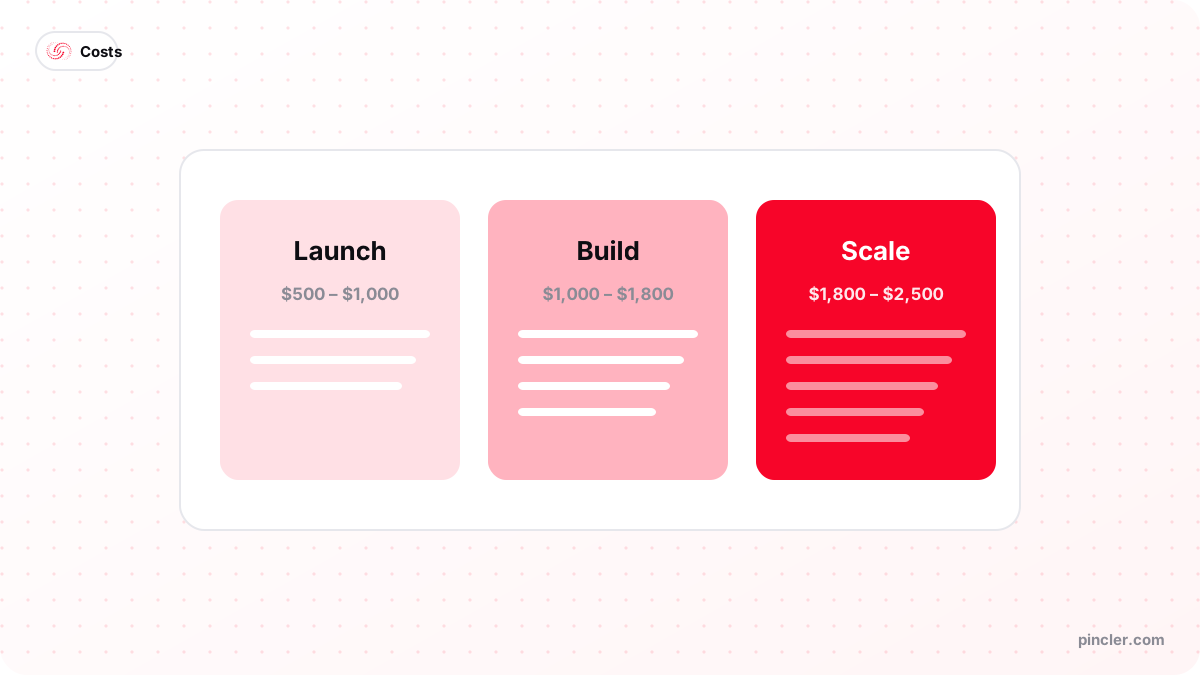
| Tier | Fixed price | What changes |
|---|---|---|
| Lead-capture bot | $500–$1,200 | Answers common questions on your site, qualifies visitors, captures contact details and emails you every lead |
| Support bot (RAG) | $800–$1,800 | Trained on your docs, policies and past tickets; cites sources; hands off to a human when confidence is low |
| Multi-channel assistant | $1,500–$2,500 | Same knowledge on website, WhatsApp and Instagram, plus CRM sync, booking integration and conversation history |
PINCLER's perspective: what our chatbot projects cost
Across the 79 builds in PINCLER's published fixed-price catalogue, the six chatbot builds carry a median advertised price of $1,375 and a median quoted delivery of 13 days, with individual builds spanning the full $500 to $2,500 band. That median sits just under the overall catalogue median of $1,450, which fits the theory: a chatbot is mid-complexity software — more moving parts than a website, fewer than a SaaS product.
Two neighbouring categories are worth knowing when you phase the work. Integrations run cheaper and faster — a median of $1,200 and 10 days — so wiring a bot into your CRM or booking system as a later phase is a modest add, not a second project. AI agents, which act across systems rather than just answering, run a median $1,450 and 13 days — agent costs are broken down separately. The full catalogue behind these numbers is published on our research page.
What drives the price up or down?
Four factors explain nearly every quote we send, and three of them are in your control before the project starts.
- Knowledge base shape — fifty clean FAQ pages are quick to ingest; a decade of PDFs, scanned forms and contradictory policy versions takes real preparation work.
- Number of channels — each additional channel (WhatsApp, Instagram, Messenger) brings its own API, message formats and approval process.
- Integrations — a bot that reads order status from Shopify or writes leads into HubSpot costs more than one that only talks, and is usually worth far more too.
- Handoff design — routing hard conversations to a human, with full context attached, is the feature that separates bots customers tolerate from bots they appreciate.
What does a chatbot cost to run each month?
A custom chatbot has two ongoing bills. Hosting is small — these are lightweight services, typically $5–15 a month on a small server or serverless plan. LLM usage scales with conversations: at typical small-business volume, token costs usually land between $10 and $50 a month in your own API account, and sensible engineering (smaller models for routing, caching for repeated questions) keeps it at the low end.
Compare that with per-seat or per-resolution pricing on hosted platforms, which commonly grows with exactly the metric you are trying to increase. The custom bot's costs grow gently with volume; you own the whole stack; and no vendor can reprice your support channel from under you.
A quick shape check on the token line: a support bot handling 1,000 conversations a month, averaging four exchanges each, makes roughly 4,000 model calls. With retrieval keeping each call short and a smaller model fielding routine questions, that volume sits at the bottom of the $10–50 range; route everything to the largest model with long contexts and it climbs towards the top. This is why how will you control token spend is a fair question to ask in any scoping call — the architecture decides the bill.
Custom build or per-resolution pricing: which is cheaper?
Outcome-priced platforms make the comparison easy to run. Intercom's Fin AI agent, for example, lists $0.99 per resolution at the time of writing, on top of a seat subscription. Suppose your bot resolves 400 conversations a month: that is $396 a month, or $4,752 a year, before seats — and the bill grows precisely as the bot gets better at its job. At 800 resolutions it is $792 a month.
A custom retrieval bot at $1,400 fixed plus roughly $40 a month in tokens and hosting costs $1,880 in year one and about $480 a year after that. Against the 400-resolution scenario, the custom build overtakes the platform inside five months. The platform still wins in some situations — you get a mature product on day one, with analytics and a team behind it, and at very low volume the per-resolution meter barely runs. The point is not that either answer is always right; it is that a ten-minute spreadsheet beats a pricing page's framing every time.
When is a subscription chatbot builder enough?
Subscription builders — the drag-and-drop tools with free tiers — are the right choice more often than a development studio should probably admit. If your bot needs scripted answers to a fixed question list, no access to your systems, and you are comfortable inside the builder's template, spend $0–50 a month and skip custom development entirely.
Custom earns its price in three situations: your answers live in your own documents and change often; the bot must read or write other systems — bookings, orders, CRM records; or the conversation itself is a product experience you want full control over. If you are unsure which side you fall on, that is precisely a scoping-call question, and the honest answer is sometimes the cheaper one.
A simple test cuts through most of the uncertainty: write down the ten conversations you most want the bot to handle, then mark which ones require looking something up in your systems or your documents. Zero marks means a builder template will do. Three or more means you are in custom territory, because those lookups are exactly what subscription tools either cannot do or charge platform-tier prices to approximate.
Write down the 10 conversations the bot must handle.
How many need a lookup in YOUR systems or documents?
    0   → subscription builder ($0–50/month)
    1–2 → builder now; revisit custom as volume grows
    3+  → custom build ($500–$1,800 fixed)
What does the adoption data say?
Chatbots are no longer an early-adopter purchase. McKinsey's State of AI research reported 88 percent of organisations using AI in at least one business function, and customer-facing conversation is one of the commonest first deployments. The competitive baseline has quietly moved: an unanswered enquiry at 9pm now goes to whichever competitor answers at 9pm.
Speed is the mechanism, and it is measurable. A Harvard Business Review audit of 2,241 US firms found the average lead response time was 42 hours, that 23 percent of firms never responded at all — and that responding within an hour made a firm nearly seven times more likely to qualify the lead. A chatbot's answer arrives in seconds. Even if it only collects a name, a need and a callback window, it moves every after-hours enquiry from the 42-hour bracket into the instant one.
One trust statistic belongs in every chatbot brief: Stack Overflow's 2025 Developer Survey found 46 percent of developers do not trust the accuracy of AI output. The people building these systems are the most sceptical users of them — which is exactly why retrieval grounding, source citations and human handoff are non-negotiable in a support bot, not premium extras.
Why do chatbots get switched off?
Chatbots rarely fail loudly; they get quietly disabled. The first cause is a stale knowledge base — the bot launched on January's policies and nobody owned updating it, so by June it was confidently wrong. Fix it structurally: connect the bot to the documents your team already maintains, so updating the source updates the bot.
The second cause is missing handoff. A bot that traps frustrated customers in a loop does measurable brand damage, and the transcript of a customer begging for a human is the screenshot that ends the project. The third is launching without measurement. Decide up front what the bot is for — deflection rate, captured leads, response time — and review the numbers monthly. A bot resolving 60 percent of conversations is a quiet employee of the month; without the dashboard, nobody notices, and the subscription conversation eventually kills it.
Next step: a fixed quote in one working day
Tell us what the bot should answer, where the answers currently live, and what systems it should touch. That is enough for a written fixed quote within a working day — free, and never above $2,500 for a single phase.
The AI customer support chatbot use case has the full deliverable list if support is your pain point, and the website lead-capture chatbot page covers the sales side. Or book the free 30-minute call and bring your messiest support questions with you.
Related PINCLER builds
Frequently asked
How long does it take to build a custom AI chatbot?
Five to ten days for a lead-capture bot, seven to fourteen for a support bot trained on your documentation, and up to three weeks for a multi-channel build with integrations — the median quoted delivery for the chatbot builds in PINCLER's published catalogue is 13 days. The schedule usually depends more on how quickly your content and API access arrive than on the engineering itself.
Is it cheaper to build a custom chatbot or pay per resolution?
At moderate volume, custom wins on arithmetic. Intercom's Fin lists $0.99 per resolution at the time of writing; at 400 resolutions a month that is roughly $4,752 a year before seat fees, while a custom retrieval bot — AI drafts it, a senior engineer reviews and tests it — costs $1,400 fixed plus about $40 a month and overtakes the platform inside five months. At very low volume, or if you want a mature platform with zero build time, per-resolution pricing can be the better deal — run your own volumes through both models before deciding.
Will the chatbot make things up to my customers?
This is the right question to ask any builder. A properly built retrieval-based bot answers only from your approved content, cites where each answer came from, and says it does not know — then hands off to a human — rather than guessing. That handoff behaviour is a build requirement in every support bot we ship, not an optional extra.
What do I need to prepare before a chatbot project starts?
Three things, and they matter more than the technology choice. First, your answer sources: FAQ pages, policy documents, past tickets — whatever currently holds the truth. Second, access: API keys or admin invitations for any system the bot must read or write. Third, escalation rules: who receives handoffs, during which hours, through which channel. Projects with these ready at kickoff ship at the fast end of the 5–14 day range.
Should I build the chatbot in-house instead of hiring a studio?
If you have a developer with slack capacity and no deadline, in-house is a fine way to learn. The case for a studio practising ai based software development is speed and the edge cases: retrieval tuning, handoff design, and the failure handling that separates a demo from a product are exactly where first builds burn weeks. A build priced at the $1,375 chatbot median and quoted at 13 days — AI drafting the first pass, a senior engineer reviewing and testing it — is often cheaper than a month of an engineer's diverted time.
Can the same chatbot work on my website and WhatsApp?
Yes — the knowledge base and logic are built once and connected to each channel through its own API. Website plus WhatsApp is the most common pairing and typically lands in the $1,500–$2,500 tier, because AI drafts each channel adapter quickly and the senior review time — testing both channels against your content — is what the second channel genuinely adds. WhatsApp adds Meta's business platform setup and per-message fees for business-initiated conversations, which are billed by Meta directly to you.
How much does a multilingual chatbot cost?
Usually a few hundred dollars above the single-language quote, not a multiple of it. Modern LLMs handle the languages themselves; the real work is duplicated testing, language-specific prompts for tone, and making sure retrieval works when your documents exist in only one language. Two or three languages typically keeps a support bot inside the $800–$1,800 tier, because AI drafts the extra prompt and test variants in minutes and senior review is where the remaining hours go — the cost driver is how many languages your source content needs translating into, which is a content job before it is an engineering one.
Sources
Want to build this?
PINCLER builds custom software, AI agents and GTM systems for a fixed price between $500 and $2,500, delivered in 3–30 days, with the code owned by you.
Keep reading
Related articles

Why Do Agencies Charge $30,000 for What We Build for $2,500?
Why is custom software so expensive at one supplier and not another? A transparent breakdown of agency cost structure, hour counts and the arithmetic behind a $2,500 build.
What Can You Actually Build for $2,000?
What can you build for $2000? One complete workflow, live in about two weeks — AI-drafted, senior-reviewed — with the exact scope and what gets deferred to phase two.
Can You Build a Custom CRM for Under $2,000?
The cheapest way to build a custom CRM, compared honestly: free tiers, spreadsheets, no-code, and an AI-drafted, senior-reviewed $1,200–$2,000 build. Which one you should pick.