Working Out the ROI of Custom Software for a Small Business
Custom software ROI for a small business: a simple payback formula, a worked example with honest numbers, and when the right answer is not to build at all.
Quick answer
- The formula
- Payback in months = total first-year cost ÷ monthly saving
- Good payback
- Under 12 months is strong; 12–24 reasonable; over 36 — do not build
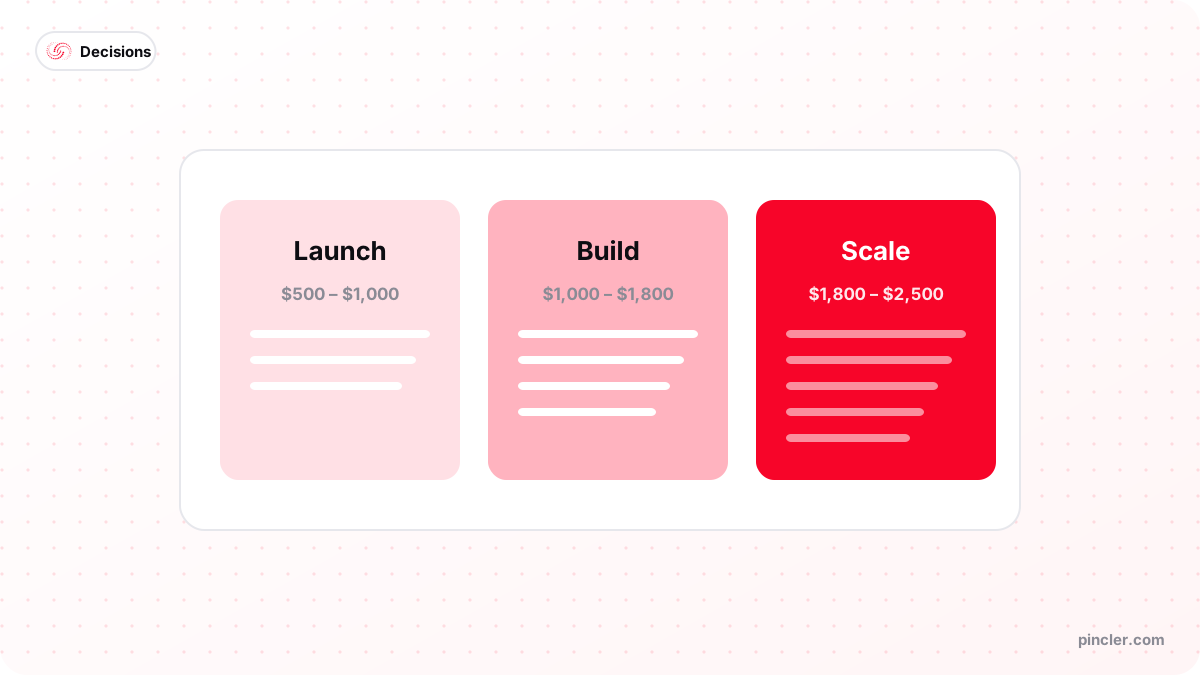
- Typical build cost
- $500–$2,500 fixed, median $1,450 — AI writes the first draft, senior engineers review, test and harden it
- Value time at
- Loaded cost — salary plus employer taxes and overheads, never bare salary
- Common result
- Small automations pay back in two to six months on time savings alone
Custom software ROI comes down to one line of arithmetic: what the build costs, divided by what it saves or earns each month, gives the payback period in months. If that number is under twelve, the project usually deserves serious consideration. If it is over thirty-six, the honest answer is probably to not build — and a good custom software development company should be willing to say so.
Small businesses rarely run this arithmetic, in both directions. Some commission software on enthusiasm and never define what it was supposed to return. Others assume custom software is a luxury and keep paying, invisibly, in hours — and the scale of that invisible bill is well documented: McKinsey Global Institute research has estimated that about half of all work activities globally could theoretically be automated with currently demonstrated technologies, and that in some 60% of occupations at least three in ten constituent activities are automatable.
The other half of the equation moved too. AI-assisted development pushed build prices down to the point where, across PINCLER's published catalogue of 79 builds, the median advertised price is $1,450 — which changes what counts as a good payback. This guide gives you the formula, a fully worked example with honest numbers, the costs people forget to count, and the situations where the calculation says no.
The formula, without the spreadsheet theatre
ROI calculations for small-business software do not need discounted cash flows. Two numbers do the work. First, the full first-year cost: the fixed build price, plus twelve months of running costs (hosting, API fees), plus an honest allowance for your own hours during the project. Second, the monthly benefit: hours saved per month multiplied by the loaded hourly cost of whoever saves them, plus any hard cost the software removes, such as a subscription it replaces.
Divide cost by monthly benefit and you have payback in months. The threshold is a business judgement, but a usable rule: under twelve months, strong case; twelve to twenty-four, reasonable if the process is stable; beyond thirty-six, the money almost certainly has a better home. Loaded cost matters — a person's true hourly cost includes employer taxes, benefits and overheads, typically well above bare salary, and using bare salary quietly understates every saving.
Payback (months) = first-year cost ÷ monthly benefit

first-year cost = fixed build price
                + 12 × running costs
                + your own hours, priced honestly
monthly benefit = hours saved × loaded hourly cost
                + hard costs removed (subscriptions)

    under 12 months → strong case
    12–24 months    → build if the process is stable
    24–36 months    → borderline — check off-the-shelf
    over 36 months  → do not build
A worked example with honest numbers
A five-person services firm produces quotes and invoices by hand: templates, copy-paste from a price list, chasing by memory. Call it six hours a week across the team — a deliberately modest figure; measure your own before trusting anyone's example. At a loaded cost of $35 an hour, that is roughly $910 a month in admin time. The fix is a small quotation and invoice tool; here is its first-year ledger.
| Line item | Amount |
|---|---|
| Quotation and invoice tool, fixed build price | $1,400 (one-off) |
| Hosting and email, twelve months | $180 |
| Owner's time during build and rollout, ~10 hours at $50 | $500 |
| Total first-year cost | $2,080 |
| Monthly saving: ~26 hours at $35 loaded | ~$910 |
| Payback period | ~2.3 months |
How much of the work week is actually automatable?
Before hunting for a project, it helps to know how big the hunting ground is. McKinsey Global Institute's automation research estimated that about half of all work activities globally could theoretically be automated by adapting currently demonstrated technologies — and, more usefully for a small business, that in roughly 60% of occupations at least 30% of the constituent activities are automatable. Very few whole jobs disappear into software; large slices of most jobs do.
Treat those numbers as a prompt, not a promise. The practical translation: almost every small business contains more automatable hours than it has budget to address, so the ROI exercise is a ranking problem. List the recurring manual processes, estimate weekly hours for each, and let the payback formula pick the first project. The winner is usually unglamorous — quoting, rekeying, chasing, reconciling — because frequency beats drama in this arithmetic every time; what should a small business automate first ranks the usual candidates.
Which costs do people forget to count?
The build price is the visible cost; three others belong in the calculation. Running costs are small but real — hosting, transactional email, any API usage — typically $15–50 a month for a tool of this size. Your own time is the one everyone omits: answering questions during the build, testing, and rolling the tool out to the team. Ten to twenty hours is normal for a small project, and it is only honest to price them.
The third is the adoption dip. For the first couple of weeks, the team is slower with the new tool than they were with the old mess, and some processes run in parallel. It is temporary and normal, but a calculation that assumes full savings from day one will look wrong for a month and shake confidence in the whole exercise. Start the savings clock at week three or four.
Why did build costs fall — and what does that do to the formula?
Payback thresholds that made sense at agency prices deserve rethinking, because the denominator changed. The production shift is thoroughly documented: Google Cloud's 2025 DORA report found 90% of software professionals now use AI at work, and Stack Overflow's 2025 Developer Survey found 51% of professional developers using AI tools daily. A controlled GitHub experiment measured developers completing a standardised task 55.8% faster with an AI assistant. AI-based software development is simply how small projects get built now — and the labour saving lands in the quote.
The first-party numbers show where that leaves prices: across PINCLER's published catalogue of 79 builds, every build is priced between $500 and $2,500 fixed, with a median of $1,450 — the full dataset is at /research/what-you-can-build. When the build cost drops by an order of magnitude, processes that failed the ROI test five years ago pass it comfortably today. The formula did not change; the inputs did, and it is worth re-running old 'no' decisions against current prices.
Revenue upside is real — but keep it out of the core case
Software often earns as well as saves: an enquiry answered in two minutes converts better than one answered tomorrow, an online booking page captures the customers who will not phone, a tidy follow-up sequence revives quotes that would have gone quiet. These effects are real, and for some builds they dwarf the time savings.
They are also hard to predict for your specific business, which is why the disciplined move is to build the case on time saved — measurable, defensible — and treat revenue effects as upside. If a project only makes sense when optimistic revenue assumptions hold, it does not make sense yet. If it pays for itself on hours alone, the revenue effects arrive as a bonus rather than a requirement.
PINCLER's perspective: payback benchmarks from 79 catalogue builds
To turn the formula into expectations, here are category medians from across PINCLER's published catalogue of 79 builds, paired with the monthly saving each would need to pay back inside twelve months. The saving column is pure arithmetic — median price divided by twelve — and most operational processes clear it easily once hours are counted at loaded cost.
Read the last column against your own numbers: $100 a month is under three hours of saved admin at $35 loaded. A process consuming six hours a week — roughly $910 a month — pays back the median automation in under two months. That gap between required saving and typical saving is why small fixed-price builds so often produce the best ROI a small business will see anywhere.
| Category | Median fixed price | Saving needed for 12-month payback |
|---|---|---|
| Cloud & DevOps | $850 | ~$71/month |
| Data tools | $1,100 | ~$92/month |
| Integrations | $1,200 | ~$100/month |
| Internal tools | $1,725 | ~$144/month |
When does the calculation say do not build?
Run honestly, the formula returns no reasonably often, and the reasons repeat. The process happens too rarely — automating a quarterly task that takes an afternoon saves a few hours a year, and no build price justifies it. The process is still changing shape — software freezes a workflow, and freezing the wrong one costs more than the manual work did. Or an off-the-shelf tool already covers it — if a standard $30-a-month product does the job, the ROI of custom code is negative by exactly the build price.
There is also a scale threshold worth respecting: below roughly two or three hours saved a week, even a $500 build competes poorly with simply doing the work. The best candidates are boringly consistent: high-frequency, stable, rule-based processes that someone currently performs by hand every single week.
Who this is for, and who should keep doing it by hand
This calculation is for the owner or manager of a business where a handful of people repeat the same administrative work every week, where the hours are visible on a rota or a timesheet, and where nobody has yet priced what that repetition costs across a year. It is not for a team whose real problem is a decision nobody has taken; automating an unresolved process only makes the confusion faster.
Keep doing it by hand when the process is rare, unstable or already covered. A quarterly reconciliation, a workflow being redesigned each month, or a task a standard subscription performs adequately — each of those returns a negative number in the formula, and running it honestly on those cases is what makes the positive ones credible.
The three-year view: build, subscribe, or keep doing it by hand
Payback answers 'how fast'; the three-year comparison answers 'which option'. Take the quoting process from the worked example and price all three routes over thirty-six months. Doing nothing: roughly $910 a month in admin time, about $32,760. A SaaS subscription that fits the workflow, if one exists at say $60 a month: $2,160, plus whatever manual steps survive around its edges. The custom build: $1,400 once plus about $15 a month running, roughly $1,940 — with the workflow fitting exactly and no per-seat meter as the team grows.
The ranking will differ per process, and the SaaS option wins whenever a standard product genuinely fits — that is the honest answer more often than a development studio should admit. The point of the exercise is that 'keep doing it by hand' is also a purchase, made monthly, and it is routinely the most expensive of the three once it is priced. Custom software vs SaaS runs the same three-year comparison for full products.
Run your own numbers, then get a real quote
The exercise takes twenty minutes: pick the process, measure the weekly hours honestly for two weeks, multiply by loaded cost, and set the result against a realistic build price and a year of running costs. Do this before talking to any developer — including us — because walking in with your own payback number is the strongest negotiating position a buyer can have.
When you want the other side of the fraction filled in, a free 30-minute call gets you a written fixed quote within one working day, always between $500 and $2,500 per phase. Or browse the workflow automation and internal-tool use cases first — each lists a fixed price band you can drop straight into the formula.
Related PINCLER builds
Frequently asked
What is a good payback period for small business software?
Under twelve months is a strong case; many small automation projects at fixed prices of $500–$2,500 pay back in two to six months on time savings alone, because AI drafts the build and senior engineers review it, which keeps the cost low relative to the monthly hours removed. Twelve to twenty-four months is still reasonable for a stable process. Beyond thirty-six months, the honest answer is usually to spend the money elsewhere or buy an off-the-shelf tool instead.
How do I measure the hours a manual process actually takes?
Track it for two normal weeks rather than estimating, because people reliably misjudge — usually underestimating the small frequent tasks and overestimating the annoying rare ones. A shared note where each person logs minutes against the process is enough. Then multiply by loaded hourly cost, which includes employer taxes and overheads on top of salary. The two-week number is your defensible baseline for the whole calculation.
Does custom software hold its value, or will I rebuild in two years?
A tool built for a stable process holds value well — a quoting tool or booking system does the same job for years, with modest maintenance of perhaps a few hundred dollars annually as dependencies need updates. What forces rebuilds is automating a process that was still changing, which is why process stability belongs in the ROI decision. Owning the code outright in your own GitHub also matters: it means maintenance is a choice of vendor, not a hostage situation.
How do I work out ROI when the software earns revenue rather than saves time?
Use the same payback formula but with conservative revenue inputs you can defend: current enquiry volume, your existing conversion rate, and a cautious estimate of the improvement — never a hoped-for one. A booking page capturing two extra $80 jobs a month adds $160 to the monthly benefit line; that is a defensible number, unlike 'we expect demand to double'. Where a project has both savings and revenue, build the case on the savings and let revenue shorten the payback as a bonus.
What ongoing costs should a software ROI calculation include after year one?
Three lines cover it: running costs of roughly $15–50 a month for hosting, email and API usage; an annual maintenance allowance of a few hundred dollars for dependency updates and small fixes; and any paid third-party services the tool depends on. There are no licence fees or per-seat charges on code you own outright, which is exactly why custom builds age well in ROI terms — years two and three are nearly free while the savings continue at full rate.
Does AI-assisted development change the ROI calculation itself?
It changes the inputs dramatically, not the formula. Because AI writes the first draft while senior engineers review, test and harden it, AI software development has compressed build prices: across PINCLER's published catalogue of 79 builds the median advertised price is $1,450, a fraction of traditional agency quotes for equivalent scope. Processes that failed the payback test at five-figure prices now pass it easily. Google Cloud's 2025 DORA research found 90% of software professionals using AI at work; the resulting labour saving is precisely what a fixed quote passes on to the buyer. Re-run any old 'not worth it' decisions against current numbers.
Sources
Want to build this?
PINCLER builds custom software, AI agents and GTM systems for a fixed price between $500 and $2,500, delivered in 3–30 days, with the code owned by you.
Keep reading
Related articles
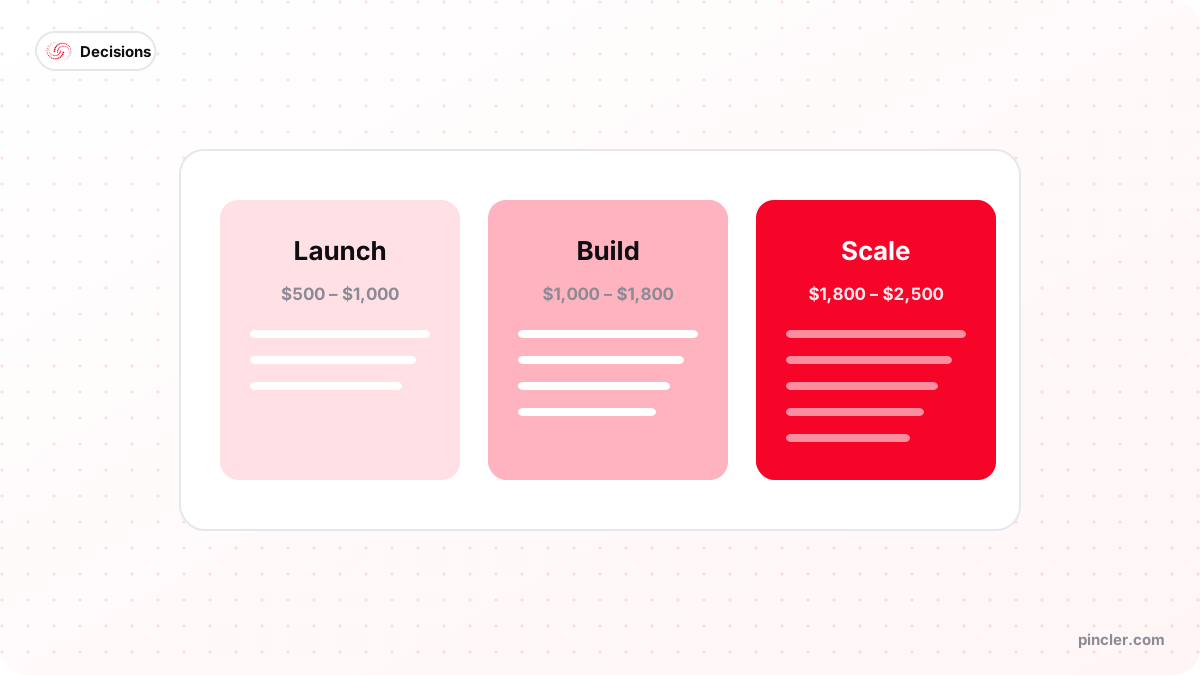
Is Cheap Custom Software Too Good to Be True?
Is cheap custom software any good? The six failures that actually sink low-cost builds, the checks that separate method from corner-cutting, and how to run them on us.
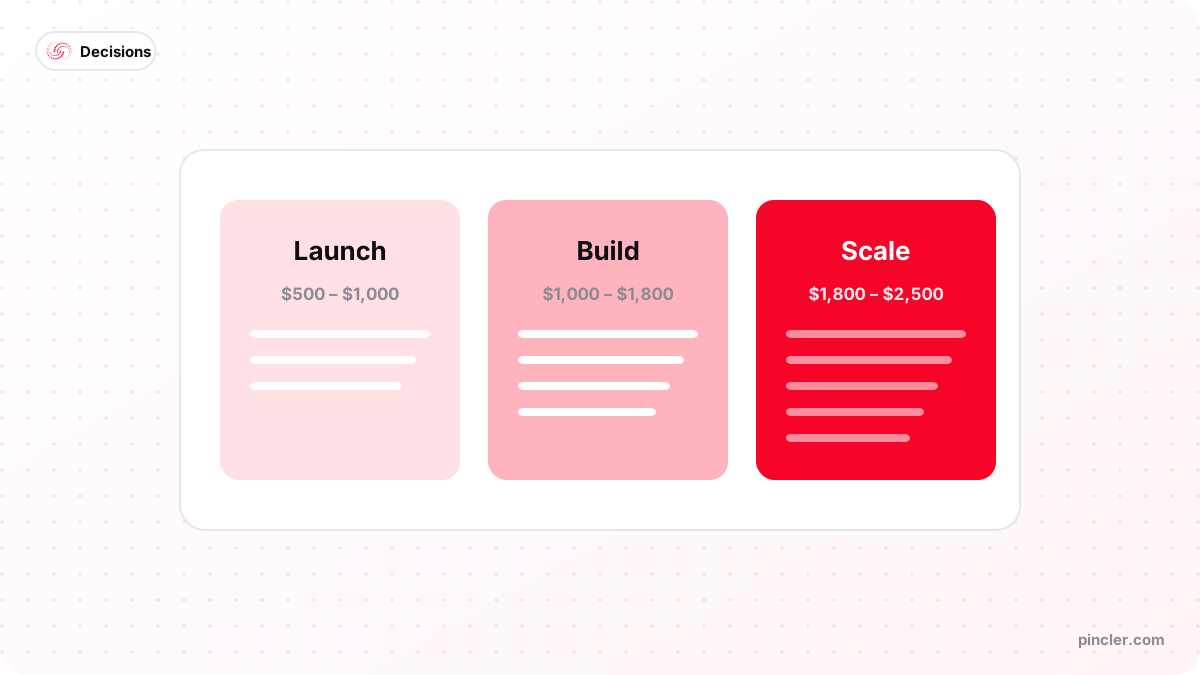
Internal Tool Development for Under $3,000
Internal tool development for a small business runs $800–$2,500 fixed price at PINCLER — AI-drafted, senior-reviewed — not the five-figure numbers agency guides quote. When Retool wins.
Freelancer vs Agency vs AI-Assisted Studio
Freelancer vs agency software development vs an AI-assisted studio: honest cost ranges, risks and delivery speed for each — and how to pick the right one for your project.