How Much Does a Restaurant QR Menu Cost?
Restaurant QR menu cost in 2026: free tools, $38–$119 subscriptions and $500–$900 AI-drafted, senior-reviewed custom builds compared, with three-year arithmetic.
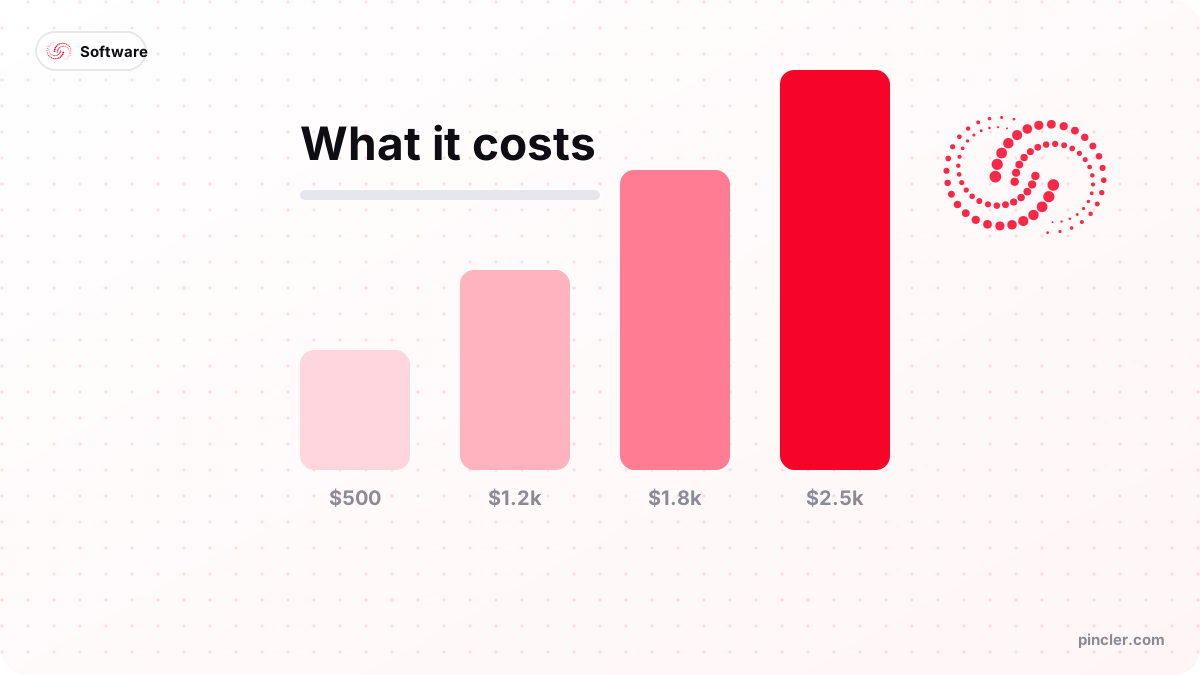
Quick answer
- Free tools
- $0 — basic menus with vendor branding and limits
- Subscription tools
- $38–$119/month on MENU TIGER's published tiers, at the time of writing
- Custom build
- $500–$900 fixed at PINCLER, 3–7 days, AI-drafted with senior engineer review, code and domain are yours
- Ongoing (custom)
- Hosting ~$5–15/month; menu edits are yours to make, free
- Break-even
- A one-off build overtakes a $38/month subscription inside ~19 months
A restaurant QR menu costs between nothing and about $119 a month on subscription tools, or $500–$900 as a one-off custom build you own outright. For reference, MENU TIGER's published pricing runs from a free plan to $38, $89 and $119 monthly tiers at the time of writing, while PINCLER builds a custom menu page on your own domain for a fixed $500–$900, delivered inside a week — AI writes the first draft and senior engineers review and test it.
Which option is cheaper depends entirely on how long the menu will live. A subscription looks cheap in month one and keeps costing forever; a build costs more up front and then almost nothing. This guide puts the actual numbers side by side, shows the three-year arithmetic in the open, and flags the costs vendors mention quietly — per-location fees, feature gates and the price of leaving.
One boundary to draw before the numbers: this page covers menu-only costs — the page diners read. If diners should also order and pay from the table, that is an ordering system with different economics, priced separately in our QR ordering features and cost guide.
The Short Answer: $0 to $119 a Month, or $500–$900 Once
There are three ways to pay for a digital restaurant menu. Free tools give you a hosted menu with the vendor's branding and hard limits on items, images or scans. Paid subscriptions — $38 to $119 a month on MENU TIGER's published pricing at the time of writing, with competitors clustered in the same band — remove the limits and add analytics, scheduling and multi-language support. A custom build puts the same result on your own domain for a one-off $500–$900 at PINCLER's fixed pricing.
None of these numbers should shock anyone: a menu page is one of the smallest useful pieces of software a restaurant can commission. The interesting question is not the sticker price but the shape of the spend — recurring versus one-off — and that is decided by how long the menu lives, which the arithmetic below makes concrete.
What Does Each Option Cost?
The table compares like with like: a single-location restaurant that wants an editable mobile menu with categories, photos and dietary tags. Setup labour is your own time on the DIY rows and included in the fixed price on the custom row.
| Option | Upfront | Ongoing | You own it? |
|---|---|---|---|
| Free menu tool | $0 | $0 — vendor branding, feature limits | No — menu lives on their platform |
| Paid subscription | $0 | $38–$119/month (published tiers) | No — cancelling deletes the menu |
| Custom web menu (PINCLER) | $500–$900 fixed | ~$5–15/month hosting | Yes — code, domain and page are yours |
| QR ordering system | $900–$2,000 fixed | Hosting + payment processing | Yes — covered in its own cost guide |
What Moves a QR Menu's Price Up or Down?
For subscriptions, the price climbs with locations, languages and features: multi-branch menus, scheduled menus (breakfast switching to lunch automatically), analytics and ordering modules each push you up a tier. For custom builds, the drivers are content volume and design ambition — a 40-item menu with tags is quicker to build than a 200-item menu with photography, translations and seasonal scheduling.
The quiet cost on the subscription side is exit. A menu that has lived at a vendor's URL for two years has accumulated scans, bookmarks and Google results pointing at an address you do not control; leaving means breaking every printed code. A custom page on your own domain has no exit cost at all — which is worth actual money, not just comfort.
- Locations — per-branch pricing multiplies subscription costs; a custom build serves all branches from one codebase.
- Menu updates — unlimited and free on any decent option; treat per-edit charges as a red flag.
- Languages — often gated to higher tiers; a custom page adds them as a scoped feature.
- Photography — good images are a real cost in time or money whichever route you choose.
- Ordering — the moment you want cart and payment, you have left menu pricing entirely.
The Three-Year Arithmetic, in the Open
Take the mid-tier subscription at $38 a month: that is $456 a year and $1,368 over three years, every input visible. A custom build at $700 plus hosting at $10 a month is $700 plus $360 — $1,060 over the same three years, and the asset is yours at the end. The break-even lands around month 19 ($700 divided by the $28 monthly difference), and every month after that is saved cash.
Run the honest version too. The subscription includes the vendor's uptime, templates and support, and if there is a real chance you shut the restaurant or redesign the brand within a year, $38 a month with no commitment is the better risk. The build wins when the menu is a permanent fixture — which, for an operating restaurant, it almost always is. This is the same logic as any custom software versus SaaS decision, shrunk to menu size.
When Is the Free Option Genuinely Enough?
A free tier is the right answer more often than vendors would like: a food truck testing a concept, a pop-up running eight weekends, a café with twelve items and no interest in analytics. If the menu is short, single-language and single-location, take the free plan, accept the branding, and spend the savings on photography.
Move off free when you hit its walls — item caps, no scheduling, no allergen fields — or when the vendor's branding on your menu starts to grate. And skip the whole subscription-versus-build question if your menu changes twice a year and your diners prefer paper anyway; Toast's guest survey found 81 percent of diners prefer physical menus, and a laminated card is still the cheapest menu technology ever invented.
Who Should Build a Menu Page, and Who Should Not?
Build the page when the menu is a permanent fixture: an operating restaurant or café at a fixed address, prices that move more than twice a year, more than one branch to serve from a single codebase, or a menu you want ranking in search on your own domain. At that profile the $500–$900 pays for itself in avoided subscription fees inside about 19 months, and in avoided reprints immediately.
Stay on a subscription — or on paper — in four specific situations, and none of them is a failure of ambition. Don't commission a build if a free tier already covers the menu you actually run: twelve items, one language, one site, no interest in analytics. Don't build if the venue is a pop-up, a seasonal kitchen or a concept you may close by spring, because $38 a month with no commitment is the cheaper way to be wrong. Don't build if a POS package you already pay for includes a menu module you have never switched on — Merchant Maverick's Toast pricing guide lists online ordering as a paid add-on to a $69-a-month core, so audit the bundle before buying anything else. And don't build if your guests simply do not scan: Toast's guest survey found 81 percent of diners still prefer physical menus, and a laminated card serves a twenty-cover dining room better than any web page will.
Common Mistakes When Budgeting for a QR Menu
The failure pattern in menu budgeting is rarely overspending — the numbers are small — it is paying repeatedly for something that should have been paid for once, or twice for things that overlap.
- 1. Comparing month-one prices instead of three-year totals — the subscription always wins month one and usually loses year three.
- 2. Ignoring per-location multipliers until branch two opens and the bill doubles.
- 3. Buying an ordering-capable tier 'for later' and using a tenth of it — pay for the menu you run today.
- 4. Printing codes that point at a vendor URL, then discovering the reprint bill when you switch suppliers.
- 5. Forgetting the content cost — photography, descriptions and translations cost the same whichever platform hosts them.
- 6. Treating a POS bundle as free — Merchant Maverick's Toast pricing guide lists the core POS from $69 a month with online ordering as a separate paid add-on, so a bundled menu is never actually $0.
PINCLER's Perspective: Why a Menu Build Is Priced at $500–$900
PINCLER's published catalogue lists 79 builds, and its Websites category — where a menu-only page sits — carries a median advertised price of $1,025 and a median quoted delivery of 8 days, with simpler builds like a menu page listed below that median at $500–$900. Every entry in the catalogue is priced between $500 and $2,500, and the full itemised table is published at what you can build — a level of price disclosure almost no development studio offers.
The reason the price is low is the production method, not the corner-cutting: AI tools generate the page structure, components and first-draft styling, and a senior engineer reviews, hardens and deploys to your domain. A menu page has one job and no integrations, which makes it one of the cheapest categories of affordable custom software development we quote — and one where owning the asset matters more than the invoice, because the printed codes on your tables should point at a URL nobody can take away. Fixed quotes are free and arrive within a working day via our pricing page or a short call.
Bottom Line
Budget $0 for a test, $38–$119 a month for a subscription with room to grow, or $500–$900 once for a page you own — and decide by lifespan, not sticker price. A permanent restaurant with a permanent menu is better served by the one-off build; a concept still proving itself is better served by a free or cheap subscription.
When table ordering enters the conversation, the budget changes shape entirely — start with the restaurant QR menu and ordering use case to see fixed prices for both versions side by side.
Related PINCLER builds
Frequently asked
How much does a restaurant QR menu cost per month?
Subscription menu tools run from free to roughly $119 a month — MENU TIGER's published tiers are $38, $89 and $119 at the time of writing, with a free plan below them. A custom-built menu page has no subscription at all: $500–$900 once at PINCLER's fixed pricing — AI drafts it, senior engineers review and test it — then hosting of about $5–15 a month, with unlimited edits because the page is yours.
Is a free QR menu tool good enough for a small restaurant?
Often, yes. A single-location restaurant with a short, single-language menu loses little by starting free: the trade-offs are vendor branding, item caps and fewer features like scheduling or analytics. Upgrade when you hit those walls. The one caution is the URL — printed codes pointing at a free vendor's address become worthless if you later switch, so factor a reprint into any move.
Is it cheaper to build a QR menu or subscribe to one?
Over any horizon past about 19 months, building wins. A $38-a-month subscription totals $1,368 over three years; a $700 custom build — AI-drafted, senior-engineer reviewed — plus $10-a-month hosting totals $1,060 and leaves you owning the page, domain and code. Under a year — a pop-up, a concept test — the subscription's zero upfront cost and zero commitment make it the better buy.
What ongoing costs does a custom QR menu have?
Hosting at roughly $5–15 a month, a domain renewal of $10–20 a year, and nothing else mandatory. Menu edits cost nothing because you control the page. PINCLER builds include a bug-fix warranty of 14–60 days by tier, and there is no retainer — a deliberate contrast with subscriptions, where the monthly fee is the product.
Does a QR menu cost more if diners can order from it?
Yes, substantially — ordering turns a content page into transactional software. Adding a cart, table identification, payments and a kitchen order view moves the build from $500–$900 to $900–$2,000 at PINCLER's fixed pricing, where AI writes the first draft and senior engineers review, test and harden it, and subscription tools gate ordering behind their higher tiers similarly. Scope it as its own decision; a menu page does not become an ordering system by accident.
Sources
Want to build this?
PINCLER builds custom software, AI agents and GTM systems for a fixed price between $500 and $2,500, delivered in 3–30 days, with the code owned by you.
Keep reading
Related articles
What Does a Booking App With WhatsApp Notifications Cost?
A booking app with WhatsApp notifications costs $900–$2,500 fixed price — AI-drafted, senior-reviewed — plus per-message Meta fees. How WhatsApp billing works and what to budget.
How Much Does a Telegram Mini App Cost to Build?
Telegram Mini App development cost: $500–$2,500 fixed price — AI-drafted, senior-reviewed — against agency guides of $10,000–$80,000. What that buys and what it does not.
How to Build an Online Booking System
How to build an online booking system: the six core components, a step-by-step build plan, realistic timelines, and when a SaaS scheduler is the smarter choice.