What Does a Booking App With WhatsApp Notifications Cost?
A booking app with WhatsApp notifications costs $900–$2,500 fixed price — AI-drafted, senior-reviewed — plus per-message Meta fees. How WhatsApp billing works and what to budget.
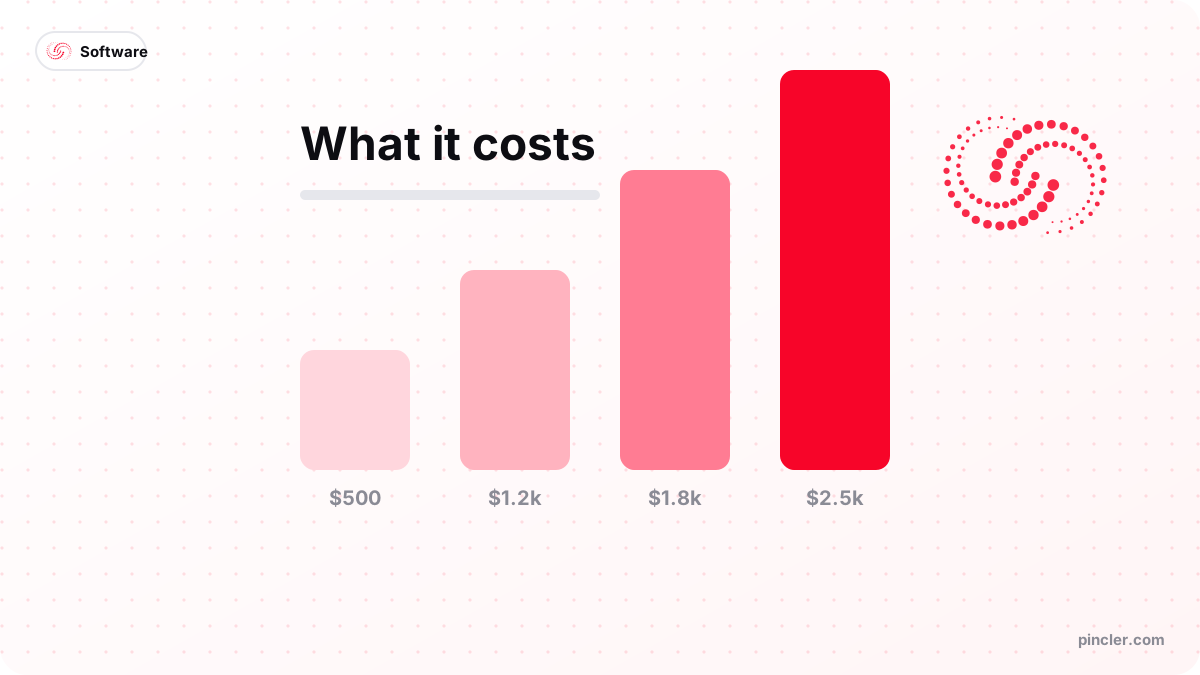
Quick answer
- Build cost
- $900–$2,500 fixed price because AI drafts and senior engineers review and harden every build. Web apps median across 79 published catalogue builds: $1,925.
- Timeline
- 10–16 days for a booking app with calendar sync, payments and WhatsApp confirmations plus reminders.
- Running cost
- Per delivered template message. About $0.0084 combined at Twilio's listed US rates; varies by country and volume tier.
- Monthly example
- 600 appointments, two utility templates each = 1,200 messages ≈ $10 a month at those rates, plus hosting.
- Prerequisite
- A verified WhatsApp Business account and documented opt-in that names your business before any template is sent.
- Not for
- Businesses with no repeat contact, or markets where customers do not use WhatsApp — SMS or email is cheaper and simpler.
A booking app with WhatsApp notifications costs $900 to $2,500 as a fixed-price build at PINCLER, delivered in 10 to 16 days, because AI writes the first draft and senior engineers review, test and harden it — plus a running message cost that is separate from the build and never goes away. At the rates published on Twilio's WhatsApp pricing page at the time of writing — $0.005 per message to Twilio plus a $0.0034 Meta fee for a utility template — a clinic sending a confirmation and a reminder for 600 appointments a month pays about $10 a month in messages. That split is the part buyers get caught out by, so this article prices both halves.
The reason the running cost surprises people is that WhatsApp changed how it bills. Meta's own developer documentation states that "Effective July 1, 2025, Meta charges on a per-message basis" and that "You are only charged when a template message is delivered". Before that, businesses were billed per 24-hour conversation. Anyone quoting you a conversation-based budget is working from a model Meta has retired.
There is a second surprise, and it is a compliance one rather than a billing one. You cannot message customers on WhatsApp without opt-in. Meta's opt-in documentation requires that the opt-in clearly states "that a person is opting in to receive communication from the business" and names "the business's name that a person is opting in to receive messages from". A booking form that quietly collects a phone number is not consent, and building the opt-in properly is a design decision, not a checkbox added at the end.
Below: what the build contains, how the four message categories are billed, a worked monthly cost model at four volumes, how that compares with the published market, and when SMS or email is the better answer.
What Does a Booking App With WhatsApp Notifications Cost?
The build is $900 to $2,500 fixed price, delivered in 10 to 16 days. That covers a public booking page with real availability, staff and resource calendars, buffer and lead-time rules, a customer confirmation and reschedule flow, an admin view, calendar sync, an optional payment step, and the WhatsApp notification layer with templates submitted for approval. The price does not change if the estimate was wrong.
The running cost is separate and it is per message. Budget it from your appointment volume, not from a flat monthly figure, because that is how Meta bills. A single-location salon with 200 appointments a month and a multi-site clinic with 5,000 pay very different amounts for identical software, and any quote that folds messaging into a fixed monthly line item is either marking it up or capping your volume.
PINCLER is an AI-first custom software development studio. We build online booking and appointment systems, WhatsApp business assistants and calendar and scheduling integrations using Next.js, Postgres, the WhatsApp Business Platform and providers such as Stripe. Every project is fixed price between $500 and $2,500, and larger scopes are split into phases rather than quoted higher.
| Cost line | Amount | Frequency |
|---|---|---|
| Booking app build, including WhatsApp layer | $900–$2,500 | One-off, fixed price |
| Hosting and database (Vercel Pro + Supabase Pro, list prices) | About $45 | Monthly |
| WhatsApp utility templates (Twilio + Meta fee, listed rates) | About $0.0084 each | Per delivered message |
| Replies inside the 24-hour service window | No Meta fee | Per message |
How Does WhatsApp Business Platform Pricing Actually Work in 2026?
Meta bills per delivered template message, in one of four categories, with a 24-hour window in which most of your conversation is free. Meta's pricing documentation states that "All non-template messages are free" when sent within an open customer service window, that "Utility templates delivered within an open customer service window are free", and that service conversations have been free for all businesses since 1 November 2024.
The window matters more than the rate. Meta's documentation describes a customer service window that opens when a customer messages your business and stays open for 24 hours after their last message. Twilio's WhatsApp pricing page puts it plainly: "A customer service window lasts for 24 hours after you receive a customer-initiated WhatsApp message", and "During a customer service window, Meta does not charge for utility template messages or free-form messages". There is also a free entry point window: when a business replies within 24 hours to a customer who arrived through a Click to WhatsApp advert or a Facebook Page button, Meta's documentation states that "All messages are free for 72 hours".
On the actual rates, be careful with numbers you find in blog round-ups — they disagree with each other. The figures worth working from are the ones a provider publishes for its own service. At the time of writing, Twilio's WhatsApp pricing page lists "Twilio's per-message fee for WhatsApp is $0.005, inbound or outbound", plus a Meta fee of "$0.0034 /message" for a utility template sent outside the customer service window and the same $0.0034 for an authentication template. Meta's own documentation is explicit that "Rates vary based on template category, volume tier, and country/region rate", with rate cards effective 1 July 2026 and further market changes effective 1 October 2026, so confirm the card for the countries you actually message.
Did the customer message you in the last 24 hours?

   YES -> Reply free-form or with a utility template
          -> No Meta fee (service window is open)

   NO  -> Is the message about their booking?
            YES -> UTILITY template  -> charged per message
            NO  -> Is it a login or verification code?
                     YES -> AUTHENTICATION template -> charged
                     NO  -> MARKETING template -> charged,
and needs explicit opt-in| Category | Typical booking use | When there is no Meta fee |
|---|---|---|
| Service (free-form) | Answering a customer's question about a slot | Any time inside the 24-hour customer service window |
| Utility | Booking confirmation, reminder, reschedule, receipt | When delivered inside an open service window |
| Authentication | One-time codes for a customer portal login | Charged per delivered message |
| Marketing | "Time for your next appointment" re-engagement | Charged per delivered message; opt-in required |
What Will the WhatsApp Messages Cost Me Each Month?
Work it out from appointments, not from guesswork. Most booking systems send two utility templates per appointment: a confirmation at the time of booking and a reminder 24 hours before. Some add a third for a receipt or a follow-up. Multiply appointments by templates per appointment, then by the per-message rate for your market.
Using Twilio's listed rates — $0.005 to Twilio plus $0.0034 to Meta for a utility template outside the service window — the combined cost is $0.0084 per message. Every input in the table below is that arithmetic and nothing else. A clinic with 600 appointments a month sending two templates each sends 1,200 messages, which is 1,200 × $0.0084 = $10.08.
Two adjustments matter in practice. First, a meaningful share of your messages will land inside an open service window, because customers reply to confirmations — those carry no Meta fee, so real bills usually come in under the table. Second, rates in other markets differ from the US card, and marketing templates cost more than utility ones everywhere. Treat the table as a method, not as your invoice.
There is also a reason to send the reminder at all, and it is not a small one. Lin and colleagues, in a randomised controlled trial published in the International Journal of Pediatrics in 2016, reported no-show rates of 23.5% in the text-reminder group against 38.1% in the control group across 170 enrolled patients at a paediatric clinic. If a reminder costs under a cent and a missed appointment costs you an hour of a practitioner's time, the payback arithmetic is not close.
| Appointments per month | Utility templates sent | Estimated monthly message cost |
|---|---|---|
| 200 | 400 | $3.36 |
| 600 | 1,200 | $10.08 |
| 2,000 | 4,000 | $33.60 |
| 5,000 | 10,000 | $84.00 |
What Goes Into the Build, and What Does $2,500 Not Buy?
The build is one booking workflow done properly, with WhatsApp as the notification channel rather than as a separate product. Concretely: availability that reflects real staff calendars, rules for buffers, lead times and cancellation windows, a reschedule link that does not require an account, an admin view for the team, calendar sync, an optional deposit or full payment, and the WhatsApp templates written, submitted and approved before launch.
What it does not buy is a messaging platform. Two-way AI conversation, a shared team inbox with assignment and SLAs, campaign broadcasting with segmentation, and multi-language template libraries are separate builds — good ones, but not the same brief. A conversational WhatsApp assistant that handles enquiries as well as bookings is its own project; we cost that separately in WhatsApp chatbot cost.
It also does not buy the account. You need a verified WhatsApp Business account and a Business Solution Provider relationship, template approval takes time, and the opt-in has to exist in your booking flow before a single template goes out. We set all of that up as part of the build, but the approvals belong to your business and Meta's timelines are not ours to compress.
- Included: booking page, availability engine, staff and resource calendars, reschedule and cancel flows, admin dashboard, calendar sync.
- Included: WhatsApp confirmation and reminder templates, opt-in capture with a timestamped record, delivery status handling and retries.
- Included: source code in your GitHub organisation, your cloud account, your Meta account, and a 14–60 day bug-fix warranty by tier.
- Separate phase: two-way AI conversation, shared team inbox, marketing broadcasts, loyalty programmes, native mobile apps.
How Does That Compare With the Published Market?
Published guides for this category start about ten times higher, and their arithmetic is sound for a staffed team. LI Solutions' 2026 booking system cost analysis puts a booking MVP for a single business at $25,000–$60,000 over eight to sixteen weeks, a full booking product at $80,000–$180,000, and a multi-property platform at $120,000–$250,000 and climbing. Clutch's 2026 pricing guide reports most listed development companies charging $24–$49 per hour, which is how a booking MVP reaches five figures without anyone padding an invoice.
PINCLER's number is lower because the production method differs, not because the scope is thinner. AI drafts the schema, the availability logic, the API layer and the test suite; senior engineers own the timezone handling, the double-booking guarantees, the payment reconciliation and the security review. Timezone and concurrency bugs are the two things that actually break booking systems, and both are review problems rather than typing problems, which is precisely why the review stays.
The honest comparison is not price against price, it is scope against scope. A $60,000 booking MVP typically includes discovery workshops, bespoke design, a dedicated project manager and a longer warranty. If you need those, buy them. If you need a booking app that takes bookings, sends WhatsApp confirmations and does not double-book, that fits inside $2,500 and ships in a fortnight.
| Scope | Published market figure | PINCLER fixed price |
|---|---|---|
| Booking MVP, single business | $25,000–$60,000 over 8–16 weeks (LI Solutions, 2026) | $900–$2,000 in 10–16 days |
| Full booking product, multi-staff | $80,000–$180,000 over 4–6 months (LI Solutions, 2026) | $1,500–$2,500, phased |
| Multi-property platform | $120,000–$250,000 and climbing (LI Solutions, 2026) | Phased; each phase ships usable software |
Do You Actually Need WhatsApp, or Will SMS or Email Do?
Use WhatsApp when your customers already use it, when your messages benefit from images or buttons, and when you want replies. Its advantage over SMS is not price — it is that the conversation continues in a thread the customer keeps, and that inbound replies open a free 24-hour window in which you can talk without per-message template fees.
Do not use WhatsApp if your customers are in markets where it is not the default messenger, if you send one message per customer per year, or if you cannot collect opt-in honestly. Meta's documentation notes that businesses can be rate limited if quality stays low for a sustained period, and low quality is what happens when people receive messages they did not agree to. Email costs effectively nothing and asks no consent question of this kind, and if a Calendly subscription with email reminders already covers your bookings, subscribe and build nothing.
The middle path is worth considering: email for the receipt, WhatsApp for the reminder. Reminders are where the value is, they are short, and they are the message customers actually want. If you are still choosing between building and subscribing, Calendly versus custom booking software works through that decision, and how to build an online booking system covers the mechanics.
- Good fit: clinics, salons, tutors, garages, home services — repeat appointments, high no-show cost, customers who already message you.
- Good fit: businesses whose customers reply, because inbound replies open a free window and cut your template spend.
- Poor fit: one-off bookings with no follow-up, or markets where WhatsApp penetration is low and SMS is the norm.
- Poor fit: any business that cannot show where and when each customer agreed to be messaged.
What Are the Most Common Mistakes With WhatsApp Booking Notifications?
The failures cluster in the same five places, and four of them are decided before any code is written. None of them are exotic; they are simply the parts that a booking brief tends to skip because they are not visible on a screen.
The last one is the expensive one. Categories are assigned to templates, and a template that reads like a promotion can be classified as marketing even when you think of it as a reminder. Write utility templates that are strictly about the customer's own booking, and keep the offers in a separate, opt-in marketing template.
- 1. Treating opt-in as a tick box. Meta requires the opt-in to state that the person is agreeing to receive messages and to name your business. Record when and where it was given.
- 2. Budgeting per conversation. Meta retired conversation-based billing on 1 July 2025; budget per delivered template message instead.
- 3. Ignoring the 24-hour window in the design. Prompting a reply on the confirmation opens a free window and reduces template spend on everything that follows.
- 4. Building reminders without idempotency. A retry loop that fires twice sends the customer two reminders and bills you twice; the scheduler needs a delivered-once guarantee.
- 5. Writing promotional copy inside a utility template. Category is assigned at approval, and the wrong category costs more and risks rejection.
PINCLER's Perspective on Pricing This Build
Across the 79 builds in PINCLER's published fixed-price catalogue the median price is $1,450 and the median quoted delivery 13 days, with web apps higher at $1,925 and 18 days. A booking app with WhatsApp notifications lands in that upper band, because the scheduling logic and the notification pipeline both need genuine review time rather than generated code accepted as-is.
The parts we never hand to AI unsupervised are the same parts that break in production: timezone arithmetic across daylight-saving boundaries, concurrent booking attempts on the last remaining slot, payment and refund reconciliation, and the retry logic on message delivery. AI writes the first draft of all of it and a senior engineer reads every line, which is what keeps a $1,900 booking system from behaving like a $1,900 booking system.
We also separate the two costs on the quote, deliberately. The build is fixed and ours; the message spend is variable and Meta's, and it lands on your account with your Business Solution Provider rather than being marked up through us. Clients who have been quoted an all-inclusive monthly figure elsewhere are usually paying a margin on messages they could buy directly. The fixed pricing bands and the published catalogue in what you can build — advertised prices, not a delivery record — carry the same numbers we quote on a call.
The Bottom Line
Budget two numbers, not one. The build is $900–$2,500 fixed price over 10 to 16 days; the messages are a few cents per appointment and scale with volume, with a large share falling inside free windows once customers start replying.
Get the opt-in right, keep utility templates strictly transactional, and check Meta's current rate card for the countries you message before you commit to a monthly figure. If you want the build scoped, the free 30-minute call returns a written fixed quote within a working day, and the online booking system page shows the finished shape.
Related PINCLER builds
Frequently asked
How much does a booking app with WhatsApp notifications cost?
The build is $900–$2,500 fixed price at PINCLER, delivered in 10 to 16 days because AI drafts it and senior engineers review and harden it, and the WhatsApp messages are billed separately per delivered template. At the rates listed on Twilio's WhatsApp pricing page at the time of writing, a utility template costs about $0.0084 all in, so 1,200 messages a month is roughly $10. Published market guides put the same build at $25,000–$60,000.
Does WhatsApp charge per message or per conversation in 2026?
Per message. Meta's developer documentation states that effective 1 July 2025 it charges on a per-message basis and that you are only charged when a template message is delivered. The earlier model billed per 24-hour conversation. Any budget built on conversation pricing is out of date, and rates now vary by template category, volume tier and recipient country.
Which WhatsApp messages are free?
Service messages are free for all businesses, and Meta's documentation states that non-template messages sent inside an open customer service window are free, as are utility templates delivered within that window. The window opens when a customer messages you and lasts 24 hours after their last message. A free entry point window from Click to WhatsApp adverts gives 72 hours of free messaging.
Do I need customer opt-in before sending WhatsApp booking reminders?
Yes. Meta requires opt-in before template messages, and the opt-in must state that the person is agreeing to receive communication from the business and must name the business. It can be collected outside WhatsApp — on a website, by SMS, over the phone or on paper. Build it into the booking form and store a timestamped record of when and where consent was given.
What ongoing costs does a WhatsApp booking system have?
Three: hosting, message fees and your Business Solution Provider account. Hosting a small booking app on Vercel Pro and Supabase Pro is about $45 a month at list prices. Messages are billed per delivered template and scale with appointment volume. Provider fees vary — Twilio, for example, publishes a $0.005 per-message platform fee on top of Meta's charge.
Are WhatsApp reminders worth the cost compared with no reminders?
Usually, by a wide margin. Lin and colleagues, in a randomised controlled trial published in the International Journal of Pediatrics in 2016, reported no-show rates of 23.5% with text reminders against 38.1% without, across 170 enrolled patients at a paediatric clinic. When a reminder costs a fraction of a cent and a missed appointment costs a practitioner's hour, the arithmetic favours sending it.
Can I use SMS or email instead of WhatsApp?
Yes, and sometimes you should. Email costs effectively nothing per message and suits receipts; SMS is the better default in markets where WhatsApp is not the common messenger. WhatsApp earns its fee when customers reply, because inbound replies open a free 24-hour window and because threaded conversation with buttons and images reduces phone calls to your team.
Sources
- Meta for Developers — WhatsApp Business Platform Pricing
- Meta for Developers — Get opt-in for WhatsApp
- Twilio — WhatsApp Pricing
- LI Solutions — Booking System Cost (2026)
- Clutch — Software Development Pricing Guide (2026)
- Lin et al. — Text Message Reminders Increase Appointment Adherence (2016)
- Vercel — Pricing
- Supabase — Pricing
Want to build this?
PINCLER builds custom software, AI agents and GTM systems for a fixed price between $500 and $2,500, delivered in 3–30 days, with the code owned by you.
Keep reading
Related articles
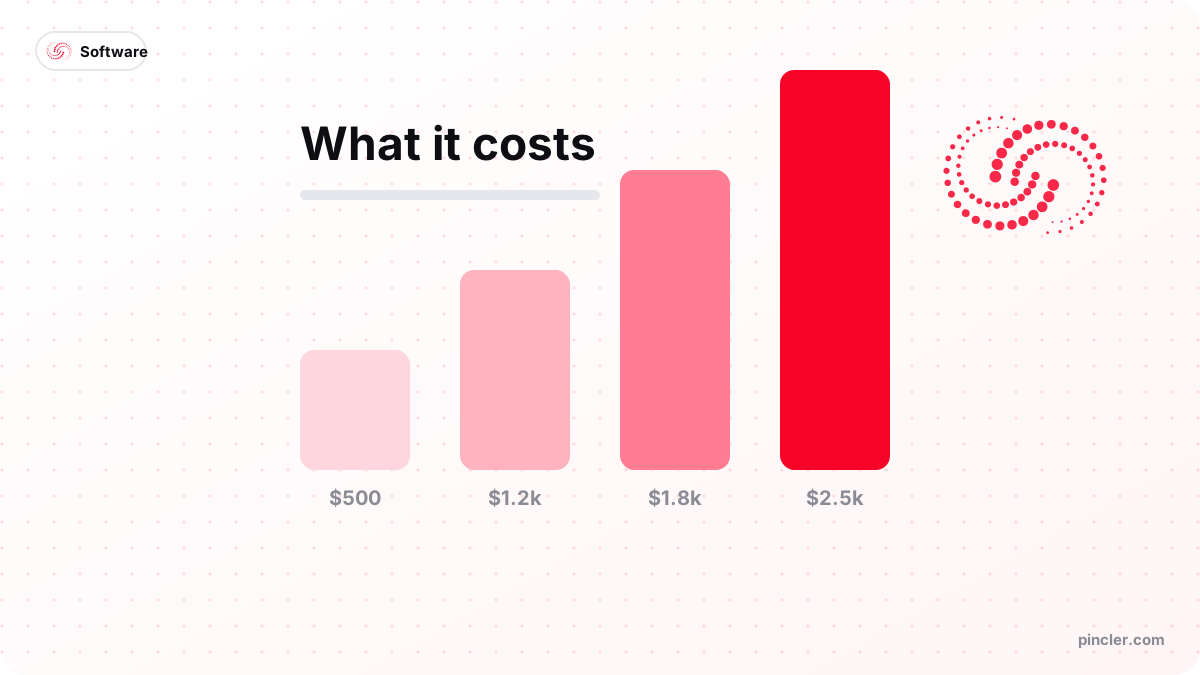
How Much Does a Telegram Mini App Cost to Build?
Telegram Mini App development cost: $500–$2,500 fixed price — AI-drafted, senior-reviewed — against agency guides of $10,000–$80,000. What that buys and what it does not.
How to Build an Online Booking System
How to build an online booking system: the six core components, a step-by-step build plan, realistic timelines, and when a SaaS scheduler is the smarter choice.
Online Booking System vs Booking Software: Build or Buy?
Online booking system vs booking software: when an off-the-shelf scheduler wins, when a custom build pays for itself, and the three-year arithmetic behind the choice.