How Much Does a Telegram Mini App Cost to Build?
Telegram Mini App development cost: $500–$2,500 fixed price — AI-drafted, senior-reviewed — against agency guides of $10,000–$80,000. What that buys and what it does not.
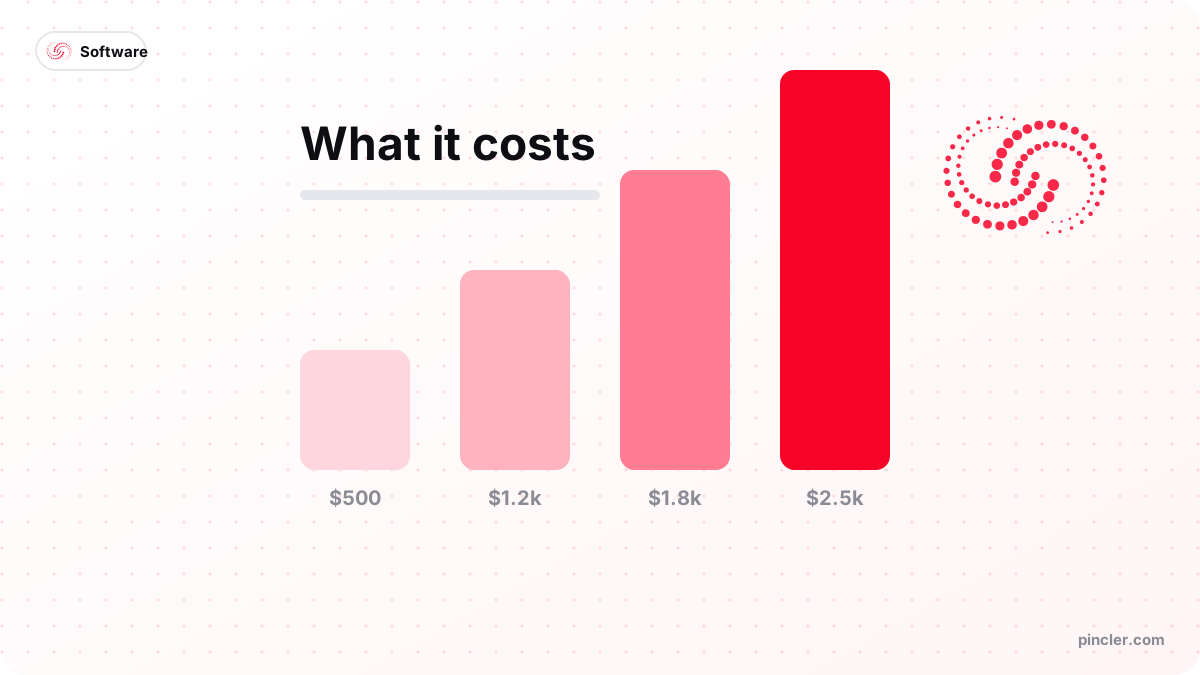
Quick answer
- Cost
- $500–$2,500 fixed price, because AI drafts and senior engineers review and harden. Utility Mini Apps from $500; payments plus admin panel up to $2,500.
- Timeline
- 4–26 days. Simple Mini Apps ship in under 10; catalogue plus payments plus admin runs 16–26.
- Market comparison
- CimpleO's 2026 guide: $10,000–$20,000 simple, $20,000–$35,000 booking, $40,000–$80,000 B2B portal with ERP integration.
- Payments
- Telegram Stars (XTR) are mandatory for digital goods; cards and 20+ providers are available for physical goods and services.
- Best for
- Communities, small commerce, bookings and internal tools where your audience already lives inside Telegram.
- Not for
- Products needing background processing, push independence, offline use or an audience that is not on Telegram.
A Telegram Mini App costs $500 to $2,500 as a fixed-price build at PINCLER, delivered in 4 to 26 days, because AI writes the first draft and senior engineers review, test and harden it. Published agency guides sit an order of magnitude higher: CimpleO's 2026 Telegram Mini App pricing guide puts a simple internal-tool Mini App at $10,000–$20,000 over four to six weeks, a booking Mini App at $20,000–$35,000, and a full B2B portal with ERP integration at $40,000–$80,000. Both numbers can be right; they describe different production methods, and this article explains the difference and the scope boundary that comes with it.
That boundary matters more here than in most categories. Readers arriving from those five-figure pages have calibrated their expectations to a five-figure scope, so a low Telegram Mini App development cost invites the wrong assumption — that the same feature list is on offer for a twentieth of the money. It is not: what fits under $2,500 is one Mini App doing one job well.
The technical ground is unusually favourable, which is a large part of why the price works. A Mini App is a web page that Telegram opens inside its own client, so there is no app store review, no native build and no separate login: Telegram passes your page an initData payload that your server verifies cryptographically. Below: how that works, how payments work, and when a Mini App is the wrong build entirely.
How Much Does a Telegram Mini App Cost to Build?
Between $500 and $2,500, fixed price, with delivery from 4 to 26 days. A community or utility Mini App attached to a bot starts at $500 and ships in a week; a Mini App with a catalogue, a cart, Stars or card payments and an admin panel reaches the $2,500 ceiling and takes three to four weeks. The price is set before work starts and does not move.
The published market sits far above that. CimpleO's 2026 Telegram Mini App pricing guide puts a simple internal-tool Mini App of three to five screens with no payments at $10,000–$20,000 over four to six weeks, a booking or appointment Mini App at $20,000–$35,000 over six to ten weeks, and a full B2B portal with ERP integration at $40,000–$80,000. CimpleO's guide prices the payment work separately again, at $2,000–$5,000 to add Telegram Pay and $1,000–$2,500 to add Stars.
Neither figure is wrong. Clutch's 2026 pricing guide reports most listed development companies charging $24–$49 per hour, so a team billing 400 hours arrives at CimpleO's lower band honestly. PINCLER's number is lower because AI writes the first draft — the Mini App shell, the initData verification, the data layer, the tests — and senior engineers review the architecture, the payment handling and the security before release. The review is where the cost that protects you sits, and it is the part that does not compress.
PINCLER is an AI-first custom software development studio. We build Telegram and Discord bots and Mini Apps, payment gateway integrations and the API backends behind them, all fixed price between $500 and $2,500, with larger ideas split into phases that each ship something usable.
| Mini App type | Fixed price | Typical delivery |
|---|---|---|
| Community or utility Mini App attached to a bot | $500–$1,200 | 4–9 days |
| Loyalty, referral or leaderboard Mini App | $1,000–$2,000 | 10–16 days |
| Booking or order-taking Mini App with payments | $1,200–$2,200 | 10–18 days |
| Catalogue, cart, payments and admin panel | $1,800–$2,500 | 16–26 days |
What Is a Telegram Mini App and How Does It Work?
A Mini App is a web page that Telegram opens inside its own client, with a JavaScript bridge to Telegram features. There is no app store submission, no native binary and no separate sign-up flow, which is why the build is cheaper than a mobile app of similar scope. You write a normal web application, Telegram frames it, and the user never leaves the chat.
Telegram's Mini Apps documentation lists seven launch surfaces: a keyboard button, an inline button, the bot's menu button, a Main Mini App button on the bot profile, a direct link of the form t.me/botusername/appname with an optional startapp parameter, inline mode results, and the attachment menu. That variety matters commercially — the same build can be reached from a chat, a channel post, a link in an advert and a button on your website.
Authentication is the part that surprises people, because it is essentially free. When the Mini App opens, Telegram passes an initData payload containing the user's id, first name, username, language code, an auth_date timestamp and a hash. Telegram's documentation instructs the server to "compare the received hash parameter with the hexadecimal representation of the HMAC-SHA-256 signature of the data-check-string with the secret key, which is the HMAC-SHA-256 signature of the bot's token", using WebAppData as the constant key. Verify that, and you have a trusted Telegram user id with no password, no email confirmation and no OAuth flow to build.
User taps your Mini App button inside Telegram
        |
        v
Telegram opens your web page in its own client
        |   and passes window.Telegram.WebApp.initData
        v
Your server recomputes the HMAC-SHA-256 hash
        |
        +-- hash matches --> trusted Telegram user id
        |                    (no login screen, no password)
        |
        +-- hash fails ----> reject the request

Never trust initData that has not been verified
server-side. The client can send anything.
What Can a Mini App Do That a Plain Bot Cannot?
A bot is a conversation; a Mini App is an interface. Anything needing a multi-field form, a scrolling list, a map, a calendar, a cart or a chart is painful in chat and straightforward in a Mini App. The bot stays useful as the notification channel and the entry point, which is why most builds ship both.
The platform gives the web page real device and account capability. Telegram's documentation describes theme parameters that match the client's light and dark modes, main, secondary and back buttons rendered by Telegram itself, cloud storage of up to 1,024 items per user, device storage of 5MB, secure storage of 10 items, biometric authentication with token management, geolocation, accelerometer and gyroscope access, haptic feedback, invoice opening for payments, and sharing media to chats and stories.
Cloud storage deserves a mention on a budget build, because it removes work. Per-user state that would otherwise need a database table and a sync strategy can live in Telegram's own cloud storage, keyed to the user, available on every device they sign in from. Used well, it takes a day out of a small build. Used badly — for anything you need to query, report on or trust — it creates a data model you cannot audit.
- Use a Mini App when the task needs a screen: catalogues, carts, calendars, dashboards, multi-step forms, maps, leaderboards.
- Keep the bot for what chat does well: notifications, confirmations, quick commands, and the button that opens the Mini App.
- Use cloud storage for preferences and drafts; use your own database for anything with money, history or reporting attached.
- Use biometrics and secure storage when a returning user needs to reauthorise a sensitive action, not as a substitute for server-side checks.
How Do Payments Work in a Telegram Mini App?
There are two mechanisms and the choice is not yours to make freely — it depends on what you sell. Telegram's payments documentation for digital goods is explicit: "all sales of digital goods and services are carried out exclusively in Telegram Stars" and "Payments for digital goods and services must be carried out exclusively in Telegram Stars." The reason is app store policy, and the consequence is stated equally plainly: "Telegram cannot display your bot or mini app to mobile users if you attempt to sell digital goods and services via other currencies or through third-party payment providers."
For physical goods and real-world services, the Payments API and card providers apply instead. Telegram's documentation states that "Telegram does not charge any commission for using the Payments API", that bots can "Accept payments from over 200 countries using more than 20 providers", and that "Telegram does not process payments from users and instead allows developers to integrate directly with different third-party payment providers" — so card details never touch Telegram or your bot. The provider's own fees apply; the documentation gives Stripe's US rate as "2.9% + 30¢ per successful card charge" as an example.
Practically, this means the classification of your product decides the build. A course, a subscription, an in-app upgrade or a digital collectible is Stars, with refunds issued through the refundStarPayment method on the Bot API. A restaurant order, a salon appointment or a shipped product is a card provider. Getting this wrong is not a minor rework — it changes the checkout, the refund path, the accounting and, for digital goods, whether Telegram will show your Mini App to mobile users at all.
| What you sell | Payment mechanism | Fees |
|---|---|---|
| Digital goods and services | Telegram Stars (XTR) only | Telegram's Star pricing applies; refunds via refundStarPayment |
| Physical goods | Payments API with a card provider | No Telegram commission; provider fees, e.g. Stripe US 2.9% + 30¢ |
| Real-world services and bookings | Payments API with a card provider | No Telegram commission; provider fees apply |
What Does $2,500 Buy, and What Does It Not?
It buys one Mini App with one core flow, finished. A catalogue or a booking calendar, a checkout through Stars or a card provider, verified initData authentication, an admin view for you to manage content and orders, the companion bot for notifications, and deployment on your own hosting. Source code goes to your GitHub organisation and the bot token stays in your account.
It does not buy the things the five-figure pages are quietly including. Multi-tenant architecture where each client gets their own instance, ERP or warehouse integration, a token or crypto economy with on-chain settlement, localisation into six languages with a translation workflow, custom illustration and motion design, or an ongoing growth and moderation service. Those are legitimate scopes and they cost what they cost — they simply do not fit in one phase here.
The workable pattern for a bigger ambition is phasing rather than a bigger budget. Phase one ships the Mini App with one revenue flow and real users. Phase two adds the integration or the second market once phase one has told you whether anyone wants it. Each phase is fixed price and each ships something you can use, which is a materially different risk profile from a single four-month engagement. If you are working out where to draw the line, how to scope a project to fit a budget is the practical version of this argument.
| Scope | Published market figure (CimpleO, 2026) | PINCLER fixed price |
|---|---|---|
| Simple internal-tool Mini App, 3–5 screens | $10,000–$20,000 over 4–6 weeks | $500–$1,200 in 4–9 days |
| Booking or appointment Mini App | $20,000–$35,000 over 6–10 weeks | $1,200–$2,200 in 10–18 days |
| B2B portal with ERP integration | $40,000–$80,000 | Phased; each phase $500–$2,500 |
Who Should Build a Telegram Mini App, and When Should You Not?
Build one when your audience is already on Telegram. Communities with an existing channel, businesses in markets where Telegram is a primary messenger, and products whose users are reached through channel posts get distribution that a standalone web app has to buy. The absence of app store review also means you can ship a change on a Tuesday afternoon rather than waiting on a submission queue.
Do not build one when Telegram is not where your customers are. A Mini App reaches Telegram users and nobody else, and no amount of good engineering fixes an audience mismatch. If your customers are on WhatsApp, a WhatsApp business assistant is the equivalent build on the channel they actually use, and we cost that in WhatsApp chatbot cost.
Do not build one when the product needs to run independently of the client — background processing on a schedule, offline use, deep native device integration, or notifications you control end to end. And do not build a Mini App as your only surface if you also need a public website for search traffic; a Mini App is not indexed the way a website is. Where you are choosing between a bot, a Mini App and a chatbot on another channel, AI chatbot development cost compares the options on price.
- Good fit: an existing Telegram channel or group with an audience you already reach.
- Good fit: small commerce, bookings, loyalty schemes, member directories, internal tools for a distributed team.
- Poor fit: audiences that do not use Telegram, or products that need to be found through search.
- Poor fit: anything requiring offline operation, background schedules under your control, or heavy native device features.
What Are the Most Common Mistakes When Building a Mini App?
The failure modes are consistent and mostly architectural. The first is the most serious, because it is a security hole rather than an inconvenience, and it appears in a striking amount of tutorial code.
The other recurring error is commercial: choosing the payment rail after the build rather than before it, when it shapes the checkout, the refund path and the accounting from day one.
- 1. Trusting initData without verifying it. The client can send any payload it likes. Recompute the HMAC-SHA-256 hash server-side on every request and reject anything that does not match.
- 2. Using the Telegram user id as the only identity. Keep your own user record keyed to it, so the account survives if you later add a web or WhatsApp surface.
- 3. Choosing the payment rail late. Digital goods must use Stars; physical goods use a card provider. Decide before the schema, not after the checkout is built.
- 4. Putting real business data in cloud storage. It is capped at 1,024 items per user, it is per-user, and you cannot query or report on it. Use a database for anything that matters.
- 5. Ignoring the theme parameters. A Mini App that renders white text on white in dark mode looks broken, and Telegram supplies the palette for free.
PINCLER's Perspective on Mini App Pricing
Across the 79 builds in PINCLER's published fixed-price catalogue the median price is $1,450 and the median quoted delivery 13 days, with chatbots at $1,375 and 13 days. Mini Apps sit across that band and the web apps band above it, depending on whether payments and an admin panel are in scope. The bands measure reach at a build's published starting price: a $1,000 budget reaches 55 of the 79, and a $2,000 reaches all 79.
What makes the price hold in this category is that Telegram supplies so much of what would otherwise be built: identity from verified initData, distribution from the channel rather than an app store listing, payments from Stars or a provider rather than a bespoke checkout. Removing three subsystems from a build removes them from the invoice, and that is a structural saving rather than a discount.
The senior review still happens on every project, and on Mini Apps it concentrates on three things: the initData verification path, the payment and refund handling, and the boundary between what the client may assert and what the server decides. Those are the places where generated code looks correct and is not. Across the catalogue, the tooling listed most often is GPT on 76 builds, Cursor on 75 and Claude Code on 63 — the drafting is fast, the reading is not, and the reading is what we charge for.
You keep everything: the repository in your GitHub organisation, the bot token in your account, the database in your cloud, and a bug-fix warranty of 14 to 60 days by tier. The fixed pricing bands and the catalogue behind them — advertised prices, not a delivery record — are at what you can build.
The Bottom Line
A Telegram Mini App is one of the cheapest ways to put a real interface in front of an existing audience, because Telegram supplies identity, distribution and payments and you supply one well-built flow. At PINCLER that is $500–$2,500 fixed price in 4 to 26 days. CimpleO's 2026 guide puts comparable scopes at $10,000–$80,000.
Decide the payment rail before the build, verify initData on the server, and be honest about whether your customers are on Telegram at all. If they are, a free 30-minute call returns a written fixed quote within a working day, and the Telegram and Discord bot page shows the shape of a finished build.
Related PINCLER builds
Frequently asked
How much does a Telegram Mini App cost to build?
A Telegram Mini App costs $500–$2,500 fixed price at PINCLER, delivered in 4 to 26 days, because AI drafts the build and senior engineers review and harden it. CimpleO's 2026 pricing guide puts comparable work at $10,000–$20,000 for a simple internal-tool Mini App, $20,000–$35,000 for a booking Mini App and $40,000–$80,000 for a B2B portal with ERP integration. The difference is production method, not scope thinness.
Why is a Mini App cheaper than a mobile app?
Because Telegram supplies the parts that usually cost the most. A Mini App is a web page Telegram opens in its own client, so there is no app store submission, no native build for two platforms, and no authentication system — Telegram passes verified user data through initData. Removing three subsystems from the build removes them from the price.
How does authentication work in a Telegram Mini App?
Telegram passes an initData payload containing the user's id, name, username, language, a timestamp and a hash. Your server recomputes an HMAC-SHA-256 signature using the bot token and the constant key WebAppData, then compares it with the received hash. If they match, the user id is trustworthy. Never trust initData that has not been verified server-side.
Can I take payments in a Telegram Mini App?
Yes, through two mechanisms. Telegram's documentation states that all sales of digital goods and services are carried out exclusively in Telegram Stars, with refunds through refundStarPayment. Physical goods and real-world services use the Payments API with a card provider — Telegram charges no commission there, and bots can accept payments from over 200 countries using more than 20 providers.
What does a $2,500 Telegram Mini App not include?
It excludes multi-tenant architecture, ERP or warehouse integration, on-chain token economies, six-language localisation with a translation workflow, bespoke illustration and motion design, and ongoing growth or moderation services. Those are real scopes with real costs. The route to them is phasing: each phase is fixed price under $2,500 — AI-drafted, senior-reviewed — and ships software you can put in front of users.
Should I build a Mini App or just a bot?
Build a bot when the interaction is conversational — commands, notifications, quick confirmations. Add a Mini App when the task needs a screen: a catalogue, a cart, a calendar, a chart, or a form with more than two fields. Most projects ship both, with the bot acting as the notification channel and the entry point that opens the Mini App.
How long does Telegram Mini App development take?
Four to twenty-six days. A community or utility Mini App attached to an existing bot ships in four to nine days. A booking or order-taking Mini App with payments takes ten to eighteen. A catalogue with cart, payments and an admin panel runs sixteen to twenty-six. Across PINCLER's 79 published catalogue builds the overall median quoted delivery is 13 days.
Sources
Want to build this?
PINCLER builds custom software, AI agents and GTM systems for a fixed price between $500 and $2,500, delivered in 3–30 days, with the code owned by you.
Keep reading
Related articles
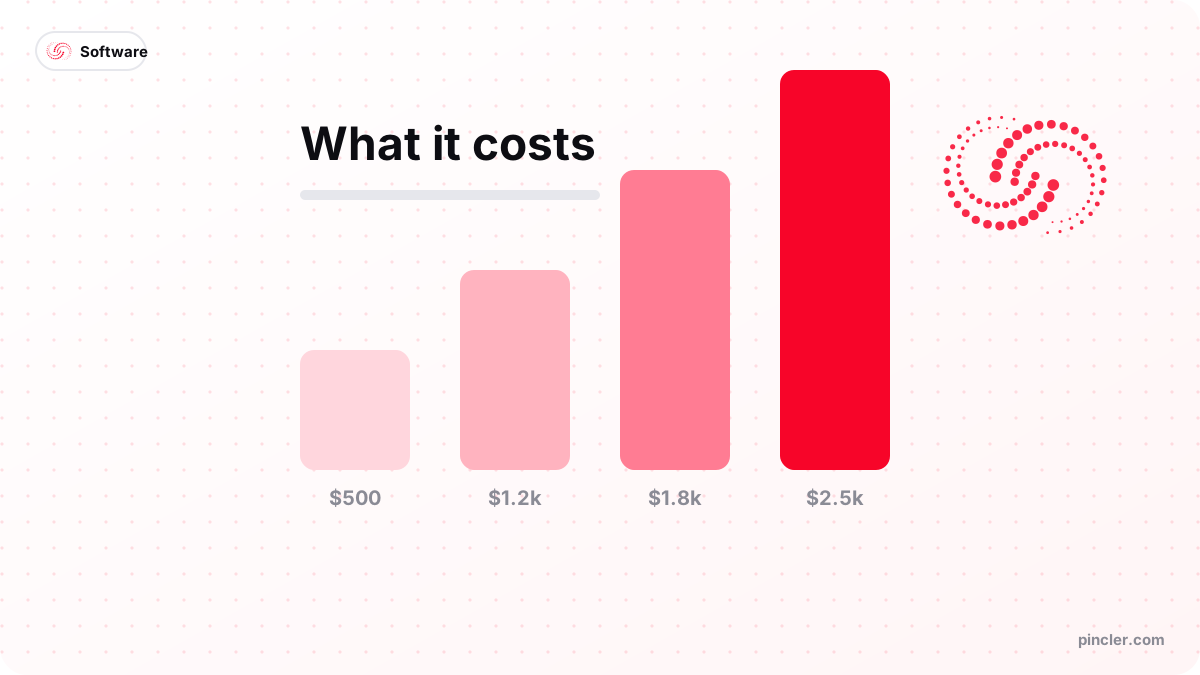
What Does a Booking App With WhatsApp Notifications Cost?
A booking app with WhatsApp notifications costs $900–$2,500 fixed price — AI-drafted, senior-reviewed — plus per-message Meta fees. How WhatsApp billing works and what to budget.
How to Build an Online Booking System
How to build an online booking system: the six core components, a step-by-step build plan, realistic timelines, and when a SaaS scheduler is the smarter choice.
Online Booking System vs Booking Software: Build or Buy?
Online booking system vs booking software: when an off-the-shelf scheduler wins, when a custom build pays for itself, and the three-year arithmetic behind the choice.