How to Build an MVP and Pitch It to Investors
How to build an MVP and pitch investors with it: which metrics to instrument from day one, what traction means at pre-seed, and how to demo without a live failure.
If you plan to build an MVP and pitch investors with it, build the product and the pitch as one project: an MVP that is instrumented from day one generates the exact numbers — activation, retention, early revenue — that the pitch will stand on three months later. Investors at pre-seed and seed are not buying your features; they are buying evidence that you learn fast and that demand is real, and the MVP is the machine that produces both.
The attention economics are unforgiving. DocSend's pitch deck research puts average investor review time at 3 minutes 44 seconds for seed decks, rising only to 4 minutes 10 seconds at pre-seed. Whatever your MVP proves has to survive compression into a few charts that make sense in under four minutes.
This guide covers the build side — what to instrument and why cheap matters — and the pitch side: which metrics carry weight, how to structure the narrative, how to demo safely, and when the honest answer is that you should not be raising yet.
What Do Investors Actually Want From an MVP?
Evidence, in three specific forms: evidence of demand (strangers using and ideally paying), evidence of learning velocity (what you changed and why), and evidence of judgement (what you chose not to build, and what it all cost). A feature tour provides none of these. The most fundable MVP in a pitch is often the smallest one attached to the steepest usage chart.
This reframes the build decision. The question is not 'what will impress investors on screen' but 'what will generate believable numbers fastest'. A SaaS MVP with working auth, billing and a dashboard that twenty strangers pay for beats a polished prototype with a waitlist, because payment converts opinion into data. Investors have seen a thousand demos; they have seen far fewer week-eight retention curves that bend the right way.
How Should You Build the MVP With the Pitch in Mind?
Instrument before you decorate. The build order that serves a future pitch: core workflow first, payments second, analytics events third — all before any visual polish. Every user action that matters (sign-up, activation moment, core action, upgrade, cancellation) should emit an event from day one, because traction charts can only start the day the events do. A founder who adds analytics in month three has deleted their own evidence.
PINCLER is an AI-first custom software development studio, and pitch-bound builds are a pattern we know well: the analytics events, a simple KPI dashboard for cohort and revenue charts, and Stripe from the first release, so revenue data accrues even at tiny volumes. Across the 79 builds PINCLER publishes fixed prices for, the median build is priced at $1,450 on a quoted 13-day delivery — which means the instrumented version of your MVP costs no meaningful premium over the naive version, it is simply a scoping decision made early.
Build cheap, and say so in the pitch. Spending $2,500 where a competitor spent $80,000 to learn the same lesson is not a compromise to apologise for; it is capital efficiency, and it reads as judgement. The cost mechanics are broken down in our SaaS MVP development cost guide if you want the number pinned before you start.
Which Metrics Matter at Pre-Seed and Seed?
The ones that show a repeatable loop forming: people arrive, activate, stay, and pay. Absolute numbers stay small at this stage and investors know it — shape and slope carry the argument. A retention curve that flattens above zero is worth more than any total, because it proves the product holds the users it wins.
| Metric | What it proves | What to show |
|---|---|---|
| Activation rate | Onboarding delivers the core value | % of sign-ups reaching the 'aha' action in session one |
| Cohort retention | The product holds users | Weekly cohorts; a curve that flattens, not falls to zero |
| Revenue / pre-orders | Someone pays | MRR or paid pilots, however small, with growth rate |
| Usage frequency | The problem recurs | WAU/MAU or actions per active user per week |
| Qualitative pull | Demand exceeds supply | Unprompted referrals, inbound requests, waitlist conversion |
How Do You Structure the Pitch Around the MVP?
Put the evidence early and let the MVP carry the middle. DocSend's research found investors spend an average of 3 minutes 44 seconds on a seed deck and that only 58 percent of decks are read to the final slide — so a traction chart on slide three gets seen, and the same chart on slide fourteen may not. The narrative arc that works keeps the MVP as proof, not protagonist: the problem, your insight, and then what happened when the insight met real users.
Practise the sixty-second version of the MVP story: what you built, for how much, what strangers did with it, and what you learnt that competitors do not know. That last clause is the one investors remember — the MVP as an instrument for generating private knowledge about a market. If the raise itself is premature, the same story compounds another quarter and improves; our investor-ready MVP checklist covers what to have in place before the first meeting.
PITCH ARC (MVP as evidence, not protagonist)
problem → insight → MVP built (cost, time)
        → what users did (activation, retention, revenue)
        → what you learnt that others do not know
        → market size → team → the ask → use of funds
What Does the Funding Context Look Like?
Know the round you are actually pitching for. Carta's private-market data put the median seed round at roughly $3 million in 2025, with pre-seed rounds smaller and priced far more on team and evidence than on revenue. At either stage, what the money funds is the search for repeatable growth — not the product build, which modern tooling has made the cheap part.
That context sets the capital-efficiency bar. If the MVP cost $2,500 and three months, the implied question — 'what will you do with a thousand times that?' — has a good answer: buy growth experiments and hires, not software. If the MVP consumed $150,000 before the first user, the same question has a worse one. Walk into the room with the arithmetic of your build in one sentence, because someone across the table will do it anyway.
Timing follows from the same logic. A cheap, instrumented MVP compounds evidence every month you wait, so raising is rarely urgent on the product side — the constraint that forces timing is a growth channel you have proven but cannot afford to feed. Pitch when that sentence is true and the round writes its own use-of-funds slide; pitch before it and you are asking investors to fund a search you could have finished cheaply yourself.
How Do You Demo Without a Live Failure?
Assume the demo will be interrupted, the wifi will wobble, and someone will ask to click around — and prepare for all three. Seed the demo account with realistic data, never lorem ipsum; an empty product looks unloved, and fake-looking data quietly undermines the traction claims made two slides earlier. Script a ninety-second happy path through the one workflow the product does best, and rehearse it until it is boring.
Record that same path as a backup video and keep it one keystroke away. A recording shown confidently after a wifi failure costs nothing; three minutes of live debugging in front of the room costs the meeting. And if an investor wants to explore the product themselves, send a sandbox login after the meeting — enthusiasm plus an unsupervised broken edge case is how demos turn into diligence problems.
How Do You Handle the Questions an MVP Pitch Invites?
Every MVP pitch triggers the same four questions, and rehearsed answers are worth more than extra slides. 'Will it scale?' — the honest answer is that nothing at this stage is built for a million users, and deliberately so: the architecture is standard, the costs are known, and scaling work begins when scaling is the problem. Investors hear over-engineering stories weekly; a founder who spent on evidence instead of imagined scale sounds like an operator.
'Why was it so cheap to build?' — answer with the production method, not an apology: AI-assisted development with senior review has moved the cost of a working product to a few thousand dollars, and the savings sit in your runway. 'What stops a bigger company copying this?' — your compounding private knowledge of users, which the instrumented MVP generates weekly and a copycat starts without. And 'what breaks first if you triple usage?' deserves a specific, technical, unpanicked answer — knowing your bottleneck is more credible than claiming none exists.
The pattern across all four: investors probe an MVP pitch for self-awareness, not perfection. Naming your product's limits precisely, with the plan and price for fixing each one, converts every apparent weakness into evidence that you know exactly where you are.
Who Should Raise on an MVP — and When Should You Not Pitch Yet?
Raise if the opportunity is genuinely venture-scale, the MVP shows a loop forming, and capital is the binding constraint on growth rather than a substitute for demand. Founders in that position pitch from strength: the evidence exists, the burn is low, and the round buys acceleration.
Do not pitch yet if the MVP has no usage — CB Insights' post-mortem analysis found 42 percent of failures cited no market need, and an investor reads an unvalidated product exactly that way. Do not pitch if the metrics are one month old; curves need at least a quarter to mean anything. And consider not pitching at all if the business could simply be profitable: a product covering its costs, as covered in how to make an MVP profitable, turns fundraising into one option among several rather than survival. The strongest position in any pitch meeting is not needing it to succeed.
What Are the Common Mistakes When Pitching an MVP?
Most MVP pitches fail on the same handful of avoidable errors — almost all of them decided weeks before the meeting.
- 1. Pitching the roadmap instead of the evidence — investors fund what happened, discounted by what might.
- 2. No analytics until month three — the traction slide cannot be reconstructed retroactively.
- 3. Vanity totals instead of cohorts — cumulative sign-up charts convince nobody who matters.
- 4. A live demo with no seeded data and no backup recording.
- 5. Overspending on the build, then explaining low runway — capital inefficiency is read as a judgement signal.
- 6. Raising to discover demand — the round funds scaling demand you have already demonstrated.
PINCLER's Perspective: Cheap Builds Are Pitch Assets
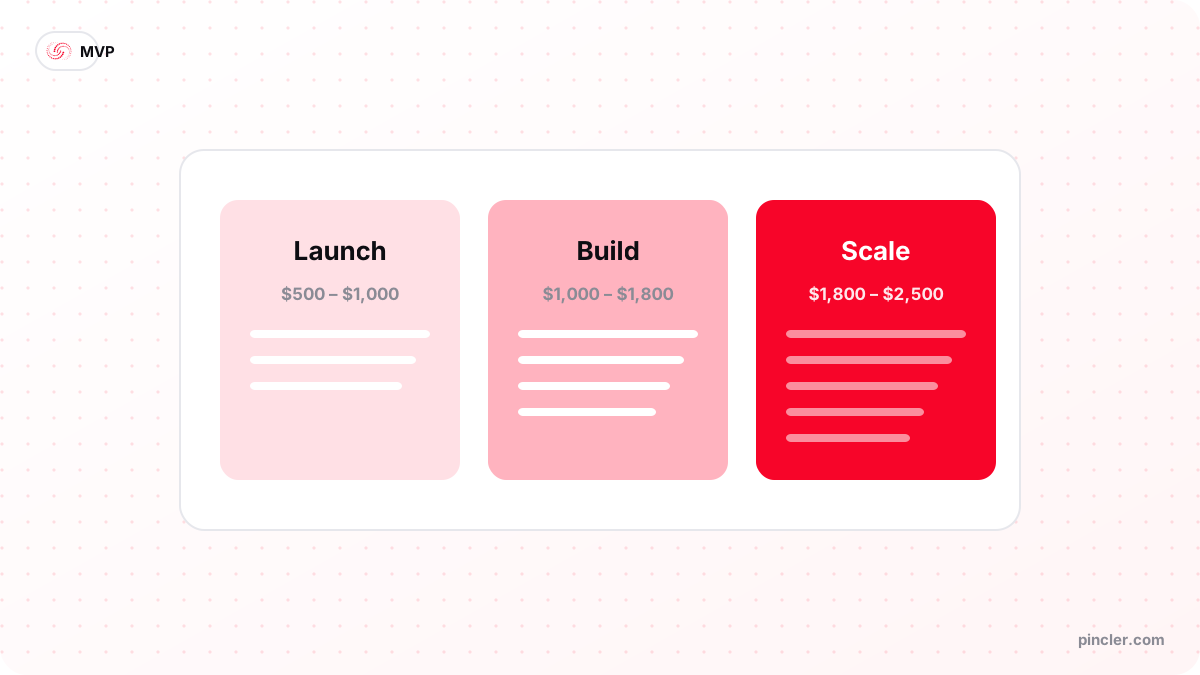
Across the 79 catalogue builds PINCLER lists prices for — every one fixed-price between $500 and $2,500, median $1,450 quoted at 13 days — the fundraising-relevant pattern is what low build cost does to a cap table story: founders arrive at their first pitch with the product built, usage accruing, and nearly all of their pre-seed capital still unspent. The dataset is public at our research page.
Two details investors check in diligence are built into how we work: the code sits in the founder's own GitHub from day one, and the scope document shows exactly what was bought for what price. Clean ownership and a legible cost history are small things until the week someone's lawyer asks for them — at which point they are the difference between a smooth close and a delayed one.
The Bottom Line
Build the MVP as an evidence machine: instrumented from day one, charging early, cheap enough that the runway survives the learning. Then pitch the evidence, not the features — a four-minute deck built on three months of honest cohort data, with a demo that cannot fail in the room.
If the build side is the missing piece, a free 30-minute call gets you a written fixed quote within one working day — and a product in your own repo a few weeks later, generating the numbers your pitch will need. Start the analytics on day one; your future traction slide is being written now, whether or not anything is recording it.
Related PINCLER builds
Frequently asked
Do investors expect a working MVP at pre-seed?
Increasingly, yes — because building one has become cheap. When a working product costs $2,500 and a few weeks through AI-assisted development, 'we have not built yet' reads as a choice rather than a constraint. Pre-seed investors still weight team and insight heavily, but a live MVP with even modest usage moves the conversation from belief to evidence, and evidence prices better.
How much traction does an MVP need before pitching?
Enough to show a loop forming, not big numbers: a quarter of cohort data, activation above roughly a third, a retention curve that flattens above zero, and some revenue — even a handful of paying users. DocSend's research shows seed decks get under four minutes of attention, so one honest, steep chart beats ten flattering ones. If every metric is one month old, wait a quarter and pitch stronger.
Should I mention how little the MVP cost to build?
Yes, proudly. Capital efficiency is evidence of judgement: a product built for $2,500 fixed through software development for startups — AI drafting the first version, senior engineers reviewing, testing and hardening it — with usage data attached, tells investors their money will buy growth experiments rather than engineering burn. The follow-up question — 'what would you do with real capital?' — is exactly the conversation you want, and a cheap, instrumented build sets it up perfectly.
What should an MVP demo include in an investor meeting?
A rehearsed ninety-second happy path through the single workflow the product does best, running on seeded, realistic data — plus a recorded backup one keystroke away in case the room's wifi fails. Do not click around live at an investor's request; offer a sandbox login after the meeting instead. The demo's job is to make the traction slides feel tangible, not to survive unsupervised exploration.
Can I raise money with a prototype instead of an MVP?
Sometimes at pre-seed, where team and insight dominate — but the bar keeps rising as builds get cheaper. A prototype proves you can imagine the product; an MVP with strangers using it proves someone wants it, which is the claim investors are actually pricing. Given that the difference in cost is now a few thousand dollars and a few weeks, the MVP is usually worth having before the first meeting.
What metrics dashboard should an MVP have before fundraising?
Event-level analytics from launch (sign-up, activation, core action, payment, cancellation) feeding a simple dashboard with weekly cohort retention, activation rate and revenue. It needs to answer, on demand, the three questions every investor asks: do people use it, do they come back, does anyone pay. A basic KPI dashboard wired to your own database is a small, cheap build and pays for itself in the first diligence call.
Sources
Want to build this?
PINCLER builds custom software, AI agents and GTM systems for a fixed price between $500 and $2,500, delivered in 3–30 days, with the code owned by you.
Keep reading
Related articles
How to Build an MVP Without Being Technical
How to build an MVP without coding: the three realistic routes for non-technical founders, what each costs, where no-code breaks, and how AI-assisted builds compare.
How to Build an MVP Fast Without a Large Development Team
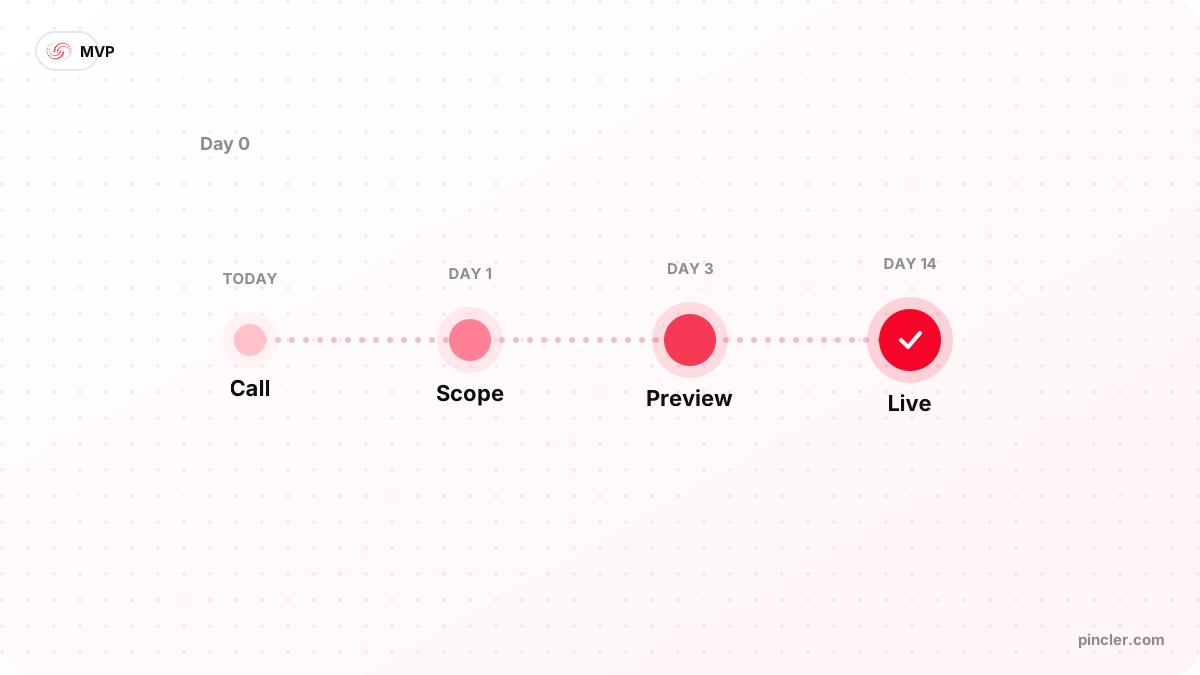
How to build an MVP fast: shrink the scope before growing the team. A day-by-day 14-day plan, the research on small-project success, and what AI-assisted delivery changes.
How to Make an MVP Profitable
How to make an MVP profitable: charge from day one, keep the build small enough that a handful of customers covers it, and let retention decide what you add next.