How Much Does Inventory Management Software Cost?
Inventory management software cost in 2026: real SaaS prices from free tiers to $999 a month, and when a $500–$2,500 AI-drafted, senior-reviewed custom build wins.
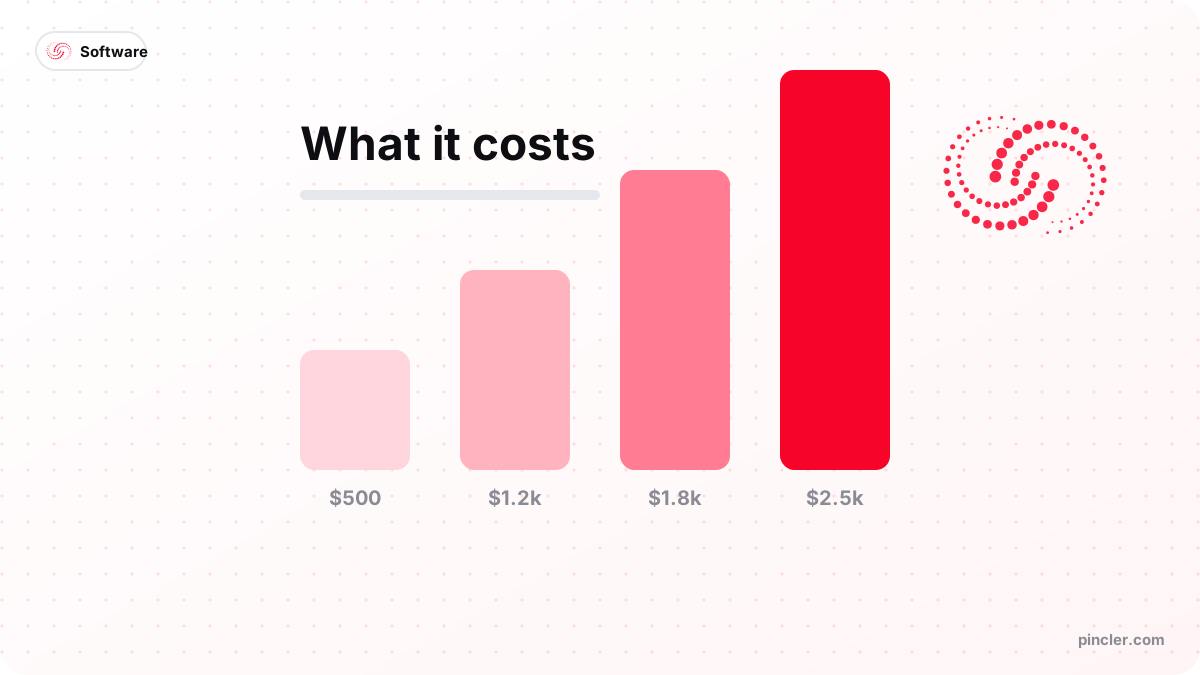
Quick answer
- SaaS entry tier
- Free–$49/month (order caps, 1–2 users; Zoho Inventory from $39/month per Capterra, at the time of writing)
- SaaS mid-market
- $349–$999/month (Cin7 Core published pricing, at the time of writing)
- Custom build (one-off)
- $900–$2,200 fixed at PINCLER, AI-drafted and senior-reviewed; never above $2,500
- Custom running costs
- Roughly $10–$30/month hosting; no per-user fees
- Typical break-even
- An AI-drafted, senior-reviewed $1,600 build vs a $150/month subscription pays back in about 11 months
Inventory management software costs anywhere from free to about $999 a month as SaaS: at the time of writing, Capterra lists Zoho Inventory's paid plans from $39 to $299 a month with a free tier capped at 50 orders, while Cin7's published pricing starts its Core Standard plan at $349 a month and tops out at $999 for Advanced. A custom-built system is a one-off $900–$2,200 at PINCLER's fixed prices — never more than $2,500, because AI writes the first draft and senior engineers review, test and harden it — which typically equals one to two years of a mid-tier subscription.
The honest complication is that the sticker price is rarely the real price. SaaS inventory software is usually priced per user, per order volume or per location, so the quote that looked reasonable for two users and one warehouse can triple as the operation grows. Custom software inverts that: the build costs more than month one of a subscription and then stops charging you for growth.
This guide puts real numbers on both routes — subscription tiers, the add-ons that inflate them, custom build prices from a published 79-build fixed-price catalogue, and a transparent three-year comparison — so you can decide with arithmetic rather than instinct.
What Is the Short Answer?
Expect free to $49 a month for entry-level SaaS with tight order and user caps, a few hundred a month for serious multi-channel tiers, and $349–$999 a month once you are in mid-market territory such as Cin7's published Core plans. A custom inventory and stock management system built to your exact workflow is a one-off $900–$2,200 fixed price at PINCLER, plus hosting of roughly $10–$30 a month.
Which route is cheaper depends almost entirely on time horizon and team size. Over six months, SaaS nearly always wins. Over three years with five warehouse users, the custom build usually wins by thousands — the arithmetic section below shows every input in that claim.
What Does SaaS Inventory Software Cost?
Published prices cluster into three bands. At the entry level, Capterra lists Zoho Inventory at $39 to $299 a month at the time of writing, with a free plan capped at 50 orders a month — genuinely usable for a very small operation. The mid-market band is steeper: Cin7's own pricing page lists Core Standard at $349, Core Pro at $599 and Core Advanced at $999 a month at the time of writing. Above that sit ERP inventory modules, quoted rather than listed.
Read the caps before the price. Entry tiers limit orders per month, users, warehouses and sometimes SKUs; the tier you qualify for is set by your busiest month, not your average one. A business doing 600 orders a month with three staff and two locations often discovers the honest comparison is not the $39 tier but the $159–$349 one.
| Band | Typical price (at the time of writing) | What you get |
|---|---|---|
| Entry SaaS | Free–$49/month | Order caps (e.g. 50/month free on Zoho), 1–2 users, single location |
| Growth SaaS | $99–$299/month | Higher order caps, more users, multi-location, channel sync |
| Mid-market SaaS | $349–$999/month | Cin7 Core Standard to Advanced: B2B, EDI, advanced automation |
| Custom build | $900–$2,200 one-off | Your exact workflow, unlimited users, code owned outright |
What Drives the Price Up?
Four multipliers turn an advertised tier into a real invoice, and they compound. Per-user pricing is the big one: every picker, packer and bookkeeper who needs to see stock becomes a seat. Order-volume caps are the second — grow past the tier and the upgrade is mandatory. Locations and warehouses are the third. Integrations are the fourth: connecting your store, accounting package and shipping tool is sometimes an add-on fee per connector, and always the feature that forces you off the cheap tier.
Custom builds have their own cost drivers, and they are different: the number of integrations, barcode workflows, and multi-warehouse transfer logic move a build from $900 towards $2,200. What does not move it is headcount — a custom system has no seats — which is why the comparison flips as teams grow. If integration sprawl is your actual problem, a targeted integration and data sync build between the tools you already own is sometimes the cheapest fix of all, at a median advertised price of $1,200 across the integration builds in PINCLER's published catalogue.
What Does a Custom Inventory System Cost to Build?
A custom inventory system costs $900–$2,200 fixed price at PINCLER, with a quoted delivery of roughly 8 to 16 days, and no phase ever exceeds $2,500. PINCLER's published catalogue lists 79 builds — every one priced between $500 and $2,500 — with a median price of $1,450 and a median quoted delivery of 13 days; the internal-tools category, where inventory systems sit, has a median of $1,725 and 16 days. The full itemised catalogue is published at /research/what-you-can-build, so every figure here can be checked line by line.
The band maps to scope: catalogue, stock ledger and low-stock alerts at $900–$1,300; purchase orders and goods-in at $1,300–$1,700; barcode scanning and store sync at $1,700–$2,200. What each of those pieces involves — and the build order that gets you using the system by day ten — is covered step by step in our guide on how to build an inventory management system.
Ongoing costs are hosting (roughly $10–$30 a month for a system this size), a domain, and any third-party API fees. There is no mandatory retainer; a 14–60 day bug-fix warranty is included, and the code sits in your own GitHub from day one.
Custom vs SaaS: the Three-Year Arithmetic
Take a five-person operation that has outgrown free tiers and honestly needs a $150-a-month plan. Three years of subscription: $150 × 36 = $5,400. The custom route: a $1,600 build plus $20 a month hosting is $1,600 + $720 = $2,320 over the same period. The gap is $3,080 — and the break-even lands at month 11 ($1,600 ÷ $150 ≈ 10.7).
Run the honest version too. The subscription includes support, mobile apps and years of edge-case fixes; if a standard workflow fits your business, that is real value and you should buy it. The custom case turns decisive when the multipliers bite: at $349 a month, three years is $12,564 against the same $2,320, a gap of over $10,000. And at the other end, if a free tier genuinely covers you, the correct spend on inventory software this year is zero.
One number worth keeping beside all of these: NetSuite's inventory guides, citing the Institute for Supply Management, put annual carrying costs at 20 to 30 percent of inventory value. On $100,000 of stock that is $20,000–$30,000 a year — an order of magnitude more than any software bill. Choose the tool that makes your counts accurate; the subscription-versus-build saving is secondary to that.
Should You Buy or Build?
The decision compresses into three questions, and the general version of this trade-off is covered in our build vs buy software guide. For inventory specifically:
Does a standard SaaS workflow fit your operation?
  YES -> under ~600 orders/month, 1-2 users?
           YES -> entry SaaS tier (free-$49/mo). Done.
           NO  -> price the REAL tier (seats x users,
                  order caps, locations, connectors)
                    affordable? -> BUY
                    $250+/mo?   -> BUILD ($900-$2,200 one-off)
  NO (quirky process, odd integrations,
      batch/expiry rules, own-brand barcodes)
        -> BUILD custom, phased
When Should You Not Buy Any Inventory Software?
Three situations where the right spend this year is nothing at all, and they are more common than any vendor comparison admits. If a free tier genuinely covers you — Capterra lists Zoho Inventory's free plan at up to 50 orders a month at the time of writing — then both subscribing and building are premature. If you hold under 50 SKUs in one location on a single sales channel, a disciplined spreadsheet plus a monthly physical count outperforms software nobody has learned yet.
The third case wastes the most money: don't buy or build to fix a process problem. If damage goes unrecorded, deliveries are received without checking, or counts get skipped in the busy season, software records the same bad inputs faster and with more authority behind them. Fix the receiving-and-counting routine first — it costs nothing — and buy once the routine is consistent and doing it by hand has become the bottleneck. And don't commission a custom build purely to escape a $39-a-month bill: at that tier the arithmetic never pays back, and it is the answer we give on the call rather than a quote.
What Are the Common Budgeting Mistakes?
Most inventory software budgets go wrong the same six ways, and every one of them is visible in advance if you know to look for it. Before signing anything on either route, check your plan against this list:
- 1. Comparing the entry tier, not your tier — price the plan your order volume and headcount actually require, including next year's.
- 2. Ignoring per-user growth — a $99 plan for three users is a $250+ plan for eight; custom builds do not charge for seats.
- 3. Forgetting integration add-ons — connectors to your store and accounts package are often paid extras, and always tier-gated.
- 4. Counting the build price but not hosting — a custom system costs $10–$30 a month to run; include it in the comparison honestly.
- 5. Treating migration as free — cleaning and importing a messy catalogue takes real effort on either route; budget time for it.
- 6. Buying features you will not use — paying mid-market prices for EDI and forecasting you never switch on is the quietest waste of all.
PINCLER's Perspective
PINCLER is an AI-first custom software development studio: every project is fixed-price between $500 and $2,500, AI tools such as Claude, GPT and Cursor write the first draft, and senior engineers own architecture, review and release. That production method is the entire reason a custom inventory system costs $900–$2,200 rather than the five-figure quotes traditional agencies attach to the same scope — it is what affordable custom software development looks like when the cost base changes.
Across the 79 builds we publish, the figure relevant to this article is budget reach: a $1,000 budget covers the starting price of 55 of the 79 catalogue builds, and $2,000 covers all 79. In practice that means the buy-versus-build decision for inventory software is no longer 'monthly fee versus enterprise project'; it is 'monthly fee versus one to two years of that fee, paid once'. We quote the number in writing within a working day of a free 30-minute call, and if a SaaS tier genuinely fits you, we will say so on the call — a build that should not happen is not a project we want.
The Bottom Line
Inventory management software costs free to $49 a month at the entry level, $349–$999 at the mid-market (per Cin7's published pricing at the time of writing), or a one-off $900–$2,200 built custom. Price your real tier, run the three-year sum, and let the seats-and-caps arithmetic decide. If you are a smaller operation weighing simpler options first, start with our guide to inventory systems for small businesses before committing either way.
Related PINCLER builds
Frequently asked
How much does inventory management software cost per month?
SaaS inventory software runs from free tiers with order caps to about $999 a month. At the time of writing, Capterra lists Zoho Inventory's paid plans at $39–$299 a month with a free tier capped at 50 orders, and Cin7's published pricing runs $349–$999 a month for its Core plans. Your real cost depends on users, order volume, locations and integration add-ons rather than the advertised entry price.
How much does a custom inventory system cost to build?
A custom inventory system costs $900–$2,200 fixed price at PINCLER and ships in roughly 8–16 days, because AI drafts the first version and senior engineers review, test and harden it — a catalogue with a stock ledger and alerts at the bottom of the band, barcode scanning and store sync at the top. Across the 79 builds in PINCLER's published catalogue, the internal-tools category has a median price of $1,725 and a median quoted delivery of 16 days, and no entry exceeds $2,500.
Is custom inventory software cheaper than SaaS in the long run?
Usually, once you need a paid multi-user tier. An AI-drafted, senior-reviewed $1,600 build plus $20 a month hosting totals $2,320 over three years, against $5,400 for a $150-a-month subscription — break-even around month 11. Below that threshold SaaS wins: if a free or $39 tier genuinely covers your volume, buying is the right answer and building is premature.
What ongoing costs does a custom inventory system have?
Hosting of roughly $10–$30 a month, a domain, and any third-party API fees if you sync with a store or accounting package. There are no per-user fees and no mandatory retainer; PINCLER includes a 14–60 day bug-fix warranty by tier, and because the code lives in your own GitHub and cloud accounts, you can have anyone maintain it later.
Why do SaaS inventory bills grow faster than expected?
Because pricing multiplies along four axes at once: seats per user, order-volume caps, locations, and paid integration connectors. A plan chosen for two users and one warehouse is re-priced by growth in any of the four. This is the main structural difference from an affordable custom software development approach, where the one-off build price is fixed and headcount never changes the bill.
Does better inventory software actually pay for itself?
The carrying-cost arithmetic says yes if it improves accuracy. NetSuite's guides, citing the Institute for Supply Management, put carrying costs at 20–30 percent of inventory value per year — $20,000–$30,000 on $100,000 of stock. A system that trims dead stock and prevents double-ordering by even a few percentage points returns more than the software costs on either route.
Sources
Want to build this?
PINCLER builds custom software, AI agents and GTM systems for a fixed price between $500 and $2,500, delivered in 3–30 days, with the code owned by you.
Keep reading
Related articles
What Does a Booking App With WhatsApp Notifications Cost?
A booking app with WhatsApp notifications costs $900–$2,500 fixed price — AI-drafted, senior-reviewed — plus per-message Meta fees. How WhatsApp billing works and what to budget.
How Much Does a Telegram Mini App Cost to Build?
Telegram Mini App development cost: $500–$2,500 fixed price — AI-drafted, senior-reviewed — against agency guides of $10,000–$80,000. What that buys and what it does not.
How to Build an Online Booking System
How to build an online booking system: the six core components, a step-by-step build plan, realistic timelines, and when a SaaS scheduler is the smarter choice.