How Much Does a Delivery Tracking System Cost?
Delivery tracking software cost in 2026: subscriptions from $150 to $3,099 a month vs an $1,800–$2,500 AI-drafted, senior-reviewed custom build, with three-year arithmetic.
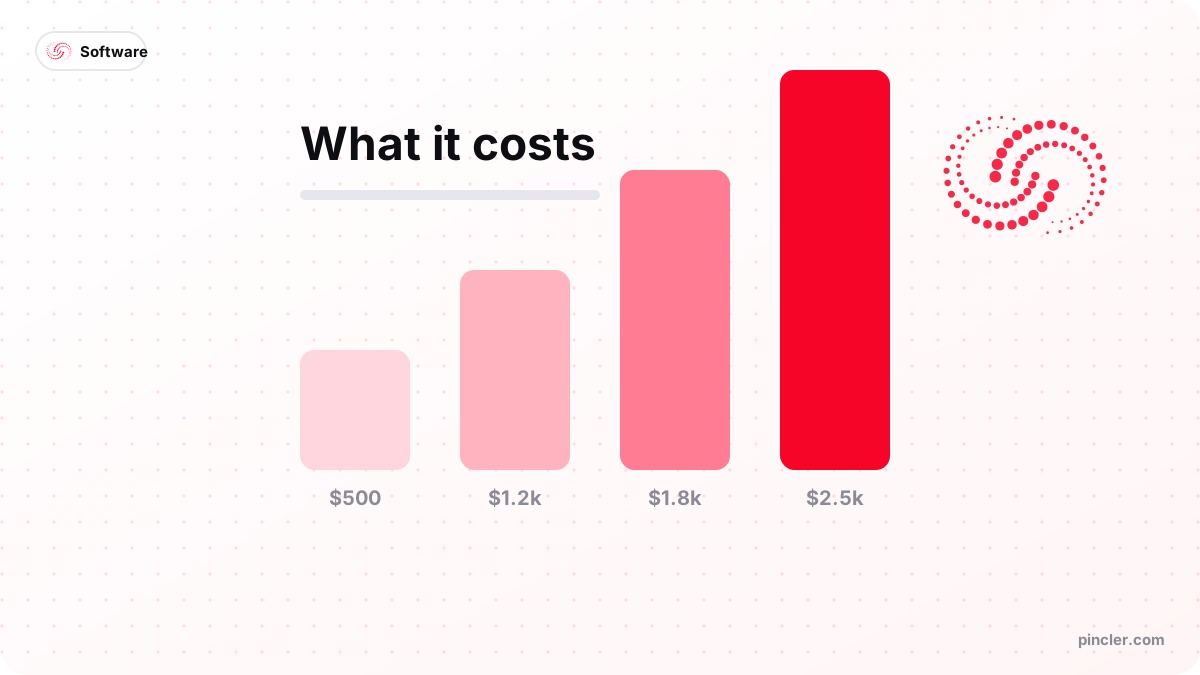
Quick answer
- Subscriptions
- Routific from $150/month after a free 100-order tier; Onfleet from $619/month (published pricing)
- Custom build
- $1,800–$2,500 fixed at PINCLER, delivered in 20–30 days — AI drafts, senior engineers review and harden
- Running costs
- ~$15/month hosting; maps and SMS usage-based on every option
- Break-even
- Custom overtakes a $150/month subscription around month 14
- Best value
- Small fixed fleets: build. Large fleets needing route optimisation: subscribe
Delivery tracking software cost splits cleanly by payment shape. Subscriptions: Routific's published pricing starts free for up to 100 orders a month and then from $150 a month for up to 1,000 orders, while Upper's Onfleet pricing guide lists Onfleet's plans at $619, $1,349 and $3,099-plus a month by tier. Custom: a one-off $1,800–$2,500 fixed-price build at PINCLER — driver app, live tracking page, notifications, dispatcher board — priced there because AI writes the first draft and senior engineers review, test and harden it, with running costs in the tens of dollars monthly.
Which shape is cheaper depends on volume, horizon and how much routing science you need. This guide puts published subscription prices next to build economics, works the three-year arithmetic for a typical small fleet with every input visible, and itemises the usage costs — maps, SMS — that apply whichever route you choose.
If you are still scoping what a tracking system contains, read the delivery tracking build guide first; this page assumes you know what you need and want the price of getting it.
The Short Answer: $150–$3,099 a Month, or $1,800–$2,500 Once
The subscription market prices by volume and features. At the accessible end, Routific publishes a free tier up to 100 orders a month and a $150-a-month plan covering up to 1,000 orders with per-order pricing beyond. At the fleet-operations end, Upper's Onfleet pricing guide lists Launch at $619 a month for 2,500 tasks, Scale at $1,349, and Enterprise from $3,099. Between those anchors sit dozens of platforms, but the shape is constant: pay monthly, scaled to your delivery volume, for as long as you deliver.
The custom route is a one-off: $1,800–$2,500 fixed at PINCLER for the full system — driver app, customer tracking links, dispatcher board, notifications, proof of delivery — then hosting and usage fees measured in tens of dollars a month. The delivery and order tracking use case lists exactly what the fixed price includes.
What Do the Published Options Cost Side by Side?
Prices below are published figures at the time of writing; subscription platforms revise tiers often enough that the pattern matters more than any cell. Note what each column actually buys — the platforms bundle routing optimisation the custom build only adds if you scope it.
| Option | Pricing | What it buys |
|---|---|---|
| Routific | Free ≤100 orders/mo, then from $150/mo to 1,000 orders | Route optimisation, driver app, tracking links |
| Onfleet (via Upper's guide) | $619–$3,099+/mo by tier | Fleet dispatch, driver apps, analytics, API |
| Custom build (PINCLER) | $1,800–$2,500 once + ~$15/mo hosting | Your workflow, your data, tracking on your domain, no per-driver fees |
The Three-Year Arithmetic, Every Input Visible
A small fleet doing 600 deliveries a month fits Routific's $150 tier: $1,800 a year, $5,400 over three years. The custom build at $2,200 plus $15 a month hosting and roughly $6 a month of usage fees is $2,200 + $540 + $200 ≈ $2,940 over the same period. Crossover lands around month 14 ($2,200 divided by the ~$150 monthly saving, adjusting for the small running costs), after which the build banks about $130 a month.
Run the honest counter-case too. The subscription includes route optimisation — genuinely hard software the $2,200 build does not replicate — plus support and continuous updates. A fleet whose routes are complex enough that optimisation saves an hour of driving a day is buying something real for its $150. The build wins where routes are simple or fixed, where volume would push you up subscription tiers, and where owning the customer relationship — tracking links on your domain, delivery data in your database — carries value beyond the fee saved. The software vs custom comparison works through that decision in full.
What Usage Costs Apply to Every Option?
Maps and messages meter on usage whichever route you take, so they belong in every column of your comparison rather than just the custom one. Twilio's published US SMS pricing starts at $0.0083 per outbound message segment before carrier surcharges — three messages per delivery across 600 monthly deliveries is roughly $15 before those fees, and WhatsApp or email alternatives shift the number. Google's Maps Platform pricing page lists SKUs from roughly $2 to $40 per 1,000 requests with per-SKU free monthly caps at the time of writing; a small fleet rendering maps only during active deliveries commonly stays inside or near the free allowances.
Hosting rounds out the custom column at roughly $15 a month for a system this size. The practical takeaway: for small fleets, running costs are noise compared with the subscription-versus-build decision — a well-architected system's monthly meters cost less than a single delivery's margin.
What Moves a Custom Build's Price Within the Band?
The $1,800–$2,500 band flexes on structure, and knowing the levers lets you scope towards the bottom of it.
- Driver app depth — a mobile-web driver app scopes cheaper; native builds with background GPS push towards the top of the band.
- Live map versus status-only — dropping live GPS for an honest status timeline with notifications can move the project below the band entirely.
- Order intake — manual entry and CSV import are cheap; a live integration with your shop or ERP adds an API workstream.
- Proof of delivery — photo capture is standard; signatures, PINs and cash-reconciliation flows add scope.
- Routing — assignment by dispatcher is included; algorithmic multi-stop optimisation is the one feature where subscriptions hold a real edge.
- Fleet size at launch — more drivers means more concurrency testing, though unlike subscriptions it never means a bigger monthly bill.
When Is the Subscription the Right Answer?
Genuinely often. Choose the platform when route optimisation across many stops is your daily reality, when you need a polished native driver app on day one, when delivery is a short-term or seasonal operation, or when your volume sits comfortably inside a cheap tier — Routific's free 100-order month covers many micro-fleets indefinitely, and $150 a month is defensible spend for a fleet it saves real driving time.
Choose the build when the subscription's shape fights you: per-driver or per-order fees compounding with growth, workflow quirks the template cannot hold, or tracking links and delivery data you want on your own domain in your own database. And if you are not sure, run one quarter on a free or cheap tier first — the experience will sharpen your custom brief more than any requirements workshop.
Who Should Build, Who Should Subscribe — and When Not to Buy at All
Three answers, in the order the decision actually arrives. The tree below settles the routing question first because it is the only one where the platforms hold a capability a four-figure build does not replicate.
Who the build is for: permanent fleets of roughly three to ten drivers on simple or stable routes, businesses whose per-driver fees climb with every hire, and operators who want the tracking link on their own domain because it is the most-viewed page their brand owns. Who it is not for: anyone whose hardest daily problem is sequencing forty drops across ten vans — that is accumulated vendor routing science, and buying it is cheaper than commissioning it.
When not to buy anything at all: under roughly 100 deliveries a month, Routific's published free tier covers the whole operation and any purchase is premature. Don't build if delivery is an experiment you may drop by spring — run it manually and keep the exit cost at zero. And don't build live GPS when the real complaint is silence rather than uncertainty; a status timeline with three honest notifications fixes that at a fraction of the price, and a good share of the tracking briefs we scope turn out to be exactly that problem wearing a map's clothes.
Is multi-stop route optimisation your daily hard problem?
│
├─ YES → SUBSCRIBE (Onfleet-class, $619+/mo published)
│
└─ NO → How many deliveries a month?
         ├─ Under ~100 → FREE TIER (Routific publishes one)
         │               buy nothing yet
         ├─ 100–600 and seasonal, or under a 1-year horizon
         │             → SUBSCRIBE (~$150/mo published)
         └─ 100+ and permanent
                       → Does a template hold your workflow?
                          ├─ YES → SUBSCRIBE, revisit at renewal
                          └─ NO  → BUILD ($1,800–$2,500 fixed)
Common Budgeting Mistakes with Tracking Software
The errors below recur across briefs we see; all are cheaper to fix on paper than in production.
- 1. Comparing the build fee to one month's subscription instead of the horizon total — always run both to three years.
- 2. Forgetting usage meters apply everywhere — SMS and maps bill the subscriber and the owner alike.
- 3. Paying fleet-operations prices for a three-driver fleet — feature lists sell; unused features still invoice.
- 4. Scoping live GPS when status tracking solves the actual complaint — half the cost, most of the value.
- 5. Ignoring exit costs — tracking links, driver habits and delivery history bound to a platform make later migration a project of its own.
- 6. Building without a pilot week — one driver, one real day, before the fleet; the cheapest QA a tracking system will ever get.
PINCLER's Perspective: Why the Build Costs What It Costs
PINCLER's published catalogue lists 79 builds, and its Mobile category carries a median advertised price of $1,850 with a median quoted delivery of 19 days — the delivery tracking build is listed at $1,800–$2,500 over 20 to 30 days because it is really three surfaces in one project: driver app, customer view and dispatcher board. Every entry is priced between $500 and $2,500, and the whole table is public at what you can build, which is a rare thing for a development studio to publish at all.
The economics that make a four-figure price possible are the same across our catalogue: AI tools generate the scaffolding — maps wiring, status machinery, notification plumbing — while senior engineers spend their review time on offline sync, battery behaviour and the money-adjacent paths. That is what an affordable software development company looks like operationally, and it is why the quote is written, fixed and delivered within a working day of the scoping call rather than estimated in ranges that drift.
Bottom Line
Budget $150–$3,099 a month for subscription delivery tracking, scaled to volume and routing needs, or $1,800–$2,500 once for a custom system you own, with tens of dollars in monthly running costs. Small fixed fleets with simple routes cross over to the build's favour around month 14; optimisation-heavy operations stay better served by the platforms.
For your own number, the delivery and order tracking use case lists the fixed band and timeline, and a free 30-minute call converts your fleet size and delivery flow into a written quote.
Related PINCLER builds
Frequently asked
How much does delivery tracking software cost per month?
Published subscription pricing spans a wide band: Routific starts free for up to 100 orders a month and then from $150 a month for up to 1,000 orders, while Upper's guide to Onfleet's pricing lists tiers at $619 a month, $1,349 a month and $3,099-plus a month. Where you land depends on delivery volume and whether you need route optimisation. Usage costs for SMS and maps come on top of most plans.
How much does a custom delivery tracking system cost to build?
At PINCLER, $1,800–$2,500 fixed price, delivered in 20 to 30 days — AI writes the first draft, senior engineers review and test it — driver app, customer tracking links with a live map, dispatcher board, notifications and proof of delivery. Ongoing costs are hosting of roughly $15 a month plus usage-based maps and SMS, typically tens of dollars monthly for a small fleet. The price is written and fixed before work starts, and the code ships to your own GitHub.
Is it cheaper to build or subscribe for delivery tracking?
For a small fleet on simple routes, building is cheaper from roughly month 14: an AI-drafted, senior-reviewed $2,200 build plus running costs totals about $2,940 over three years against $5,400 on a $150-a-month plan. Subscriptions stay the better buy for short horizons, seasonal operations, and fleets whose multi-stop routing genuinely benefits from optimisation algorithms — that is the one capability a modest custom build does not replicate.
What are the hidden costs of delivery tracking systems?
Three worth naming. Usage meters — SMS (from $0.0083 per US message on Twilio's published pricing) and map requests — apply to subscriptions and custom builds alike. Tier jumps — growth pushes subscription volume into the next band, a cost builds never incur. And exit costs — delivery history, driver workflows and tracking links accumulated inside a platform make switching later a project, which is an argument for owning the system early if you know delivery is permanent.
Does per-driver pricing matter for small fleets?
It is often the deciding factor. Per-driver and per-order fee structures mean the bill grows exactly when the business does, and a five-driver fleet can find its tracking spend rivalling a vehicle lease. A custom system inverts that: adding driver six costs nothing but another login. Bespoke software development earns its fee precisely in these fee-structure escapes — the build price buys out a meter that would otherwise run forever.
Sources
Want to build this?
PINCLER builds custom software, AI agents and GTM systems for a fixed price between $500 and $2,500, delivered in 3–30 days, with the code owned by you.
Keep reading
Related articles
What Does a Booking App With WhatsApp Notifications Cost?
A booking app with WhatsApp notifications costs $900–$2,500 fixed price — AI-drafted, senior-reviewed — plus per-message Meta fees. How WhatsApp billing works and what to budget.
How Much Does a Telegram Mini App Cost to Build?
Telegram Mini App development cost: $500–$2,500 fixed price — AI-drafted, senior-reviewed — against agency guides of $10,000–$80,000. What that buys and what it does not.
How to Build an Online Booking System
How to build an online booking system: the six core components, a step-by-step build plan, realistic timelines, and when a SaaS scheduler is the smarter choice.