Website Development Cost in 2026: Honest Numbers
Website development cost in 2026: $500 to $2,000 fixed by site type, AI-drafted and senior-reviewed. What genuinely moves the number, and when a site builder is enough.
Quick answer
- Landing page
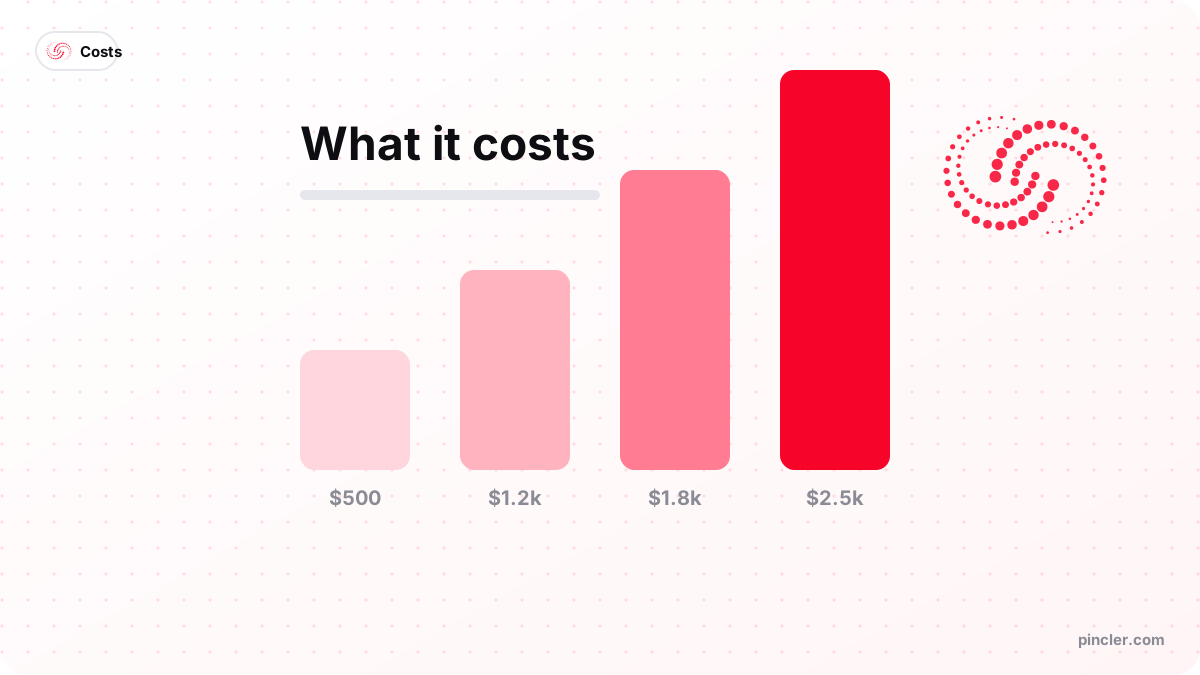
- $500–$1,000 fixed, 3–7 days — AI drafts it, a senior engineer reviews and deploys it
- Portfolio site
- $500–$900 fixed, 3–6 days, AI-drafted with senior review before launch
- Corporate site with CMS
- $800–$2,000 fixed, 7–14 days; AI writes the first draft, senior engineers review and test it
- Documented median
- Websites: $1,025 and 8 days across PINCLER's catalogue, every build AI-drafted then senior-reviewed
- Builder alternative
- $16–39 a month on published Squarespace and Wix plans at the time of writing
A professionally built website costs $500 to $2,000 at PINCLER, fixed price: $500–$1,000 for a landing page built to convert, $500–$900 for a portfolio site, and $800–$2,000 for a full corporate site with a CMS. AI writes the first draft of the markup, components and CMS wiring; a senior engineer then reviews it, tests the performance and accessibility, and ships it. Delivery runs three days to two weeks.
The market quotes everything from $50 to $50,000 for 'a website', which makes the phrase nearly meaningless. The spread is real, but it is explainable: it comes from what the site must do, who maintains it afterwards, and how the builder produces the work — not from mystery.
This guide gives you the website development cost picture by site type, names the factors that genuinely move the number, shows what published performance research says a fast site is actually worth, and is direct about when you should skip custom development entirely and use a site builder.
How much does a website cost in 2026?
Website pricing is only confusing when quotes hide what is being bought. Priced by what the site must do, the numbers settle into narrow, predictable bands. These are ours, fixed in writing before work starts, with the site deployed to your own hosting and domain and the code in your GitHub.
The bands are also a communication tool. When you can name your site type before asking for quotes, every conversation gets shorter and every number you receive gets more comparable — vendors quote the product you described instead of the one they imagined.
| Site type | Fixed price | Typical timeline |
|---|---|---|
| Landing page built for one conversion goal | $500–$1,000 | 3–7 days |
| Portfolio or personal brand site | $500–$900 | 3–6 days |
| Corporate site with CMS and blog | $800–$2,000 | 7–14 days |
| Multilingual corporate site | $800–$1,800 | 7–14 days |
What actually moves website development cost?
Most buyers assume price scales with page count. It barely does — the tenth page on an established design system is nearly free. These are the factors that genuinely move a quote, in rough order of impact.
- CMS and editing — if your team must edit pages, post articles and swap images without a developer, a content layer joins the build and testing scope.
- Integrations — CRM forms into HubSpot, booking widgets, live chat, analytics events and newsletter signups each add configuration and testing.
- Design origin — applying a clean design system is fast; translating a bespoke Figma design pixel-for-pixel, with animations, is slower and pricier.
- Languages — every additional language multiplies content management and layout testing, especially right-to-left scripts.
- SEO depth — structured data, performance budgets and a proper heading architecture are cheap to include early and expensive to retrofit.
- Content readiness — arriving with final copy and photography can shave days; 'we will write it as we go' reliably adds them.
What is a fast website actually worth?
A website's speed is not a technical nicety; it is a published revenue lever. Google and Deloitte's 'Milliseconds Make Millions' study analysed 30 million user sessions across 37 brands and found that a 0.1-second improvement in mobile load time lifted retail conversions by 8.4% and improved bounce rates on lead-generation pages by 8.3%. Same visitors, same ad spend, measurably more outcomes.
Put small-business numbers on that. A services site drawing 1,000 visits a month at a 3% enquiry rate produces 30 leads. A relative lift of the order that study measured — around 8% — is roughly two to three extra leads a month, every month, at zero additional marketing cost. If a lead is worth even $100 to you, the speed work pays for a large share of the build by itself.
This is why our builds ship on modern static-first stacks with performance budgets rather than on plugin-heavy platforms. Speed is cheap to build in on day one and genuinely expensive to retrofit into a slow theme later.
When is a site builder honestly enough?
If you need a presentable five-page brochure, have simple needs and do not mind a template look, a site builder is a legitimate answer, and you can have something live this weekend. At the time of writing, Squarespace's published plans run $16 to $99 a month and Wix's from $17 to $159 on annual billing. We say this on sales calls, because a custom site someone did not need is a poor use of $1,500.
The builder stops being enough at recognisable points: you need forms flowing into a real CRM rather than an inbox; page speed and Core Web Vitals start mattering for rankings; the template fights your brand; you need multilingual content managed properly; or you are tired of monthly fees for something you could own outright. Any two of those and custom is usually the better spend.
There is also a middle path worth naming: start on a builder this month, and commission the custom site when the business proves the channel works. Nothing about the sequence is wasteful — the copy, photography and sitemap you develop on the builder transfer directly into the custom build, and the builder subscription simply ends. The mistake is not choosing a builder; it is staying on one for three years out of inertia while paying more than ownership would have cost.
Do you need the site live this week?
  YES → builder now ($16–39/month); revisit once it earns
  NO  → count what applies:
          forms must land in a CRM   · speed rankings matter
          template fights the brand  · multilingual content
        0–1 apply → the builder is enough
        2+  apply → custom build ($500–$2,000, owned outright)
Builder or owned: which costs less over three years?
Run the arithmetic over the period you will actually keep the site. A builder plan suitable for a business — with a connected domain, no platform ads and basic marketing features — commonly sits around $23–39 a month on the published pricing above. Call it $30: over three years that is $30 × 36 = $1,080, and at the end you still rent the result and its template constraints.
The owned route: an $800 custom landing page or small corporate site, hosted on a modern platform whose free tier covers typical business traffic, plus a $15-a-year domain. Three-year total: roughly $845 — less than the builder — with full ownership, no template ceiling, and speed the builder cannot match. The builder still wins on day-one cost and self-service editing; the owned site wins on everything after month one. Choose knowingly.
PINCLER's perspective: why our numbers sit where they do
Traditional agencies commonly quote $5,000–$25,000 for a corporate site — a general market observation, and not necessarily dishonest. Their process involves more people: account managers, designers, developers and QA, each billing time. AI-powered software development collapses the production hours: tools like Claude and Cursor generate first-draft components and content structures in minutes, while a senior engineer owns the design decisions, accessibility, performance and release.
This is now the industry's normal way of working, not an experiment. Stack Overflow's 2025 Developer Survey found 84% of developers use or plan to use AI tools, and GitHub's controlled experiment on AI pair programming measured a 55.8% speed improvement on a standard build task. The production economics of websites have genuinely changed; pricing that ignores this is charging you for hours nobody works any more.
Where the craft still takes human time — understanding your business, information architecture, the words on the page — we spend it, which is why a corporate site is still a two-week project rather than a two-hour one.
What do 79 published catalogue prices say about websites?
Across the 79 builds in PINCLER's fixed-price catalogue — all priced between $500 and $2,500, listed at /research/what-you-can-build — websites are the cheapest and quickest category: a median advertised price of $1,025, quoted at a median 8 days, on a range of $500 to $2,000. Only cloud and DevOps work carries a shorter quoted window.
The budget-reach numbers from the same catalogue are worth pinning above any quote you receive: $500 reaches 11 of the 79 published builds, $1,000 reaches 55, and $1,500 reaches 75. For pure website work the reach is even better, since the category's whole range tops out at $2,000. If a website quote lands at five figures, you are being quoted a different production method — not a different website.
What does a website cost to run after launch?
A custom site is cheap to keep: hosting on Vercel or similar is free to $20 a month at typical business traffic, a domain runs about $15 a year, and there are no licence fees for the site itself — the fuller picture is in our software maintenance cost guide. Compare that with builder subscriptions, which on the published pricing above cost more over three years than most landing-page builds cost once.
Every build includes a bug-fix warranty of 14 to 60 days by tier. After that, a static or CMS-backed site needs very little — occasional dependency updates and whatever content you choose to add. There is no retainer requirement, and because the code lives in your GitHub, any developer can pick it up later.
One habit is worth adopting from day one: review the site quarterly against the goal it was built for. Fifteen minutes with the analytics — which pages earn enquiries, which are ignored, where visitors leave — tells you whether the next spend should be content, a new landing page or nothing at all. Sites decay through neglect of purpose long before they decay technically.
Where do small website projects go wrong?
The failure modes are predictable, and none of them are code. The most common is content: the build finishes in a week, then the site waits a month for copy and photography. The fix is to write the six most important pages — or have them drafted for your review — before development starts, not after.
The second is scope creep dressed as small favours: a blog 'while we are at it', a members area, a second language. Each is legitimate work; bundled mid-build they blur the scope and the schedule — the same drift pattern we document in the hidden costs in software contracts. Phase them instead — ship the core site, then add a fixed-price phase for each addition once the core is live and earning.
The third is launching without measurement. A site with no analytics events on its forms and calls-to-action cannot tell you whether the investment worked. Insist that basic conversion tracking is in the quoted scope; it costs almost nothing during the build and everything to reconstruct later.
How do you get a number for your site?
Three answers produce an accurate quote: what the site must achieve (leads, credibility, bookings), whether your team needs to edit content themselves, and what already exists — brand, copy, photography. Bring those to a free 30-minute call and a written fixed quote arrives within one working day.
Or start from the corporate and business website use case, which lists the standard scope and band — most site quotes we issue land inside it without drama. The catalogue at /research/what-you-can-build lists every published website build's price and quoted timeline if you want the evidence first.
Related PINCLER builds
Frequently asked
Why do website quotes range from $500 to $50,000?
Because 'website' describes wildly different products: a template brochure, a custom-designed corporate presence, or effectively a web application with editorial workflow. Production method matters too — AI-assisted studios carry far lower production hours than traditional teams, a general market difference in cost base rather than in honesty. Compare quotes only after normalising the scope: pages, CMS, integrations, languages, and who supplies the content.
Do I need a CMS or can the site be static?
If you will publish articles or your team edits pages monthly, yes — build the CMS in from the start, since retrofitting one costs more than including it. If the site changes a few times a year, a static build is faster, cheaper, more secure, and a developer edit now and then costs less than the CMS complexity you would otherwise carry.
Should I redesign my existing site or rebuild it?
Rebuild, in most cases under $2,000 of scope — AI drafts a clean modern codebase in hours, so a senior engineer's time goes into review, redirects and testing rather than untangling the old one. Old sites carry accumulated plugins, slow themes and dated markup that make renovation slower than starting clean on a modern stack — and a rebuild preserves your URLs and SEO with proper redirects. Redesign-in-place makes sense mainly when a large content base must stay untouched on its current platform.
How long does a professional website take to build?
Three days to two weeks for the site types in this guide — and across PINCLER's 79 catalogue builds, the website category's median quoted delivery is 8 days. The schedule is set less by code than by decisions and content: sites whose owners arrive with copy, photography and a clear sitemap routinely ship in under a week, while 'we will write it as we go' reliably doubles the calendar.
Is ai powered software development safe for a business website?
Yes — ai powered software development is now the industry's standard production method, not a gamble: Stack Overflow's 2025 Developer Survey found 84% of developers use or plan to use AI tools. The safety question is really about review: generated code should be checked, tested and released by senior engineers, which is exactly how our builds run. What changes is the price and speed, not the quality bar the release has to clear.
What should be in a website brief to get an accurate quote?
Five things: the site's single main goal, a rough sitemap with page count, whether your team needs to edit content, every integration by name (CRM, booking, analytics, newsletter), and an inventory of what exists — brand, copy, photos. That one page removes the interpretation gap that causes most quote spread, and it usually lands the price at the bottom of the band because nothing needs padding for uncertainty.
Sources
Want to build this?
PINCLER builds custom software, AI agents and GTM systems for a fixed price between $500 and $2,500, delivered in 3–30 days, with the code owned by you.
Keep reading
Related articles

Why Do Agencies Charge $30,000 for What We Build for $2,500?
Why is custom software so expensive at one supplier and not another? A transparent breakdown of agency cost structure, hour counts and the arithmetic behind a $2,500 build.
What Can You Actually Build for $2,000?
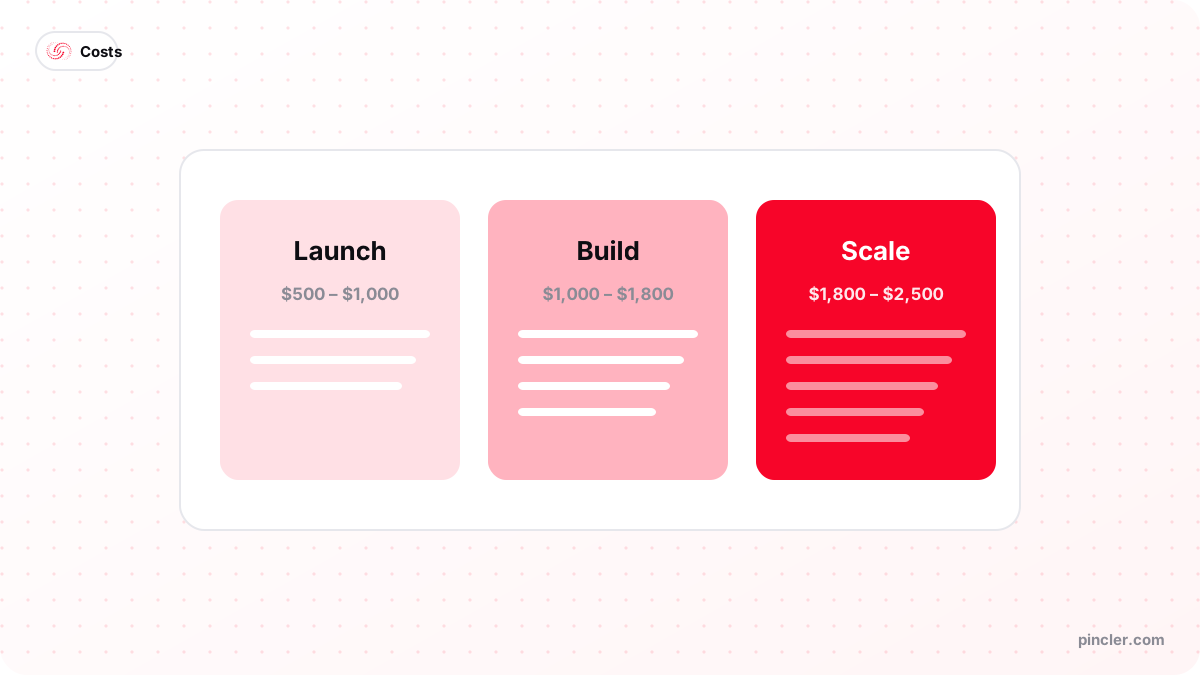
What can you build for $2000? One complete workflow, live in about two weeks — AI-drafted, senior-reviewed — with the exact scope and what gets deferred to phase two.
Can You Build a Custom CRM for Under $2,000?
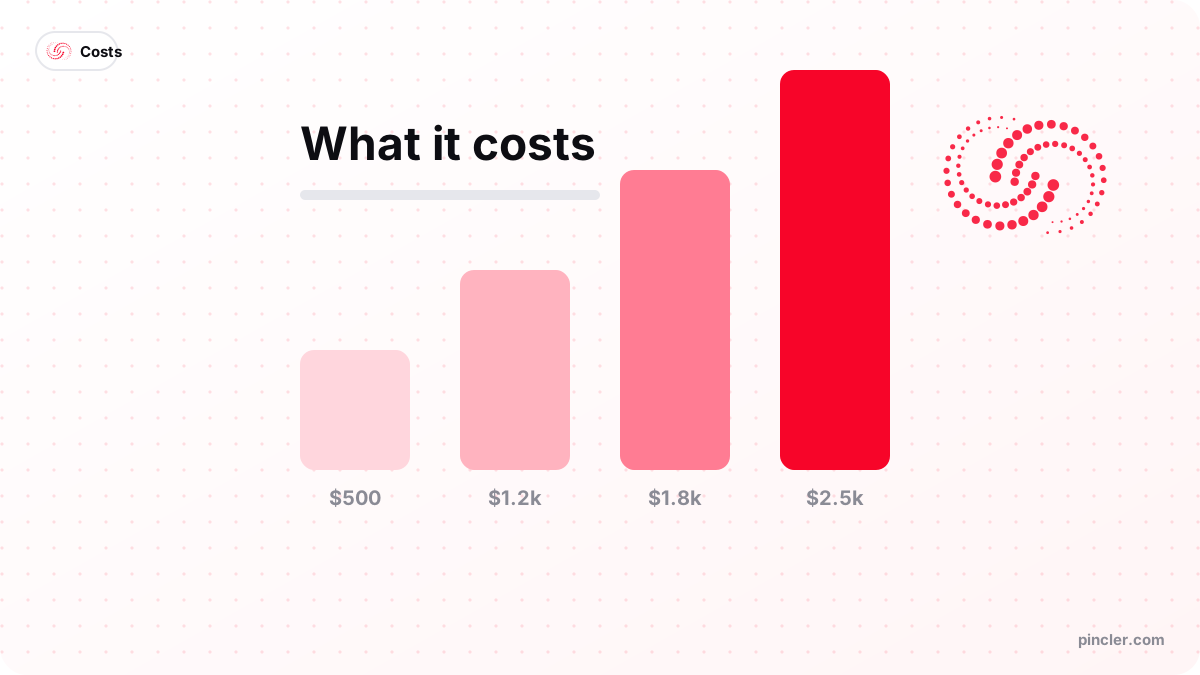
The cheapest way to build a custom CRM, compared honestly: free tiers, spreadsheets, no-code, and an AI-drafted, senior-reviewed $1,200–$2,000 build. Which one you should pick.