The Hidden Costs in Software Development Contracts
The hidden costs in software development contracts: where quotes quietly grow after signing, the clauses that cause it, and the questions that surface each one early.
Quick answer
- Biggest source of overrun
- Line items outside the quote — discovery, changes, deployment, licences, hosting markup
- The research
- Large IT projects average 45% over budget (McKinsey/Oxford, 5,400+ projects)
- The word to hunt for
- 'Estimate' can grow without limit; a fixed quote cannot
- The defence
- Ten written questions before signature — deployment, migration, IP, warranty, retainer
- PINCLER's answer
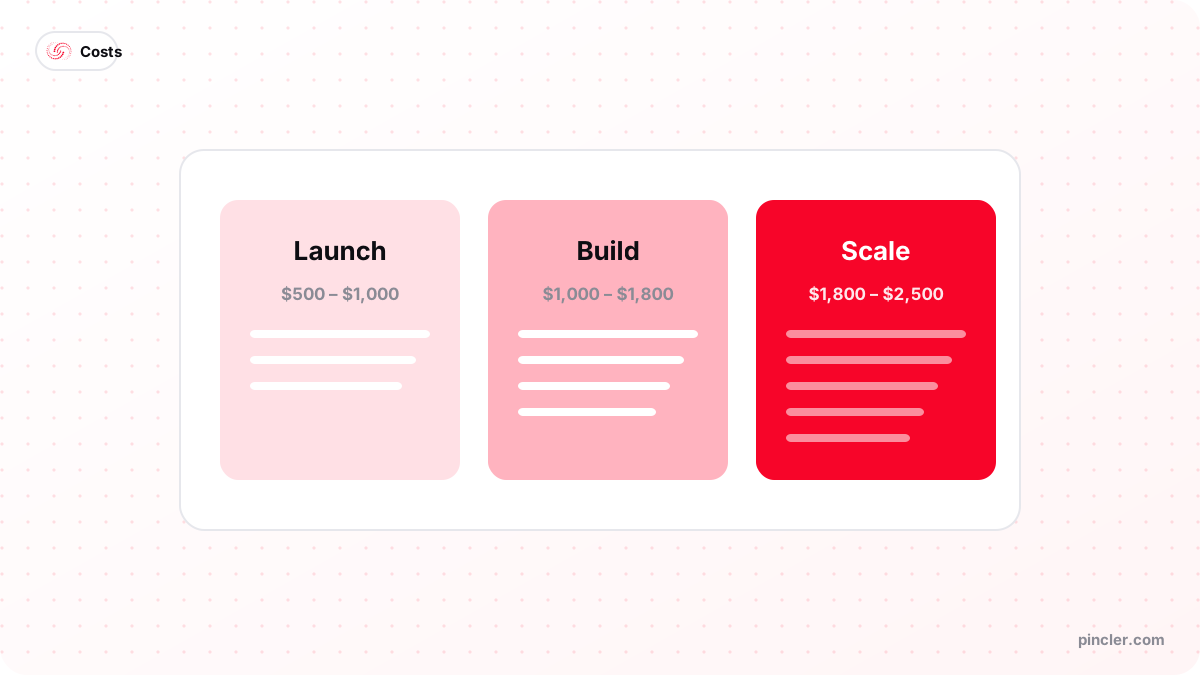
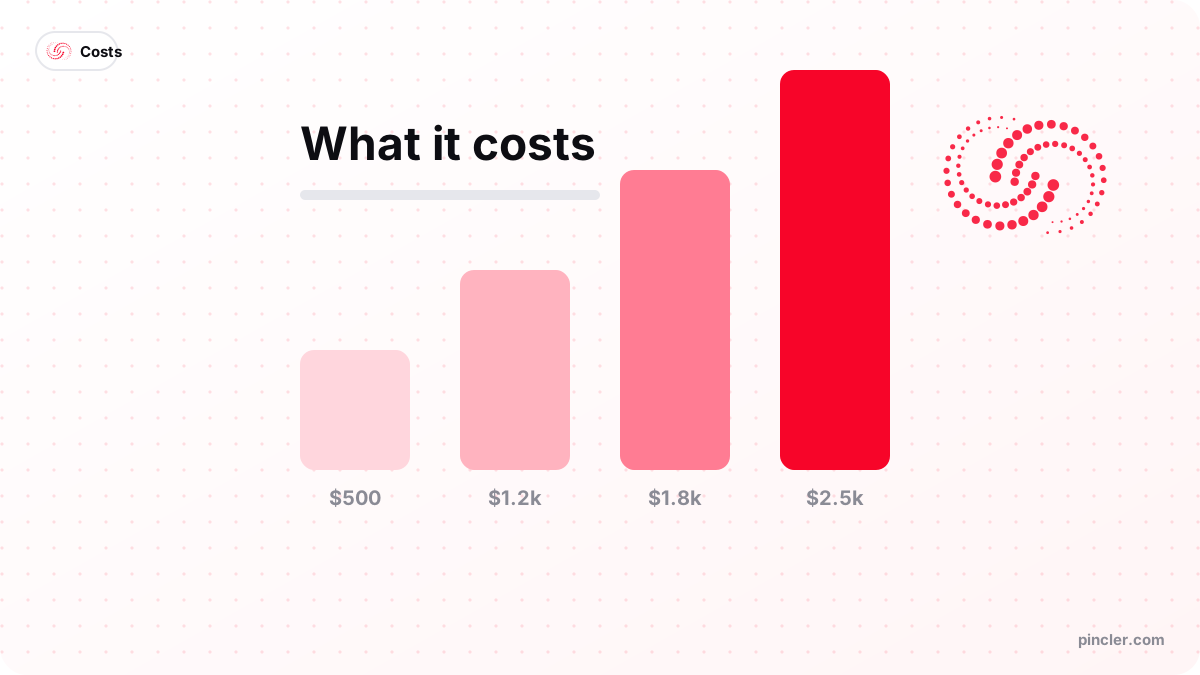
- Every project fixed price $500–$2,500 — AI drafts, senior engineers review and test — with code and cloud in your own accounts
The quote is rarely the number you end up paying — unless the contract makes it so. Most software budget overruns are not caused by bad engineering; they are caused by line items that were never in the quote in the first place: discovery fees, change requests, deployment charges, licences, hosting markups and post-launch retainers that turn a $10,000 project into a $25,000 relationship.
None of this requires bad faith. Hourly estimates drift by nature, 'estimate' and 'quote' are legally different words, and every vendor draws the scope boundary somewhere. But the hidden costs in software development contracts follow patterns, and once you know the patterns you can surface almost all of them with a handful of questions before signing.
This is the checklist we would use to review any software contract — including ours — backed by the published overrun research and a worked example showing exactly how a $10,000 estimate becomes $20,000 in a year. For anything you are about to sign, have a lawyer read it; this article is practical experience, not legal advice.
What does the overrun research actually show?
Budget overruns are not anecdote; they are among the best-documented phenomena in the industry. McKinsey research with the University of Oxford, covering more than 5,400 IT projects, found that large IT projects run 45% over budget and 7% over time on average while delivering 56% less value than predicted — and that 17% overrun so badly they threaten the company's existence.
The Standish Group's CHAOS research tells the same story from a different angle: its original report found that challenged projects averaged 189% of their initial cost estimates, and its more recent figures classify only 31% of projects as successful, with 50% challenged and 19% outright failed. Small projects fare dramatically better than large ones in the same data — which is itself an argument for phased, tightly scoped work.
Read those numbers as a buyer and the lesson is structural: the risk is not that your vendor is dishonest, it is that open-ended arrangements drift by default — the same forces that make the same brief return wildly different quotes in the first place. Everything in this article is a mechanism for closing the gaps the research says projects fall through.
Which costs hide before you sign?
The first cluster arrives before any code exists. Paid discovery is the common one: a 'scoping phase' at $2,000–$10,000 that produces a document rather than software — a general market pattern, and sometimes legitimate for genuinely complex systems, but often a way to charge for writing the quote. For small and mid-sized projects, scoping should be part of selling to you, not a product.
The second is the estimate-versus-quote distinction. An estimate is a guess with no ceiling; a quote is a commitment. Contracts that say 'estimated at 120 hours' commit you to a rate, not a price. Read for the word, then ask directly: is this number fixed, and what happens if the work takes longer? If the answer is a bigger invoice, you are carrying all the risk — the full mechanics are in fixed price vs hourly billing, and the 45% average overrun above tells you what that risk is worth.
Payment schedules deserve the same scrutiny. A deposit tied to milestones you can verify is normal; a schedule that front-loads most of the money before anything runs in production removes the vendor's incentive to finish. The clean pattern is simple: a fair deposit, payments attached to demonstrable milestones, and a meaningful final payment released on deployment — the structure itself does the enforcement that goodwill otherwise has to.
Where does the meter run during the build?
Change requests are the classic. Some scope movement is normal — you will learn things mid-build — but the pricing of changes is where budgets die: vague scope definitions make everything arguable, and hourly change pricing at premium rates turns each small adjustment into a few hundred dollars. The defence is a scope document precise enough that 'in or out' is rarely debatable, plus a written change process with prices attached.
Watch also for meetings and communication billed as project time under hourly contracts, and for third-party costs incurred on your behalf — API fees, stock assets, plugins — appearing at cost-plus. Neither is scandalous; both belong in the open before work starts.
A practical habit keeps the meter visible: insist that every proposed change arrives as a short written note with a price and a schedule impact before anyone builds it, and keep a running list of accepted changes next to the original scope. The discipline takes minutes, and it converts the classic end-of-project invoice argument into a document both sides already agreed to, line by line.
Which line items surprise you at launch?
Launch is where omitted items surface, because launch is when they become unavoidable. Four dominate, and every one of them can be priced in advance if you ask. For scale: a standalone cloud deployment and CI/CD setup is a $500–$1,200 fixed project, and data migration and cleanup runs $600–$1,800 — neither should ever appear as an unpriced surprise.
| Line item | How it appears | The question that surfaces it |
|---|---|---|
| Deployment | 'Deployment support' billed separately at the end | Is deploying to production included in the price? |
| Licences | Paid themes, plugins or components you must keep paying for | What third-party licences does the build depend on? |
| Data migration | 'Out of scope' when your old data needs importing | Is migrating our existing data in the quote? |
| Hosting setup | Marked-up hosting resold through the vendor | Can this run in our own cloud account from day one? |
Which costs continue after launch?
Post-launch is where hidden costs compound, because now the vendor has leverage over a system you depend on. Mandatory retainers are the visible version — support contracts at $200–1,000 a month presented as non-optional. Sometimes support is worth buying; it should never be compulsory for a small app.
The quieter versions cost more. Hosting in the vendor's account means your product's availability is attached to your relationship with them. Code that never lands in your repository means every future feature is a negotiation with a monopoly supplier. And IP clauses that licence the software to you rather than assigning ownership mean you may not have the right to hire someone else at all. Check where the code lives, whose cloud it runs in, and what the contract says about ownership on final payment — and have a lawyer confirm the IP language before signing.
Price the dependency, not just the fees. If leaving your vendor would require a migration project, an unknown handover period and a legal review, that switching cost — realistically a few thousand dollars for even a small system — is silently added to every future invoice they send you, because both sides know you will pay a premium before you will pay to leave.
A worked example: how $10,000 becomes $20,800
Here is the pattern with every number visible, assembled from the mechanisms above. The engagement opens with paid discovery at $2,500. The build is 'estimated at 100 hours' at $100 an hour — $10,000 on paper. The work actually takes 135 hours, a 35% drift well inside the published overrun averages: $13,500.
Mid-build, six change requests at $450 each — a field here, a report there — add $2,700. At launch, 'deployment support' appears as a $1,200 line item, and hosting is arranged through the vendor at $75 a month against a direct cost of about $15, adding $720 of markup in year one. Year-one total: $2,500 + $13,500 + $2,700 + $1,200 + $900 of hosting = $20,800 against a $10,000 anchor.
Every step was defensible in isolation; the total is the problem. Now run the same project as a fixed quote with deployment, migration and a warranty inside the number, hosting in your own account, and changes priced individually in writing — the drift mechanisms simply have nowhere to attach.
Where a $10,000 anchor grows to $20,800
  BEFORE SIGNING  paid discovery +$2,500 · "estimate", not quote
  DURING BUILD    35% hour drift +$3,500 · change requests +$2,700
  AT LAUNCH       deployment +$1,200 · hosting markup +$60/month
  AFTER LAUNCH    retainer pressure · vendor-held code · licensed IP
  THE DEFENCE     fixed quote + the ten questions → nowhere to attach
What should you ask before signing?
Ten questions, ten minutes, and most of this article becomes unnecessary. Ask them in writing and keep the answers with the contract.
- Is the price fixed or an estimate — and what happens if the work takes longer?
- Exactly what is in scope, and what named items are out?
- How are change requests priced, and is there a written process?
- Is production deployment included?
- What third-party licences or paid services does the build depend on, and who pays for them?
- Is our existing data migrated as part of the quote?
- Does the code live in our repository and run in our cloud accounts from day one?
- Do we own the IP outright on final payment?
- What warranty covers defects after launch, and for how long?
- Is any ongoing retainer required, and what does it cover?
When are extra costs actually legitimate?
Fairness cuts both ways, and a buyer who treats every additional invoice as a betrayal will burn good vendors. Genuine scope additions are new work: if you add a member portal mid-build, paying for it is not a hidden cost, it is a purchase. The test is whether the addition was yours and whether it was priced in writing before the work happened.
Third-party costs are similarly legitimate when they are disclosed: payment-provider percentages, SMS credits, API usage and domain fees exist whoever builds the software. What separates a fair contract from a fee trap is timing and transparency — costs named before signature, at cost rather than cost-plus, in accounts you control. Insist on the disclosure, not on the impossibility of the costs.
Who should budget for these costs, and when should you not commission at all?
The buyers most exposed are first-time commissioners without an in-house technical reader. If nobody on your side can tell whether deployment sits inside the scope or beside it, the gaps in a proposal stay invisible until they arrive as invoices. Next most exposed are teams buying on an hourly estimate against a vague brief, because there every ambiguity is billable.
Do not commission at all if you cannot yet write down what the software must do on a single page. Every hidden cost in this article grows out of ambiguity, so the cheapest correction is the one made before any money moves. Spend a fortnight running the process by hand and writing down what actually happens; the specification that produces is worth more than any discount you could negotiate.
And do not commission if a tool you already pay for would do the job after an afternoon of configuration. A build carries a permanent tail — hosting, updates, somebody's attention — that a subscription absorbs on your behalf. Paying for that tail to escape a monthly fee you have never properly tried is the most expensive hidden cost of the lot.
- Most exposed — first-time buyers, hourly contracts, and briefs that describe outcomes rather than screens.
- Least exposed — buyers with a written fixed scope, named exclusions, and deployment inside the price.
- Do not commission yet — a specification you cannot fit on one page.
- Do not commission at all — a need that a properly configured off-the-shelf tool already covers.
PINCLER's perspective: why we publish fixed prices instead
Our answer to this entire category of problem is structural: every project is a fixed price between $500 and $2,500, scope in writing, code in your GitHub, running in your cloud, IP yours on final payment, with a 14–60 day warranty and no compulsory retainer. Not because we are saints — because removing the mechanisms that create hidden costs is cheaper than arguing about them later.
The approach is published at scale: across the 79 builds in PINCLER's fixed-price catalogue, every one carries an advertised price between $500 and $2,500, with a median of $1,450 and a median quoted delivery of 13 days — the full list is published at /research/what-you-can-build. That is what a custom software development company looks like when the drift mechanisms are removed by design rather than policed by goodwill.
Whoever you build with, take the checklist above into the conversation. A vendor comfortable answering all ten questions in writing is probably safe to work with. If you want to see how we answer them for your specific project, the free 30-minute call and written quote are the fastest test.
Related PINCLER builds
Frequently asked
Are change request fees normal in software contracts?
Yes — genuine scope additions are new work and it is fair to price them. The problems are vague scope that makes everything a chargeable change, and premium hourly rates applied to each small adjustment. Insist on a scope document precise enough to make 'in or out' obvious, and a written change process where each change gets its own fixed price before work starts.
How do I check I will actually own the code?
Look for an assignment of IP on final payment, not a licence to use the software — the words matter, and a lawyer should confirm them before you sign. Then verify operationally: the repository is in your GitHub organisation, the cloud accounts are yours, and you hold admin credentials. Ownership on paper without access in practice still leaves you negotiating with a monopoly supplier.
Is vendor-managed hosting a hidden cost?
It can be. Some markup for genuine management is defensible; the trap is dependency — if the app runs only in the vendor's account, leaving them means a migration project, and that switching cost is priced into every future negotiation. Prefer your own cloud account from day one with the vendor as a collaborator, which costs nothing extra and preserves your leverage.
How common are software budget overruns really?
Very — the published research is unambiguous. McKinsey's study with the University of Oxford across more than 5,400 projects found large IT projects running 45% over budget on average, and the Standish Group's CHAOS research found challenged projects averaging 189% of their original estimates, with recent data rating only 31% of projects successful. The same research shows small, tightly scoped projects succeed at far higher rates — which is the strongest argument for phasing large ideas.
Does a fixed price remove all hidden costs?
No — it removes the largest category, estimate drift, but the checklist still matters. A fixed price with deployment excluded, licences undisclosed or hosting locked to the vendor can still grow after signature. The full defence is a fixed price plus explicit answers on the ten checklist questions: what is out of scope, who owns the code, where it runs, what the warranty covers and whether any retainer is required.
Should bespoke software development always cost more than off-the-shelf?
Not any more, at small-business scale. Bespoke software development priced the traditional way — teams of billable roles over months — does cost multiples of a subscription. AI-assisted studios have changed the cost base: fixed-price bespoke builds between $500 and $2,500 now compete directly with two or three years of subscription fees, with ownership at the end. The honest comparison is the three-year total of each route, including every line item this article lists.
Sources
Want to build this?
PINCLER builds custom software, AI agents and GTM systems for a fixed price between $500 and $2,500, delivered in 3–30 days, with the code owned by you.
Keep reading
Related articles

Why Do Agencies Charge $30,000 for What We Build for $2,500?
Why is custom software so expensive at one supplier and not another? A transparent breakdown of agency cost structure, hour counts and the arithmetic behind a $2,500 build.
What Can You Actually Build for $2,000?
What can you build for $2000? One complete workflow, live in about two weeks — AI-drafted, senior-reviewed — with the exact scope and what gets deferred to phase two.
Can You Build a Custom CRM for Under $2,000?
The cheapest way to build a custom CRM, compared honestly: free tiers, spreadsheets, no-code, and an AI-drafted, senior-reviewed $1,200–$2,000 build. Which one you should pick.