How Much Does It Cost to Build a Two-Sided Marketplace?
Two sided marketplace development cost: $1,800–$2,500 fixed, AI-drafted and senior-reviewed, for a working MVP — what moves the price, plus no-code and agency comparisons.
Quick answer
- Custom MVP
- $1,800–$2,500 fixed price at PINCLER, AI-drafted and senior-engineer reviewed
- Timeline
- 20–30 days to a working marketplace
- No-code route
- $99–$299/month on published Sharetribe plans, plus per-transaction fees
- Traditional agency route
- $40,000–$150,000 (general market observation)
- Biggest cost drivers
- Transaction-flow complexity, payout and refund logic, second transaction types
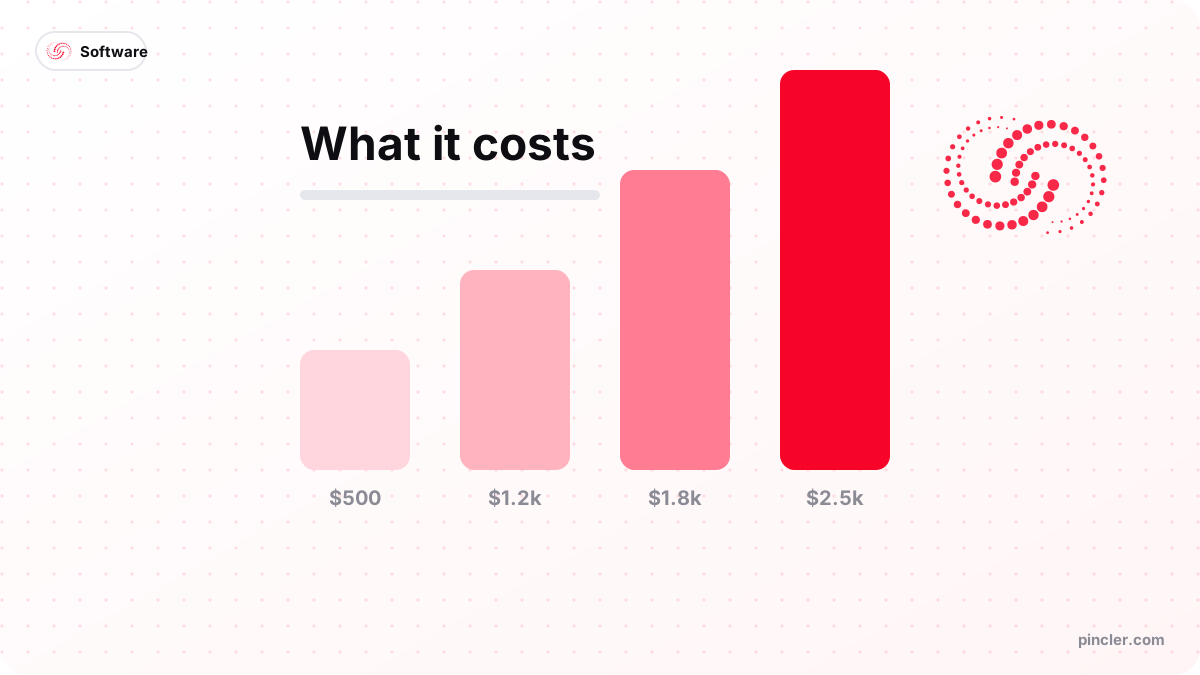
Two sided marketplace development cost at PINCLER: $1,800–$2,500 fixed price for a working MVP — supplier listings, search, one transaction flow, payments with held funds and payouts, and reviews — delivered in 20 to 30 days because AI writes the first draft and senior engineers review, test and harden it. It sits at the very top of our $500–$2,500 band because a marketplace is genuinely the most software per launch of anything we build: two user types, money movement between strangers, and a trust loop.
The alternatives frame the number. Traditional agencies commonly quote $40,000–$150,000 for a custom marketplace — a general market observation that reflects team-months of hand-written code. No-code marketplace platforms invert the trade: cheap to start, with monthly fees and per-transaction charges that accumulate, and a ceiling on how far you can customise.
This guide prices all three routes with the arithmetic in the open, breaks down what moves a custom build up or down the band, lists the running costs, and covers the cases where the right spend this quarter is zero. The build itself — features, payments, cold start — is covered in how to build a two-sided marketplace.
The Short Answer: $1,800 to $2,500, Fixed
A two-sided marketplace MVP is a fixed-price PINCLER build at $1,800–$2,500 with a 20–30 day delivery — the top of our band and the longest timeline in the catalogue, for an honest reason: it is two products on one database plus money movement. The price is agreed in writing before work starts and never grows mid-project.
The band's width is the transaction flow. A listings-plus-booking marketplace with a single payment capture sits at $1,800; add held funds with delayed payouts, cancellation windows and seller dashboards and you reach $2,500. Anything beyond — second transaction types, native apps, subscription tiers — splits into later fixed-price phases rather than inflating version one.
What Do You Get at Each Budget?
The tiers below are how marketplace scope actually maps to money. As with every two-audience product, the jumps buy moving parts, not polish.
| Tier | Fixed price | What is included |
|---|---|---|
| Lean marketplace | $1,800–$2,000 | Supplier listings, search and filters, one transaction flow, direct payment capture, per-transaction reviews |
| Standard marketplace | $2,000–$2,300 | Everything lean, plus held funds with payout release, platform fee collection, transaction messaging, email notifications |
| Full MVP | $2,300–$2,500 | Everything standard, plus supplier dashboard, cancellation and refund handling, admin moderation panel, basic analytics |
What Moves Marketplace Development Cost Up or Down?
Six levers explain nearly every quote difference between two marketplace briefs. Knowing them lets you write a constraint that lands at the bottom of the band.
- Transaction type count — one flow (instant buy OR booking OR quote) is the single biggest scope decision; two roughly doubles the transaction surface.
- Payout logic — instant transfer is simple; held funds, delayed release, partial refunds and cancellation windows are real engineering.
- Trust features — verified reviews are included; identity verification, vetting workflows and dispute systems are later phases.
- Search sophistication — database search with filters is included; instant geo-search with availability calendars costs more.
- Supplier tooling depth — a listing form is cheap; dashboards, calendars and bulk tools belong in phase two.
- Messaging scope — a thread per transaction is included; general-purpose chat with attachments and moderation is not MVP scope.
What Does the No-Code Route Cost?
No-code marketplace platforms price as subscriptions. Sharetribe's published pricing, at the time of writing, runs from a $39-a-month build plan through Lite at $99, Pro at $199 and Extend at $299 a month (billed yearly), each with a monthly transaction allowance and $0.19 per additional transaction. Over three years, the Pro plan alone is 199 x 36 = $7,164 before overage fees — against $2,500 once for a custom build you own outright, plus hosting.
The honest comparison is not only money. No-code is the faster way to get a live test — a weekend versus weeks — and for validating a loop that is worth a lot. The trade arrives later: platform fees scale with your success, customisation hits the platform's ceiling, and migrating off means rebuilding. Our working rule: no-code to prove strangers will transact, custom when the loop works and the fees or the ceiling start to bite.
What Does the Traditional Agency Route Cost?
Run the arithmetic in the open: a three-person team at $60 an hour, 40 hours a week for ten weeks, is 3 x 60 x 40 x 10 = $72,000 — before a project manager, a designer or the first change request. That is how $40,000–$150,000 marketplace quotes happen without dishonesty; hand-written code at team rates costs that much.
The risk premium is real too. McKinsey's study with the University of Oxford across more than 5,400 IT projects found large IT projects run 45 percent over budget and 7 percent over time on average — and marketplaces, with their two-sided scope, invite exactly the kind of mid-project expansion that produces those numbers. Fixed-price phases cap the downside structurally: a phase either ships at the agreed price or the builder absorbs the difference.
What Are the Ongoing Running Costs?
A young marketplace is cheap to operate: standard hosting and transactional email land in the tens of dollars a month, and file storage for listing photos adds little. The meaningful line is payment infrastructure, which scales with volume rather than sitting as overhead — Stripe Connect's published pricing lists its Express model at $2 per monthly active account plus 0.25 percent and $0.25 per payout sent, alongside standard processing fees on each charge.
That per-transaction shape is what you want pre-liquidity: costs near zero while transactions are near zero. Budget seriously for one non-software line instead — supply seeding. The hours or incentives you spend recruiting your first suppliers, as covered in how to get your first 100 users on a marketplace, routinely matter more than any feature in the second tier.
When Should You Spend Nothing Yet?
Before any build — custom or no-code — run the concierge test: match five buyers and five suppliers by hand, move the money yourself, take a manual commission. CB Insights' analysis of startup post-mortems found 42 percent of failures cited no market need and 29 percent ran out of cash; a marketplace commissioned before the manual test risks both at once.
The decision tree we use with clients is blunt about sequencing: prove the loop by hand, keep the test cheap while the shape still moves, and only buy the custom build once the loop is stable enough to be worth owning outright.
Have strangers transacted with you as a manual middleman?
  NO  -> spend $0: run the concierge test for 2-4 weeks
  YES -> is the loop still changing shape week to week?
          YES -> cheap live test (no-code or landing page + forms)
          NO  -> custom MVP ($1,800-$2,500 fixed)
                  |
                  proven volume + fee pressure or feature ceiling?
                  YES -> extend in fixed phases (each <= $2,500)
Who Should Buy This Build — and When Not to Buy Anything Yet
Who should commission the custom MVP: founders who already hold one side of the market — an audience of buyers, a network of suppliers, or an industry position that makes recruiting either side cheap — and who have matched real transactions by hand until the shape stopped changing week to week. At that point $1,800–$2,500 buys an owned loop with no platform fee stacked on top of every future transaction, which is the whole economic case.
When not to buy anything yet comes down to three concrete situations. Don't commission a build before you have matched five buyers with five suppliers by hand and taken a manual commission: CB Insights' analysis of startup post-mortems found 42 percent of failed startups cited no market need, and the concierge test returns that diagnosis in a fortnight rather than after a build. Don't go custom while the transaction shape is still moving — Sharetribe's published $39-a-month build plan is a far cheaper place to be wrong, and rebuilding a moving target twice costs more than renting once. And don't build at all if your niche transacts entirely off-platform: with no money moving through you there is no take rate, and a directory bought at marketplace prices is an expensive way to learn that.
What Cost Mistakes Do Marketplace Founders Make?
The expensive marketplace mistakes are almost all scope and sequencing, made before the first invoice.
- 1. Building two transaction types in version one — the classic doubling of scope before either flow is proven.
- 2. Native apps at launch — they double the build while the loop is still being learned; responsive web validates it first.
- 3. Paying for growth features pre-liquidity — referral schemes and loyalty points multiply an empty experience.
- 4. Custom-building payment plumbing — platform payment infrastructure exists, is priced publicly, and is better tested than anything you will write.
- 5. Open-ended hourly contracts — two-sided scope invites expansion, and hourly billing charges you for every expansion.
- 6. Spending the seeding budget on features — $500 of founder time recruiting suppliers beats a $500 dashboard nobody needs yet.
PINCLER's Perspective on Marketplace Pricing
PINCLER is an AI-first custom software development studio, and marketplaces are where the fixed ceiling earns its keep: across the 79 builds in our published fixed-price catalogue — every one between $500 and $2,500 — web apps are the priciest category at a median advertised price of $1,925 and a median quoted delivery of 18 days, and a $2,000 budget already covers the starting price of all 79 catalogue builds. The marketplace MVP sits at the top of that band because it genuinely is the most software.
The method is what makes the number possible: AI writes boilerplate, tests and first-draft interfaces while senior engineers own architecture, security, review and release, so affordable custom software development stops being a contradiction. Everything ships to your GitHub and your cloud with a 14–60 day bug-fix warranty, the catalogue those medians are computed from is public and itemised at what you can build, and phase two only ever gets quoted after phase one earns it.
Bottom Line
A real marketplace MVP costs $1,800–$2,500 fixed and runs for tens of dollars a month; the five- and six-figure quotes price a production method, not a better marketplace. Prove the loop by hand for free, use no-code if the shape is still moving, and buy the custom build when the loop is stable and worth owning. Our pricing page has the fixed bands, and a free 30-minute call turns your constraint into a written quote within one working day.
Related PINCLER builds
Frequently asked
How much does it cost to build a marketplace MVP?
$1,800–$2,500 fixed price at PINCLER, delivered in 20–30 days because AI drafts the first version and senior engineers review, test and harden it, covering listings, search, one transaction flow, payments with payouts, and reviews. PINCLER's published catalogue lists 79 builds with a median price of $1,450 and a median quoted delivery of 13 days, with marketplaces at the top of the range because they are two products plus money movement. Traditional agency quotes of $40,000–$150,000 reflect hand-written code at team rates.
Is a no-code marketplace cheaper than a custom build?
In year one, usually; over three years, rarely. Sharetribe's published plans run $99–$299 a month billed yearly plus $0.19 per transaction beyond allowances — the Pro plan alone is $7,164 over three years before overages, against $2,500 once for an AI-drafted, senior-reviewed custom MVP you own. The smart sequence uses no-code's speed to validate, then goes custom when fees or the customisation ceiling bite.
What are the monthly running costs of a marketplace?
Tens of dollars early on: hosting at $10–25, transactional email, and photo storage. Payment infrastructure scales per transaction rather than as overhead — Stripe Connect's published Express pricing is $2 per monthly active account plus 0.25% and $0.25 per payout, on top of standard processing fees. Near-zero volume therefore means near-zero cost, which is exactly the shape a pre-liquidity budget wants.
Why does a marketplace cost more than other MVPs?
Because it is several products in one launch: a supplier product (listings, payouts), a buyer product (discovery, checkout), a shared transaction engine with held funds, and a trust loop of reviews and moderation. Each side alone resembles a standard web app; the marketplace price covers both plus the money movement between them. That is why it tops PINCLER's fixed-price catalogue at $1,800–$2,500, even with AI writing the first draft and senior engineers reviewing and hardening it.
What makes a marketplace build go over budget?
Scope expansion, overwhelmingly: a second transaction type, native apps, growth features and custom payment plumbing added before the loop is proven. McKinsey-Oxford research across 5,400+ IT projects found large projects run 45% over budget on average, and two-sided scope invites exactly that drift. Fixed-price phases are the structural defence — each phase ships at its agreed price or the builder absorbs the difference.
Can I start with a marketplace under $1,800?
Yes, by trimming the transaction: a listings-and-enquiry platform without on-platform payment can land around $1,200–$1,500 as an AI-drafted, senior-reviewed custom build, and it can validate matching demand. Be clear about what it is not: without money movement there is no take rate and no marketplace economics — treat it as a validation step with a planned payments phase, not a finished platform.
Sources
Want to build this?
PINCLER builds custom software, AI agents and GTM systems for a fixed price between $500 and $2,500, delivered in 3–30 days, with the code owned by you.
Keep reading
Related articles
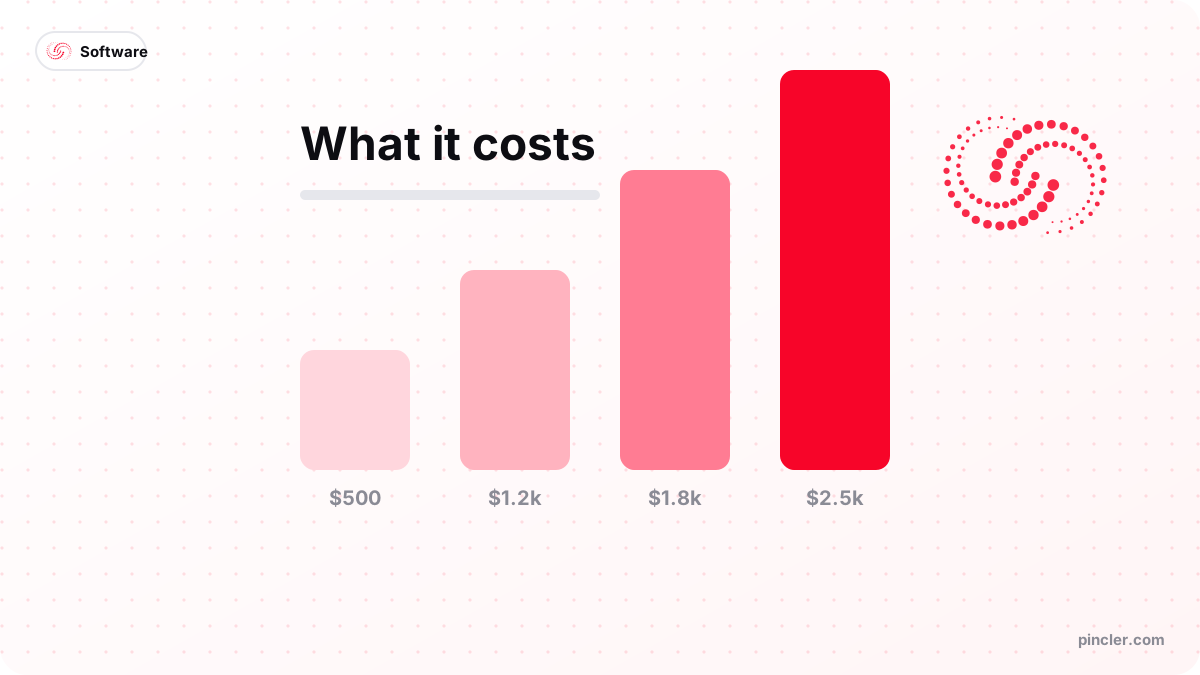
What Does a Booking App With WhatsApp Notifications Cost?
A booking app with WhatsApp notifications costs $900–$2,500 fixed price — AI-drafted, senior-reviewed — plus per-message Meta fees. How WhatsApp billing works and what to budget.
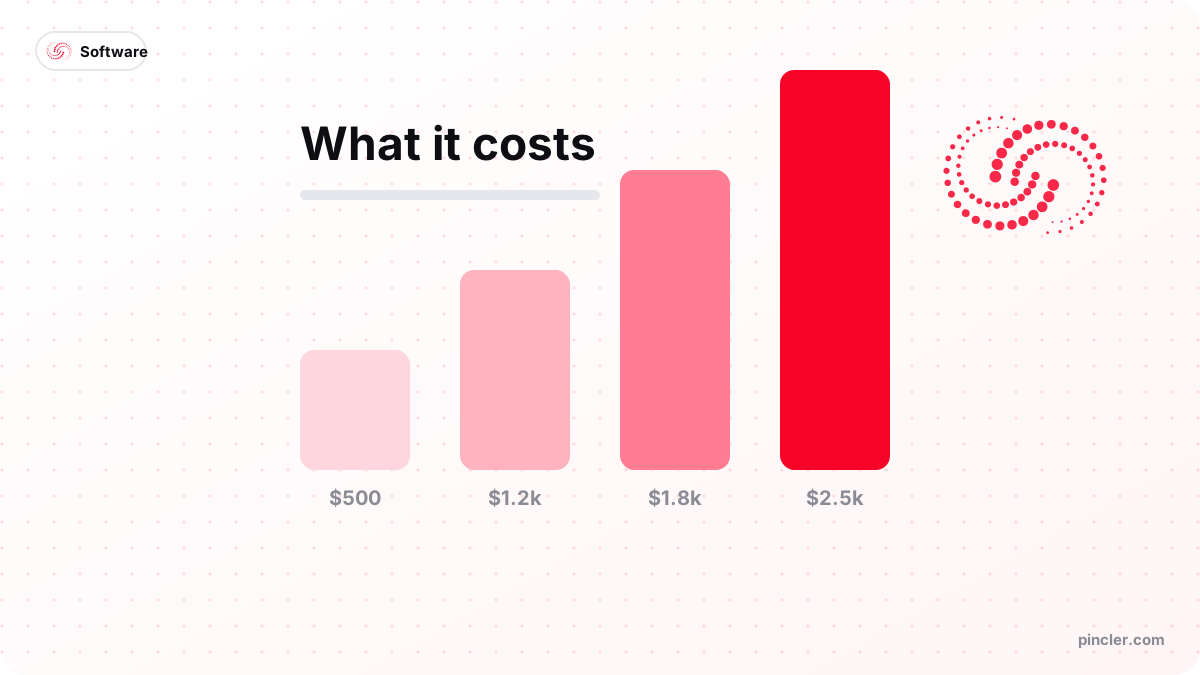
How Much Does a Telegram Mini App Cost to Build?
Telegram Mini App development cost: $500–$2,500 fixed price — AI-drafted, senior-reviewed — against agency guides of $10,000–$80,000. What that buys and what it does not.
How to Build an Online Booking System
How to build an online booking system: the six core components, a step-by-step build plan, realistic timelines, and when a SaaS scheduler is the smarter choice.