How to Get Your First 100 Users on a Marketplace
The first 100 users on a marketplace come from hand-recruited supply, a deliberately small launch market and founder-led matching. The playbook, step by step.
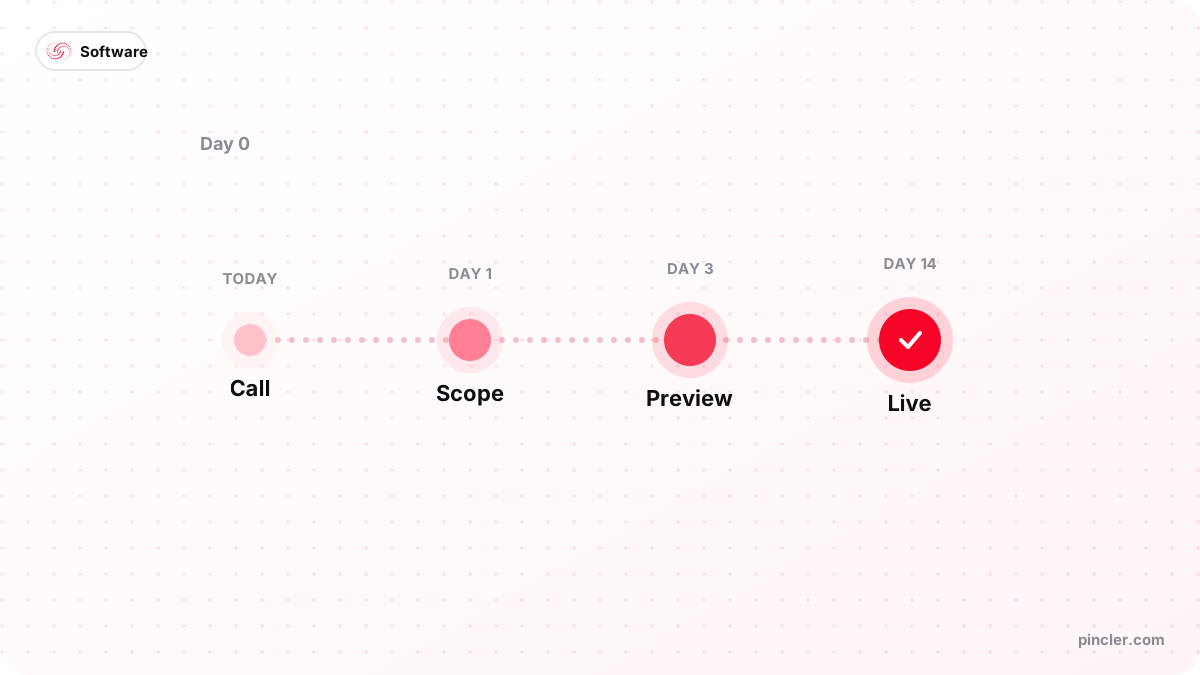
Quick answer
- First side
- Supply — 20–50 hand-recruited suppliers before launch
- Launch market
- One niche and one geography, small enough to saturate
- First transactions
- Founder-matched, by hand
- Success metrics
- Fill rate, time-to-first-transaction, repeat rate — not sign-ups
- Widen when
- The loop clears thresholds in the small market
The way to get first users onto a marketplace is unglamorous: recruit 20–50 suppliers personally before launch, open demand in a market small enough to saturate, and match the first transactions by hand until the loop runs without you. The first 100 users are recruited, not acquired — no channel, no ad budget and no feature replaces the founder doing this work directly.
The stakes are documented. CB Insights' analysis of startup post-mortems found 42 percent of failed startups cited no market need and 29 percent ran out of cash — and a marketplace can fail both ways at once, burning money while real demand meets an empty supply page. The cold start is not a marketing problem to outspend; it is a sequencing problem to out-think.
This playbook covers which side to recruit first, how to land the first 50 on each side, what single-player value means, the liquidity metrics that tell you the loop works, and the discipline of not launching wider until it does. It pairs with how to build a two-sided marketplace, which covers the software itself.
What Is the Cold Start Problem?
The cold start problem is the circular dependency every marketplace launches into: buyers only come for supply, suppliers only stay for buyers, and at zero users both statements are true simultaneously. The escape is never symmetrical — you pick one side, fill it by unscalable means, and use it to pull the other.
The target has a name: liquidity — in Andreessen Horowitz's marketplace glossary, the reasonable expectation that a listing sells or a buyer finds what they came for. The same glossary notes platform take rates run from low single digits to the mid-30s percent, but none of it is collectable at zero liquidity. Everything in this playbook is a means to that one end.
Which Side Should You Recruit First?
Supply, in almost every category. The asymmetry is behavioural: listing costs a supplier little and pays off whenever a buyer arrives, so suppliers tolerate a quiet start; buyers give a marketplace exactly one chance to be useful. Fifty patient listings can wait for demand — fifty disappointed buyers are gone.
The exception is an existing audience. If you already own the demand side — a newsletter, a community, a client base that trusts you — invert the sequence and recruit supply against demonstrable buyers. That is the position to check honestly before choosing, and the decision tree is short.
Do you already own an audience on one side?
  YES, buyers   -> recruit supply against proven demand
  YES, suppliers -> open demand carefully; supply is banked
  NO -> default: supply first
         |
         recruit 20-50 suppliers by hand
         seed their listings personally
         THEN open demand in one small market
         match early transactions yourself
How Do You Get Your First 50 Suppliers?
Personally, one conversation at a time. List the 50 suppliers you most want, ranked by how much their presence would attract buyers, and work the list by message, call and referral. The pitch is concrete: free or discounted membership as a founding supplier, your help creating their listings, and honest numbers about where the marketplace is.
Make listing effortless — do it for them. Build each founding supplier's listing yourself from their photos and details, because a marketplace with 50 complete, well-written listings looks alive on day one and the suppliers cost you hours rather than budget. Founding-cohort perks (badges, permanent fee discounts, first access to features) buy loyalty that outlasts the cold start, and the supplier interviews you conduct while onboarding are free product research.
How Do You Get Your First 50 Buyers?
Go where the niche already gathers: the communities, groups and forums where your buyers ask for exactly what your supply offers, and show up as a useful participant with specific listings, not a logo with a launch post. In a properly constrained market there are only a handful of such places — that is the sign your constraint is right.
Well-structured listing pages compound this. Each listing that answers a specific search — service, place, price — is a small door into the marketplace, the same mechanism that powers a good SEO landing page; intent-rich pages become your cheapest durable channel. And for the first weeks, close the loop personally: when a buyer enquires, walk them to the right supplier yourself. Concierge service to buyer number ten is how you earn buyer number fifty.
What Is Single-Player Value and Why Does It Help?
Single-player value is usefulness one side gets before the other side shows up: a supplier's listing that doubles as their booking page, a portfolio they can share anywhere, a price calculator, a directory entry that ranks in search. It breaks the circular dependency by giving the early side a reason to arrive and stay that does not depend on liquidity.
Choose one cheap single-player hook and build it into onboarding rather than treating it as a feature project. A supplier who uses their marketplace page as their public presence keeps it current, links to it, and quietly markets you — the marketplace layer then activates on top of behaviour that already exists. The hook also softens the quiet weeks: a supplier getting standalone value has a reason not to churn while demand catches up.
How Do You Measure Whether the Loop Is Working?
Liquidity metrics decide everything in the first hundred users, and none of them is a sign-up count. These four, reviewed weekly, tell you whether you have a marketplace or a mailing list.
| Metric | What it answers | Healthy early signal |
|---|---|---|
| Fill rate | What share of buyer intent finds supply? | Above ~50% of enquiries matched within days |
| Time to first transaction | How long before a new supplier earns? | Under 2–3 weeks in a constrained market |
| Repeat rate | Do both sides come back? | Meaningful share of second transactions within a month |
| Supplier utilisation | Is supply active or decorative? | Most listings receiving enquiries, not a top-heavy few |
When Should You Not Launch Wider?
Do not widen while the loop leaks. If fill rate is low, buyers are bouncing off supply that does not match; if repeat rate is low, the first transaction is disappointing someone. Expanding geography or category at that point multiplies the leak — the marketing spend brings users into a loop that loses them, which is how the 29 percent who ran out of cash in CB Insights' post-mortems spent their runway.
Set expansion thresholds before launch and hold to them: for example, fill rate above half, repeat behaviour visible, and supplier churn flat for four consecutive weeks in the constrained market. Expansion is then a decision the data makes. This is also when monetisation earns attention — a loop that clears thresholds can carry a take rate, and the sequencing lives in how to monetise a marketplace.
What Mistakes Waste the First Hundred?
The cold-start mistakes are consistent enough to name, and most of them are impatience wearing a strategy costume.
- 1. Launching both sides at once, everywhere — thin supply spread invisibly across a wide market reads as an empty product.
- 2. Counting sign-ups — a thousand registrations with no transactions is a landing page, not liquidity.
- 3. Paid acquisition before fill rate — ads pour buyers into a loop that cannot serve them yet.
- 4. Automating matching too early — founder-led matching is your richest learning channel; keep it manual until it hurts.
- 5. Treating founding suppliers as rows in a CRM — the first fifty deserve concierge onboarding and permanent recognition.
- 6. Widening on a good week — one strong fortnight is noise; thresholds held for a month are signal.
PINCLER's Perspective on Marketplace Launches
PINCLER is an AI-first custom software development studio, and the launch pattern above shapes how we scope marketplace software: a two-sided marketplace MVP ships in 20–30 days at $1,800–$2,500 fixed precisely so the founder's time and money stay pointed at supply recruitment and matching, not at a six-month build. Our published catalogue lists 79 builds — median price $1,450, median quoted delivery 13 days, all between $500 and $2,500 — and the two-sided entries are scoped on the assumption that the constraint and the supplier list exist before the code does.
The phasing mirrors the playbook: version one carries the loop, and the growth features — referral schemes, supplier analytics, automated matching — arrive as later fixed-price phases only after the liquidity metrics clear their thresholds. The catalogue behind those numbers is public at what you can build; it is also why we would rather quote a smaller first phase than sell a platform to a founder who has not yet matched five transactions by hand.
Bottom Line
The first 100 users on a marketplace are recruited by hand: supply first, one small market, founder-matched transactions, and liquidity metrics as the only scoreboard. Software's job is to make that loop cheap to run — which is why the MVP should ship in weeks, not quarters. Hold the constraint until the numbers release it, and the second hundred users arrive far more easily than the first. When your supplier list is written, a free 30-minute call will scope the build around it.
Related PINCLER builds
Frequently asked
How do marketplaces get their first users?
By hand: founders recruit 20–50 suppliers personally with founding-member perks, seed their listings, then open the buyer side in one deliberately small market and match early transactions themselves. The first hundred users are recruited through direct conversations, not acquired through channels — paid acquisition only makes sense after fill rate proves the loop can serve the buyers it attracts.
Should a marketplace launch with supply or demand first?
Supply first in almost every category, because the tolerance is asymmetric: suppliers can list and wait at little cost, while a buyer who finds an empty marketplace never returns. The exception is founders who already own a buyer audience — a community or client base — who should instead recruit supply against that proven demand. Either way, one side is banked before the other opens.
How small should a marketplace launch market be?
Small enough that saturation is a realistic goal with founder effort alone: one niche and one city, or one tight community, where 50 suppliers give a buyer real choice and the gathering places for demand can be counted on one hand. Liquidity in a small pond beats emptiness in an ocean — every additional segment multiplies the supply needed to look alive.
What metrics matter most before 100 marketplace users?
Four liquidity measures: fill rate (share of buyer intent that finds supply), time-to-first-transaction for new suppliers, repeat-transaction rate, and supplier utilisation. Sign-ups measure marketing, not the marketplace. Healthy early signals look like most enquiries matched within days and new suppliers earning inside two to three weeks in a constrained market — reviewed weekly, against thresholds set before launch.
When should a marketplace start paid marketing?
Only after the loop holds its thresholds in the constrained market — fill rate above half, visible repeat behaviour, stable supplier activity for around a month. Paid traffic into a leaking loop burns cash on users the product cannot yet serve, which is how marketplaces join the 29 percent of startups CB Insights found ran out of cash. Fix the loop with hand-matching first; ads amplify whatever already works.
Does building more features help get early marketplace users?
Almost never. The first hundred users respond to supply quality, founder attention and a working match — not to referral schemes, apps or dashboards, which multiply whatever experience exists, including an empty one. Ship the four-system loop in weeks, then spend founder time recruiting and matching. Feature spend re-enters the picture when liquidity metrics, not enthusiasm, ask for it.
Want to build this?
PINCLER builds custom software, AI agents and GTM systems for a fixed price between $500 and $2,500, delivered in 3–30 days, with the code owned by you.
Keep reading
Related articles
What Does a Booking App With WhatsApp Notifications Cost?
A booking app with WhatsApp notifications costs $900–$2,500 fixed price — AI-drafted, senior-reviewed — plus per-message Meta fees. How WhatsApp billing works and what to budget.
How Much Does a Telegram Mini App Cost to Build?
Telegram Mini App development cost: $500–$2,500 fixed price — AI-drafted, senior-reviewed — against agency guides of $10,000–$80,000. What that buys and what it does not.
How to Build an Online Booking System
How to build an online booking system: the six core components, a step-by-step build plan, realistic timelines, and when a SaaS scheduler is the smarter choice.