LMS Development Cost in 2026: A Custom Build vs Kajabi, Teachable and Thinkific
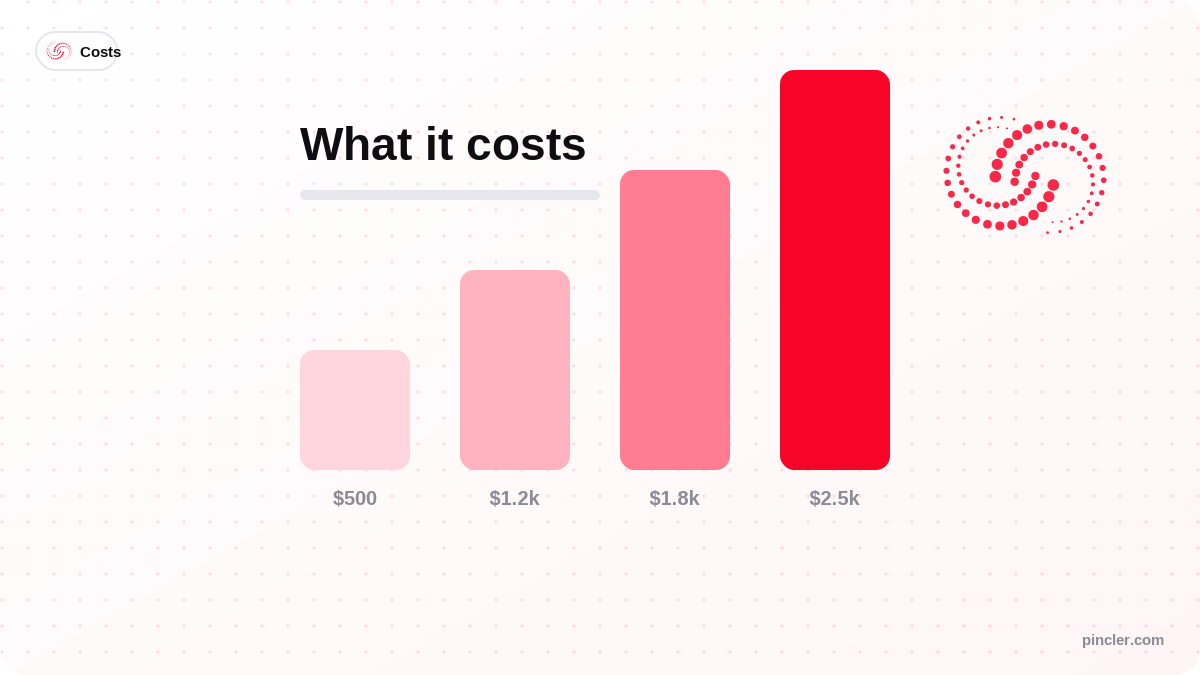
LMS development cost in 2026: agencies quote $20,000 to $300,000+. A cohort LMS costs $1,200 to $2,500 fixed when AI drafts and senior engineers review it.
Quick answer
- PINCLER build
- $1,200–$2,500 fixed, 14–24 days, because AI drafts the code and senior engineers review payments, access rules and grading.
- Renting instead
- November 2026, annual or monthly billing: Teachable Builder $69–$89, Thinkific Grow $164–$219, Kajabi Growth $199–$249 a month. Maven keeps 10% after Stripe fees.
- Payback
- About 10–15 months against Kajabi Growth and 12–21 months against Thinkific Grow in this article's illustration.
- Best for
- Academies running dated, live cohorts with graded work and seat limits.
- Not for
- Self-paced video with modest sales, or a corporate LMS that needs SCORM and single sign-on from day one.
LMS development costs $20,000–$50,000 for a basic agency feature pack and $120,000–$300,000+ for a full custom platform, according to Cleveroad's June 2026 guide, whose own module table adds up to 2,859 hours of work. A narrower LMS, a cohort platform for one academy, costs $1,200–$2,500 fixed in 14–24 days with PINCLER, because AI drafts the code and senior engineers review payments, access rules and grading. Renting costs $69–$249 a month on the middle plans of Teachable, Thinkific and Kajabi at the time of writing (November 2026), depending on annual or monthly billing.
Agency ranges cover SCORM packages, single sign-on and multi-tenant portals that a corporate training department may need. A coach running cohorts needs something narrower: a start date, a seat cap, live sessions and graded work. The cohort platform Maven's October 2026 instructor guidebook describes a 10% platform fee on each sale, taken after Stripe fees, rather than a monthly plan.
You can try the live demo in about a minute: set a seat cap and an early-bird price in USD, AED or INR, watch 12 sample learners check out with overflow sent to a waitlist, then approve AI-drafted rubric grades and issue a certificate. The cohort learning platform build is the same software on your domain.
How Much Does LMS Development Cost in 2026?
LMS development cost runs from about $20,000 for a basic agency feature pack to $300,000 and more for an enterprise platform, going by published agency guides, while a fixed-price cohort platform built with AI coding tools and senior review costs $1,200–$2,500. The gap is hours: agency quotes are hours multiplied by an hourly rate.
Cleveroad's June 2026 module table (user and course management, reporting, gamification, admin, QA, project management, DevOps) totals 2,859 hours, and Purrweb's April 2026 stage table assumes $50 an hour:
A $1,800 build is about 1% of the $142,950 that Cleveroad's 2,859 hours cost at its lowest rate, for two reasons. The scope is one academy, with no SCORM, single sign-on, multi-tenancy or gamification. And on a cohort learning platform build, AI coding tools draft the enrolment, lesson and grading screens while senior engineers review payments, access rules and data handling. Cleveroad itself credits AI-assisted teams with 30–40% more output per sprint.
- Cleveroad's 2,859 hours at $50–$80 an hour, its Eastern European rate: $142,950–$228,720.
- The same 2,859 hours at $100–$200+ an hour, its US and Canada rate: $285,900–$571,800+.
- Purrweb's 200–800 design hours and 1,500–6,000 development hours, plus QA and release, at $50 an hour: $102,000–$403,000. Its FAQ says $100,000 buys about 1,500 hours in Eastern Europe against 500–800 in the US.
| Route | Price | Timeline | What it covers |
|---|---|---|---|
| Agency, basic feature pack (Cleveroad) | $20,000–$50,000 | 3–4 months for an MVP | Sign-in, catalogue, quizzes, basic admin |
| Agency, full custom LMS (Cleveroad) | $120,000–$300,000+ | 6–12+ months | Adds SCORM/xAPI, multi-tenancy, live video, analytics |
| Agency, course-platform MVP (RaftLabs) | $25,000–$60,000 | 12–16 weeks | Video, progress, quizzes, certificates, Stripe |
| Agency, scale tier (RaftLabs) | $80,000–$140,000 | 20–28 weeks | Adds SCORM, SAML single sign-on, multi-tenancy, HR-system sync |
| Fixed-price AI-assisted build (PINCLER) | $1,200–$2,500 | 14–24 days | One academy's cohorts, checkout, grading and certificates |
How Much Does Each Type of LMS Cost?
A cohort platform for one academy rents for $29–$249 a month or is built for $1,200–$2,500 fixed with AI drafting and senior review, a corporate training LMS is priced per user, and an EdTech product sold to other schools costs $25,000–$140,000 with an agency.
For a per-seat corporate LMS the crossover is about users, not fees. Purrweb puts custom ahead from 1,000+ active users, and Cleveroad's June 2026 build-or-buy guide says SaaS suits a stable user base under about 1,000. Cleveroad lists SaaS at $10–$100 per user a year plus $3,000–$35,000+ for implementation, so 300 users for three years cost $9,000–$90,000 before implementation.
An EdTech product is a software business, not a tool; SaaS MVP development cost covers that route.
| Type of LMS | Renting costs | Building costs | Fits a fixed price? |
|---|---|---|---|
| Course or cohort platform for your own academy | $29–$249 a month (Teachable, Thinkific, Kajabi) | $1,200–$2,500 fixed (PINCLER) | Yes |
| Corporate training LMS | $3–$25 per user a month (Purrweb); TalentLMS Core from $119 a month | $20,000–$300,000+ (Cleveroad) | Small internal version only |
| EdTech product sold to other creators or schools | Not applicable | $25,000–$140,000 (RaftLabs, MVP to scale tier) | First phase only |
| Open-source or WordPress LMS | LearnDash from $350 a year for one site | Moodle: free licence, but 0.5–1.0 of a full-time admin ($47,000–$94,000 a year) and $500–$5,000 per premium plugin (Academy Smart) | Setup and custom features only |
How Much Do Kajabi, Teachable and Thinkific Cost?
Kajabi, Teachable and Thinkific cost $29 to $249 a month on their lower and middle plans at the time of writing (November 2026): Teachable from $29 billed annually or $39 monthly, Thinkific from $82 or $109, and Kajabi from $143 or $179. Annual billing takes 20–25% off the middle plans.
Teachable Starter takes 7.5% of sales; Builder and Growth take 0% on Teachable Payments, and US cards cost 2.9% plus 30 cents. Thinkific charges no gateway fee on Thinkific Payments (2.9%), while a third-party gateway fee varies by plan. Kajabi takes no revenue share but charges 2% (Basic), 1% (Growth) or 0.5% (Pro) on an outside processor.
Kajabi Basic and Growth include unlimited email sends, landing pages and funnels, a community and a customer mobile app; Growth adds live cohort courses, affiliates and advanced automations. Thinkific lists live Zoom lessons on every plan and a 'Live cohorts and coaching' feature, so Kajabi Growth and Thinkific are the closest rented fits for cohorts.
| Plan | Monthly / annual billing | Fee on your sales | Limits worth checking |
|---|---|---|---|
| Teachable Starter | $39 / $29 a month | 7.5% | 5 products, 1 admin |
| Teachable Builder | $89 / $69 a month | 0% on Teachable Payments | 10 products, 1 admin |
| Teachable Growth | $189 / $139 a month | 0% on Teachable Payments | 50 products, 5 admins |
| Thinkific Start | $109 / $82 a month | None on Thinkific Payments (2.9%); a third-party gateway fee varies by plan | 2 admins, groups up to 50 |
| Thinkific Grow | $219 / $164 a month | As Start | 6 admins, groups up to 100 |
| Kajabi Basic | $179 / $143 a month | No revenue share | 5 products, 2,500 contacts |
| Kajabi Growth | $249 / $199 a month | No revenue share | 50 products, 25,000 contacts |
| Maven | No plan fee described | 10% after Stripe fees | Cohort course platform |
Is It Cheaper to Build Your Own Platform or Keep Paying a Plan?
Building pays back in about 10–15 months against Kajabi Growth and 12–21 months against Thinkific Grow, depending on monthly or annual billing, and loses to Teachable Builder. As an illustration, not a measured result: an academy runs four cohorts a year of 15 learners at $899, the demo's price, or $53,940 of sales. Card fees apply on every route, so the table leaves them out.
Self-hosting at published prices: Vercel Pro $20 a month, Supabase Pro from $25, and Mux storage for 20 hours of 1080p video (1,200 minutes at $0.003) $3.60, with 72,000 viewing minutes a year inside Mux's 100,000 free delivery minutes a month. Total: $48.60 a month. Upkeep at Cleveroad's 15–20% of build cost a year adds $22.50–$30 a month on $1,800.
So the $1,800 build saves $170–$178 a month against Kajabi Growth billed monthly ($249 minus $48.60 minus upkeep), paying back in 10–11 months, or $120–$128 against the $199 annual price (14–15 months). Against Thinkific Grow it saves $140–$148 a month on monthly billing (12–13 months) and $85–$93 on annual billing (19–21 months).
This is not like for like. Kajabi includes email campaigns, funnels and a community, and Teachable's April 2026 post, written by the vendor, puts a marketing email tool at $30–$100 a month and self-built infrastructure at $90–$190, so treat $48.60 as a floor. Against Kajabi Growth billed annually, a build clearly wins only if you already pay for an email tool or cohort features are why you are leaving. Price your scope in the cost calculator; custom software vs SaaS covers the support you give up.
A percentage fee is where a build wins biggest, because it grows with sales. Maven's fee per sale is (price minus 2.9% minus $0.30) x 10%, or $87.26 on an $899 US card sale. Spread evenly across the year, against the same $1,800 build:
- 30 sales a year ($26,970): Maven keeps $2,618 a year, $7,854 over three years; the build pays back in about 12–13 months.
- 60 sales ($53,940): $5,236 a year, $15,707 over three years; payback in about 5 months, during the second cohort.
- 120 sales ($107,880): $10,472 a year, $31,415 over three years; payback in under 3 months.
| Route | 3 years, monthly billing | 3 years, annual billing | Note |
|---|---|---|---|
| Teachable Builder | $3,204 | $2,484 | Cheapest here; built for self-paced courses |
| Thinkific Grow | $7,884 | $5,904 | Live Zoom lessons included |
| Kajabi Growth | $8,964 | $7,164 | Email, funnels, community and learner app included |
| Maven | About $15,700 | No plan fee described | 10% after Stripe fees on 60 sales a year |
| Own platform, $1,800 tier | $4,360–$4,630 | Same | Hosting, video and 15–20% a year upkeep |
| Own platform plus an email tool | $5,440–$8,230 | Same | Adds $30–$100 a month (Teachable's estimate) |
What Does It Cost to Take Payments in AED, INR and USD?
Taking payments on your own platform costs only the payment provider's fee: about 2–3% on a domestic card, with 1–2 points more for international cards and currency conversion, at the time of writing (November 2026). Hosted platforms charge similar card rates, so a build saves the plan fee, not processing.
Course sales may carry VAT or GST depending on where you and your learners are, so ask your accountant before setting prices. Adding a gateway to a site you already run is a separate payment gateway integration.
| Provider | Domestic card | International card | Currency conversion |
|---|---|---|---|
| Stripe UAE | 2.9% + AED 1.00 | +1% | +1% |
| Stripe India | 2% (Mastercard, Visa) | 3%, or 4.3% charged in USD or another currency | +2% |
| Razorpay (India) | 2% platform fee on cards, UPI and netbanking, plus 18% GST on the fee | Up to 3% | Not listed |
| Kajabi Payments (US) | 2.9% + 30¢ Basic, 2.8% + 30¢ Growth, 2.7% + 30¢ Pro | Varies by country | Not listed |
What Do You Get for $1,200, $1,800 and $2,500?
$1,200 buys a branded course site with checkout and cohorts, $1,800 adds live sessions and rubric grading, and $2,500 adds AI draft feedback, certificates and a dashboard. All three include the source code in your GitHub repository, deployment on your domain, lesson and learner migration, and a 30-day bug-fix warranty.
The AI does not grade on its own: Claude drafts scores and feedback against your rubric, and the instructor edits and approves every grade. Every tier is a web platform; the course platform page lists no native iOS or Android app, so confirm how lessons play on phones in discovery. For comparison, Kajabi Basic and Growth include a customer mobile app (a branded App Store app is Pro only), and Thinkific sells a branded mobile app add-on at $199 a month.
In the live demo, with the learner's view in a phone frame, a failed instalment gets a retry link, an at-risk list shows who to nudge, and you approve simulated AI draft grades on a four-part rubric before issuing certificates.
- Course and checkout, $1,200: branded course site, Stripe or Razorpay checkout, dated cohorts with seat caps, drip lessons and learner progress.
- Live cohort build, $1,800: adds instalment plans, a live session calendar with attendance, assignment uploads with rubric grading and email reminders.
- Full academy build, $2,500: adds AI draft feedback, the at-risk learner list, WhatsApp nudges, verifiable certificates and an instructor revenue and completion dashboard.
Which Features Drive the Cost of an LMS?
Integrations drive LMS cost: Cleveroad's June 2026 guide prices each one separately at $2,000–$20,000+, and Purrweb's estimator adds $8,000 for payments and $15,000 for AI. Seat caps, drip lessons and attendance are cheap to build and expensive to run by hand. The table maps agency estimates to PINCLER's fixed tiers.
Settle video and certificate rules before coding. RaftLabs cites a client whose late move of 400 hours of video from S3 to Mux cost $65,000 and eight weeks, and says certificate rules scoped after completion tracking add two to three weeks.
| Feature | Agency estimate (source) | In PINCLER's fixed tiers? |
|---|---|---|
| Payments | $3,000–$8,000 (Cleveroad); +$8,000 (Purrweb estimator) | Stripe or Razorpay checkout from $1,200 |
| Video conferencing | $8,000–$20,000 (Cleveroad, Purrweb) | Zoom or Meet links and attendance from $1,800, via the account's API, confirmed in discovery |
| Reporting and analytics | $10,000–$25,000 for a custom module (Purrweb) | Revenue and completion dashboard at $2,500 |
| AI features | +$15,000 in Purrweb's estimator; $15,000–$40,000 for recommendations | AI draft feedback the instructor approves, at $2,500 |
| SCORM or xAPI | $5,000–$15,000 (Cleveroad) | Not included |
| Single sign-on (SSO/SCIM) | $5,000–$12,000 (Cleveroad) | Not included |
| HR-system (HRIS) sync | $5,000–$15,000 (Cleveroad) | Not included |
What Hidden Costs Do LMS Budgets Miss?
Hidden costs can add 20–40% to an LMS estimate, according to Cleveroad (June 2026), which prices user training at $5,000–$20,000 and localisation at $2,000–$8,000 per language. Selleo's March 2026 guide sums it up as Cost = Build + Implement + Run. Ask about each line on any quote:
- Migration: $2,000–$8,000 for a clean move, $10,000–$30,000 with SCORM packages (Cleveroad). All three PINCLER tiers include lesson and learner migration.
- Marketing: Cleveroad budgets $20,000–$80,000 in year one for a consumer (B2C) platform.
- Card fees: 2.9% plus 30 cents on an $899 US card sale is $26.37, so 60 sales cost about $1,582 a year on any route.
- Upkeep: 15–20% of the build cost a year, or $270–$360 on $1,800; Cleveroad adds $10,000–$30,000 of unplanned year-one support on agency builds.
- Open source: Moodle's licence is free, but Academy Smart (October 2026) estimates 0.5–1.0 of a full-time admin, $47,000–$94,000 a year, plus 15–30 hours per major upgrade, two a year.
How Long Does It Take to Build an LMS?
A cohort platform for one academy is quoted at 14–24 days at PINCLER, against three to six months for an agency MVP and up to 14 months for a full platform, because the scope is narrow and AI drafts the code while senior engineers review each phase. Published timelines, then our day plan:
- Day 0: a free 30-minute call, then a written fixed quote.
- Days 1–5: learner sign-up, checkout with instalments, cohorts with seat caps and the lesson player.
- Days 6–11: week-by-week unlocks, the live session calendar, attendance and assignment grading against your rubric.
- Days 12–17: the at-risk list, reminders, certificates and the instructor dashboard, with your lessons migrated in.
- Days 18–24: a pilot with one real cohort, fixes and admin training.
| Source | Scope | Timeline |
|---|---|---|
| PINCLER | Cohort platform for one academy | 14–24 days |
| RaftLabs | Course-platform MVP | 12–16 weeks |
| Cleveroad | Basic MVP; MVP-scope custom LMS | 3–4 months; 3–5 months |
| Purrweb | Basic MVP; full-featured platform | 4–6 months; 8–14 months |
Should You Build an LMS or Buy One?
Rent an LMS if learners study recorded lessons at their own pace; build one if you run dated cohorts with live sessions and graded work, and your plan or revenue share costs more than about $200 a month. Build vs buy software covers the wider decision.
A custom build makes sense for coaches, academies and training teams who repeat one cohort format. Teachable, a vendor with an interest in the answer, argues in its April 2026 post that a solo creator who builds a platform becomes its maintainer; for self-paced video we agree.
Do learners start on a fixed date and meet live?
  NO  -> rent a course platform for self-paced video
  YES -> Do you grade work or issue certificates on rules?
           NO  -> a plan with live cohorts may be enough
           YES -> Does a plan fee or a share of sales
                  cost more each year than a build?
                    NO  -> keep renting, review yearly
                    YES -> build your own cohort platform
(SCORM or SSO needed? phase it)| Situation | Better choice |
|---|---|
| Dated cohorts with live sessions, assignments and seat limits | Build: good fit |
| A programme paying a percentage of every sale | Build: the fee grows with each cohort |
| A single self-paced course with modest sales | Rent: Teachable Builder costs less |
| Heavy use of Kajabi's email, funnels and community | Rent, unless cohort features are the gap |
| SCORM, single sign-on and multi-tenant portals from day one | Not a fixed-price build: phase it or use an agency |
| Nobody to own hosting and fixes after the 30-day warranty | Rent |
What Should You Ask Before Paying for an LMS Build?
Ask any LMS vendor these twelve questions before paying, covering price, ownership, migration, running costs, accessibility and exit. PINCLER's answers follow where our use-case page states them:
- Is the price fixed, and what changes it? Ours is a written fixed quote after a free call.
- Who owns the code, payment and video accounts? Ours: your GitHub repository, domain and cloud account.
- How are learners, progress and instalment plans migrated? Every tier includes lesson and learner migration; confirm active plans in discovery.
- Where are videos hosted, and at what cost per minute? We use Mux, which publishes its rates.
- What is the monthly running cost at 100 and at 1,000 learners?
- Who fixes bugs after the warranty, and at what rate?
- Can SCORM or single sign-on be added later without a rebuild?
- How are certificate rules and pass marks agreed before coding starts?
- Does the quote price Selleo's five budget lines: platform, implementation, integrations, compliance and operations?
- Which accessibility target, such as WCAG 2.1 AA, is tested, with what evidence? Selleo notes the European Accessibility Act applies from 28 June 2025; ask your lawyer whether it covers your courses.
- Can I export every learner, payment and progress record as CSV if I leave?
- How are paid videos protected from link sharing, such as with signed playback URLs?
PINCLER's Perspective on Course Platform Builds
Across the 95 builds in PINCLER's published fixed-price catalogue, the median advertised price is $1,450 and the median quoted delivery 13 days. This build's midpoint of $1,850 matches the median of its Web Apps & SaaS MVPs category (12 builds, median quoted window 18 days), and it is one of 29 builds whose band tops out at the $2,500 ceiling, because AI drafts the screens and senior engineers spend their time on payments, access rules and the pilot; how we work sets out each review step.
These are advertised prices and quoted windows, not a delivery record; the data is in what you can build. An enterprise LMS with SCORM, single sign-on and multi-tenant portals does not fit one fixed price: we split it into phases, each inside the band, or decline it. Whoever builds yours, get the code and learner database in your company's name; who owns your code lists what to put in the contract.
The Bottom Line
A cohort learning platform for one academy costs $1,200–$2,500 as a fixed-price build in 14–24 days, because AI drafts the code and senior engineers review payments, access rules and grading. Agencies quote $20,000 and up for thousands of hours on a wider product.
If your course is self-paced, or Kajabi's email and funnels do your selling, rent. If you run live, graded cohorts on a $200-plus plan, a build pays back in about 10–15 months against Kajabi Growth and 12–21 months against Thinkific Grow on this article's inputs, and within months against a share of every sale. Bring your plan, cohort size and price to a free 30-minute call for a written fixed quote; the online course and cohort platform page shows each tier.
Related PINCLER builds
- Online Course & Cohort Learning Platform$1,200 – $2,500Try the live demo
- School & Coaching Centre Management System$1,500 – $2,500Try the live demo
- Payment Gateway Integration (Stripe, Razorpay, PayTabs, Telr)$500 – $1,200Try the live demo
- SaaS MVP with Auth, Billing & Dashboard$1,800 – $2,500Try the live demo
Frequently asked
How much does LMS development cost?
LMS development costs $1,200–$2,500 at PINCLER for one academy's cohort platform, fixed, in 14–24 days, because AI drafts the code and senior engineers review payments, access rules and grading. Cleveroad (June 2026) prices a basic agency feature pack at $20,000–$50,000 and a full custom LMS at $120,000–$300,000+; its own module table totals 2,859 hours, or $142,950 at $50 an hour.
Is it cheaper to build an LMS or use Kajabi, Teachable or Thinkific?
Over three years, Teachable Builder costs $2,484–$3,204 on annual or monthly billing, less than any build here. A $1,800 build, possible because AI drafts the code and senior engineers review it, totals about $4,360–$4,630 with hosting and upkeep, or up to $8,230 with a marketing email tool. Thinkific Grow costs $5,904–$7,884 and Kajabi Growth $7,164–$8,964.
How long does it take to build an LMS?
A cohort platform for one academy is quoted at 14–24 days at PINCLER: sign-up, checkout and the lesson player first, then weekly lesson release, live sessions and grading, then reminders, certificates and the dashboard, and finally a pilot with one real cohort. RaftLabs puts a course-platform MVP at 12–16 weeks, and Purrweb a full-featured platform at 8–14 months.
What does a custom LMS cost to run each month?
In this article's illustration, about $49 a month: Vercel Pro at $20, Supabase Pro from $25, and Mux storage for 20 hours of 1080p video at $0.003 a minute, with 100,000 delivery minutes free each month. Add upkeep at 15–20% of the build cost a year, any email tool, and card fees of about 2–3% a sale.
Does a course platform need SCORM?
Only if your lessons come from e-learning authoring tools or a corporate client requires SCORM packages. SCORM, xAPI and single sign-on are what push an LMS into agency price bands: Cleveroad estimates $5,000–$15,000 for SCORM or xAPI support and $5,000–$12,000 for single sign-on, each as a separate integration.
How much does it cost to maintain an LMS?
Plan on 15–20% of the build cost a year, the rule Cleveroad's June 2026 guide uses, plus hosting. For an $1,800 cohort platform, where AI drafts the code and senior engineers review it, that is $270–$360 a year. On a $120,000 agency LMS it is $18,000–$24,000. Self-hosted Moodle needs 0.5–1.0 of a full-time admin, about $47,000–$94,000 a year, per Academy Smart.
Sources
- Cleveroad — How much does it cost to build an LMS in 2026 (June 2026) (opens in a new tab)
- Cleveroad — Build or buy LMS software (June 2026) (opens in a new tab)
- RaftLabs — How to build a course platform like Teachable (November 2026) (opens in a new tab)
- Purrweb — How much does it cost to build an LMS (April 2026) (opens in a new tab)
- Academy Smart — LMS development cost (October 2026) (opens in a new tab)
- Selleo — How much does an LMS cost in 2026 (March 2026) (opens in a new tab)
- Teachable — Pricing (November 2026) (opens in a new tab)
- Teachable — Claude Code vs Teachable for course creators (April 2026) (opens in a new tab)
- Thinkific — Pricing (November 2026) (opens in a new tab)
- Kajabi — Pricing (November 2026) (opens in a new tab)
- Maven — Instructor policy guidebook (October 2026) (opens in a new tab)
- Maven — Instructor guide to the Student Growth Program (November 2026) (opens in a new tab)
- TalentLMS — Pricing (November 2026) (opens in a new tab)
- Liquid Web — LearnDash pricing (November 2026) (opens in a new tab)
- Stripe — UAE pricing (November 2026) (opens in a new tab)
- Stripe — India pricing (November 2026) (opens in a new tab)
- Razorpay — Pricing (November 2026) (opens in a new tab)
- Mux — Video pricing (November 2026) (opens in a new tab)
- Vercel — Pricing (November 2026) (opens in a new tab)
- Supabase — Pricing (November 2026) (opens in a new tab)
Want to build this?
PINCLER builds custom software, AI agents and GTM systems for a fixed price between $500 and $2,500, delivered in 3–30 days, with the code owned by you.
Keep reading
Related articles
Custom Software vs SaaS: The Real Three-Year Cost
Custom software vs SaaS over three years: subscription arithmetic, the exit costs nobody prices in, and an honest look at when each option wins.
SaaS MVP Development Cost: What You Get at Each Budget
SaaS MVP development cost: $1,800–$2,500 fixed buys auth, Stripe billing and a dashboard — AI drafts, senior engineers test. What to cut from version one.
Build vs Buy: When Off-the-Shelf Software Is Enough
Build vs buy software: a decision framework with three-year cost arithmetic, the questions to ask before building, and the hybrid option most teams miss.