How Much Does It Cost to Build a Job Board?
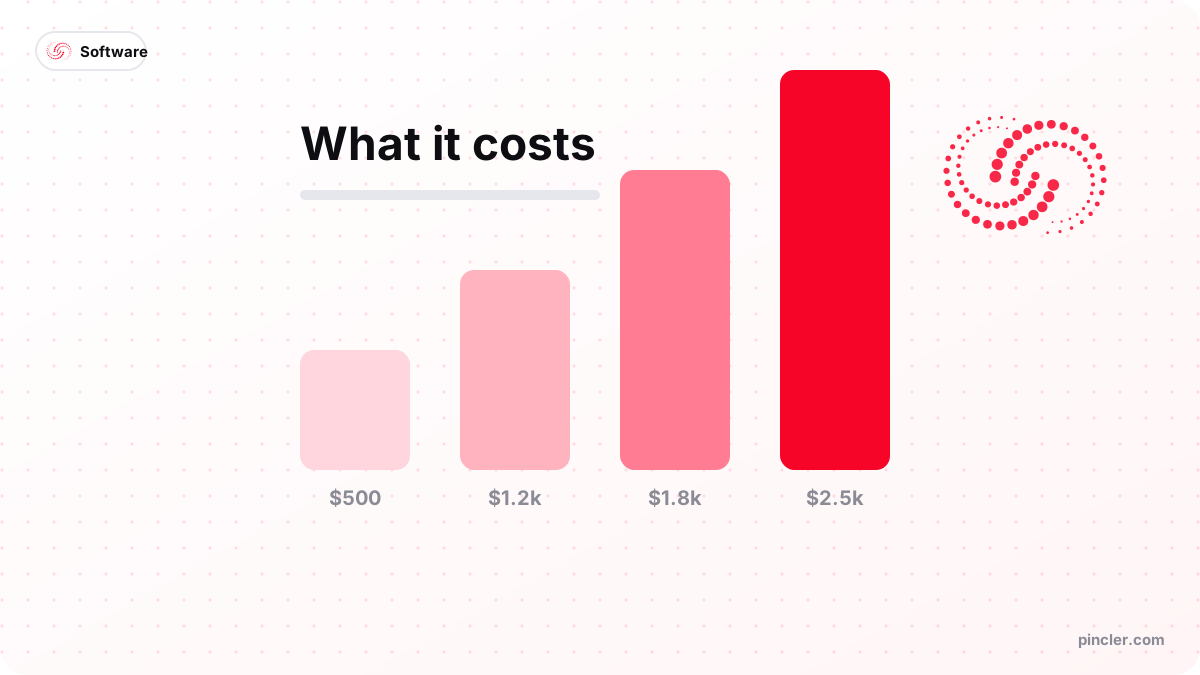
Job board development cost in real numbers: $1,500–$2,500 fixed price, AI-drafted and senior-reviewed, for a board with paid listings, search and applications — plus running costs.
Quick answer
- Custom build
- $1,500–$2,500 fixed price at PINCLER, AI-drafted with senior engineer review
- Timeline
- 16–24 days to a working board
- Running costs
- $30–80/month early on (hosting, email, storage)
- Biggest cost drivers
- Search sophistication, employer billing, integrations
- Cheapest validation
- A curated jobs newsletter — near-zero code
Job board development cost at PINCLER: $1,500–$2,500 fixed price for a working board — employer posting flow with payments, search and filters, candidate applications with CV upload, and email alerts — delivered in 16 to 24 days because AI writes the first draft and senior engineers review, test and harden it. Running costs after launch are modest: typically $30–80 a month for hosting, transactional email and file storage while the board is young.
The wider market quotes very different numbers for the same deliverable. Traditional agencies commonly price a custom job board in the $15,000–$60,000 range — a general market observation that reflects headcount and hand-written code rather than a different product. AI-assisted development moved that arithmetic, which is what affordable custom software development means in practice.
This guide breaks the cost down by budget tier, shows the factors that genuinely move the price, works through the traditional-route arithmetic in the open, and covers the honest cases where the right spend is zero. If you want the feature-by-feature build order instead, start with how to build a job board website.
The Short Answer: $1,500 to $2,500, Fixed
Every PINCLER build is fixed price between $500 and $2,500, and a job board and recruitment portal sits at $1,500–$2,500 of that band with a 16–24 day delivery. The price is agreed in writing before work starts, and the deliverable is the complete commercial loop: employers post and pay, candidates search and apply, applications arrive with CVs attached.
The band exists because two founders asking for a job board rarely want the same thing. A single-niche board with per-listing Stripe checkout sits at the bottom; add employer subscriptions, featured placement and richer filtering and you reach the top. Nothing goes above $2,500 — bigger ambitions split into fixed-price phases, each shipping something usable.
What Do You Get at Each Budget?
The jump between tiers is never prettier screens — it is more moving parts: billing models, alerting, dashboards and reporting. This is the split we actually quote against.
| Tier | Fixed price | What is included |
|---|---|---|
| Lean board | $1,500–$1,800 | Listings, search with core filters, applications with CV upload, per-listing Stripe checkout, admin panel |
| Standard board | $1,800–$2,200 | Everything lean, plus employer dashboard, saved-search email alerts, featured listings, basic analytics |
| Full board | $2,200–$2,500 | Everything standard, plus employer subscriptions or listing packs, candidate accounts, moderation tools, richer reporting |
What Moves the Price Up or Down?
Structural complexity moves job board pricing; cosmetics do not. Knowing the levers lets you write a brief that lands at the bottom of the band rather than the top.
- Search sophistication — database full-text search is included; a dedicated search engine with typo-tolerance and instant results is a later phase.
- Billing model — one-off listing payments are simple; subscriptions, listing packs, proration and invoicing add real work.
- Employer self-service depth — a posting form is cheap; a full dashboard with team seats and role permissions is not.
- Integrations — CV parsing, calendar scheduling or pushing applicants into an employer's existing systems each add authentication, error handling and testing.
- Moderation and quality control — approval queues, spam filtering and duplicate detection matter once posting is open to strangers.
- Data structure discipline — structured salaries and locations cost nothing extra now and a painful migration later.
What Does the Traditional Route Cost?
Run the arithmetic in the open. A modest traditional build — two developers at $60 an hour, 40 hours a week for six weeks — is 2 x 60 x 40 x 6 = $28,800, before a project manager, a designer or a single change request. That is how a $20,000–$60,000 job board quote happens without anyone being dishonest: hand-written code at team rates genuinely costs that much.
Overruns compound the gap. McKinsey, working with the University of Oxford on a study of more than 5,400 IT projects, found large IT projects run 45 percent over budget and 7 percent over time on average. A fixed-price phase transfers that risk to the builder: if the work takes longer, the invoice does not grow. When comparing quotes, ask what happens if the estimate is wrong — the answer tells you who carries the risk.
What Are the Ongoing Running Costs?
Early job boards are cheap to operate: standard cloud hosting at $10–25 a month, a transactional email service for alerts and application notifications, and file storage for CVs — realistically $30–80 a month all-in until traffic grows. Payment processing fees scale with revenue rather than sitting as a fixed cost, which is exactly what you want pre-revenue.
Budget honestly for two later lines: a dedicated search service if listings grow past what database search handles gracefully, and whatever you spend seeding the board. For context on what employers already pay elsewhere, Forbes Advisor's guide to Indeed job posting costs describes a pay-per-click model with minimum daily budgets from about $5 — the spend you are competing to redirect is real and recurring.
When Should You Spend Nothing at All?
The most expensive job board is one nobody posts to. CB Insights' analysis of startup post-mortems found 42 percent of failed startups cited no market need — and a job board's market need has a cheap, brutal test: can you get 20 employers in your niche to say yes before the build exists?
If you cannot, spend zero on development this month. Run a curated jobs newsletter or a public spreadsheet of roles in your niche, by hand, for four weeks. If employers start asking how to be included and candidates start subscribing, you have proven the demand a board formalises — and the build becomes an obvious next step rather than a bet. That decision logic is the same one we walk through in build vs buy software.
Can you name 20 employers who would post?
  NO  -> spend $0: run a curated jobs newsletter for 4 weeks
  YES -> do employers need self-serve payments at launch?
          NO  -> lean board ($1,500-$1,800)
          YES -> subscriptions or packs too?
                  NO  -> standard board ($1,800-$2,200)
                  YES -> full board ($2,200-$2,500)
Who Should Pay for a Custom Job Board?
Three profiles justify the spend, and they share one trait: privileged access to employers. First, the operator of a niche audience — a community, a newsletter, an industry association, a training provider — whose members already ask for candidates, because that access converts to paid listings within weeks. Second, a staffing firm digitising its own client book. Third, an existing trade publication or directory adding a board to traffic it already owns.
Who should not spend this money yet is the more useful half. Don't build if you cannot name 20 employers who would post — employer access is the constraint, not software, and a curated jobs newsletter tests it for nothing. Don't build a generalist board: Forbes Advisor's guide to Indeed job posting costs describes a pay-per-click model with minimum daily budgets from about $5, and competing for broad queries against that traffic is a spending race with one winner. And don't build if your actual goal is filling your own vacancies — a careers page plus an off-the-shelf hiring tool costs a fraction of $1,500 and does that job better than any board you would run for yourself.
What Cost Mistakes Do Founders Make?
The expensive mistakes on job board projects are scope decisions, and they repeat often enough to list.
- 1. Paying for AI matching in version one — it needs application volume to mean anything, and volume is precisely what a new board lacks.
- 2. Building both a board and native apps at once — responsive web covers launch behaviour; apps are a later phase if retention data asks for them.
- 3. Accepting an open-ended hourly estimate — small projects grow in hourly billing because nothing prevents it.
- 4. Skipping structured data to save days — unstructured salaries and locations quietly delete your two best filters.
- 5. Spending the seeding budget on development instead — $500 of founding-employer outreach beats $500 of extra features every time.
PINCLER's Perspective on Job Board Pricing
PINCLER is an AI-first custom software development studio, and the cost base explains the price: AI writes the boilerplate, tests and first-draft UI while senior engineers own architecture, security, review and release. The method is now mainstream — Stack Overflow's 2025 Developer Survey found 84 percent of developers use or plan to use AI tools in their work — and it is what holds the published catalogue's median price to $1,450 with a median quoted delivery of 13 days across 79 builds, every one inside the $500–$2,500 band.
For job boards specifically we list $1,500–$2,500, and phase anything beyond it. You own everything from day one — code in your GitHub, your cloud, your database — with a bug-fix warranty of 14–60 days by tier. The full 79-build catalogue behind these numbers is published at what you can build, itemised rather than summarised, and a free 30-minute call gets you a written fixed quote within one working day.
Bottom Line
A real job board costs $1,500–$2,500 fixed and under $100 a month to run — the five-figure quotes reflect an older production method, not a better board. Spend on the build only after 20 employers have said yes, keep version one lean, and put the difference into seeding listings. If you want your exact number, our pricing page and a short call will give you a written fixed quote.
Related PINCLER builds
Frequently asked
How much does a job board cost to build in total?
A working board — paid employer listings, search, applications, alerts — is $1,500–$2,500 fixed price at PINCLER, delivered in 16–24 days because AI drafts the first version and senior engineers review, test and harden it. PINCLER's published catalogue lists 79 builds with a median price of $1,450 and a median quoted delivery of 13 days, and nothing in it exceeds $2,500. Traditional agency quotes of $15,000–$60,000 for similar scope reflect hand-written code at team rates, a general market pattern rather than a different product.
How much does it cost to run a job board each month?
Early running costs are $30–80 a month: cloud hosting at $10–25, a transactional email service for alerts and notifications, and file storage for CVs. Payment processing fees scale with revenue rather than adding a fixed cost. The figure grows only when you add a dedicated search service or serious traffic — both good problems that arrive with usage, not before it.
Why do agencies quote $20,000 or more for a job board?
Because their arithmetic is honest for their method: two developers at $60 an hour for six weeks is $28,800 before project management. Hand-written code at team rates costs that much. AI-assisted development changes the cost base — boilerplate, tests and first-draft UI are generated, senior engineers review everything — which is how the same deliverable lands under $2,500 as a fixed-price build.
Is it cheaper to build a job board on WordPress?
Upfront, often yes — a theme plus plugins can get a basic board live cheaply, and for pure validation that can be enough. The costs move downstream: employer billing models, structured salary filters, saved-search alerts and moderation are where plugin stacks get brittle, and plugin licences plus maintenance accumulate. A custom board at $1,500–$2,500 — AI-drafted, senior-engineer reviewed — with code you own is frequently cheaper over two years.
Does a bigger budget buy a meaningfully better job board?
Not at launch — the $2,500 ceiling holds because AI-generated first drafts meet senior engineering review, automated tests and security hardening on every build. Past that mark the extra spend typically buys native apps, matching algorithms and integrations — features that only pay off once the board has employers and applications flowing. The board's early success depends far more on niche selection and seeded listings than on feature count, which is why phasing beats one large build for almost every new board.
What does it cost to add AI matching to a job board later?
As a separate phase, typically $800–$2,500 depending on depth — from ranked search results to candidate-to-role matching with explanations, AI-drafted then reviewed and tested by senior engineers. Later is also the right time: matching needs a base of real listings and applications to learn from, which is why we scope AI features as a second phase once the underlying data exists.
Sources
Want to build this?
PINCLER builds custom software, AI agents and GTM systems for a fixed price between $500 and $2,500, delivered in 3–30 days, with the code owned by you.
Keep reading
Related articles
What Does a Booking App With WhatsApp Notifications Cost?
A booking app with WhatsApp notifications costs $900–$2,500 fixed price — AI-drafted, senior-reviewed — plus per-message Meta fees. How WhatsApp billing works and what to budget.
How Much Does a Telegram Mini App Cost to Build?
Telegram Mini App development cost: $500–$2,500 fixed price — AI-drafted, senior-reviewed — against agency guides of $10,000–$80,000. What that buys and what it does not.
How to Build an Online Booking System
How to build an online booking system: the six core components, a step-by-step build plan, realistic timelines, and when a SaaS scheduler is the smarter choice.