How We Ship Production Software in Days, Not Months
Rapid software development with AI, day by day: how a production build ships in 3–30 days, what makes it fast, what never gets skipped, and when speed is the wrong promise.
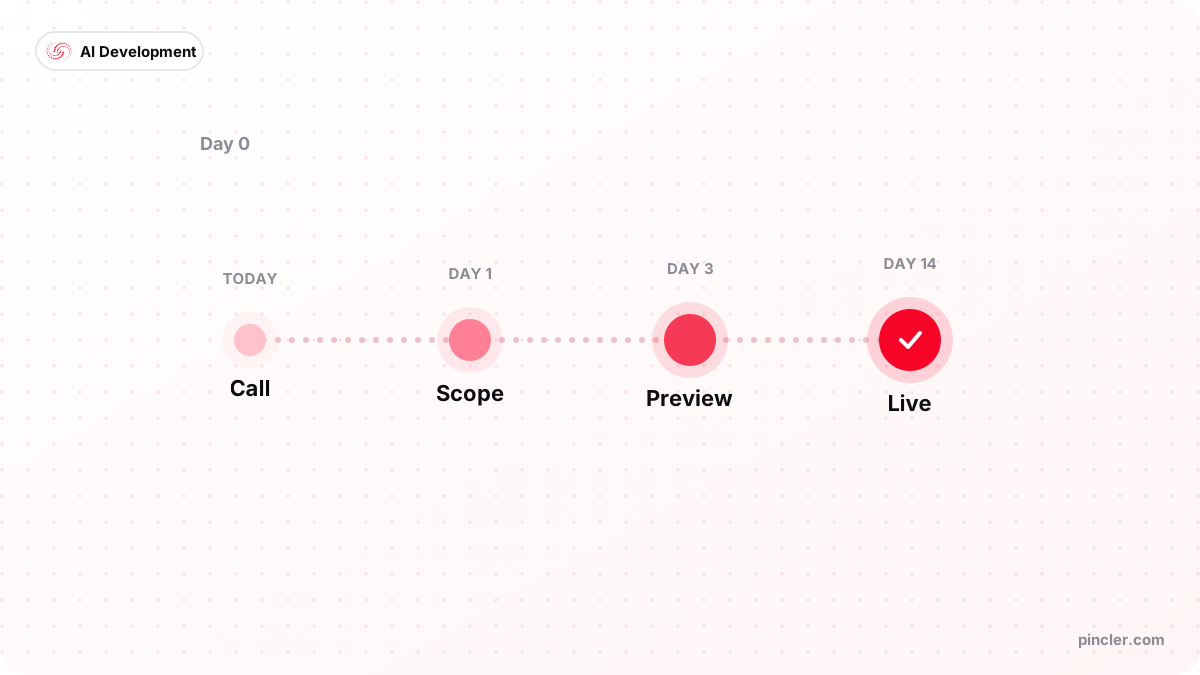
Quick answer
- Typical delivery
- 3–30 days; median 13 days quoted across PINCLER's 79 published catalogue builds
- Typical price
- Fixed $500–$2,500 per project, median $1,450 — AI drafts every build, senior engineers review, test and harden it
- What makes it possible
- Fixed scope, AI-generated volume code, one senior owner, a boring stack, daily deploys
- Never skipped
- Automated tests, security review, staging and UAT, clean handover with warranty
Every PINCLER project ships in 3 to 30 days: a landing page in under a week, a booking system in about two weeks, a SaaS MVP with billing in under a month. Those are delivery dates for production software — deployed to the client's cloud, code in their GitHub, warranty running — not for a prototype.
The speed is not heroics and it is not corner-cutting. Rapid software development with AI works because the two slowest parts of traditional delivery — writing volume code by hand, and coordinating the large team that hand-writing requires — are the two parts that have genuinely changed.
Here is exactly where the time goes on a typical build, day by day, what never gets skipped no matter the deadline, and — because honesty ranks above marketing — the projects where days is the wrong promise altogether.
Where do the months actually go on a traditional project?
Watch a conventional three-month build closely and very little of the elapsed time is anyone typing code. It is a discovery phase producing documents nobody rereads, work batched into fortnightly sprints with review waiting at the end, handoffs between designer and developer and QA — each with a queue — and status meetings to coordinate all of the above. The larger the team, the more of the calendar coordination eats.
The code itself was the other slow half: authentication, forms, database plumbing and test suites, all typed by hand at human speed. That half is what models such as Claude and GPT collapsed. And once one senior engineer plus AI can produce what a five-person team produced, most of the coordination overhead disappears with the headcount. The speed-up compounds from both directions at once.
Traditional timeline = typing + coordinating
    the typing       → AI generates volume code → hours, not weeks
    the coordinating → one senior owner         → no handoff queues
    what remains     → judgement: scope, review, security, release
What does the published research say about the slow baseline?
The traditional record is not a strawman; it is documented at scale. Research by McKinsey with the University of Oxford across more than 5,400 IT projects found that large projects run 45% over budget and 7% over time on average while delivering 56% less value than predicted — and that 17% go badly enough to threaten the existence of the company. The Standish Group's long-running CHAOS research tells the same story from another angle: in recent editions only around 31% of software projects finished on time, on budget and with full scope, with 50% challenged and 19% failed outright.
Speed and safety are not opposites in the delivery research, either. DORA's State of DevOps programme has consistently found that elite-performing teams deploy on demand — up to 182 times more frequently than low performers — while also recovering faster and failing less often. Small, frequent, verified releases are the documented winning pattern. A 3-to-30-day project with daily preview deploys is that pattern compressed, not a gamble against it.
None of this proves any individual fast project is good, and it is not meant to. It sets the baseline for custom software development honestly: the slow, expensive way fails often enough that "quality takes months" deserves scepticism — aimed at us as much as at anyone else.
What makes days possible? Five ingredients
None of these is exotic on its own. The speed comes from stacking all five on every project, without exception.
- Fixed, written scope — the brief is agreed before day one, so no mid-build debate burns the calendar.
- AI writes the volume code — scaffolding, CRUD, tests and first-draft UI arrive in hours, leaving humans the judgement work.
- One senior owner — a single engineer holds the whole build, so nothing waits in a handoff queue.
- A standard, boring stack — TypeScript, Postgres, proven integrations like Stripe. Novelty is spent on your product, never on infrastructure.
- Something visible every day — daily deploys to a preview URL mean feedback lands while the work is warm, not at a fortnightly reveal.
A typical two-week build, day by day
Here is the shape of a representative mid-band project — a booking system or a small SaaS at the $1,500–$2,500 end. Shorter builds compress the same phases; nothing is reordered.
| Days | Phase | What happens |
|---|---|---|
| 1–2 | Spec and skeleton | Scope locked, data model designed, repository and CI set up, walking skeleton deployed |
| 3–6 | Core build | Main workflows generated, reviewed and refined daily; preview URL updates every evening |
| 7–9 | Integrations | Payments, calendar, email or WhatsApp Business API wired in and tested against real sandboxes |
| 10–11 | Hardening | Security review, error handling, edge cases, automated test suite completed |
| 12–13 | Staging and UAT | You test on staging with real scenarios; fixes land same day |
| 14 | Launch and handover | Production deploy to your cloud, code and docs in your GitHub, warranty starts |
PINCLER's perspective: every project inside 30 days
Across the 79 builds in PINCLER's published catalogue, the median quoted delivery is 13 days at a median advertised price of $1,450. Four builds are quoted within 7 days, 33 within 14, and all 79 inside a 30-day window — the range runs from 3-day deployment jobs to 30-day web and mobile builds, every one priced between $500 and $2,500. The full dataset, with per-category medians, is in our what-you-can-build research.
The spread by category is the useful part for planning, because it tells you what kind of build takes what kind of time. Infrastructure and website work ships fastest; web and mobile applications sit at the long end, because screens, states and store requirements multiply the surface area. If your project resembles a category below, its median is a far better anchor than any generic industry estimate.
| Category | Median price | Median delivery |
|---|---|---|
| Cloud & DevOps | $850 | 5 days |
| Websites | $1,025 | 8 days |
| Integrations | $1,200 | 10 days |
| Chatbots | $1,375 | 13 days |
| Web Apps | $1,925 | 18 days |
| Mobile | $1,850 | 19 days |
A worked example: what a saved month is actually worth
Speed is a cost lever, not a bragging right, and the arithmetic is easy to run for your own case. Say a distributor's team spends two hours a day retyping orders between a spreadsheet and an invoicing tool. At $22 an hour across 22 working days, that is 2 × 22 × 22 = $968 a month of pure re-keying. An automation that removes it, built at our median price of $1,450, pays for itself in about six and a half weeks.
Now price the timeline itself. If a traditional quote for the same tool says 14 weeks and an AI-assisted build ships in 13 days, the twelve-week difference is 12 weeks × 5 days × 2 hours = 120 hours of re-keying that still happens while you wait — about $2,640 of cost the slower timeline quietly adds before either version has done anything at all. For revenue-generating software, swap the hourly figure for margin per day and the gap widens from there. Time-to-live is part of the price, whether or not it appears on the quote.
What never gets skipped?
Speed earned by deleting the safety net is just deferred slowness, so four things are scheduled into every build rather than squeezed out of it. Automated tests, because generated code that is not pinned down by tests cannot be changed safely next month. A human security pass over authorisation, secrets and payment paths, because that is where plausible-looking code hides its worst surprises. A staging environment and your own acceptance testing, because the person who knows the business must try to break the build before customers can. And a clean handover — code, documentation and credentials in your accounts — because software you cannot take elsewhere is not really yours.
It is worth saying plainly: the fixed price is what keeps these honest — the incentive mechanics are the subject of fixed price vs hourly billing for software projects. An hourly shop profits when hardening drags; a fixed-price shop eats every overrun itself. The incentive to be both fast and right sits entirely on our side of the table.
When is days the wrong promise?
Some work is genuinely slow, and a studio that never says so is selling you a guess — the honest stage-by-stage numbers live in realistic software project timelines. Novel algorithms with no well-trodden pattern for the AI to draw on move at research speed. Regulated domains — medical devices, serious financial infrastructure — carry review and audit cycles that no tooling shortens. Migrating years of messy legacy data safely is often a project in itself. And a client who has not yet decided what version one is will spend more time deciding than we spend building; no methodology fixes an unmade decision.
Our approach for big ideas is phasing rather than heroic deadlines: each phase fixed-price at $2,500 or less, each shipping something usable in its own 3–30 day window. You get working software early and a genuine exit after every phase.
How to pressure-test any fast quote — including ours
Speed claims are easy to make and cheap to fake, so put the same five questions to anyone quoting days, us included. Specific answers within a minute are the mark of a shop that has actually done this; hesitation on any of them means the fast timeline is aspiration rather than process.
- What exactly ships on the delivery date — a demo, or production software deployed to my cloud with the code in my repository?
- Where in the schedule do security review and my own acceptance testing sit?
- What happens to the price if the build overruns — and is that in writing?
- What does the warranty cover after handover, and for how long?
- Which parts of my project would make you say days is the wrong promise?
How to keep your own build fast
The fastest projects share a client-side pattern, and it costs nothing to copy. Arrive with decisions made — a tight one-page brief is the single highest-leverage document you can write. Nominate one decision-maker, because committees add a day per opinion. Have real examples ready: the spreadsheet you use today, a screenshot of the flow you like, live sample data. And test the previews the day they land, while the context is loaded on both sides.
If you want the concrete version of all this for your own idea, our use-case pages list fixed prices and timelines for dozens of common builds — the MVP-in-14-days sprint is the distilled version — or book the free 30-minute call and you will have a written quote, with a day-by-day plan, within one working day.
Related PINCLER builds
Frequently asked
Is software built in days lower quality than software built in months?
Not inherently — the calendar was never the quality mechanism. Quality comes from review, tests, staging and monitoring, and those are scheduled into every build here rather than skipped. A three-month timeline mostly contains coordination overhead, not extra care. The fair comparison is what a team ships, not how long it took; ask any studio to show their review process and warranty instead of their Gantt chart.
What happens if the build takes longer than quoted?
You pay nothing extra — the price is fixed in writing before work starts, so overruns are our cost. If a delay comes from our side, the schedule slips at our expense. If it comes from scope growing on yours, we say so immediately and either park the addition for a later phase or agree a new written quote before touching it. Silent scope creep billed by the hour is precisely the failure mode fixed pricing exists to kill.
Can genuinely large projects really be delivered this way?
Yes, by phasing rather than by pretending, and every phase is built the same way: AI drafts it, senior engineers review, test and harden it. A large system splits into phases of $2,500 or less, each shipping something independently useful — the customer-facing product first, then the admin panel, then the deeper integrations. You can stop after any phase and own everything built so far. What we will not do is promise a six-month enterprise programme in a fortnight; when a project truly needs months, we say so at the quote stage.
How long does custom software development actually take in 2026?
For well-understood small-business builds, days to weeks: across PINCLER's catalogue the median is 13 days, ranging from 3-day deployment jobs to 30-day web and mobile apps, all fixed-priced between $500 and $2,500 on the same method — AI writes the first draft, senior engineers review and test it. Larger or novel systems still take months, and should. The honest heuristic: if your build resembles patterns that exist in thousands of codebases, affordable custom software development in under a month is now normal; if it is genuinely novel or heavily regulated, be suspicious of anyone promising days.
Does shipping fast mean skipping testing?
No — on a well-run fast build, testing is scheduled rather than squeezed. Roughly a fifth of our standard fortnight is hardening, security review and your own acceptance testing on staging, and the automated suite runs on every commit from day one. The delivery research points the same way: DORA has consistently found the fastest-deploying teams also fail less and recover faster, because small verified releases are safer than big-bang ones. Speed achieved by deleting the safety net is a different and worse product.
Why do traditional software projects take months when the code can be written in days?
Because most of a traditional timeline was never code — it was coordination: discovery phases, fortnightly sprint boundaries, handoffs between design, development and QA, and the meetings that keep a five-person team aligned. McKinsey and Oxford's research across 5,400 projects found large IT efforts averaging 45% over budget, which is what that structure tends to produce. Remove the hand-typing with AI and shrink the team to one accountable senior, and both slow halves — the typing and the coordinating — collapse together.
Sources
- McKinsey & University of Oxford: delivering large-scale IT projects
- The Standish Group CHAOS research
- DORA State of DevOps research
Want to build this?
PINCLER builds custom software, AI agents and GTM systems for a fixed price between $500 and $2,500, delivered in 3–30 days, with the code owned by you.
Keep reading
Related articles
How AI-Native Development Changes Software Pricing
AI-native development pricing explained: what actually changed in the unit economics of building software, where AI does not help, and why lower variance makes fixed prices possible.
AI Agents vs Chatbots: What Your Business Actually Needs
AI agent vs chatbot: a chatbot answers questions, an agent takes actions across your systems. Here is how to tell which one your business needs, and what each costs.
AI-First vs Traditional Software Development
AI-first software development explained: how it differs from the traditional agency model, what changes in cost and speed, and where each approach genuinely wins.