How AI-Native Development Changes Software Pricing
AI-native development pricing explained: what actually changed in the unit economics of building software, where AI does not help, and why lower variance makes fixed prices possible.
Quick answer
- What actually changed
- The hour count for a defined build, and the variance around it — not the hourly rate. Lower variance is what makes a fixed price quotable at all.
- Where AI helps most
- Scaffolding, CRUD endpoints, forms and validation, admin screens, test fixtures, integration boilerplate, migrations and documentation.
- Where it does not help
- Requirements, undocumented third-party systems, large legacy codebases, data migration, regulated validation and stakeholder decisions.
- The non-negotiable step
- Senior review, testing and security hardening before release. Generation speed without review raises throughput and lowers stability.
- PINCLER pricing
- Fixed $500–$2,500 per project because AI drafts and senior engineers review and harden; phases, not bigger budgets. Catalogue median of 79 builds: $1,450.
What changed is not the price of an engineering hour — it is how many hours a defined piece of software takes, and how tightly that number can be predicted. AI native development pricing follows from the second fact more than the first. When the spread between the expected and the worst-case hour count narrows, a supplier can quote a fixed price instead of an estimate, because the risk premium that made fixed pricing dangerous collapses. That is why PINCLER quotes $500 to $2,500 in writing with a hard ceiling — AI writes the first draft, senior engineers review, test and harden it — against a market where Clutch reports the average custom software project at $132,480 over about 13 months.
The evidence on AI productivity is genuinely mixed, and an honest version of this argument has to start there rather than bury it. A controlled experiment by researchers at Microsoft Research, GitHub and MIT Sloan measured a 55.8% speed-up on a standard task. METR's 2025 randomised trial measured experienced maintainers going 19% slower on their own large repositories. Both results are real, and the difference between them is the whole argument.
This article works through where AI collapses hours and where it does not, why senior review is the step that cannot be removed, and how variance rather than raw speed is what makes fixed pricing possible. It also states plainly what this model does not cover, because a pricing claim without a stated boundary is not a claim worth checking.
What is AI-native development pricing?
AI-native development pricing is a fixed-price model made possible by a change in how software is produced: a language model writes the first draft of the code and a senior engineer reviews, corrects, tests and hardens it before release. The price reflects the hours that method actually consumes, not the hours a hand-written build would have consumed.
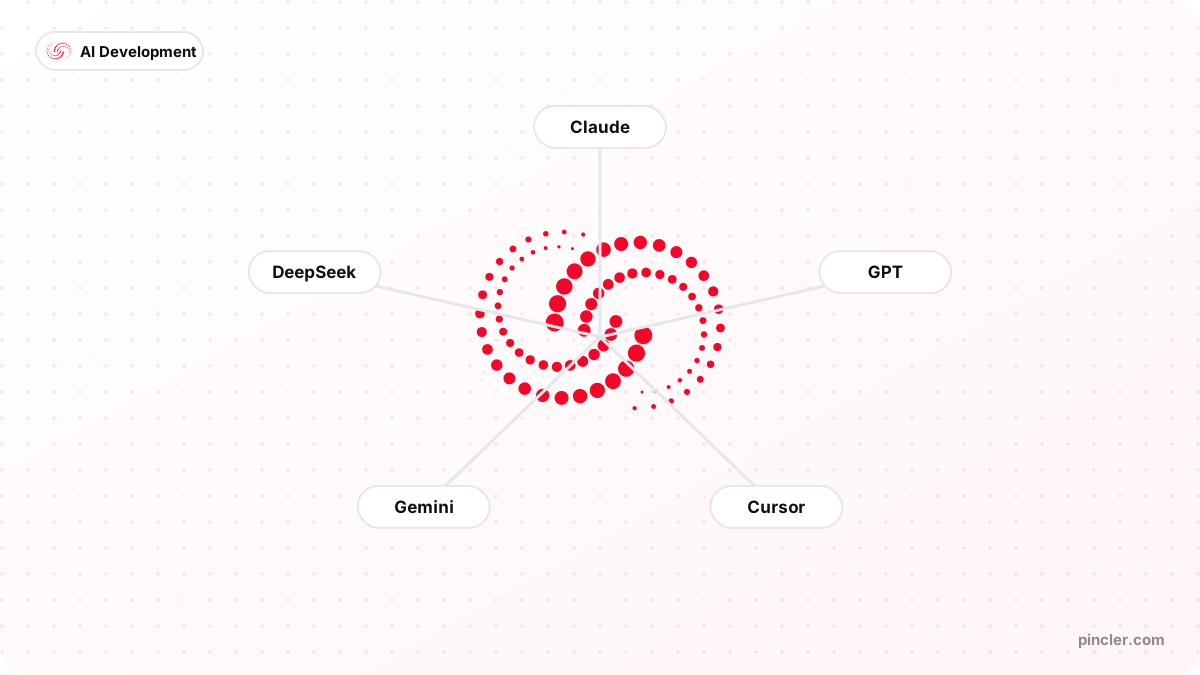
PINCLER is an AI-first custom software development studio. We build business systems — internal tools, dashboards, booking systems, CRMs, integrations and AI agents — using tools such as Claude, GPT, Cursor and Claude Code, with a named senior engineer owning architecture, security and release on every project. Our process describes each step, because a pricing claim that cannot be inspected is not worth much to anyone.
It is not the same thing as "AI wrote it, so it is cheap". Unreviewed generation is a different product with a different failure profile, and the review step accounts for most of the remaining cost rather than a footnote of it. What follows is the arithmetic underneath that sentence.
What actually changed in the unit economics?
Break a build into task types and the effect turns out to be very uneven, which is the part most summaries flatten out. AI collapses the hours on work that is highly patterned and has been written a million times before. It does close to nothing for work that requires knowing your business.
The commercial consequence is that a build's cost is now dominated by the rows AI does not touch. On a typical PINCLER project of around 25 focused senior hours, roughly ten go to directing and correcting generation, six to review and testing, five to deployment and handover, and four to scoping. The generation itself takes minutes.
That is a different distribution from a traditional engagement, where typing was the bulk of the cost and review a slice of it. Inverting that ratio is what moved the price. It is also why the remaining hours are almost entirely senior hours: junior time has less to do when the boilerplate writes itself, which is a real change in how a delivery team is shaped.
| Task type | Effect of AI on hours | Who owns it |
|---|---|---|
| Scaffolding and CRUD endpoints | Large reduction | AI drafts, engineer reviews |
| Forms, validation, admin screens | Large reduction | AI drafts, engineer reviews |
| Test fixtures and documentation | Large reduction | AI drafts, engineer reviews |
| Data model and architecture | Little to none | Senior engineer |
| Auth, permissions, payment paths | Small, and risky unreviewed | Senior engineer |
| Undocumented third-party integrations | Little to none | Senior engineer |
| Requirements and scoping | None | Client and engineer together |
Does AI actually make developers faster?
Sometimes, and the exceptions matter more than the headline. In a randomised controlled experiment by researchers at Microsoft Research, GitHub and MIT Sloan, developers given GitHub Copilot implemented an HTTP server in JavaScript 55.8% faster than a control group — 71 minutes against 161.
METR's 2025 randomised controlled trial produced the opposite result in a different setting. Sixteen experienced open-source developers worked 246 real issues on their own repositories, which averaged over 22,000 stars and more than a million lines of code, and took 19% longer when allowed to use AI tools. They had forecast a 24% speed-up beforehand and still believed afterwards that they had been 20% faster. METR is explicit that the finding does not generalise to all developers or settings, but it is the most rigorous negative result available and it deserves quoting rather than ignoring.
Both results are true because they measured different work. The GitHub task was greenfield, small, well-specified and heavily represented in training data. The METR tasks were changes to large, mature, idiosyncratic codebases whose conventions the model did not know, where the cost of reading and verifying a suggestion exceeds the cost of writing the line yourself.
That bounds our own claim rather than supporting it without limit. AI-native pricing works where the work resembles the first study: a new, narrowly-scoped system on a standard stack. It does not work on a fifteen-year-old codebase, which is one reason the price band has a ceiling instead of a sliding scale. The honest position is that the mechanism is real and its domain is narrow, and why agencies charge $30,000 for what we build for $2,500 walks the same boundary from the cost side.
| Study | Setting measured | Measured effect |
|---|---|---|
| Microsoft Research / GitHub / MIT Sloan | Greenfield standard task, recruited developers | 55.8% faster |
| METR (2025) | 246 real issues on large mature repositories | 19% slower |
| DORA (2025) | Nearly 5,000 technology professionals surveyed | Throughput up, stability down |
Why is senior review the step that cannot be removed?
Because the output is confidently wrong often enough to matter, and the errors cluster in exactly the places that hurt. Stack Overflow's 2025 Developer Survey, drawn from over 49,000 responses across 177 countries, found 84% of developers use or plan to use AI tools while 46% do not trust the accuracy of their output — up from 31% the previous year — and 66% name output that is almost right but not quite as their main frustration, with a further 45% reporting they lose significant time debugging AI-generated code.
Almost right is the expensive category. Code that is obviously wrong fails immediately and costs an hour. Code that is almost right passes the demo and then fails on the authorisation edge case, the currency rounding, or the retry that quietly duplicates a payment. Finding that class of defect is a reading task, and reading is precisely what the senior engineer is paid for in this model.
The systemic evidence points the same way. DORA's 2025 State of AI-assisted Software Development found AI adoption relates positively to delivery throughput and negatively to delivery stability, with 30% of respondents reporting little or no trust in AI-generated code. GitClear's analysis of 211 million lines of changed code found copy-pasted lines rose from 8.3% of the total in 2020 to 12.3% in 2024 while refactored lines fell from 24.1% to 9.5%, meaning code is increasingly duplicated rather than reused.
None of that is an argument against using AI. It is an argument that the saving sits in generation while the cost has moved to verification, which is exactly where the remaining budget goes. Is AI-generated code safe to put in production takes that question on directly, and what humans check in AI-assisted code review lists the specific things a reviewer is looking for.
Why does fixed pricing become possible when variance falls?
A fixed price is an insurance product. The seller charges the expected cost plus a premium for the risk of overrun, and the size of that premium is set by the worst case rather than the average. That is why traditional suppliers default to hourly billing or heavily padded estimates: when the realistic worst case is three times the expected case, a fixed quote either bankrupts the seller or insults the buyer.
Two things narrow the spread. Generation removes the long tail of tedious work where estimates historically went wrong — the fourteenth form, the reporting screen nobody scoped, the export nobody mentioned. And a hard ceiling forces scope to be defined precisely up front, because a supplier who cannot bill more has every incentive to know exactly what they are agreeing to.
The arithmetic is straightforward. At a $58 effective hourly cost, a 25-hour expected build is $1,450 and a 43-hour worst case is $2,494, which still sits inside the ceiling — a 72% overrun absorbed without a change order. Pricing at the published median means the overruns are paid for by the builds that come in under, and that only works because the distribution is tight. Widen the worst case to 150 hours and no fixed price is safe below $8,700 at the same rate — which is precisely the position a traditional supplier is in, and precisely why they bill by the hour.
The trade is real and worth stating rather than glossing. A fixed ceiling means we say no more often. Scope that cannot be pinned down before work starts is not quotable at $2,500, so it becomes a smaller first phase or it becomes somebody else's project. Fixed price versus hourly billing compares who carries which risk under each model.
WHY LOW VARIANCE MAKES A FIXED PRICE QUOTABLE

  TRADITIONAL BUILD — unfamiliar scope, large codebase
    expected  120 h   |   realistic worst case  400 h    (3.3x)
        -> a safe fixed quote must be priced near 400 h
        -> so the seller bills hourly, and the BUYER carries the risk

  AI-NATIVE BUILD — narrow scope, known stack, senior review
    expected   25 h   |   realistic worst case   43 h    (1.7x)
        -> the gap is small enough for the SELLER to absorb it
        -> fixed price, agreed in writing, ceiling enforced

  The premium tracks the TAIL, not the average.
  Narrow the tail and a fixed price stops being a gamble.
Who should choose an AI-native studio, and who should not?
The mechanism picks the customer rather than the other way round. AI-native pricing suits work that resembles the first study above: a new, narrowly-scoped system on a mainstream stack, where AI drafts the repetitive layers and a senior engineer reviews, tests and hardens whatever ships. If your project is that shape, a fixed $500 to $2,500 quote is a fair reflection of the hours involved rather than a discount on somebody else's price.
In practice that means small and mid-sized businesses building one workflow, founders validating one idea before raising money, and operations teams retiring a spreadsheet or a manual handover. All three share the property that matters more than sector or size: somebody can describe the finished thing in a paragraph. That is what keeps the variance low, and low variance is the entire reason the fixed price is safe for both sides.
It is the wrong purchase for a buyer whose real need is capacity rather than a deliverable. If you want engineers available next quarter, a roadmap owned for three years, or a supplier to carry discovery risk on their own invoice, an hourly engagement prices that honestly and this model does not pretend to. Fixed price versus hourly billing sets out who ends up carrying which risk in each case.
- Good fit: one workflow, a mainstream stack, and a requirement you can describe in a paragraph.
- Good fit: a first build whose job is to tell you whether the idea deserves more investment.
- Poor fit: large legacy modernisation, where the measured effect of AI assistance runs the other way.
- Poor fit: buyers who need capacity, certification evidence or multi-year roadmap ownership rather than a defined deliverable.
Where does AI-native pricing not apply?
The mechanism has a domain, and pretending otherwise is how a credible argument turns into a sales pitch. These are the cases where the model does not hold and a conventional engagement is the correct purchase.
Inside the domain the model holds well. Outside it, a traditional engagement priced against Keyhole Software's 2026 benchmarks — a simple or MVP-scope build at $40,000 to $120,000 over two to four months — is the honest comparison, and we say so rather than quoting a number we could not deliver against.
- Large legacy modernisation — the METR setting, where AI assistance was measured to slow experienced developers down.
- Regulated builds where audit evidence, formal validation and independent testing form part of the deliverable.
- Undocumented third-party systems with no API, where the cost is reverse-engineering rather than writing.
- Data migration from messy sources, which is a data-cleaning problem no model shortcuts.
- Work blocked on stakeholder decisions — the calendar does not care how fast the code gets written.
- Anything needing a dedicated standing team, round-the-clock on-call, or a multi-year roadmap.
What mistakes do buyers and builders make with AI pricing?
The same seven errors turn up on both sides of the table, and most of them come from treating AI as a uniform discount rather than an uneven change in where the hours sit.
- 1. Assuming AI makes everything cheaper. It makes patterned work cheaper and leaves requirements, integrations and migrations priced roughly as before.
- 2. Buying generation without review. That is a different product with a worse failure profile, and DORA's stability finding is what it looks like at scale.
- 3. Measuring output in lines of code. GitClear's data shows duplication rising while refactoring falls, so more lines is often the symptom rather than the result.
- 4. Expecting the METR result to hold for a greenfield build, or the GitHub result to hold for a legacy one. The setting decides even the sign of the effect.
- 5. Treating a fixed price as a discount rather than a risk transfer. The supplier absorbs the overrun, which is exactly why scope gets defined properly.
- 6. Assuming faster delivery means less thinking. The scoping conversation became more important, not less, because there is less time to correct course mid-build.
- 7. Scoping to the ceiling instead of to the first useful outcome — how to scope a project to fit a budget is the better starting point.
PINCLER's perspective: 79 published builds under one ceiling
Across the 79 builds in PINCLER's published fixed-price catalogue the median price is $1,450 against a median quoted delivery of 13 days, with quoted windows running 3 to 30 days. Four are quoted at a week or less, 33 at a fortnight or less, and all 79 within a month. Every one is priced inside the $500 to $2,500 band, because nothing is quoted above the ceiling — larger ideas are split into phases instead. It is a published price list rather than a delivery record, and publishing all of it, itemised, is the part that lets you argue with it.
The tooling record published alongside those builds is mundane rather than impressive, which is rather the point: GPT is listed on 76, Cursor on 75, Claude Code on 63, Claude on 55, v0 on 28 and DeepSeek on 22. A senior engineer reviews every one before release. The numbers describe a workshop, not a conjuring trick.
The ordering in the table below is the mechanism showing through. Cloud and DevOps work is heavily patterned and is quoted at a median of five days; web apps carry more novel decisions and are quoted at 18. The price tracks the review burden rather than the line count, which is the clearest single piece of evidence that the model behaves the way this article says it does. Typical builds include an AI lead qualification agent, a workflow automation across n8n, Zapier or Make and an admin dashboard for back-office work. The full dataset is published at what you can build.
| Category | Median price | Median days |
|---|---|---|
| Cloud & DevOps | $850 | 5 |
| Websites | $1,025 | 8 |
| Integrations | $1,200 | 10 |
| AI Agents | $1,450 | 13 |
| GTM Engineering | $1,600 | 14 |
| Internal Tools | $1,725 | 16 |
| Web Apps | $1,925 | 18 |
The bottom line
AI-native pricing is not a discount and not a claim that software got easy. Generation became close to free, verification did not, and the buildable scope narrowed to work that fits inside a predictable envelope. Inside that envelope the variance is small enough to quote a fixed number. Outside it, the traditional price is the right one and we will say so.
The test of any argument like this is whether the supplier will state its limits. Ours are a $2,500 ceiling, phases rather than bigger budgets, and a named senior engineer on every review. Our process sets out the rest, and a 30-minute call produces a written fixed quote within a working day.
Related PINCLER builds
Frequently asked
What is AI-native development pricing?
AI-native development pricing is a fixed-price model reflecting the hours an AI-assisted build actually takes: a language model writes the first draft and a senior engineer reviews, tests and hardens it before release. Because generation removes the long tail of repetitive work, the spread between expected and worst-case effort narrows enough for a supplier to quote a fixed number rather than an hourly estimate.
Does AI really make software development faster?
It depends on the setting, and the research disagrees for good reasons. A controlled experiment by Microsoft Research, GitHub and MIT Sloan measured developers completing a standard greenfield task 55.8% faster with an AI assistant. METR's 2025 randomised trial measured 16 experienced maintainers taking 19% longer on large mature repositories. Patterned new work speeds up; unfamiliar legacy work does not.
Why is senior review still necessary if AI writes the code?
Senior review is necessary because AI errors cluster in the expensive places: authorisation edge cases, error handling, rounding and retry logic. Stack Overflow's 2025 survey found 46% of developers distrust AI output accuracy and 66% cite answers that are almost right but not quite. Code that is obviously wrong costs an hour; code that is almost right passes the demo and fails in production.
Why can AI-assisted studios offer fixed prices when agencies cannot?
Fixed pricing is a risk transfer, and the premium is set by the worst case rather than the average. When a build's realistic worst case is 43 hours against an expected 25, the seller can absorb the difference. When it is 400 hours against 120, no safe fixed quote exists, so the supplier bills hourly and the buyer ends up carrying the overrun risk instead.
Does AI reduce the cost of every part of a software project?
No. AI reduces hours on patterned work such as scaffolding, CRUD endpoints, forms, admin screens, test fixtures and documentation. It does little for requirements gathering, undocumented third-party integrations, data migration from messy sources, regulated validation or waiting on stakeholder decisions. Those parts cost what they always cost, which is why scope discipline matters more than tooling.
How many hours does an AI-assisted build actually take?
A median PINCLER build takes roughly 25 focused senior engineering hours inside the 13-day window the catalogue quotes: about four hours scoping, ten directing and correcting generation, six reviewing and testing, and five on deployment and handover. Generation itself takes minutes. Elapsed time exceeds working time because review waits on test results and several projects run in parallel.
Sources
- METR — Impact of Early-2025 AI on Experienced Open-Source Developer Productivity
- The Impact of AI on Developer Productivity: Evidence from GitHub Copilot
- Stack Overflow — 2025 Developer Survey, AI section
- DORA — State of AI-assisted Software Development 2025
- GitClear — AI Copilot Code Quality 2025 Research
- Clutch — Software Development Pricing Guide
- Keyhole Software — Cost of Custom Software Development
Want to build this?
PINCLER builds custom software, AI agents and GTM systems for a fixed price between $500 and $2,500, delivered in 3–30 days, with the code owned by you.
Keep reading
Related articles
AI Agents vs Chatbots: What Your Business Actually Needs
AI agent vs chatbot: a chatbot answers questions, an agent takes actions across your systems. Here is how to tell which one your business needs, and what each costs.
AI-First vs Traditional Software Development
AI-first software development explained: how it differs from the traditional agency model, what changes in cost and speed, and where each approach genuinely wins.
n8n vs Zapier vs Make: Which to Build Your Automation On
n8n vs Zapier vs Make compared honestly: pricing models, self-hosting, complex logic and which automation platform fits your team — from a studio that builds on all three.