Realistic Software Project Timelines, Stage by Stage
A realistic software project timeline, stage by stage: what discovery, build, testing and launch actually take, what stretches each one, and where AI compresses the middle.
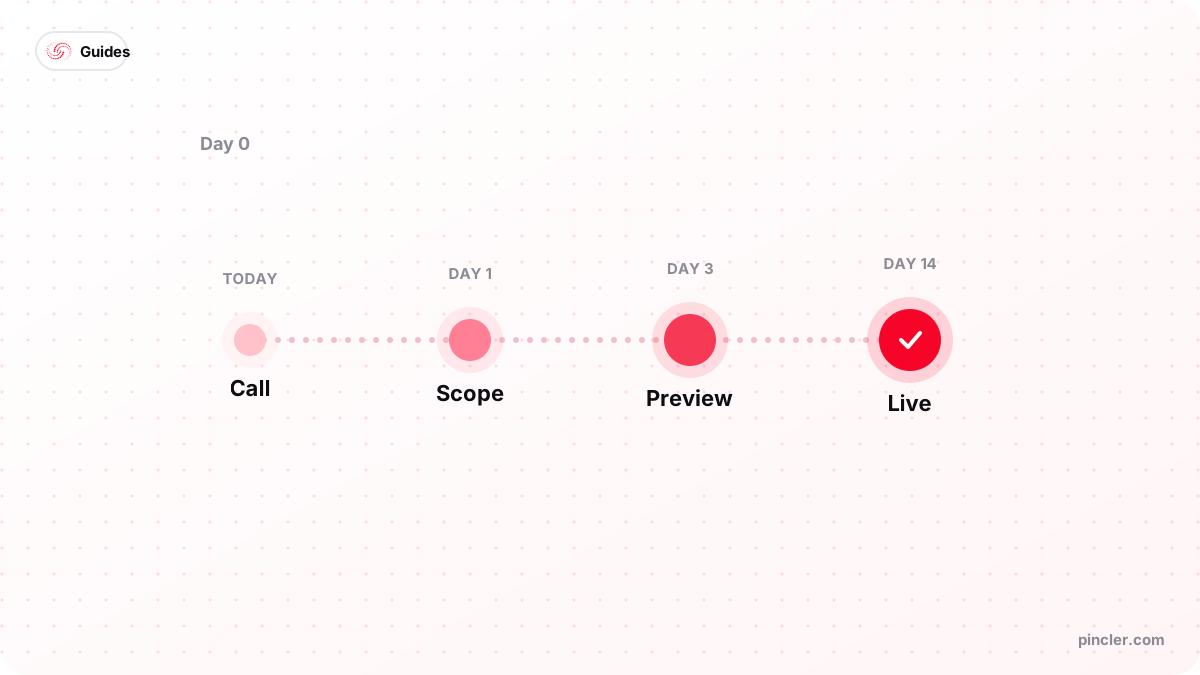
Quick answer
- AI-first delivery
- 3–30 days for most small-business projects; median 13 days quoted across PINCLER's 79 catalogue builds
- Traditional pipeline
- Commonly three to six months for similar scope — a general market observation
- What AI compresses
- The build middle — boilerplate, first-draft UI, tests — measured at 55.8% faster in GitHub's controlled experiment
- What it cannot compress
- Discovery, decisions, testing and verification — the ends run at human speed
- Main cause of delay
- Client-side inputs: pending decisions, late content, missing account access
Small business software ships in 3 to 30 days when built AI-first with tight scope; comparable work through a traditional agency pipeline commonly runs three to six months. Both numbers are real, and understanding why they differ is the key to reading any software project timeline you are quoted — and to spotting the ones that are fiction.
The difference is not that anyone types faster. It is that the middle of a project — boilerplate, first-draft interfaces, tests, integration plumbing — has been compressed by AI tooling, while the two ends, deciding what to build and verifying it works, still take the time human judgement takes. Timelines that claim to compress the ends are the ones that slip.
This guide walks through each stage, gives honest durations for both production methods, and lists the specific things — most of them on the client's side of the table — that stretch a schedule.
What are the stages of a software project?
Every software project passes through the same five stages regardless of who builds it or what it costs. What varies is the duration of each stage and how much ceremony surrounds it. The table gives typical ranges for a small, well-scoped project — under roughly $10,000 of scope — under both production methods. The traditional column reflects general market patterns, not any specific firm, and assumes a competent agency rather than a bad one.
Notice where the compression happens: build time collapses, discovery and testing merely tighten. That asymmetry is the honest signature of AI-powered software development. A quote that promises a one-day discovery on a complex brief, or no testing stage at all, has not compressed those stages — it has skipped them, and skipped stages always reappear later with interest.
Discovery → Spec → BUILD → Testing → Launch
  1–2 d     1–3 d   2–20 d    1–4 d     1–2 d   (AI-first)
  2–6 w     2–8 w   2–6 m     2–6 w     1–4 w   (traditional)

AI compresses the middle — code volume.
The ends — decisions and verification — run at human speed.
| Stage | AI-first studio | Traditional agency |
|---|---|---|
| Discovery and written quote | 1–2 days | 2–6 weeks |
| Specification and design | 1–3 days | 2–8 weeks |
| Build | 2–20 days | 2–6 months |
| Testing and review | 1–4 days | 2–6 weeks |
| Launch and handover | 1–2 days | 1–4 weeks |
How long does each project type take end to end?
Between 3 and 30 days for most small-business builds, depending mainly on how many decisions and integrations the scope carries. Stage durations mean more when attached to real project types. These are the fixed timelines we publish and work to at PINCLER, measured from agreed spec to deployed product in the client's own cloud. They assume the client-side inputs — content, account access, decisions — arrive when scheduled, which is the assumption that fails most often in practice.
| Project type | Typical timeline | What usually extends it |
|---|---|---|
| Landing page or small site | 3–7 days | Copy and brand assets arriving late |
| Workflow automation | 4–10 days | Access to the accounts being connected |
| AI chatbot | 5–18 days | Assembling the knowledge base to train on |
| Booking or scheduling system | 10–16 days | Undecided cancellation and refund rules |
| Custom e-commerce store | 16–26 days | Product data cleanup and payment approval |
| Mobile app MVP | 18–28 days | App store review adds days after code-complete |
| SaaS MVP with auth and billing | 18–28 days | Pricing model decisions arriving mid-build |
What actually stretches a timeline?
Ask teams what delays projects and the honest answers cluster on the client side of the fence — not because clients are lazy, but because nobody warned them they were on the critical path. Every item below is a known quantity you can prepare before the project starts, and preparing them is the single cheapest way to protect a schedule.
- Decisions pending — refund rules, pricing tiers, who approves what. Every open question becomes a paused task.
- Access not granted — domain registrar, hosting, Stripe, HubSpot, WhatsApp Business API. Collect credentials before day one.
- Content not ready — copy, images, product data, legal pages. The build finishes and then waits.
- Feedback in trickles — five contradictory comments over two weeks costs more than one consolidated review in two days.
- Scope added mid-build — each 'small addition' restarts testing on everything it touches.
- Third-party approvals — app store review, payment gateway onboarding, business verification for messaging APIs. Apple's published figure is that 90% of App Store submissions are reviewed within 24 hours, but the remaining 10% can take days. Start these on day one; they run on other people's clocks.
Why does AI compress the middle but not the ends?
Modern tooling — Claude, GPT, Cursor and their peers — generates boilerplate, tests and first-draft interfaces at a small fraction of hand-written speed. That is precisely the middle of the pipeline, and it is why the build column in the first table collapses from months to days. What the tooling does not compress is deciding what the software should do, and verifying that it actually does it. At PINCLER those ends belong to senior engineers: architecture and scope up front, review, security and release at the back — a split described in more detail in how we ship production software in days.
This has a practical consequence for reading quotes. When an AI-assisted team quotes fourteen days, roughly half of it is typically ends — discovery, review, testing, handover — and that proportion is healthy. When a team quotes fourteen days of pure build with the ends waved away, the timeline is optimistic in the way that always resolves in one direction.
A worked example: inside a 14-day schedule
Here is how a real two-week booking-system build actually distributes its days, so you can see the ends-and-middle shape in one concrete schedule — the anatomy of a 14-day MVP sprint. Days 1–2: discovery call, one-page scope agreed, written fixed quote, client gathers Stripe access and content. Days 3–4: data model and architecture decided by a senior engineer, first-draft screens generated and reviewed. Days 5–9: the build proper — booking flow, payments, notifications, admin list — with the client answering questions same-day. Days 10–11: internal testing, security review, and the client's own acceptance pass against the written criteria. Days 12–13: fixes from testing, content and polish. Day 14: deployment to the client's cloud, handover notes, warranty clock starts.
Count the shape: roughly five of fourteen days are ends — discovery, review, testing, handover — and nine are middle. Strip the AI assistance out of that schedule and the middle stretches to six or eight weeks while the ends barely move, which is the whole compression story in one project. When you are handed any schedule, redraw it this way; if the ends are missing, the plan is a build estimate wearing a project's clothes.
What does published research say about schedules?
The industry's track record on timelines is well documented and grim. McKinsey's study with the University of Oxford across more than 5,400 IT projects found large projects running 7% over time and 45% over budget on average — and, more usefully, that every additional year of scheduled duration increases cost overruns by 15%. The Standish Group's CHAOS research adds the outcome distribution: only around 31% of projects succeed outright, roughly half are 'challenged', and 19% fail, with small projects consistently succeeding at several times the rate of large ones.
Read together, those findings make one structural argument: schedule risk compounds with duration, so the safest project is a short one, delivered whole, followed by another short one. That is not an argument for rushing — it is an argument against the eighteen-month grand build, whose 7%-average overrun conceals a long tail of projects that double or die. Phasing a big idea into month-sized deliveries keeps every phase inside the zone where the success statistics are on your side.
PINCLER's perspective: benchmarks from 79 fixed-scope catalogue builds
Published averages describe other people's projects, so here is a complete dataset you can inspect. Across the 79 builds in PINCLER's published catalogue, the median quoted delivery is 13 days: 4 builds are quoted at 7 days or less, 33 at 14 days or less, and all 79 within 30. Every project shipped from an agreed one-page scope at a fixed price between $500 and $2,500, and the full data — category by category — is published in our what-you-can-build research.
The table shows the medians by category. Two things keep these numbers honest: the scope is written before the quote, and the $2,500 phase cap keeps every build inside the small-project zone the CHAOS research favours. When a category runs longer — web apps at 18 days, mobile at 19 — it is the ends stretching, not the middle: more decisions to make up front, more surface to verify before launch.
| Category | Median delivery | Median fixed price |
|---|---|---|
| Cloud & DevOps | 5 days | $850 |
| Websites | 8 days | $1,025 |
| Integrations | 10 days | $1,200 |
| AI agents | 13 days | $1,450 |
| Dashboards | 14 days | $1,600 |
| Web apps | 18 days | $1,925 |
| Mobile | 19 days | $1,850 |
How much faster is AI-assisted development, really?
The build-stage compression is not marketing; it has been measured. A controlled experiment by GitHub and Microsoft Research found developers using an AI pair programmer completed a standardised coding task 55.8% faster than the control group — 1 hour 11 minutes against 2 hours 41 minutes — with a higher completion rate as well (78% versus 70%). Adoption has followed the evidence: Stack Overflow's 2025 Developer Survey found 84% of developers using or planning to use AI tools, and Google's DORA research in 2024 reported 75.9% of respondents relying on AI for part of their work.
The same research draws the boundary of the speed-up. In that Stack Overflow survey, 46% of developers said they do not trust the accuracy of AI output, and DORA measured 39% with little or no trust in AI-generated code — practitioner scepticism that explains why the testing and review stages must not compress along with the build. A timeline built on AI speed with human verification is realistic; a timeline built on AI speed instead of human verification is a launch-day incident with a start date.
How do you keep your own project on schedule?
A schedule is a two-sided document, and the client-side lane is the one nobody writes down. Before the project starts, do four things: consolidate decision-making into one person with authority to answer questions within a day; gather content and access credentials into a shared folder before the build begins; book your own review time in your calendar for the days deliverables are due; and freeze scope against a one-page requirements document, keeping a written list of version-two ideas so good ones are captured rather than injected.
Then ask your builder one question: 'what do you need from me, and by when?' A team that answers with a specific list has scheduled real projects before. A team that says 'nothing, we handle everything' is telling you the timeline has no contact with reality yet. If you want to calibrate expectations for your own project, our use-case pages publish fixed timelines alongside fixed prices for over seventy build types — and a free 30-minute call will get you a written schedule for your specific scope within one working day.
Related PINCLER builds
Frequently asked
How long does a typical small software project take?
With tight scope and AI-assisted production, most small-business projects ship in 3 to 30 days: simple sites and automations in under ten, booking systems and dashboards in two to three weeks, SaaS and mobile MVPs in about four. Traditional agency pipelines commonly run three to six months for similar scope, largely due to process overhead and hand-written code rather than any difference in ambition.
Why do software projects so often run late?
The usual causes are stalled decisions, late content and access, drip-fed feedback and mid-build scope additions — most of which sit on the client's side of the critical path without anyone saying so. Builders share blame when timelines skip testing or assume perfect inputs. The fix is a two-sided schedule: your deadlines for decisions and materials written down next to theirs for deliverables.
Can a real software product genuinely be built in two weeks?
Yes, if the scope is honest: one core workflow, one or two integrations, standard design components, and decisions made before the build starts. That describes a real product, not a prototype — auth, payments and deployment included. What cannot be done in two weeks is a vague brief, five user roles and a mid-project pivot; at that point the timeline was fiction before the first line of code.
How accurate are software development time estimates?
Poorly, on the industry's own record: McKinsey research with the University of Oxford found large IT projects running 7% over time and 45% over budget on average, with each additional scheduled year adding 15% to overruns. Accuracy improves dramatically as projects shrink — a two-week scope estimated against a written spec has few places for error to hide. Distrust precision on large vague projects and expect it on small specific ones.
What is the fastest a real software project can ship?
Days, for genuinely small scope. Across PINCLER's 79 published catalogue builds, 4 are quoted at 7 days or less, and the Cloud & DevOps category has a median of just 5 days; websites run a median of 8. The precondition is that every decision is made before day one — the fast projects are the ones where the client's answers, content and account access were waiting when the build started.
Does AI software development actually make delivery faster?
Yes, and the effect has been measured rather than claimed: a GitHub and Microsoft Research controlled experiment found developers with an AI pair programmer finished a standardised task 55.8% faster than those without. In practice, AI software development compresses the build stage — boilerplate, first-draft interfaces, tests — while discovery, review and verification still run at human speed, which is why end-to-end timelines shrink from months to weeks rather than to hours.
Sources
Want to build this?
PINCLER builds custom software, AI agents and GTM systems for a fixed price between $500 and $2,500, delivered in 3–30 days, with the code owned by you.
Keep reading
Related articles
How to Write Software Requirements a Developer Can Use
How to write software requirements a developer can use: a copyable one-page skeleton, workflow-first thinking, acceptance criteria, and the mistakes that inflate quotes.
Choosing a Development Partner: A 12-Point Checklist
How to choose a software development partner: a printable 12-point checklist covering proof of shipped work, pricing, code ownership and the red flags that end the call.
10 Questions to Ask Before Signing a Software Contract
Ten software development contract questions to ask before you sign: payment triggers, IP assignment, warranty and exit terms, plus the exact clauses to search for by name.