How to Monetise a Job Board
How to monetise a job board: seven employer-side revenue models with real market price anchors, which one to launch with, and when a board should stay free.
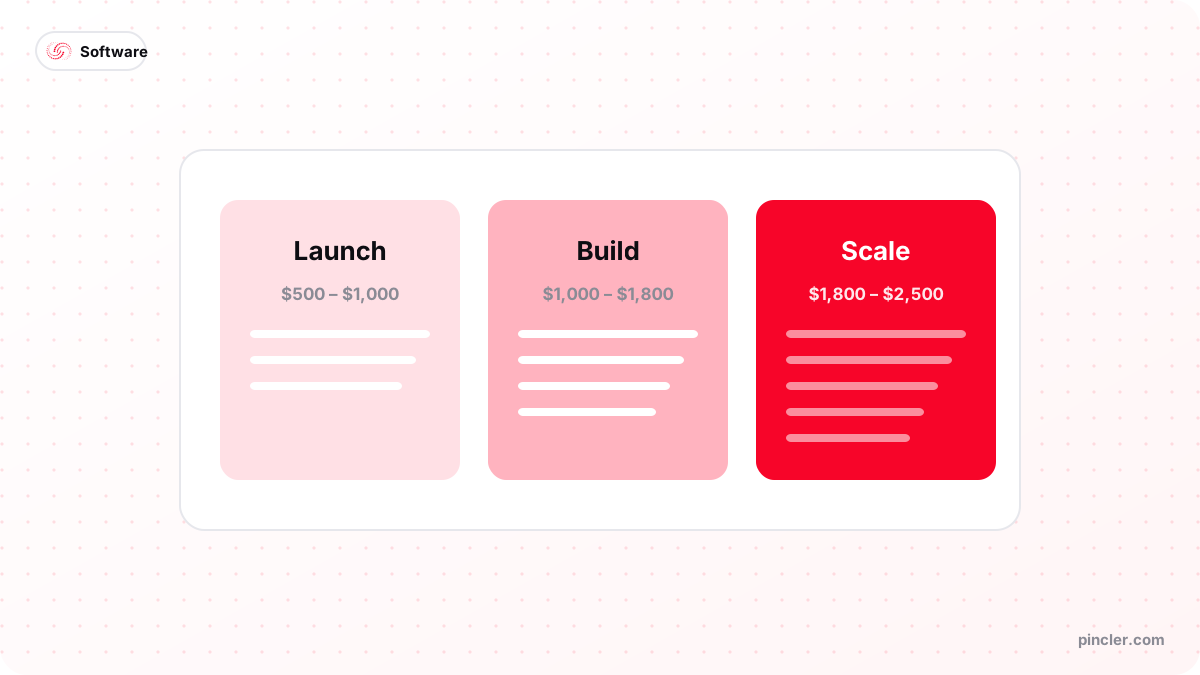
Quick answer
- Who pays
- Employers — candidates stay free, always
- First model
- Per-listing fee with Stripe checkout
- Second models
- Featured placement, then subscriptions or listing packs
- Price anchors
- PPC from ~$5/day minimums; enterprise slots $200–$1,000/month (market rates)
- When to charge
- From launch, after a dated free founding period
The way to monetise a job board is to charge employers, never candidates: per-listing fees first, then featured placement, then subscriptions or listing packs once employers post repeatedly. Whether you type monetise or monetize into a search bar, the mechanics are identical — the employer side carries all the willingness to pay, because hiring is a budgeted, recurring, expensive problem and finding work is not.
The price anchors are public. Employers already spend on pay-per-click listings with minimum daily budgets from about $5 on Indeed, according to Forbes Advisor's guide to Indeed job posting costs, and Truffle's breakdown of LinkedIn job posting pricing puts clicks there at $1.50–$4.50 with enterprise job slots at $200–$1,000 per slot per month. Your board is not competing with zero — it is competing to redirect real, recurring spend.
This guide covers the seven revenue models that work on a job board, which one to launch with, what to charge, and the honest cases where a board should stay free. It assumes the board itself exists or is scoped — that part lives in how to build a job board website.
What Is the Right Way to Monetise a Job Board?
Charge the employer side for access to candidate attention, starting with the simplest unit: one payment per listing. Every durable job board revenue model is a variation on that theme — more prominence, more volume, more duration or more candidate data — and every model that charges candidates quietly destroys the application volume employers are paying for.
The economics justify employer-side pricing easily. SHRM's benchmarking research puts the average cost of a single hire at nearly $4,700, and that is an average across all roles — hard-to-fill specialisms cost multiples of it. A board that reliably produces three good applicants in a difficult niche is cheap at $100 a listing, which is why niche boards can charge more than their size suggests.
What Are the Seven Job Board Revenue Models?
Seven models cover essentially every monetised board. They stack — mature boards usually run three or four at once — but they should arrive in order of implementation weight, not all at launch.
| Model | How it works | When it fits |
|---|---|---|
| Per-listing fee | Employer pays a flat fee per posting, typically for 30 days | Launch model for every board |
| Featured placement | Paid boost: top of search, highlighted card, homepage slot | Once organic listings compete for attention |
| Listing packs | Bundles (5 or 10 postings) at a discount, prepaid | Employers posting monthly |
| Employer subscription | Monthly plan: unlimited or quota postings plus perks | A stable base of repeat employers |
| CV or candidate database access | Recruiters pay to search opted-in candidate profiles | After candidate accounts exist, with explicit consent |
| Newsletter and alert sponsorship | Employers or vendors sponsor the jobs digest | Boards with a strong email audience |
| Placement or success fee | Board takes a fee when a hire happens | Only with tracked hiring — this is marketplace territory |
Which Model Should You Launch With?
Launch with per-listing payments, full stop. It is the easiest to build, the easiest for an employer to say yes to, and the fastest test of the only question that matters early: will employers in this niche pay anything at all? The decision tree below is the sequencing we recommend against.
START: per-listing fee (launch)
  |
  employers posting 2+ times a month?
  NO  -> stay per-listing; improve candidate quality
  YES -> add listing packs
          |
          10+ repeat employers?
          NO  -> packs are enough for now
          YES -> add employer subscriptions
                  |
                  listings competing for attention?
                  YES -> add featured placement
                  NO  -> not yet - scarcity first
How Much Can You Charge Per Listing?
Set the launch price against two anchors: what employers spend on the giant boards, and what a hire is worth in your niche. On spend, the public reference points are the ones above — pay-per-click with minimum daily budgets from about $5 per Forbes Advisor's Indeed guide, and $1.50–$4.50 per click with $200–$1,000 monthly enterprise slots per Truffle's LinkedIn pricing breakdown. A 30-day sponsored campaign on the generalist boards therefore costs an employer real money before a single application is guaranteed.
On value, work backwards from SHRM's benchmark of nearly $4,700 for the average cost of a hire. Niche boards commonly land between $50 and $300 per listing; the sharper your niche and the harder the hiring, the higher you sit. Two practical rules: publish the price — hidden pricing suppresses self-serve postings — and resist launching free with no end date, because a price of zero teaches employers the wrong lesson about what the board is worth.
When Should You Start Charging?
Charge from launch, with one deliberate exception: a founding-employer period. Give your first 20–50 employers free or heavily discounted listings in exchange for seeding the board — but put a date on it, tell them the standard price up front, and switch when the date arrives. Free seeding is a marketing cost with a schedule, not a pricing strategy.
What you learn from the first paid listings is worth more than the revenue. An employer who pays $75 and returns next month has told you the board works; fifty free listings tell you almost nothing. This is the same validation logic that applies across marketplace-style products: monetisation switched on early, at modest prices, is a measurement instrument.
One more timing rule: never raise prices silently. Announce increases to existing employers a month ahead, honour any prepaid packs at the old rate, and pair the rise with something visible — better applicant quality, faster listing approval, a cleaner dashboard. Boards live on repeat employer relationships, and a surprise on an invoice costs more of those than the increase earns.
How Do You Implement Payments on a Job Board?
Per-listing checkout is a small, well-trodden build: a Stripe checkout step inside the posting flow, a receipt by email, and the listing goes live on success — the standard shape of a payment gateway integration, which sits at $500–$1,200 as a standalone PINCLER build and comes included inside a full job board and recruitment portal build.
Subscriptions and packs add genuine complexity — plan management, quotas, upgrades, failed payments — which is exactly why they are phase two. A useful discipline: every billing feature you add should be demanded by at least three paying employers first. Billing built ahead of demand is the most common form of wasted spend we see on two-audience products.
When Should a Job Board Stay Free?
Some boards should not charge listings at all, because the board is not the business. An association board funded by membership fees, a training company's board that exists to place graduates, or a community board that feeds a paid newsletter — in each case the board is a retention or acquisition asset, and charging employers would shrink the very thing that makes it valuable.
The honest test: name the line on your accounts the board serves. If the answer is direct revenue, monetise as above. If the answer is membership, enrolment or audience, keep listings free and monetise the surrounding asset — sponsorship of the digest, for instance, often out-earns listing fees on community boards without adding any payment friction.
What Monetisation Mistakes Kill Job Boards?
Monetisation failures on boards are rarely about the price being slightly wrong. They are structural, and they repeat.
- 1. Charging candidates — it suppresses applications, which degrades the employer product, which kills the actual revenue.
- 2. Free forever with no date — an open-ended free period trains employers that listings are worth nothing.
- 3. Launching with subscriptions — heavy billing before anyone has paid once; per-listing first, always.
- 4. Hidden pricing — 'contact us' on a $100 product filters out the self-serve employers who scale a board.
- 5. Selling candidate data without consent — CV database access needs explicit opt-in, or it destroys trust and breaches data-protection rules.
- 6. Taking placement fees without tracking placements — a success fee you cannot verify is a discount you cannot control.
PINCLER's Perspective on Monetising Boards
PINCLER is an AI-first custom software development studio, and monetisation features are where we most often talk clients out of scope. Our published catalogue lists 79 builds — median price $1,450, median quoted delivery 13 days, every one between $500 and $2,500 — and the scoping rule behind it is blunt: payment features built ahead of demand get rebuilt, and payment features built against three paying customers' requests get used. Integration-sized work such as adding a billing model to an existing board sits near the catalogue's integrations median of $1,200 and 10 days.
Our standard job board build therefore ships with per-listing checkout and leaves subscriptions, packs and featured placement as later fixed-price phases, each under $2,500. The catalogue those medians are computed from is public at what you can build, and the phasing means your billing complexity only ever grows one proven step at a time.
Bottom Line
Monetising a job board is a sequencing problem: employers pay, per-listing first, packs and subscriptions once repeat behaviour appears, featured placement once attention is scarce. Anchor the price against the roughly $4,700 average cost of a hire and the real spend employers already commit elsewhere, publish it, and put an end date on every free period. If you are scoping the build itself, a free 30-minute call gets you a written fixed quote within a working day.
Related PINCLER builds
Frequently asked
How much should a niche job board charge per listing?
Most niche boards land between $50 and $300 per 30-day listing. Anchor high when hiring in your niche is hard: SHRM's benchmarking puts the average cost of a hire at nearly $4,700, so a listing that produces even a shortlist is cheap at $150. Publish the price openly, start modest, and raise it as fill rates and repeat postings prove the board's value.
Should a new job board charge employers from day one?
Yes, with a dated founding-employer exception. Seed the board with free or discounted listings for your first 20–50 employers, tell them the standard price up front, and switch on the agreed date. Paid listings are your best measurement instrument — one employer who pays and returns teaches you more than fifty free postings ever will.
How do featured job listings work as a revenue model?
Featured listings sell prominence: top of search results, a highlighted card, or a homepage slot, typically priced at two to four times the standard listing fee. They only work once ordinary listings genuinely compete for attention — on a sparse board there is nothing to rise above, so featured placement belongs in phase two, after listing volume creates scarcity.
Are subscriptions better than per-listing fees for a job board?
Eventually, for a minority of employers. Subscriptions suit the ten or twenty employers who post every month, and they stabilise revenue — but they are heavier to build and harder to sell first. The sequencing that works: per-listing at launch, listing packs when repeat posting appears, subscriptions once a stable base of frequent employers exists to buy them.
Can I sell access to my job board's CV database?
Only with explicit candidate opt-in, collected when the profile is created, and with a way to withdraw it. Recruiter-facing database access is a genuine revenue line for mature boards — generalist platforms price it as a monthly add-on — but it requires candidate accounts, consent records and data-protection compliance. Treat it as a later phase and confirm the rules with a licensed advisor.
What is the difference between monetising a board and a recruitment marketplace?
A board sells attention — employers pay to publish regardless of outcome. A recruitment marketplace sells outcomes: it participates in matching and takes a commission or success fee when a hire happens, the way service marketplaces take a percentage of transactions. Marketplace economics can be larger per transaction but require tracking hires, escrowed trust and far more product — a different build and business.
Sources
Want to build this?
PINCLER builds custom software, AI agents and GTM systems for a fixed price between $500 and $2,500, delivered in 3–30 days, with the code owned by you.
Keep reading
Related articles
What Does a Booking App With WhatsApp Notifications Cost?
A booking app with WhatsApp notifications costs $900–$2,500 fixed price — AI-drafted, senior-reviewed — plus per-message Meta fees. How WhatsApp billing works and what to budget.
How Much Does a Telegram Mini App Cost to Build?
Telegram Mini App development cost: $500–$2,500 fixed price — AI-drafted, senior-reviewed — against agency guides of $10,000–$80,000. What that buys and what it does not.
How to Build an Online Booking System
How to build an online booking system: the six core components, a step-by-step build plan, realistic timelines, and when a SaaS scheduler is the smarter choice.