How Much Should You Spend on Your First MVP?
How much should you spend on an MVP? Allocate rather than splurge: a budget split across validation, build, launch and iteration — grounded in real project data.
Quick answer
- Rule of thumb
- Spend at most a third of the capital you can afford to lose on version one, split across four buckets
- Allocation
- ≈15% validation, ≈45% build, ≈20% launch and distribution, ≈20% iteration reserve
- Typical envelope
- $2,000–$5,000 total for a first MVP; build portion $500–$2,500 fixed, AI-drafted and senior-engineer reviewed
- What data says
- In PINCLER's catalogue of 79 builds, all AI-drafted and senior-reviewed: $1,000 reaches 55 project types, $2,000 reaches all 79
- Spend zero when
- The idea is unvalidated — interviews and a landing page test come before any build spend
How much should you spend on an MVP? The useful answer is an allocation, not a number: put roughly 15 percent of your MVP budget into validation, 45 percent into the build, 20 percent into launch and distribution, and hold 20 percent back for iteration — and size the whole envelope at no more than a third of the capital you can afford to lose. For most first-time founders that envelope lands between $2,000 and $5,000 total, with the build portion at $500–$2,500 fixed — a band that exists because AI writes the first draft and senior engineers review, test and harden every build.
Notice what that framing changes. The common question — 'what does an MVP cost?' — invites a price list, and we keep ours in a separate guide. The better question is how to divide whatever you have so that no single line item can sink you, because the evidence says running out of money, not overpaying for code, is what actually kills early companies.
This guide works through the allocation with a fully worked example, shows what different build budgets reach across the 79 builds in the published catalogue, and sets the honest floor: some ideas deserve a spend of exactly zero this quarter.
How Much Should You Spend on Your First MVP?
Start from the envelope, not the wishlist. Decide what you can genuinely afford to lose without changing your life — savings earmarked for the venture, not rent — and commit at most a third of it to version one. The rest is for versions two and three, which the evidence says you will need: a first MVP is an experiment, and experiments are priced so you can afford to be wrong.
Inside the envelope, allocate before you spend a dollar. The build is the visible purchase, but it is only one of four things version one needs: proof the idea deserves building, the software itself, an audience that finds it, and the capacity to change it when reality reports back. Founders who spend the whole envelope on the build get a well-made product with no users and no money left to act on what launch teaches — the most common self-inflicted wound in early-stage software.
Why Is Spending Less Actually Safer?
Because the failure data points at cash and demand, not at product quality. CB Insights' analysis of startup post-mortems found 42 percent of failures cited no market need and 29 percent ran out of cash — and an oversized version-one spend feeds both failure modes at once: it builds more product before demand is proven, using the money that was supposed to fund the second attempt.
Project-size research says the same thing from the delivery side. McKinsey, working with the University of Oxford across more than 5,400 IT projects, found large IT projects run 45 percent over budget and deliver 56 percent less value than predicted, while the Standish Group's original CHAOS research reported success rates of 9 percent for projects in large companies against 28 percent in small ones. Small, fixed-scope spending is not a compromise forced by poverty; it is the structurally safer way to buy software at any budget.
How Should You Allocate the Budget Across the Four Buckets?
Here is the allocation with a fully worked $4,000 example — every number visible, every bucket with a job. Validation gets $600: fifteen interviews cost time, and a landing page test with paid traffic costs a few hundred dollars, as detailed in our guide to validating an MVP before spending on a build. The build gets $1,800: a single-workflow product at fixed price, scoped the way our scope-to-budget guide describes. Launch gets $800: a month of small paid-traffic experiments, a directory listing or two, and the founder's outreach time taken seriously. The reserve holds $800 untouched until real users have used the real product.
The reserve deserves its own defence, because it is the bucket founders raid first. Version one will be wrong somewhere — a confusing onboarding step, a missing export button, a price set too low — and the difference between a startup and a shelved project is whether there is money left to respond. Twenty percent held back converts launch feedback from a list of regrets into a work order.
TOTAL ENVELOPE = 1/3 of what you can afford to lose
├── 15%  validation   (spent BEFORE the build is approved)
├── 45%  build        (fixed price, one workflow)
├── 20%  launch       (nobody finds unmarketed software)
└── 20%  reserve      (untouched until users have spoken)
| Bucket | Share | $4,000 example | What it buys |
|---|---|---|---|
| Validation | ≈15% | $600 | Landing page test, paid traffic, interview tooling |
| Build | ≈45% | $1,800 | One workflow, payments, analytics — fixed price |
| Launch & distribution | ≈20% | $800 | Traffic experiments, listings, launch content |
| Iteration reserve | ≈20% | $800 | The changes real usage demands in month one |
What Does Each Build Budget Actually Reach?
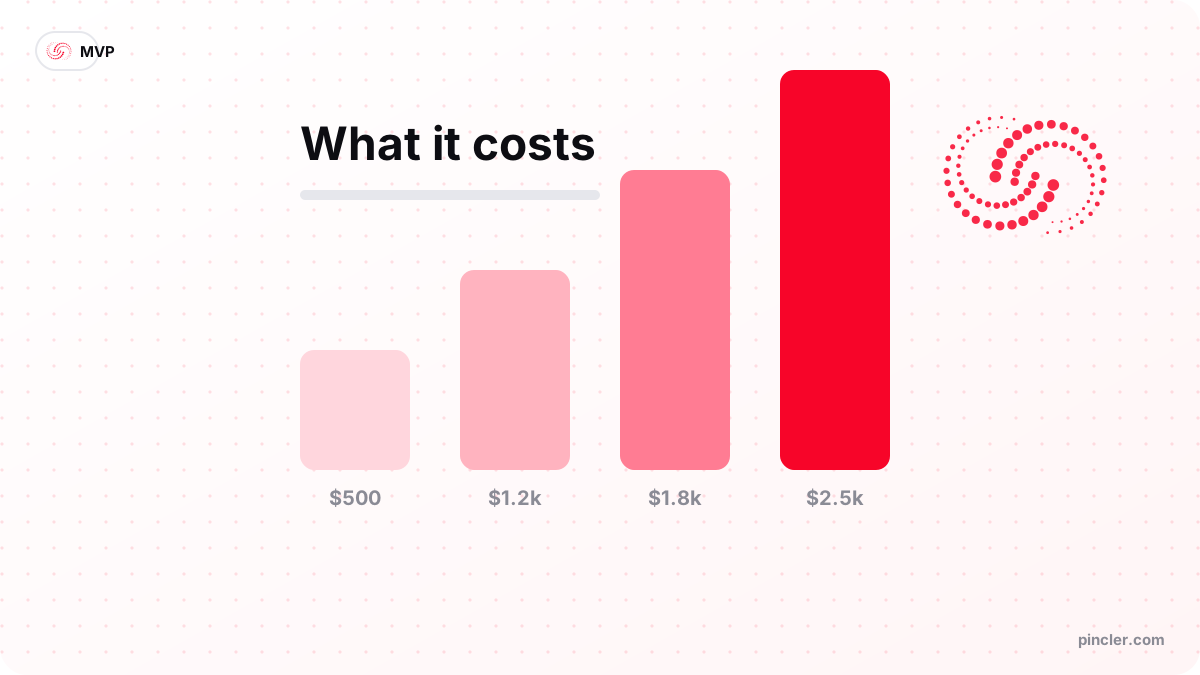
The build bucket goes further than most founders assume, and the first-party data is specific. Across PINCLER's published catalogue of 79 fixed-price builds — every one fixed-price between $500 and $2,500, median $1,450 on a quoted 13-day delivery — a $500 build budget covers the starting price of 11 project types, $1,000 covers 55, $1,500 covers 75, and $2,000 covers all 79. The complete dataset is published at our research page.
Read that as a reach map, not a price list — per-project pricing lives in our MVP development cost guide, and this article deliberately does not repeat it. The allocation lesson is simply that the 45 percent bucket rarely needs to exceed $2,000 for a first version, which is what makes the four-bucket split workable on a few thousand dollars: a SaaS MVP with auth, billing and a dashboard at the top of the band still leaves room in a $5,000 envelope for every other bucket.
| Build budget | Project types reachable (of 79) | Share of catalogue |
|---|---|---|
| $500 | 11 | 14% |
| $1,000 | 55 | 70% |
| $1,500 | 75 | 95% |
| $2,000 | 79 | 100% |
What Spending Rules Protect Your Runway?
Four rules keep the envelope honest, and each one exists because we have watched its absence cost someone a company.
- Fixed prices only — an open-ended hourly build makes the 45% bucket unbounded, which makes the whole allocation fiction. McKinsey's overrun data is the argument in one number.
- Sequence the buckets — validation money spends before build money is committed, and a failed validation rung refunds the other three buckets entirely.
- Never buy imagined scale — infrastructure for a million users is a phase-three purchase; a $15-a-month server carries your first thousand.
- Count your own hours at a real rate — a 'cheap' MVP that consumes 300 founder-hours cost more than any invoice in this article; buying the build is often the cheaper option.
Who Should Spend What — and When Should You Not Spend at All?
Employed founders testing a side idea should hold the envelope near $2,000–$3,000: validation and a lean build, launch funded by sweat rather than spend. Founders going full-time with savings can justify the fuller $4,000–$5,000 shape, because their time pressure makes the launch and reserve buckets more valuable. Funded teams allocate the same way with more zeros — the discipline scales; the percentages barely move.
And sometimes the right spend is zero. If no validation rung has been passed — no interviews, no landing page signal, no pre-sale — then build spending is premature by definition, whatever the budget. Park the build bucket, spend $600 learning whether anyone cares, and be genuinely pleased if the answer is no: a $600 'no' is the best return on capital in this entire article. There is a second zero-spend case that has nothing to do with validation: if an off-the-shelf tool already covers the workflow on a monthly fee you can cancel, keep paying it and spend the build bucket on distribution instead. The one thing not to do is drift — pick a decision date, run the test, and either commit the envelope or archive the idea.
What Are the Common MVP Budgeting Mistakes?
The same errors appear in most first budgets we see in inbound briefs, and all of them are allocation errors rather than price errors.
- 1. Spending 100% on the build — a finished product with no launch budget and no reserve is a museum piece.
- 2. Sizing the budget from an agency quote instead of from your own risk capacity.
- 3. Raiding the iteration reserve for 'one more feature' before launch — the reserve's whole point is that you cannot yet know what it is for.
- 4. Treating validation spend as optional because the founder is already convinced — conviction is the thing being tested.
- 5. Accepting hourly billing, which converts a fixed allocation into an open tab.
- 6. Ignoring running costs — hosting, APIs and tools of $30–$80 a month belong in the plan from day one.
PINCLER's Perspective: Fixed Pricing Is a Budgeting Instrument
PINCLER is an AI-first custom software development studio, and the four-bucket allocation only works because the build bucket can be a written, fixed number. Every one of the 79 builds in PINCLER's published catalogue is fixed-price between $500 and $2,500 — never more — with anything larger split into phases that each ship something usable. A founder allocating $1,800 to the build knows on day one that the figure cannot quietly become $3,400 and eat the launch bucket; that certainty, more than the price level itself, is what makes small-budget planning possible.
The phasing model is the other half. When phase one is priced at $1,450 — the published median — and phase two waits for evidence, the iteration reserve maps cleanly onto a real, quoted next step instead of a vague fear. Budgeting stops being an act of hope and becomes a sequence of small, priced decisions, which is what affordable custom software development should mean in practice.
The Bottom Line
Spend at most a third of what you can afford to lose, split roughly 15/45/20/20 across validation, build, launch and reserve — and let the validation bucket spend first, because its job is to protect the other three. On real project data, the build portion rarely needs more than $2,000, which puts a complete, honestly funded first version within a few thousand dollars.
If you want the build number pinned so the rest of the allocation can be planned around it, a free 30-minute call gets you a written fixed quote within one working day — one line of the budget made certain before you commit any of it.
Related PINCLER builds
Frequently asked
How much should a first-time founder spend on an MVP?
Cap the whole envelope at a third of the capital you can afford to lose — typically $2,000–$5,000 — and allocate it roughly 15% to validation, 45% to the build, 20% to launch and 20% to an iteration reserve. Across the 79 builds PINCLER publishes fixed prices for, $1,000 covers the starting price of 55 project types — AI writes the first draft and senior engineers review and harden each build — so the build bucket rarely needs to dominate. The allocation matters more than the total.
Why keep an iteration reserve instead of building more up front?
Because version one is a hypothesis, and the reserve is what lets you act on the result. Real users will expose a confusing step, a missing feature or a wrong price within weeks, and a founder with 20% of the budget held back turns that feedback into a work order; a founder who spent everything turns it into a list of regrets. CB Insights found 29% of failed startups simply ran out of cash — the reserve is the small-scale antidote.
Is it worth spending money on validation before the build?
Yes — it is the highest-leverage spend in the budget. Roughly $600 buys fifteen interviews' worth of time, a landing page and enough paid traffic to read demand, and it decides whether the other 85% of the envelope should be spent at all. That $600 is not a build cost: the build itself is fixed-price because AI-generated first drafts go through senior engineering review, automated tests and security hardening. A failed validation test refunds every later bucket. Skipping it to 'save money' risks the full build cost to avoid a fraction of it, which is the worst trade available.
Should the MVP budget include marketing?
It must. Software without a distribution budget is a secret: allocate about 20% of the envelope to launch — small paid-traffic experiments, listings, launch content — so the product meets enough strangers to generate honest data. The commonest budget shape we see in failed plans is 100% build, 0% launch, which produces a well-made product with no evidence either way. Twenty users finding you beats twenty features waiting for them.
Does a bigger MVP budget improve the odds of success?
Above a modest threshold, no — the research points the other way. McKinsey and Oxford found large IT projects run 45% over budget and deliver 56% less value than predicted, and Standish's CHAOS work has long shown small projects succeeding at far higher rates. Through software development for startups on a fixed-price model — AI writes the first draft, senior engineers review, test and harden it — $2,000 reaches every project type in PINCLER's published catalogue; beyond that, extra money buys risk faster than it buys learning.
Sources
Want to build this?
PINCLER builds custom software, AI agents and GTM systems for a fixed price between $500 and $2,500, delivered in 3–30 days, with the code owned by you.
Keep reading
Related articles
How to Build an MVP Without Being Technical
How to build an MVP without coding: the three realistic routes for non-technical founders, what each costs, where no-code breaks, and how AI-assisted builds compare.
How to Build an MVP Fast Without a Large Development Team
How to build an MVP fast: shrink the scope before growing the team. A day-by-day 14-day plan, the research on small-project success, and what AI-assisted delivery changes.
How to Make an MVP Profitable
How to make an MVP profitable: charge from day one, keep the build small enough that a handful of customers covers it, and let retention decide what you add next.