E-commerce Website Development Cost: A 2026 Guide
Ecommerce website development cost in 2026: $600 to $2,500 fixed, AI-drafted and senior-reviewed. When Shopify beats custom, and the running costs left out of quotes.
Quick answer
- Shopify customisation
- $600–$1,800 fixed — theme work or a private app, AI-drafted with senior review before launch
- Fully custom store
- $1,500–$2,500 fixed on Next.js and Stripe; AI drafts it, senior engineers review and test the checkout
- Timeline
- E-commerce median quoted delivery: 13 days across PINCLER's 79 catalogue builds
- Running costs
- Processing ~2.9% + 30¢ per charge, plus the platform fee or $5–40/month hosting
- Decide first
- Platform: Shopify when it fits your selling model, custom when it fights it
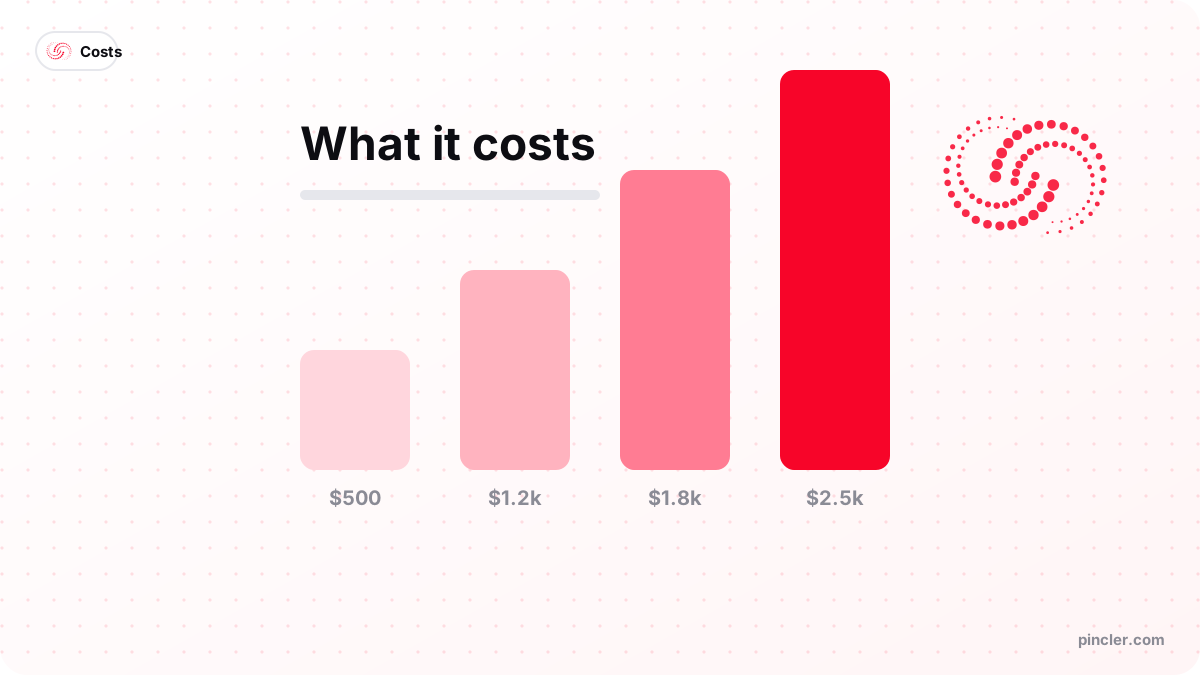
An e-commerce build costs $600 to $2,500 at PINCLER, fixed price: $600–$1,800 for serious Shopify customisation, $1,500–$2,500 for a fully custom store on Next.js and Stripe. Those numbers hold because AI writes the first draft of the templates and checkout wiring, and senior engineers review, test and harden everything that touches money. Those two bands cover almost every store a small or mid-sized brand actually needs.
The market range is far wider, and most of the spread comes from one decision made too early: custom platform versus Shopify. Plenty of brands pay five figures for custom storefronts whose every feature exists in a $39-a-month Shopify plan, and plenty of others fight Shopify's constraints for years when their selling model never fit it in the first place.
This guide gives you the ecommerce website development cost picture honestly: what each budget buys, how to make the platform decision before spending anything, what checkout research says actually moves revenue, a worked three-year cost model with every input shown, and the running costs that should be in your plan from day one.
How much does an e-commerce website cost to develop?
E-commerce pricing splits cleanly in two. If Shopify fits your selling model, customisation work — a distinctive theme, custom sections, a private app for a workflow the platform lacks — runs $600 to $1,800 fixed. If your model does not fit, a custom store built on Next.js with Stripe checkout runs $1,500 to $2,500, and you own every line of it.
Neither band includes platform subscriptions or payment processing, because nobody's quote honestly can — those are ongoing costs that scale with your sales, covered below. What the bands do include is a store ready to take real orders, deployed to your own accounts, with a bug-fix warranty of 14 to 60 days by tier.
Both bands come from the same production method: AI-assisted custom software development services with senior engineers owning architecture, security and release. The store is generated, reviewed and hardened — not hand-typed line by line — which is why the price has a comma fewer than most agency quotes for the same feature list.
What does each store budget buy?
The table below is the honest version of the pricing page most agencies will not publish. The pattern to notice: the money follows the complexity of what you sell and how you fulfil it, not how the store looks. A beautiful theme over a simple catalogue is cheap. A plain theme over configurable products with regional shipping rules is not.
| Budget | Build type | What you get |
|---|---|---|
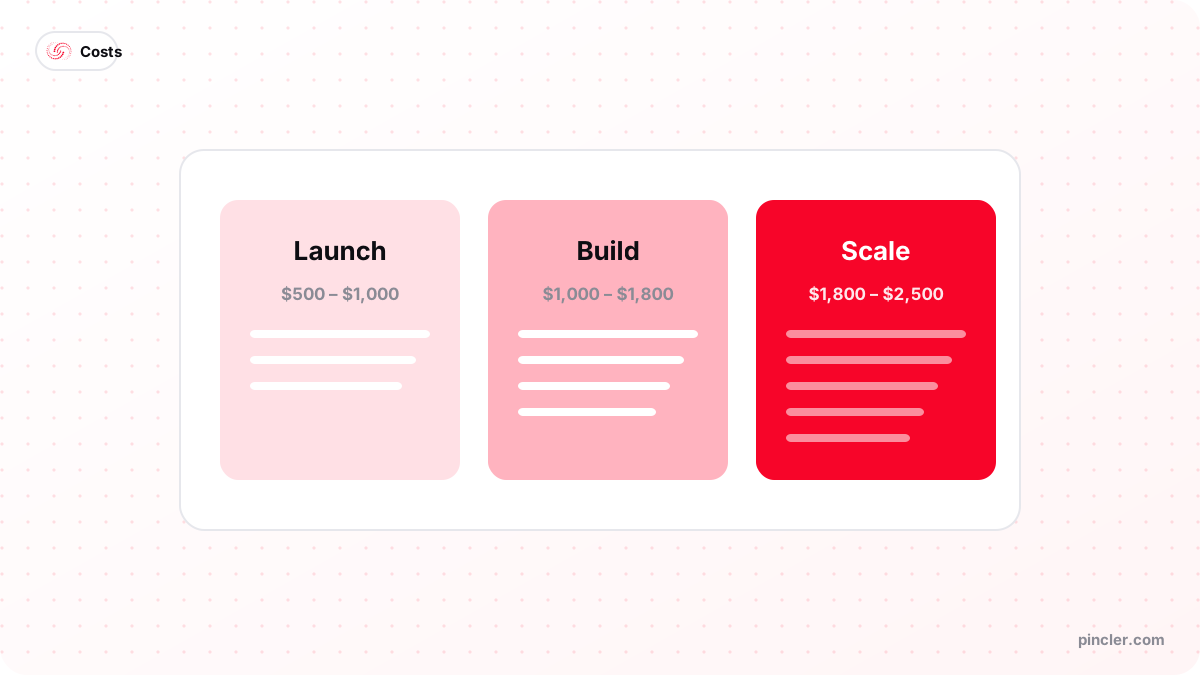
| $600–$1,000 | Shopify theme customisation | Distinctive storefront on an existing theme, custom sections, speed and SEO pass |
| $1,000–$1,800 | Shopify custom app | Private app for workflows Shopify lacks — custom bundles, B2B pricing, ERP sync |
| $1,500–$2,000 | Custom store, standard catalogue | Next.js storefront, Stripe checkout, product management, order emails, analytics |
| $2,000–$2,500 | Custom store, complex selling | Subscriptions, configurable products, multi-currency, shipping rules, admin panel |
Should you build on Shopify or go custom?
Our default advice is unfashionable for a development studio: most product brands should start on Shopify. You inherit checkout, fraud handling, PCI compliance, apps and a decade of edge-case fixes for a monthly fee — Shopify's Basic plan is listed at $39 a month, or $29 on annual billing, at the time of writing — and your budget goes into making the store distinctive rather than rebuilding solved problems.
Custom wins in specific, recognisable situations: selling models Shopify fights, such as complex configurators, quote-based B2B pricing or unusual subscription logic; per-transaction platform fees that sting at scale; a storefront that is genuinely part of your product rather than a shop window; or a need to own checkout data and flow end to end. If none of those describe you, take the cheaper band and revisit in a year — a custom rebuild later is a migration, not a rewrite from zero.
A useful tiebreaker is to count workarounds. Every app installed to bend the platform, every manual spreadsheet step between order and fulfilment, every 'we just tell customers to email us' is a vote for custom. One or two workarounds are normal platform life; six of them, each with a monthly fee attached, usually cost more in money and staff time than the build that would remove them.
Does Shopify's model fit how you sell?
  YES → is a stock theme distinctive enough for the brand?
          YES → stay put; spend nothing on development yet
          NO  → theme/app customisation ($600–$1,800)
  NO  → configurators, B2B quotes, owned checkout?
          → custom store on Next.js + Stripe ($1,500–$2,500)
  UNSURE → count the workarounds; six paid apps = go custom
Which checkout numbers matter more than the build?
Two published findings should shape any store budget more than the platform debate does. The first: Baymard Institute's long-running meta-analysis — 49 separate studies at the time of writing — puts the average cart abandonment rate at just over 70%, a figure that has held between 69% and 71% for a decade. Most of the revenue your store will ever lose is lost between cart and payment.
The second is speed. Google and Deloitte's 'Milliseconds Make Millions' study, which analysed 30 million user sessions across 37 brands, found that a 0.1-second improvement in mobile load time lifted retail conversions by 8.4% and average order value by 9.2%. Same traffic, same acquisition cost, more orders.
The budgeting implication is direct: a fast storefront, a short checkout, visible shipping costs early and guest checkout are worth more than any visual flourish. This is why both of our bands include a speed pass, and why we will argue against spending your budget on animation while your checkout takes five steps.
What moves the price within a band?
Whichever platform you choose, the same handful of factors push a quote up or down. Knowing them helps you cut scope deliberately rather than being surprised by it.
- Catalogue complexity — variants, bundles and configurable products multiply the data model and the testing surface.
- Payments beyond one-off cards — subscriptions, saved payment methods and multi-currency each add real flows to build and test; a standalone payment gateway integration is a $500–$1,200 project in its own right.
- Shipping logic — flat rate is trivial; weight bands, regional rules and carrier API quotes are proper work.
- Migration — moving an existing catalogue, customers and order history in cleanly is often days of unglamorous effort.
- Content editing — if your team must edit landing pages without a developer, a CMS layer joins the scope.
PINCLER's perspective: what the 79-build catalogue says stores are priced at
Across the 79 builds in PINCLER's published fixed-price catalogue — every one priced between $500 and $2,500 — the e-commerce category runs at a median advertised price of $1,525 with a median quoted delivery of 13 days, on a range of $600 to $2,500. That sits almost exactly where the bands in this guide predict, which is the point of publishing both: the full catalogue is at /research/what-you-can-build.
The surrounding categories give useful context for store projects that grow sideways — a storefront plus an integration, or a store plus a dashboard. Websites run at a median of $1,025 and 8 days; integrations at $1,200 and 10 days; full web apps at $1,925 and 18 days. A $2,000 budget reaches 79 of the 79 published builds, which is a practical ceiling worth knowing before any sales conversation.
| Category (of 79 catalogue builds) | Median advertised price | Median quoted delivery |
|---|---|---|
| Websites | $1,025 | 8 days |
| Integrations | $1,200 | 10 days |
| E-commerce | $1,525 | 13 days |
| Web Apps | $1,925 | 18 days |
What does three years of running a store really cost?
Here is the comparison with every input on the table — the same three-year method our custom software vs SaaS guide applies beyond retail — for a small brand doing $10,000 a month in sales. Route one, Shopify: the Basic plan at $39 × 36 months is $1,404; three typical apps at $15 each add $45 × 36 = $1,620; an $800 theme-customisation project makes the store distinctive. Three-year total: $3,824, plus payment processing.
Route two, custom: a $2,200 build on Next.js and Stripe, hosting at $15 × 36 = $540. Three-year total: $2,740, plus the same order of processing costs — Stripe's standard US online rate is 2.9% plus 30 cents per successful charge at the time of writing, and Shopify Payments on Basic is published at a comparable rate.
Read the result honestly: the totals are close, and at low volume Shopify's bundled checkout, fraud tooling and app ecosystem are easily worth the difference. The custom route wins when you need selling logic the platform fights, when apps multiply beyond a handful, or when owning the checkout flow and its data has strategic value. The model's job is to make that a decision rather than a default.
What are the running costs nobody quotes?
Every store, custom or Shopify, pays to run. Payment processing takes a percentage of every sale — at Stripe's published 2.9% plus 30 cents, $10,000 of monthly sales across 200 orders costs about $350 a month in fees. That single line dwarfs hosting, and it scales with success rather than with the software you chose.
Beyond processing: Shopify plans start at the published $39 a month plus paid apps, which quietly accumulate — three $15 apps is another $45. A custom store instead pays hosting, typically $5–40 a month at small-brand scale, and whatever email volume you send. Neither model is free; they distribute the cost differently, and the honest comparison is total monthly cost at your expected order volume.
When should you not build anything custom yet?
If you have not yet sold the product anywhere, do not start with a build. Validate demand first with the cheapest credible storefront — a Shopify trial, a single well-made landing page with a payment link, even a marketplace listing. The data you gather in a month of real orders will improve every decision in this guide, from catalogue structure to shipping rules.
The same discipline applies to features. Subscriptions, configurators and multi-currency all earn their cost only when customers are asking for them. Shipping a $1,600 standard-catalogue store now and adding a $600 subscription phase when demand proves out is cheaper and safer than betting $2,500 on assumptions — and phased fixed pricing exists precisely for that sequence.
Set a threshold before you start, so the decision makes itself. A sensible one: commit to custom work only after the validation channel has produced fifty real orders, or a month of sales covering the build cost. Thresholds convert an emotional platform debate into a milestone, and they stop the common failure of spending the launch budget on software while the actual bottleneck is still demand.
How do you get a fixed quote for your store?
The platform question plus three answers — how many products and variants, whether you need subscriptions or B2B pricing, and what needs migrating — is enough for an accurate number. Bring those to a free 30-minute call and we send a written fixed quote within one working day, always inside the bands above.
The custom e-commerce store and Shopify customisation use cases list full standard scopes and timelines, and the catalogue at /research/what-you-can-build shows what comparable stores are priced at — useful ammunition against any other quote you are holding.
Related PINCLER builds
Frequently asked
Is a custom store better for SEO than Shopify?
Marginally, sometimes — a well-built Next.js store gives you full control over rendering, page speed and structured data, and can score better on performance metrics. But Shopify stores rank perfectly well when the basics are done properly. Choose the platform on your selling model and operations, not on SEO folklore; content and product-page quality matter far more than the framework underneath.
What does an online store cost to run monthly?
Expect payment processing at published rates around 2.9% plus 30 cents per charge regardless of platform, then either Shopify's subscription plus apps (commonly $50–150 a month all-in for small brands at the time of writing) or hosting for a custom store ($5–40 a month) plus email. At low volume the platform route is usually cheaper to run; at higher volume the percentages and app stack tilt the maths towards custom.
Can we start on Shopify and go custom later?
Yes, and it is often the right sequence — validate demand on the platform, then move when constraints genuinely bite. Products and customers export cleanly; order history and app-specific data take more care. Keeping your domain and URL structure preserves most SEO value through the migration. Treat the move as a planned phase with a fixed price, not an emergency.
What cart abandonment rate is normal for an online store?
Around 70% is the published norm — Baymard Institute's meta-analysis of 49 studies puts the average at just over 70%, steady for a decade, with wide variation by industry. That number is why checkout quality outranks storefront polish in any sensible budget: visible shipping costs early, guest checkout, few steps and fast pages recover more revenue than any visual redesign.
Does page speed really affect sales enough to pay for?
Yes, and the effect is published rather than folklore: Google and Deloitte's 'Milliseconds Make Millions' analysis of 30 million sessions found a 0.1-second mobile speed improvement lifted retail conversions by 8.4% and average order value by 9.2%. On $10,000 of monthly sales, capturing even half that lift is worth several hundred dollars a month — which is why a performance pass is included in both of our bands rather than sold as an extra.
Is bespoke software development overkill for a small product brand?
Often, yes — and a studio that does bespoke software development for a living should still tell you so. Start on Shopify if your selling model is standard; the $600–$1,800 customisation band — AI drafts the theme and app code, a senior engineer reviews it — buys distinctiveness without abandoning the platform's solved problems. Go bespoke when the model does not fit: configurators, quote-based B2B, unusual subscriptions, or checkout you must own end to end. The test is whether the platform fights your business, not whether custom sounds more serious.
Sources
Want to build this?
PINCLER builds custom software, AI agents and GTM systems for a fixed price between $500 and $2,500, delivered in 3–30 days, with the code owned by you.
Keep reading
Related articles

Why Do Agencies Charge $30,000 for What We Build for $2,500?
Why is custom software so expensive at one supplier and not another? A transparent breakdown of agency cost structure, hour counts and the arithmetic behind a $2,500 build.
What Can You Actually Build for $2,000?
What can you build for $2000? One complete workflow, live in about two weeks — AI-drafted, senior-reviewed — with the exact scope and what gets deferred to phase two.
Can You Build a Custom CRM for Under $2,000?
The cheapest way to build a custom CRM, compared honestly: free tiers, spreadsheets, no-code, and an AI-drafted, senior-reviewed $1,200–$2,000 build. Which one you should pick.