Building Software on a Startup Budget
Software development on a startup budget: what $500, $1,500 and $2,500 buy when AI drafts the build and senior engineers review it — plus the running costs founders forget.
Quick answer
- Total build budget
- $500–$2,500 fixed per build, median $1,450 — AI writes the first draft, senior engineers review and test it
- Timeline
- 3–30 days; median 13 days from signed quote to delivery
- $500 buys
- A landing page with lead capture or a single workflow automation, AI-drafted and reviewed by a senior engineer
- $1,000 buys
- The starting price of 55 of the 79 builds in the catalogue, all on the same AI-drafted, senior-reviewed basis
- $1,800–$2,500 buys
- A full SaaS MVP with auth, Stripe billing, the core feature and a dashboard — AI-drafted, then hardened under senior review
- Running costs
- $30–80/month for hosting, database, email and API fees
A startup budget of $2,500 or less now buys real, production-grade software — a working SaaS MVP, a booking system, an automation that removes a day of manual work a week — because AI writes the first draft and senior engineers review, test and harden it. Five years ago that sentence would have been false. The production method made it true, and it changes how a founder should plan spending.
The constraint that matters is no longer whether you can afford software at all. It is whether you spend the small budget on the right thing. Most wasted startup software money goes to the same two places: polish that no customer asked for, and features built before anyone proved they were wanted. CB Insights' well-known analysis of startup post-mortems found the single most common reason startups fail is no market need — cited in roughly 42% of failures — which means the first job of a software budget is to test demand, not to decorate it.
This guide lays out a software development startup budget in practical terms — what each spending level buys, where the first dollars should go, the running costs that surprise founders, what PINCLER's published catalogue of 79 fixed-price builds says a given budget reaches, and what to refuse to pay for yet.
What must the first software budget prove?
A startup's first software spend is not really buying features — it is buying an answer to a question. Usually the question is: will a stranger pay for this, or will this save enough time to matter? Write that question down before spending anything, because every build decision then becomes easy to test against it. If a feature does not help answer the question, it is not a version-one feature.
This framing kills the most expensive mistake on a small budget, which is spreading money thinly across many half-built features. Half of a signup flow plus half of a dashboard proves nothing. One complete loop — however narrow — proves something real. The failure statistics back the discipline: when CB Insights analysed why startups die, no market need topped the list at roughly 42% — not bad code, not slow delivery. The budget's first job is to find out whether the market cares, and how much should you spend on your first MVP covers sizing that first cheque against your runway.
What does each slice of budget buy?
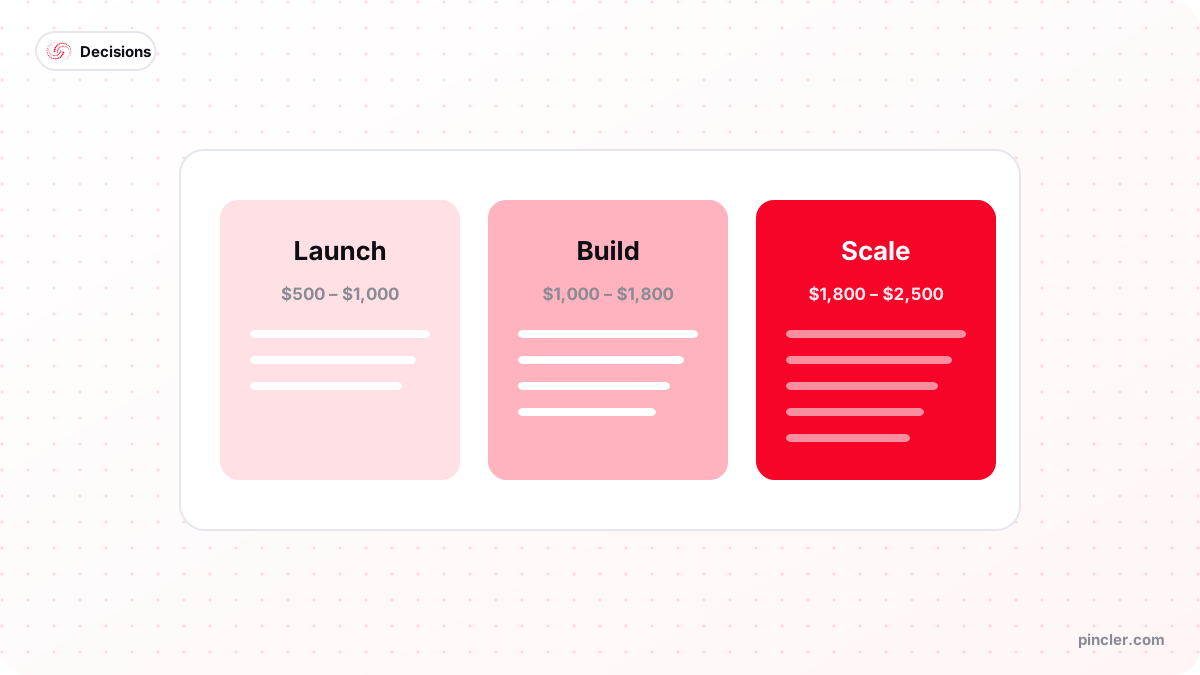
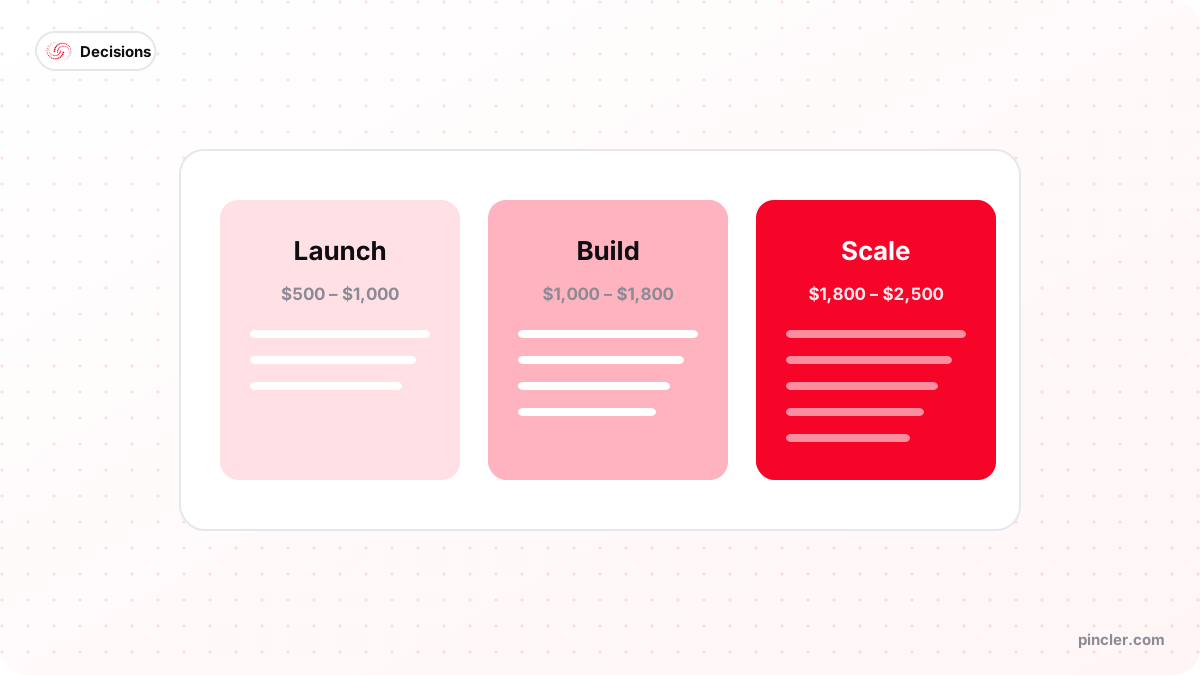
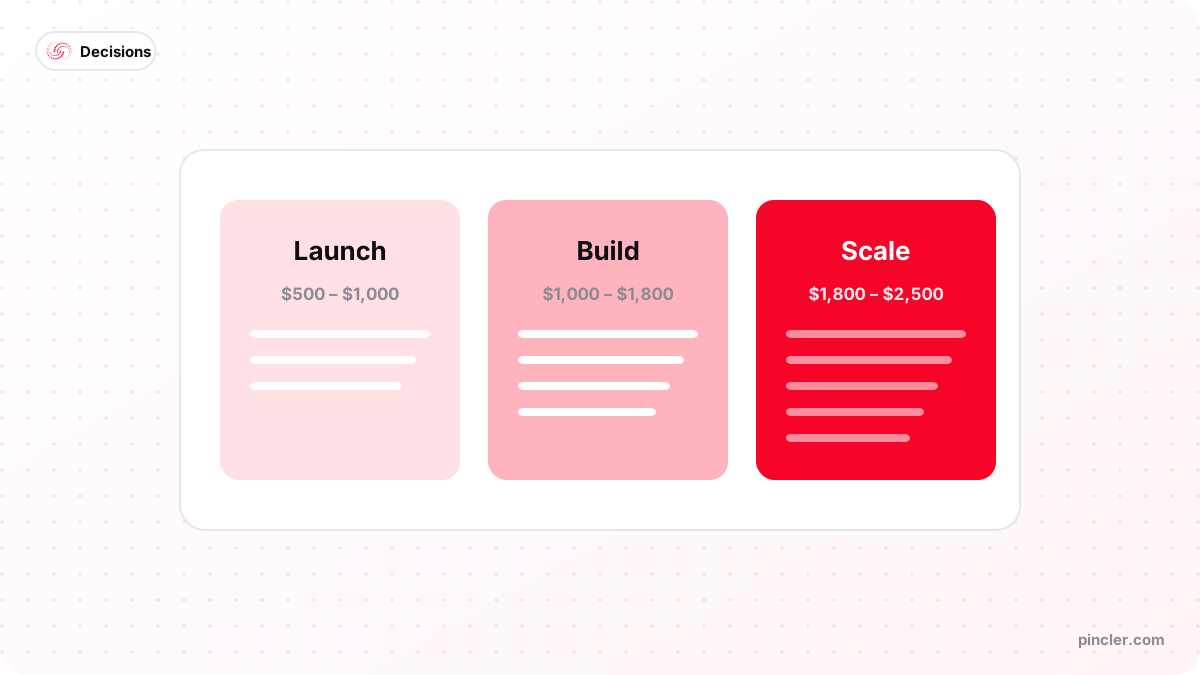
These are the fixed-price bands PINCLER quotes for common startup builds — from an SEO landing page at the bottom to a full SaaS MVP with auth and billing at the top — all delivered to your own GitHub and cloud accounts. The pattern to notice: the jump between tiers is about how much machinery surrounds the core idea, not how good it looks.
What must the budget prove first?
    "People want this"    → $500–$1,000
        landing page + lead capture + small ad test
    "The workflow works"  → $1,000–$1,800
        booking system, chatbot, portal, automation
    "Strangers will pay"  → $1,800–$2,500
        SaaS MVP: auth + Stripe billing + core feature
Then: budget $30–80/month running costs
and hold roughly half the build cost in reserve| Budget | What it buys | Typical timeline |
|---|---|---|
| $500–$1,000 | SEO landing page with lead capture, or a workflow automation (n8n, Zapier, Make) | 3–10 days |
| $1,000–$1,800 | A booking system, a lead-capture chatbot, an internal dashboard, or a simple customer portal | 8–18 days |
| $1,800–$2,500 | A full SaaS MVP: auth, Stripe billing, the core feature, a user dashboard | 18–28 days |
PINCLER's perspective: what 79 catalogue builds say a budget reaches
Bands are useful; a dataset is better. Across the 79 builds in PINCLER's published fixed-price catalogue — every one priced between $500 and $2,500 — the median advertised price is $1,450 against a median quoted delivery of 13 days. Mapping starting prices against budgets shows how quickly a founder's options open up, and the full project-by-project dataset is public at /research/what-you-can-build.
Read the table below as a menu of options, not a lottery. At $500 you can start 11 of the 79 published build types; at $1,000 you can start 55 — the single biggest jump on the curve, which is why $1,000 is the most interesting number in early-stage budgeting. By $2,000, every one of the 79 catalogue builds is within reach.
| Starting budget | Catalogue builds within reach (of 79) |
|---|---|
| $500 | 11 |
| $1,000 | 55 |
| $1,500 | 75 |
| $2,000 | 79 |
Spend on the loop, not the polish
The highest-return dollars in any startup build go to completing the commercial loop: a visitor arrives, understands the offer, signs up, uses the core feature, and pays. Every dollar that shortens or completes that loop is well spent. Every dollar spent elsewhere — animation, a bespoke design language, a settings page with twelve options — is a dollar spent decorating a question mark.
The feature-usage research is blunt about where padded budgets go. The Standish Group famously reported — in findings its chairman presented at the XP 2002 conference — that 64% of features in the systems it studied were rarely or never used. Modern component libraries make a clean, credible interface nearly free, which is why design polish is the wrong place for early money. Customers do not churn from an MVP because the buttons were standard. They churn because the core feature did not solve their problem, and finding that out fast is the entire point of the budget.
Which running costs do founders forget?
The build is a one-off; the running costs recur, and they belong in the budget from the start. None of them is large at MVP volume, but founders who have not listed them get surprised at exactly the moment cash matters most.
- Hosting — typically $5–25/month for a small app on Vercel or a modest VPS.
- A managed database — usually from around $10/month for Postgres you do not have to babysit.
- Transactional email (password resets, receipts) — a few dollars a month at low volume.
- Payment fees — Stripe's published US pricing is 2.9% + 30¢ per successful card charge at the time of writing, so it only costs you when you earn.
- LLM API usage if your product calls a model — meter it from day one so one heavy user cannot surprise you.
- A domain and, later, an app store developer account if you go mobile.
A worked example: one founder's first $2,500
Here is the arithmetic of a sensible first year, every input shown. Month one: a $700 landing page with lead capture to test the pitch — say 40 sign-ups from a $300 ad experiment proves interest. Month two: a $1,800 MVP build with auth, Stripe billing and the one core feature. Total build spend: $2,500. Running costs: roughly $40 a month — $15 hosting and database, $10 email and domain amortised, $15 of API usage — or about $480 across the year.
Now the revenue side. At $29 a month, the product needs just 15 paying customers to cover the entire year-one software cost of roughly $2,980, and every customer beyond that is margin on an asset the founder owns outright — code, repository and infrastructure. Compare that with the same idea built at a traditional $25,000 agency price: it needs 72 customers just to reach the same break-even. Small budgets do not merely cost less; they lower the bar the market has to clear before the idea is self-sustaining.
Why did small budgets become enough?
The reason a serious MVP now fits under $2,500 is a change in how software is produced, and it is well documented. Stack Overflow's 2025 Developer Survey found 84% of developers use or plan to use AI tools in their development process, up from 76% the year before. The tooling writes the predictable majority of the code; senior engineers direct, review and correct it. This is what ai powered software development means in practice for a founder: the hours you are billed for are the judgement hours, not the typing hours.
Across the 79 builds in PINCLER's published catalogue the pattern is on the record: GPT is listed on 76, Cursor on 75, Claude Code on 63 — under a senior engineer who owns architecture, security and the release on every build. The saving lands with the founder as a fixed price, which is the difference between budgeting and hoping.
What should you refuse to buy yet?
Some purchases are wrong on a startup budget not because they are bad but because they are premature. A native mobile app before a responsive web app has proved retention. SSO and enterprise features before a single enterprise customer has asked. Infrastructure sized for a million users before user one thousand exists. Each of these is a version-two purchase pretending to be urgent.
The discipline pays twice. You save the build cost now, and you avoid the near-certain rework later — because whatever you build before real usage data arrives will be built to a guess, and guesses about software are usually wrong in the details that cost money to change.
A concrete refusal, with numbers: a native iOS and Android pair typically doubles or triples the cost of the equivalent responsive web app, and across PINCLER's published catalogue mobile builds carry a category median of $1,850 and 19 days against $1,925 and 18 days for full web apps that include the whole commercial loop. Spending that premium before retention is proved buys app-store friction and a slower iteration cycle — the opposite of what a validation-stage budget needs.
How do you protect the budget from the classic overrun?
Budget overruns are the industry's most reliable product. McKinsey's joint research with the University of Oxford, covering more than 5,400 IT projects, found large IT projects run 45% over budget on average. Startups are not immune to the same dynamics at small scale — scope drift, hourly billing and vague acceptance criteria do to a $2,000 project exactly what they do to a $20 million one, proportionally.
The defences are structural, not motivational. A fixed price in writing caps the number. A one-page scope with an explicit not-doing list — the method is laid out step by step in how to scope a project to fit a small budget — stops drift before it starts. Staged payments tied to things you can click — not documents — keep the incentives aligned. None of this requires technical knowledge; it requires refusing to start until the number and the scope are both on paper.
Who this is for — and who should spend differently
This budget guide suits a founder or small-business owner with one workflow to prove, no technical co-founder, and money that has to come back as evidence rather than as assets. That reader gains most from fixed prices and phases, because the risk being managed is not the build itself — it is spending the entire budget before learning anything.
Two readers should spend differently. If your largest unknown is feasibility rather than demand — an unusual algorithm, a hardware dependency, a regulated data flow — spend the first money on a narrow technical spike, not on a polished product. And if a standard tool already runs the workflow end to end, the honest recommendation is to keep paying the subscription: a free HubSpot pipeline, a Shopify storefront or a form feeding a shared sheet beats a custom build until the process itself outgrows them.
Turning a small budget into a shipped product
The mechanics that make a small budget work are boring and effective: a one-page brief describing the single workflow that matters, a written fixed quote so the number cannot drift, and a phase plan so anything bigger than $2,500 ships as usable stages rather than one long invoice. With that structure, $2,500 is not a compromise budget — for most first products it is the correct one.
If you want a real number for your idea rather than a band, a free 30-minute call gets you a written fixed quote within one working day. Or browse the use-case pages first — each lists a fixed price and timeline, which makes budget planning a ten-minute job.
Related PINCLER builds
Frequently asked
Is $2,500 really enough to launch a software startup?
It is enough to launch the product; it is not the whole startup budget. $1,800–$2,500 buys a production SaaS MVP with auth, billing and the core feature, because AI drafts the code and senior engineers review, test and harden it. You still need running costs of roughly $30–80 a month, your own time for marketing and customer conversations, and ideally a reserve for the first round of post-launch changes once real users teach you what to fix.
Should a startup hire a freelancer, an agency, or build with no-code first?
It depends on what the budget must prove. No-code is excellent for testing demand with a landing page and a form. A freelancer can be great value but is a single point of failure. An agency is usually overkill at this stage. A studio doing software development for startups with AI-assisted methods sits in between: senior review and fixed pricing at close to freelancer cost. Whichever you choose, insist on owning the code and accounts yourself.
What is the biggest waste of money in early-stage software builds?
Building features before anyone has proved they are wanted. It usually shows up as a long version-one feature list where half the items exist because a competitor has them — and the Standish Group's oft-cited finding that 64% of features are rarely or never used shows where that road ends. Every unproven feature costs three times: the build, the maintenance, and the redesign after real usage shows what it should have been. Cutting scope is the single most effective budgeting tool available.
What can a startup actually get built for $500?
A real but narrow deliverable: 11 builds in PINCLER's catalogue have starting prices at $500 — typically a landing page with lead capture, a single workflow automation, or a small data or DevOps task, each AI-drafted and reviewed by a senior engineer before release. That is genuinely enough to start testing demand. The larger jump comes at $1,000, where 55 of the 79 catalogue builds come within reach on that same AI-drafted, senior-reviewed basis, including chatbots, integrations and simple portals.
How long does a startup build take at these prices?
The median quoted delivery across PINCLER's 79 published catalogue builds is 13 days, with the full range running 3 to 30 days; 33 of the 79 are quoted at 14 days or fewer. Landing pages and automations sit at the fast end at 3–10 days, while a complete SaaS MVP with auth and billing typically takes 18–28 days. The practical implication for planning: your product can be in front of real users within the same month you sign the quote.
How much should I keep in reserve after launch?
A sensible reserve is roughly half the build cost, held for the changes real users will demand in the first two months. If the MVP cost $2,000, keep $1,000 unallocated — enough for a follow-up phase on the same terms, AI-drafted and senior-reviewed. This is not pessimism about the build — it is realism about learning: the first contact with genuine users always produces a fix-and-adjust list, and the founders who budgeted for it iterate while the momentum is live instead of stalling to raise the money.
Sources
- CB Insights, Why Startups Fail: Top Reasons
- The Standish Group, feature-usage findings presented at XP 2002
- Stack Overflow 2025 Developer Survey
- McKinsey & University of Oxford, Delivering large-scale IT projects
- Stripe, published pricing
Want to build this?
PINCLER builds custom software, AI agents and GTM systems for a fixed price between $500 and $2,500, delivered in 3–30 days, with the code owned by you.
Keep reading
Related articles
Is Cheap Custom Software Too Good to Be True?
Is cheap custom software any good? The six failures that actually sink low-cost builds, the checks that separate method from corner-cutting, and how to run them on us.
Internal Tool Development for Under $3,000
Internal tool development for a small business runs $800–$2,500 fixed price at PINCLER — AI-drafted, senior-reviewed — not the five-figure numbers agency guides quote. When Retool wins.
Freelancer vs Agency vs AI-Assisted Studio
Freelancer vs agency software development vs an AI-assisted studio: honest cost ranges, risks and delivery speed for each — and how to pick the right one for your project.